

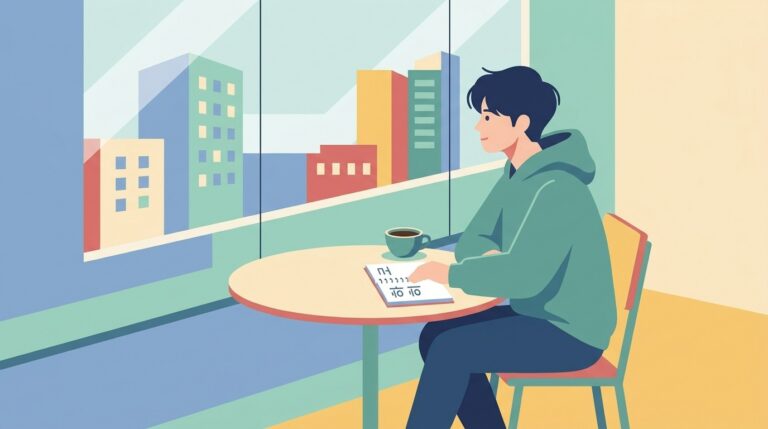
Korea’s Demographic Winter: What Young Koreans Really Think About Aging and Low Birthrates
Phase 1: 공감 (Empathetic Opening)
안녕하세요! 매일한글 에디터입니다. (Hello! I’m your Daily Hangul editor.)
If you have watched K-dramas like Because This Is My First Life or My Liberation Notes, you have probably noticed a subtle, bittersweet recurring theme: young characters sighing over cramped studio apartments, calculating monthly subway costs, and brushing off questions about marriage with an awkward laugh. In international news, you frequently hear shocking statistics: South Korea’s fertility rate has dropped below 0.75—the lowest in the world—while its society is aging at breakneck speed.
Many of our intermediate learners ask us: “Why are young Koreans choosing not to get married or have kids? Are they just being pessimistic?” The truth is far more nuanced. When you walk through the bustling streets of Gangnam or Hongdae, you see ambitious, hardworking young adults who love their culture and want a good future, but who face sky-high housing prices, intense private tutoring costs, and a hyper-competitive job market. To navigate real conversations with your Korean friends, coworkers, or language exchange partners, moving beyond textbook grammar into the real sentiments of Korean society is essential. Based on hundreds of discussions with Korean twenty- and thirty-somethings, this guide provides the cultural insight, nuanced vocabulary, and emotional phrasing you need to discuss this vital topic with empathy and depth.
Phase 2: 핵심 표현 3선 심층 분석 (Key Expressions in Depth)
1. 현실적으로 쉽지 않아요 (Hyeon-sil-jeog-eu-ro swip-ji an-a-yo)
- Pronunciation: [Hyeon-sil-jeog-eu-ro swip-ji an-a-yo] (Think: Hyeon-sil-jeog like “hyun-seel-juck”, swip sounds like a quick “sheep” with a rounded ‘w’ glide).
- Meaning: Literal: “Realistically, it is not easy.” | Nuance: “In the real world, circumstances just don’t allow it.”
- K-Culture Moment: Used constantly in variety shows and slice-of-life dramas when protagonists are asked why they haven’t bought a home or started dating.
- Editor’s Insight: Koreans avoid blunt negatives like “I can’t” or “I won’t.” Saying 현실적으로 (realistically) acknowledges external socioeconomic barriers rather than personal unwillingness.
- Situation Spectrum: Casual: ✅ (현실적으로 쉽지 않아) | Semi-formal: ✅ (현실적으로 쉽지 않아요) | Formal: ✅ (현실적으로 쉽지 않습니다)
- 🤔 Think About It: In your home country, do people blame personal choice or external economic systems when discussing family planning?
2. 제 한 몸 건사하기도 벅차요 (Je han mom geon-sa-ha-gi-do beok-cha-yo)
- Pronunciation: [Je han mom geon-sa-ha-gi-do beok-cha-yo] (Beok-cha-yo rhymes with “buck-cha-yo”, meaning overflowing or overwhelming).
- Meaning: Literal: “Taking care of my single body is already overwhelming.” | Nuance: “I can barely take care of myself, let alone support a family.”
- K-Culture Moment: Often heard among tired office workers having a late-night drink (hoesik) over grilled pork belly, lamenting their workload and living expenses.
- Editor’s Insight: 건사하다 (geonsahada) means to look after or maintain the well-being of someone. Adding 벅차다 (beokchada) conveys an emotional feeling of being stretched to the absolute limit.
- Situation Spectrum: Casual: ✅ (내 한 몸 건사하기도 벅차) | Semi-formal: ✅ (제 한 몸 건사하기도 벅차요) | Formal: ⚠️ (Slightly too emotive for formal press releases, but fine in personal interviews)
- 🤔 Think About It: Notice how the phrase uses 한 몸 (one single body) to emphasize vulnerability. How does your language express the exhaustion of surviving alone?
3. 각자도생의 시대잖아요 (Gak-ja-do-saeng-ui si-dae-ja-na-yo)
- Pronunciation: [Gak-ja-do-saeng-ui si-dae-ja-na-yo] (Gak-ja = each person, do-saeng = seeks their own life).
- Meaning: Literal: “It is an era of each seeking their own survival.” | Nuance: “We live in times where everyone has to fend for themselves.”
- K-Culture Moment: Frequently featured in headlines, podcast debates, and modern webtoons depicting the ruthless competition of urban Seoul life.
- Editor’s Insight: This four-character idiom (사자성어, sajaseong-eo) has become the unofficial slogan of younger generations facing pensions that may run dry and an aging demographic structure.
- Situation Spectrum: Casual: ✅ (각자도생의 시대잖아) | Semi-formal: ✅ (각자도생의 시대잖아요) | Formal: ✅ (각자도생의 시대라고 봅니다)
- 🤔 Think About It: Does this phrase reflect pure selfishness, or is it a defensive mechanism against collective social pressure?
Phase 3: 교과서 한국어 vs 진짜 한국어 (Textbook vs. Real-Life Korean)
Situation 1: Talking about future plans for marriage and children
- 📖 교과서 한국어: 저는 미래에 결혼을 하고 아이를 둘 낳고 싶습니다. (Jeoneun mirae-e gyeolhoneul hago aireul dul nako sipseumnida. / “In the future, I want to get married and have two children.”)
- 🗣️ 진짜 한국어: 결혼이나 육아는 아직 먼 나라 이야기 같아요. (Gyeolhon-ina yuganeun ajik meon nara iyagi gat-ayo. / “Marriage and parenting feel like stories from a faraway land.”)
- 💡 왜 다를까?: While standard textbooks treat marriage and children as standard milestones, real twenty- and thirty-something Koreans use figurative phrases like 먼 나라 이야기 (a story of a distant country) to show that such plans feel unattainable under current economic conditions.
Situation 2: Discussing the burden of the aging society
- 📖 교과서 한국어: 한국의 고령화 문제는 매우 심각합니다. (Hanguk-ui goryeonghwa munjeneun maeu simgakamnida. / “Korea’s aging population problem is very serious.”)
- 🗣️ 진짜 한국어: 우리 세대가 나중에 짊어져야 할 짐이 너무 무거워요. (Uri sedaega najung-e jilm-eo-jyeo-ya hal jimi neomu mugeowoyo. / “The burden our generation has to shoulder down the road is just too heavy.”)
- 💡 왜 다를까?: Textbook Korean relies on objective sociological descriptions (심각합니다), whereas native speakers describe demographic shifts in terms of personal, emotional weight (짊어져야 할 짐 – the burden to carry on one’s shoulders).
Phase 4: K-Culture 딥다이브 & 비언어적 매너 (Cultural Nuance & Non-verbal Cues)
4-1. 눈치 (Nunchi) & Gestures in Sensitive Discussions
When discussing low birthrates (저출산) or aging (고령화), young Koreans rarely raise their voices with anger. Instead, notice their subtle body language:
* The Gentle Head Tilt & Soft Sigh: When asked about marriage prospects, Koreans often tilt their head slightly, let out a tiny breath, and say “글쎄요…” (Well…). This signals thoughtful modesty and prevents sounding confrontational.
* Avoiding Inquisitive Eye Contact: In Korean culture, pressing someone directly with “Why aren’t you dating?” (왜 연애 안 해요?) is increasingly considered bad manners (실례). If the topic arises, keep an open, relaxed posture without staring intensely.
4-2. Cultural Code Analysis: The Shift from “Sampo” to “Gatsaeng”
In the early 2010s, media popularized the term 삼포세대 (Sampo Generation: giving up dating, marriage, and childbirth). Today, this has evolved into N포세대 (giving up infinite things). However, young Koreans have not given up on happiness! Instead of traditional milestones, many focus on 갓생 (Gatsaeng: “God-life”, living each day productively and mindfully) and 반려동물 (companion pets). In neighborhoods like Mapo and Seongsu, you will find strollers occupied not by infants, but by beloved dogs and cats—a trend often discussed as 펫팸족 (Pet-Family tribe).
Phase 5: 실전 롤플레이 시나리오 (Real-Life Roleplay Scenario)
Setting: A quiet craft beer pub near Hapjeong Station on a rainy Friday evening.
Characters:
* 민준 (Minjun): A 31-year-old UX designer in Seoul trying to balance student loans with rent.
* 알렉스 (Alex): A foreign professional working at a tech startup in Seoul, curious about local social issues.
- 민준: 알렉스 씨, 요즘 뉴스 보면 온통 저출산 이야기뿐이네요. (Alex-ssi, yojeum nyuseu bomyeon ontong jeochulsan iyagippun-ineyo. / Alex, looking at the news these days, it’s all about low birthrates.)
🎭 맥주잔을 매만지며 씁쓸하게 웃는다 (Fiddles with his beer glass and smiles wryly) - 알렉스: 맞아요. 한국 출산율이 세계 최저라는 기사를 봤어요. 민준 씨 주변 친구들은 어때요? (Maj-ayo. Hanguk chulsanyuri segye choejeoraneun gisareul bwasseoyo. Minjun-ssi jubyeon chingudeureun eottaeyo? / Right. I read that Korea’s birthrate is the world’s lowest. How about your friends?)
🎭 호기심 어린 표정으로 기울여 듣는다 (Listens intently with a curious expression) - 민준: 제 친구들도 대부분 결혼은 생각도 못 하고 있어요. 집값도 너무 비싸고요. (Je chingudeuldo daebubun gyeolhoneun saenggakdo mot hago isseoyo. Jipgapdo neomu bissagoyo. / Most of my friends can’t even dream of marriage. Housing prices are way too high, too.)
🎭 고개를 절레절레 흔든다 (Shakes his head slowly) - 알렉스: 아무래도 경제적인 부담이 가장 큰 이유겠죠? (Amuraedo gyeongjejeogin budami gajang keun iyugessjyo? / I guess financial burden is the biggest reason, right?)
🎭 공감하듯 고개를 끄덕인다 (Nods in deep empathy) - 민준: 네. 솔직히 제 한 몸 건사하기도 벅차거든요. (Ne. Soljikhi je han mom geonsahagido beokchageodeunyo. / Yes. Honestly, it’s tough just looking after myself.)
🎭 가벼운 한숨을 내쉬며 (Breathes out a light sigh) - 알렉스: 미래의 노후 준비나 부모님 부양도 걱정되겠어요. (Mirae-ui nohu junbina bumonim buyangdo geokjeongdoegesseoyo. / You must also worry about your own retirement or supporting your parents.)
🎭 차분하고 조심스러운 어조로 묻는다 (Asks in a calm, cautious tone) - 민준: 맞아요. 다들 각자도생하느라 바쁜 게 현실이에요. (Maj-ayo. Dadeul gakjadosaeunghaneura bappeun ge hyeonsirieyo. / Exactly. The reality is that everyone is busy surviving on their own.)
🎭 잔을 들어 가볍게 건배를 청한다 (Raises his glass for a gentle toast) - 알렉스: 그래도 민준 씨처럼 성실하게 사는 사람들이 많으니 희망이 있지 않을까요? (Geuraedo Minjun-ssi-cheoreom seongsilhage saneun saramdeuri maneuni huimangi itji aneulkkayo? / Still, there are so many diligent people like you, so shouldn’t there be hope?)
🎭 따뜻한 미소를 짓는다 (Smiles warmly)
🔀 인터랙티브 분기점 (Interactive Decision Point)
How should Alex respond next when Minjun asks, “알렉스 씨 나라에서는 청년들이 이런 고민 안 하나요?” (In your country, don’t young people worry about this?)
- Option A: “저희 나라는 아무 문제 없어요. 한국이 너무 유난인 것 같아요.” (Jeohui naraneun amu munje eopseoyo. Hanguki neomu yunan-in geot gat-ayo. / In our country there is no problem at all. Korea seems too dramatic.)
👉 Feedback [Bad]: Dismissive and culturally insensitive. Comparing countries without empathy damages rapport. - Option B: “정도 차이는 있지만, 우리나라도 비슷한 고민을 하는 청년들이 많아요.” (Jeongdo chaineun itjiman, urinara-do biseutan gomineul haneun cheongnyeondeuri man-ayo. / There are differences in degree, but in our country many youths share similar struggles.)
👉 Feedback [Best]: Empathetic, balanced, and creates solidarity by showing that modern economic anxieties are global. - Option C: “그냥 눈을 낮추면 결혼할 수 있지 않을까요?” (Geunyang nuneul natchumyeon gyeolhonhal su itji aneulkkayo? / Can’t people get married if they just lower their standards?)
👉 Feedback [Risk]: Overly judgmental. It overlooks systemic challenges like housing and competitive education.
Phase 6: 10초 감정 섀도잉 드릴 (Emotion Shadowing Drill)
Practice these lines out loud. Notice the pause slashes (/) and adopt the indicated emotional state:
[🥺 현실적인 막막함을 담아 / With realistic helplessness]
솔직히 / 제 한 몸 건사하기도 / 벅찬 게 현실이에요.
(Sol-jik-hi / je han mom geon-sa-ha-gi-do / beok-chan ge hyeon-sir-i-e-yo.)
“To be honest / it’s reality that / just looking after myself is overwhelming.”-
[🤝 깊은 위로와 공감을 담아 / With heartfelt comfort and empathy]
청년 세대 혼자만의 잘못이 / 아니에요.
(Cheong-nyeon se-dae hon-ja-man-ui jal-mot-i / a-ni-e-yo.)
“It is not / the fault of the youth generation alone.” -
[🤔 담담하게 현실을 직시하며 / Calmly facing the reality]
앞으로는 / 고령화 속도가 / 더 빨라질 것 같아요.
(Ap-eu-ro-neun / go-ryeong-hwa sok-do-ga / deo ppal-la-jil geot gat-a-yo.)
“Going forward / it seems the pace of aging / will become even faster.”
Phase 7: K-Culture 미니 사전 (Mini Dictionary)
-
저출산 (Jeo-chul-san)
Translation: Low birthrate.
Usage: Commonly paired with 문제 (problem) or 위기 (crisis) in public debates, news reports, and workplace conversations. -
비혼 (Bi-hon)
Translation: Non-marriage (a conscious lifestyle choice).
Usage: Distinct from 미혼 (unmarried/yet to marry), which implies that marriage is an inevitable duty. 비혼 emphasizes self-determined single life. -
갓생 (Gat-saeng)
Translation: God-level productive life.
Usage: A compound of “God” + 생 (life). Young Koreans use it when focusing on fitness, daily habits, and career growth instead of distant marital milestones. -
딩크족 (DINK-jok)
Translation: Double Income No Kids (DINK) couple.
Usage: Widely accepted among couples who choose to marry for companionship while opting out of child-rearing due to financial constraints.
Phase 8: 여행자를 위한 생존 키트 (Traveler’s Survival Kit)
Survival Phrases TOP 3
- 임산부 배려석이에요. (Im-san-bu bae-ryeo-seog-i-e-yo.)
Meaning: “This is a seat reserved for expectant mothers.”
Pro Tip: On Seoul subways, look for pink seats. Even if empty, locals rarely sit there to ensure expectant mothers feel welcome. - 어르신들이 정말 많으시네요. (Eo-reu-sin-deul-i jeong-mal man-eu-si-ne-yo.)
Meaning: “There are indeed many elderly people.”
Pro Tip: Use 어르신 (venerable seniors) instead of 노인 (old person) to show polished respect. - 요즘은 1인 가구가 대세예요. (Yo-jeum-eun il-in ga-gu-ga dae-se-ye-yo.)
Meaning: “Single-person households are the mainstream trend these days.”
Editor’s Travel Note
When traveling across Korea, you will spot modern conveniences tailored to an aging and single-centric society. Supermarkets feature single-portion vegetables (소포장), and many restaurants offer solo booths (혼밥존). To get around smoothly, make sure to read the Naver Map Application Setup and Transit Navigation Guide to find senior-accessible elevator routes and transit updates in real time.
Phase 9: “한 발 더 깊이” (Food for Thought)
Korea transitioned from an agrarian, war-torn nation to an advanced technological superpower in less than two generations. This rapid transformation created a unique cultural friction: traditional Confucian expectations demand filial duty, early marriage, and family continuation, while hyper-modern corporate life demands grueling working hours and relentless competition. Young Koreans are not indifferent to society; rather, their decision to postpone marriage or remain childless is often an act of silent resistance against impossible demands.
💬 Your Turn: In your home society, what is the most significant hurdle preventing young adults from starting families—housing, work-life balance, or changing personal values? Share your thoughts in the comments below!
Phase 10: FAQ & 오해 방지 (FAQ & Common Mistakes)
Q: Why do young Koreans prefer the word ‘비혼’ over ‘미혼’?
A: 미혼 (未婚) uses the Chinese character 미 (not yet), implying that marriage is something everyone must do eventually. 비혼 (非婚) uses 비 (non/not), affirming that living single is a deliberate, valid lifestyle choice rather than an incomplete stage of life.
Q: Is it considered offensive to bring up low birthrates in casual conversation?
A: Not at all! It is a major daily talking point in Korea. However, asking personal questions like “Why aren’t you having children?” is considered rude. Stick to general sociological observations using phrases like “요즘 집값이 비싸서 젊은 세대가 힘들 것 같아요” (With recent housing prices, the youth generation must have a tough time).
Q: What is the government doing to address this issue?
A: The Korean government offers parental leaves, financial subsidies for newborns, and specialized housing lotteries for newlyweds. However, many young citizens feel systemic pressures—like grueling work hours and hyper-competitive schooling (학원)—require deeper cultural transformation.
🚨 흔한 실수 (Common Mistakes)
- Mistake: Calling elderly people 늙은이 (neulgeuni).
- Correct Action: Always use 어르신 (eoreusin) or 할머니/할아버지 (grandmother/grandfather) to convey respect.
- Mistake: Assuming young unmarried people are just “waiting for the right partner.”
- Correct Action: Acknowledge economic realities by using terms like 현실적인 고민 (realistic concerns) or 비혼 (intentional singlehood).
- Mistake: Sitting on the bright pink subway seats marked with a pregnant woman icon.
- Correct Action: Keep the pink 임산부 배려석 empty at all times, even during rush hour.
Phase 11: 액션 미션 & 참여 유도 (Action Missions)
- 🥉 Bronze Mission (Solo Shadowing): Record yourself saying “현실적으로 쉽지 않아요” three times with the gentle head tilt described in Phase 4.
- 🥈 Silver Mission (Community Exchange): Leave a comment using the phrase “각자도생의 시대” to describe a challenge facing young workers today.
- 🥇 Gold Mission (Real-Life Dialogue): In your next Korean language exchange, ask your partner: “요즘 한국에서는 1인 가구가 점점 늘고 있죠?” (These days in Korea, single-person households are steadily increasing, right?)
- 🎮 K-Culture Mission: Watch an episode of a recent slice-of-life K-drama and spot how many times characters eat alone (혼밥) or talk about apartment prices!
Phase 12: 인터랙티브 퀴즈 챌린지 (Interactive Quiz Challenge)
1. Situational Judgment:
Your Korean language partner sighs and mentions they have to work overtime every weekend to afford rent. Which response shows the most empathetic intermediate Korean?
* (A) 빨리 결혼해서 돈을 모으세요. (Marry quickly to save money.)
* (B) 제 한 몸 건사하기도 벅찬 시대잖아요. 힘내세요. (It’s an era where caring for oneself is tough. Stay strong.)
* (C) 한국 사회는 너무 비관적인 것 같아요. (Korean society seems way too pessimistic.)
👉 Click to reveal Answer & Explanation
Correct Answer: (B)
Explanation: Option (B) uses the authentic empathetic idiom 제 한 몸 건사하기도 벅차다 to validate their exhaustion without giving unsolicited advice or passing harsh judgment.
2. Fill-in-the-Blank:
“결혼은 아직 저에게 ________ 나라 이야기 같아요.” (Marriage still feels like a story from a distant land to me.)
* (A) 가까운 (near)
* (B) 먼 (distant/far)
* (C) 작은 (small)
👉 Click to reveal Answer & Explanation
Correct Answer: (B) 먼
Explanation: The idiom 먼 나라 이야기 (a story from a faraway land) denotes something that feels completely foreign, remote, or unattainable.
3. True or False Cultural Quiz:
True or False: The term 비혼 (Bihon) means that an individual desperately wants to marry but failed to find a match.
👉 Click to reveal Answer & Explanation
Correct Answer: False
Explanation: 비혼 refers to the conscious and proactive choice to remain unmarried, whereas 미혼 refers to being not yet married.







