

Phase 1: Empathy & Storytelling Opening
안녕하세요! 매일한글 에디터입니다.
Have you ever watched a high-stakes K-drama thriller—something like Reborn Rich or Queenmaker—where an elite corporate executive drafts a ruthless, airtight policy to purge their rivals, only for a microscopic blind spot in that very policy to trigger their own catastrophic downfall? The screen dims, the tension peaks, and a seasoned Korean viewer quietly murmurs: “아, 완전히 자승자박이네.”
If you have progressed into the C2 stratosphere of Korean fluency, you already know that grammar conjugations and standard idioms are no longer your real challenge. The true barrier is unlocking that high-register cultural lexicon: idioms deeply woven with Buddhist and Daoist existential insights, where complex commentary on human hubris, karmic circularity, and self-delusion is condensed into just four profound characters (사자성어, Sajaseong-eo).
Many advanced learners tell me: “Editor, I know what ‘자승자박’ means literally, but whenever I hear native executives or news anchors drop ‘작법자폐’ and ‘자승자박’, I struggle to sense the philosophical weight behind them.”
Today, we unpack how the ancient image of a silkworm weaving its own suffocating cocoon illuminates modern Korean corporate, political, and daily discourses. Crafted from years of training foreign diplomats and executives in Seoul, this guide will elevate your Korean from merely grammatically correct to culturally resonant and intellectually piercing.
Phase 2: Core Expressions In-Depth Analysis
1. 자승자박 (自繩自縛)
- Pronunciation: [Jaseungjabak] (Think: jah-seung-jah-bahk—the ‘bak’ snaps tight like a knot pulled taut)
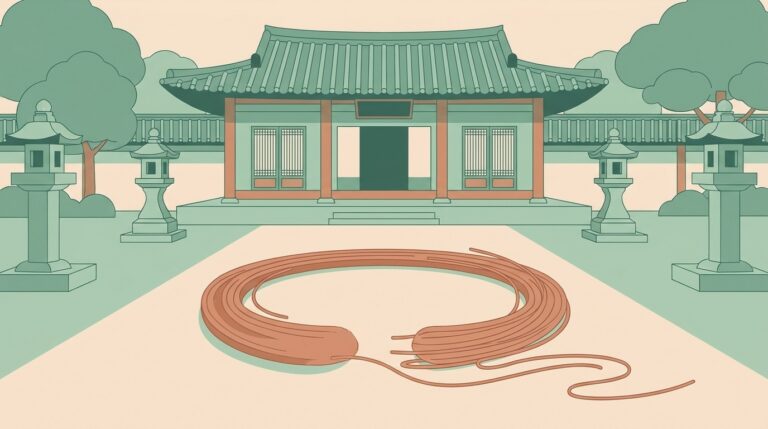
- Meaning: Literally “tying oneself with one’s own rope.” In practice, it signifies being hopelessly ensnared by one’s own declarations, dogmas, or calculated plots.
- K-Culture Moment: In legal and corporate dramas, when a prosecutor presents a defendant’s past press releases to dismantle their current defense, leading the courtroom gallery to murmur about the sheer irony.
- Editor’s Insight: Originating from Buddhist texts, 자승자박 evokes a silkworm spinning fine silk from within, only to entrap itself in a dark, airtight cocoon. It is rarely used for trivial slip-ups; it describes profound structural irony where your own egoistic ingenuity engineers your paralysis.
- Situation Spectrum: Casual ⚠️ | Semi-formal ✅ | Formal ✅
- 🤔 Think About It: English speakers often say someone is “hoist with his own petard.” How does the explosive, violent imagery of a bomb differ from the quiet, meditative self-imprisonment of a rope you twisted yourself?
2. 작법자폐 (作法自斃)
- Pronunciation: [Jakbeopjapye] (Think: jahk-beop-jah-pyeh—sharp, decisive historical cadence)
- Meaning: Literally “devising a law and perishing by it.” It characterizes an architect who constructs a punitive system or rule, only to become its ultimate casualty.
- K-Culture Moment: Editorial political commentary discussing a faction that introduced aggressive legislative filibuster reforms, which then prevented that same faction from passing their own marquee bill after an election defeat.
- Editor’s Insight: Stemming from the historical record of Shang Yang (상앙), the Legalist reformer in ancient China whose draconian state laws led directly to his own gruesome execution when he fled political persecution. While 자승자박 can describe internal psychological entrapment, 작법자폐 specifically demands an external structure, decree, or organizational standard that boomerangs back on its creator.
- Situation Spectrum: Casual 🚫 | Semi-formal ⚠️ | Formal ✅
- 🤔 Think About It: Why do Daoist-influenced societies maintain a profound skepticism toward hyper-regulation and bureaucratic overreach?
3. 자가당착 (自家撞着)
- Pronunciation: [Jagadangchak] (Think: jah-gah-dahng-chahk—sharp percussive clash)
- Meaning: Literally “striking against one’s own house.” It defines self-contradiction, where one’s rhetoric and subsequent behavior violently collide.
- K-Culture Moment: An investigative journalist confronting a celebrity influencer who built a career promoting extreme minimalism and ethical consumption, right after public records reveal their undisclosed luxury real estate portfolio.
- Editor’s Insight: While 자승자박 focuses on the state of being trapped, 자가당착 focuses on the blatant intellectual or moral inconsistency. In debate or analytical writing, 자가당착 acts as the diagnostic premise that leads directly to 자승자박 as the eventual karmic consequence.
- Situation Spectrum: Casual ⚠️ | Semi-formal ✅ | Formal ✅
- 🤔 Think About It: In Korean debate rhetoric, why is pointing out 자가당착 considered far more devastating than simply attacking the opponent’s raw facts?
Phase 3: Textbook Korean vs. Real Korean
Scenario 1: A colleague’s aggressive proposal backfires
- 📖 교과서 한국어: 그는 자기가 판 함정에 스스로 빠지고 말았습니다. (Geuneun jagiga pan hamjeonge seuseuro ppajigo marasseumnida.) — “He ended up falling into the trap he dug himself.”
- 🗣️ 진짜 한국어: 그야말로 제 꾀에 제가 넘어간 자승자박의 전형이죠. (Geuyamallo je kwoee jega neomeogan jaseungjabak-ui jeonhyeong-ijyo.) — “That’s a textbook case of self-entrapment—tripped up entirely by his own schemes.”
- 💡 왜 다를까? Advanced native speakers avoid prolonged physical metaphors like ‘digging traps’ when analyzing professional missteps. They seamlessly pair vivid vernacular idioms (제 꾀에 제가 넘어가다) with formal four-character idioms (자승자박) to deliver balanced, sophisticated commentary.
Scenario 2: Trapped by institutional policy changes
- 📖 교과서 한국어: 본인이 만든 규칙 때문에 활동하기 어려워졌습니다. (Bon-ini mandeun gyuchik ttaemune hwaldonghagi eoryeowojyeosseumnida.) — “It became difficult to operate because of rules you made.”
- 🗣️ 진짜 한국어: 본인들이 세운 규율에 발목이 잡혀 작법자폐 꼴이 났네요. (Bon-indeuri seun gyuyure balmogi japhyeo jakbeopjapye kkkori nanneyo.) — “They’ve had their ankles shackled by their own standards—a tragic textbook case of perishing by one’s own law.”
- 💡 왜 다를까? Using somatic sensory expressions (발목이 잡히다, to have one’s ankles caught) alongside high-register literary concepts like 작법자폐 creates a textured, commanding, and natural Korean executive tone.
Phase 4: K-Culture Deep Dive & Non-Verbal Manners
4-1. 눈치 (Nunchi) & Gestures
When using terms like 자승자박 or 작법자폐 in an analytical or business context, non-verbal poise is crucial:
* Restrained Gravity: Never smirk or deliver these phrases with overt schadenfreude (남의 불행을 고소해하는 태도). Doing so signals emotional immaturity. Instead, deliver the observation with a steady gaze, a subtle, slow nod, and a reflective tone.
* The Detached Hand Gesture: Keep both hands lightly resting on the conference table or folded calmly. If gesturing, open one palm slightly inward toward your chest, signaling philosophical reflection rather than outward finger-pointing.
4-2. Cultural Code Analysis: The Karmic Architecture of K-Dramas
In classic Korean screenplays—from Vincenzo to Stranger (비밀의 숲)—the primary antagonist rarely perishes via external brute force. Instead, Korean storytelling deeply honors the Buddhist paradigm of 인과응보 (因果應報, karmic retribution) and the Daoist principle of natural equilibrium (도법자연, 道法自然).
The true dramatic catharsis occurs when the villain’s own obsessive calculations, legal maneuvering, and pride form the very machinery that crushes them. Understanding 자승자박 allows you to watch Korean cinema and television not merely as entertainment, but as an existential theater where human desire inevitably devours itself.
Phase 5: Real-World Roleplay Scenario
Setting: A sleek boardroom in Teheran-ro, Gangnam. Post-mortem review of a high-stakes corporate takeover attempt.
Characters:
* 민 이사 (Director Min): A 50-something veteran strategist with a razor-sharp intellect.
* You: A senior global director participating in the internal post-mortem assessment.
민 이사: 이번 감사 결과 보고서, 검토해 보셨습니까? (Ibeon gamsa gyeolgwa bogoseo, geomtohae bosyeotseumnikka? / Have you reviewed the internal audit report?)
🎭 Slowly turning the page, setting down reading glasses on the mahogany table.
You: 네, 확인했습니다. 경쟁사를 압박하려고 도입했던 컴플라이언스 기준이 오히려 우리 쪽 발목을 잡을 줄은 몰랐습니다. (Ne, hwaginhaesseumnida. Gyeongjaengsareul apbakharyeogo do-iphaetdeon keompeullai-eonseu gijuni ohiryeo uri jjok balmogeul jabeul jureun mollasseumnida. / Yes, I reviewed it. I hadn’t anticipated that the compliance standards introduced to pressure our rival would shackle our own hands.)
🎭 Looking down at the highlighted clauses with a calm, analytical expression.
민 이사: 그야말로 자승자박(自繩自縛) 아닙니까. 상대방을 옥죄려던 밧줄로 제 몸을 꽁꽁 묶어버린 격이지요. (Geuyamallo jaseungjabak animnikka. Sangdaebangeul okjoeryeodeon batjullo je momeul kkongkkong mukkeobeorin gyeogijiyo. / Isn’t it pure jaseungjabak? It’s as if we tightly bound our own limbs with the very rope meant to constrict the opposition.)
🎭 Shaking his head with a quiet, rueful sigh.
You: 맞습니다. 게다가 이번 내부 징계 처분도 본인들이 밀어붙였던 특수 내규를 그대로 적용받게 생겼더군요. (Masseumnida. Gedaga ibeon naebu jinggye cheobundo bon-indeuri mireobuchyeotdeon teuksu naegyureul geudaero jeok-yongbatge saenggyeotdeogunyo. / Exactly. On top of that, the impending internal disciplinary actions will be executed under the exact special bylaws they pushed for.)
🎭 Leaning forward slightly, keeping voice composed and neutral.
민 이사: 그야말로 현대판 작법자폐(作法自斃)를 보는 듯합니다. 제도를 기획한 본인이 그 제도에 의해 희생되는 셈이니까요. (Geuyamallo hyeondaepan jakbeopjapye-reul boneun deut-hamnida. Jedeoreul gihoekhan bon-ini geu jedo-e uihae huisaengdoeneun seminikkayo. / It’s like watching a modern reenactment of jakbeopjapye. The architect of the system ends up sacrificed by that very system.)
🎭 Tapping a pen lightly against the report margin, acknowledging the structural irony.
You: 네. 결국 무리한 욕망이 자가당착적인 결과를 낳고 만 것 같습니다. (Ne. Gyeolguk murihan yongmangi jagadangchakjeogin gyeolgwreul nako man geot gatseumnida. / Indeed. In the end, reckless ambition appears to have yielded a self-contradictory dead end.)
🎭 Closing your folder cleanly with both hands.
민 이사: 동감합니다. 지혜로운 자는 결코 자신을 얽맬 그물을 스스로 짜지 않는 법이지요. (Donggamhamnida. Jihyeroun janeun gyeolko jasineul eongmael geumureul seuseuro jjaji anneun beobijiyo. / I completely agree. A truly wise strategist never weaves a net destined to ensnare oneself.)
🎭 Offering a subtle, approving nod of mutual comprehension.
You: 이번 사태를 반면교사 삼아, 향후 전략은 유연성을 확보하는 방향으로 재설계해야겠습니다. (Ibeon sataereul banmyeongyosa sama, hyanghu jeollyageun yuyeonseongeul hwakbohaneun banghyang-euro jaeseolgyehaeyagetseumnida. / Taking this crisis as a negative exemplar, we must redesign our forward strategy around flexibility.)
🔀 Interactive Branching Point
If Director Min turns to you and asks: “그렇다면 이번 사태를 이사회에 어떻게 보고하는 것이 현명하겠습니까?” How will you respond?
- Option A: “원칙대로 기획자의 실책과 작법자폐의 전형임을 강조하여 문책해야 합니다.” (Best / Executive Edge)
- Why: Direct, philosophically sharp, and demonstrates fearless analytical clarity without personal emotional rancor.
- Option B: “제가 처음부터 그 규정이 제 발등을 찍을 거라고 경고하지 않았습니까?” (Bad / Career Risk)
- Why: Self-centered, uses overly informal conversational idioms (발등 찍다), and creates an antagonistic atmosphere.
- Option C: “모든 게 운이 나빴을 뿐이니 적당히 덮고 조용히 넘어가시죠.” (Risk / Credibility Loss)
- Why: Completely dismisses the structural lesson, painting you as unprincipled and blind to institutional accountability.
Phase 6: 10-Second Emotion Shadowing Drill
Practice these high-frequency, authentic sentences aloud. Follow the / marks for cadence pauses and embody the emotional tag!
[냉철하고 차분하게 / Calm & Analytical]
상대를 궁지에 몰려던 전략이 / 오히려 자승자박의 올가미가 되어 / 돌아왔습니다.
(Sangdaereul gungjie mollyeodeon jeollyagi / ohiryeo jaseungjabak-ui olgamiga doeeo / dorawasseumnida.)
“The strategy intended to corner the rival / has boomeranged / as an entrapping noose of their own making.”-
[씁쓸한 통찰을 담아 / With Bittersweet Insight]
자신이 만든 원칙에 스스로 갇히는 것만큼 / 비극적인 작법자폐는 / 없습니다.
(Jasini mandeun wonchige seuseuro gachineun geotmankeum / bigeukjeogin jakbeopjapyeneun / eopseumnida.)
“There is no tragedy quite like jakbeopjapye / wherein one is utterly imprisoned / by the very principles one created.” -
[단호하고 품격 있게 / Firm & Dignified]
말과 행동의 불일치가 계속된다면 / 결국 자가당착에 빠져 / 신뢰를 잃게 될 것입니다.
(Malgwa haengdong-ui burilchiga gyesokdoendamyeon / gyeolguk jagadangchage ppajyeo / sinroereul ilke doel geosimnida.)
“If word and deed remain in discord / one will collapse into self-contradiction / inevitably eroding public trust.”
Phase 7: K-Culture Mini Dictionary
- 자승자박 (Jaseungjabak) | Self-entrapment
- Origin: Buddhist philosophy. The process whereby personal mental delusions (번뇌) weave a cocoon that paralyzes one’s existential clarity. Used routinely in high-level editorial and corporate contexts.
- 작법자폐 (Jakbeopjapye) | Perishing by one’s own statute
- Origin: Historical / Daoist critique. Refers strictly to legal, structural, or institutional mechanisms created by an authority that eventually execute or punish that very authority.
- 업보 (Eopbo / 業報) | Karmic fruition / Retribution
- Everyday/Cultural use: Beyond religious contexts, Koreans use this in daily conversation (e.g., “다 내 업보다”) with dark humor to accept that current struggles are consequences of past decisions.
- 반면교사 (Banmyeongyosa) | Negative exemplar
- Cultural use: An individual, event, or failure from which one learns what not to do. Indispensable in Korean business retrospectives and political analysis.
Phase 8: Traveler’s Survival Kit
Even as a C2 explorer diving into Korea’s profound cultural undercurrents, you will navigate elite social situations and philosophical sites:
Survival Expressions TOP 3
- 상황이 조금 역설적으로 흘러가네요. (Sanghwangi jogeum yeokseoljeogeuro heulleoganeyo.)
- Pro Tip: Use this polished phrase to describe an unfolding ironic deadlock without naming names or sounding abrasive.
- 스스로 무리수를 둔 셈이죠. (Seuseuro murisureul dun semijyo.)
- Pro Tip: Derived from Baduk (Go), this phrase explains that an entity overreached with an unreasonable, forced play, paving their own doom.
- 한 템포 쉬어 가며 본질을 봐야겠습니다. (Han tempo swieo gamyeo bonjireul bwayagetseumnida.)
- Pro Tip: When team tensions peak over complex problems, drop this Daoist-tinged remark to restore collective composure.
Editor’s Travel Note: Contemplative Spaces in Seoul
To truly grasp Buddhist and Daoist perspectives on human ambition, step away from the bustle of Gangnam and Myeongdong. Visit Jingwansa (진관사) or Bongeunsa (봉은사) on a weekday morning. You can effortlessly locate temple grounds, tranquil walking trails, and traditional tea houses by consulting your navigation tools via 네이버 지도 앱 다운로드. Observe how the architectural layout of Korean Buddhist temples emphasizes empty space (여백의 미), reminding visitors that hoarding control or scheming endlessly leads straight to self-entanglement.
Phase 9: Going One Step Deeper
Traditional Korean thought places supreme value on 비움 (Bium, intentional emptying) and 중용 (Jung-yong, the balanced mean) over ruthless optimization. In Western strategic paradigms, an agent is often encouraged to engineer contingencies for every single variable. In contrast, the Korean intellectual heritage—fertilized by centuries of Daoist skepticism toward rigid human constructs and Buddhist principles of impermanence (제행무상, 諸行無常)—warns that excessive cleverness inevitably mutates into an inescapable prison. When an individual constructs an airtight wall around others, they forget that they must live within those exact same walls.
💬 Your Turn: Have you ever devised a complex rule, routine, or strategy that ended up restricting your own freedom? Share your reflection in the comments below using the idiom 자승자박!
Phase 10: FAQ & Common Mistakes
Q: Can I use ‘자승자박’ to describe a funny mistake among close friends, like locking my keys in my car?
A: It is grammatically possible, but culturally mismatched. Calling a locked-car scenario 자승자박 sounds excessively dramatic and literary—akin to saying, “Alas, I am undone by the tragic wheel of my own hubris!” Keep 자승자박 for situations involving policies, long-term plans, moral contradictions, or intricate plots.
Q: What is the core practical difference between ‘작법자폐’ and ‘자승자박’?
A: Think of 자승자박 as general and versatile—it applies to personal behavior, psychological traps, speech, and plans. 작법자폐, however, requires an explicit rule, system, law, or institutional statute (법/法) that was intentionally enacted and then applied to its author.
Q: Is ‘자가당착’ considered rude if used during an academic or business presentation?
A: Not at all. It is a recognized, objective debate term. However, instead of saying “당신의 주장은 자가당착입니다” (which directly attacks the person), say “그 논리는 자가당착에 빠질 위험이 있습니다” (which critiques the structural logic).
🚨 흔한 실수 (Common Mistakes) 경고판
- Mistake: Confusing 자승자박 with simple bad luck (불운).
- Correct Action: Only deploy it when the outcome was undeniably woven by the subject’s own choices or statements.
- Mistake: Pronouncing 작법자폐 as [jak-beop-ja-hye].
- Correct Action: The final character is 斃 (폐, pye), not 혜 (hye). Pronounce clearly: [작뻡자폐 / Jakbeopjapye].
- Mistake: Equating 자업자득 (自業自得) identically with 자승자박.
- Correct Action: While 자업자득 means “reaping what you sow” (universal cause and effect), 자승자박 specifically highlights the feeling of paralysis and entanglement under one’s own construct.
Phase 11: Action Missions & Engagement
- Bronze Mission (Solo Mastery): Recite the three sentences from Phase 6 looking directly into a mirror. Focus on an austere, composed facial posture.
- Silver Mission (Social Application): While consuming a K-drama, Korean news analysis, or editorial, spot an instance where a character’s plot boomerangs. Write a one-sentence commentary on your social media using the tag
#자승자박. - Gold Mission (Real Dialogue Integration): In your next professional Korean exchange, debate, or advanced class, frame an institutional paradox using the phrase “자칫 작법자폐의 꼴이 되지 않도록 유의해야 합니다.”
- 🎮 K-Culture Mission: Watch an episode of a political or legal K-drama (e.g., Hyena or Stranger). Identify the exact moment an antagonist realizes their own contractual clause traps them. Note down the Korean expressions they murmur under their breath!
Phase 12: Interactive Quiz Challenge
1. Situational Judgment
A newly appointed department head introduced a strict software regulation stating that anyone who submits an expense report late by even one minute forfeits all reimbursement for the quarter. Two months later, due to an unavoidable overseas flight delay, the department head submits their own expense report two minutes late, resulting in a zero-reimbursement decision by the automated finance module.
Which idiom describes this exact event with the highest institutional precision?
(A) 자가당착
(B) 작법자폐
(C) 반면교사
🔍 정답 및 해설 확인하기 (Click to Reveal Answer)
정답: (B) 작법자폐 (作法自斃)
해설: While the situation involves irony, this specifically features a policy architect being penalized by their own institutional regulation (법), which fits the definition of 작법자폐 perfectly. 자가당착 focuses on logical contradiction in speech/principles, and 반면교사 refers to learning from another’s negative example.
2. Fill-in-the-Blank
상대방의 약점을 잡기 위해 지나치게 엄격한 잣대를 들이대다가는, 우리 역시 그 기준에서 자유롭지 못해 ( )의 덫에 걸릴 수 있습니다.
(A) 온고지신
(B) 자승자박
(C) 동문서답
🔍 정답 및 해설 확인하기 (Click to Reveal Answer)
정답: (B) 자승자박 (自繩自縛)
해설: Setting an overly strict standard that inevitably constricts your own team’s freedom is a classic manifestation of 자승자박 (binding oneself with one’s own rope). (A) refers to learning from the past, and (C) means giving an irrelevant answer.
3. True or False Cultural Quiz
Statement: The idiom 자승자박 originally derives from agricultural silkworm farming terminology rather than religious or philosophical literature.
[ True / False ]
🔍 정답 및 해설 확인하기 (Click to Reveal Answer)
정답: False
해설: While the metaphor commonly evokes a silkworm forming its cocoon, 자승자박 (自繩自縛) formally originates in Buddhist texts (such as the Mahaparinirvana Sutra and various Zen commentaries), illustrating how humanity weaves mental delusions and desires that ultimately bind its own spiritual essence.







