

Phase 1: Empathy & Storytelling Opening
안녕하세요! (Annyeonghaseyo!) I’m your Daily Hangul editor.
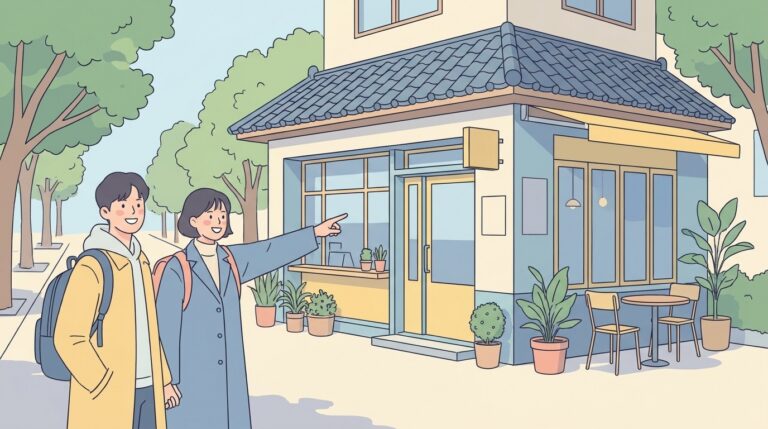
Picture this: You are strolling through the trendy, cobblestone alleyways of Yeonnam-dong in Seoul. The sun is shining, your phone battery is draining from snapping photos of aesthetic brick buildings, and your feet are starting to ache. You desperately crave an icy glass of cold brew. You look down the street, and there it is—a warm neon sign of a cozy rooftop cafe with large glass windows.
Excitedly, you turn to your Korean friend to suggest taking a break, but your mind suddenly freezes. Should you say 여기 (yeogi)? 거기 (geogi)? Or is it 저기 (jeogi)? You point your finger frantically, stammering, and by the time you figure it out, the light turns red and the moment slips away!
If you have ever felt confused by Korean spatial pointers, breathe easy. You are definitely not alone. Many A1 beginner students tell us that distinguishing where “here” ends and “there” begins in Korean feels tricky. Today, we are breaking down this simple yet essential building block so you can smoothly say, “저기 보이는 카페에 가요” (Let’s go to the cafe visible over there) with complete confidence. Let’s master the art of pointing things out like a true Seoulite!
Phase 2: Core Expressions Breakdown
1. 저기 카페 있어요 (Jeogi kape isseoyo)
- Pronunciation: [Jeo-gi ka-pe it-seo-yo] (Think: “Chaw-gee kah-pay eat-saw-yo”)
- Meaning: Literal: “Over there cafe exists” | Real Nuance: “There is a cafe over there!”
- K-Culture Moment: Seen in almost every contemporary K-drama when the main leads wander around Bukchon Hanok Village and spot a shelter from the sudden rain.
- Editor’s Insight: 저기 (jeogi) refers to a location far away from both you and the person you are talking to. Adding 있어요 (isseoyo) simply signals that the place exists right in your line of sight.
- Situation Spectrum: Casual (저기 카페 있어) ⚠️ | Semi-formal (저기 카페 있어요) ✅ | Formal (저기에 카페가 있습니다) ✅
- 🤔 Think About It: In English, “there” can mean nearby or far away. Why do you think Korean creates a strict boundary between spaces close to the listener versus spaces far from both people?
2. 저기 보이는 카페에 가요 (Jeogi boineun kape-e gayo)
- Pronunciation: [Jeo-gi bo-i-neun ka-pe-e ga-yo] (Think: “Chaw-gee boy-neun kah-pay-eh gah-yo”)
- Meaning: Literal: “To the visible cafe over there, let’s go” | Real Nuance: “Let’s go to that cafe visible over there!”
- K-Culture Moment: A staple line in travel YouTube vlogs when creators walk through Hongdae and spot an aesthetic dessert cafe on the second floor.
- Editor’s Insight: 보이는 (boineun) comes from 보이다 (to be seen / visible). It turns a plain destination into an immediate visual invitation, making you sound surprisingly poetic and natural for a beginner!
- Situation Spectrum: Casual (저기 보이는 카페 가자) ✅ | Semi-formal (저기 보이는 카페에 가요) ✅ | Formal (저기 보이는 카페로 가시지요) ⚠️
- 🤔 Think About It: English often uses relative clauses like “that you can see over there.” How does Korean make this faster and tighter by placing the descriptive verb right before the noun?
3. 여기 앉을까요? (Yeogi anjeulkkayo?)
- Pronunciation: [Yeo-gi an-jeul-kka-yo] (Think: “Yaw-gee ahn-jeul-kkah-yo”)
- Meaning: Literal: “Here shall we sit?” | Real Nuance: “Shall we sit here?”
- K-Culture Moment: Walking into a crowded Seongsu cafe, spotting a small round wooden table by the window, and asking your companion before pulling out the chair.
- Editor’s Insight: 여기 (yeogi) points strictly to the space right where the speaker is standing. The ending ~ㄹ까요? (~lkkayo?) softens the suggestion, showing thoughtfulness toward your companion.
- Situation Spectrum: Casual (여기 앉을까?) ⚠️ | Semi-formal (여기 앉을까요?) ✅ | Formal (여기에 앉으시겠습니까?) ✅
- 🤔 Think About It: Notice how Korean politeness centers around asking the other person’s consensus rather than declaring what you want to do.
Phase 3: Textbook Korean vs. Real Korean
Situation 1: Spotting a cafe down the avenue
- 📖 교과서 한국어 (Textbook): 저기에 있는 커피숍으로 갑시다. (Jeogie inneun keopisyobeuro gapsida. / Let us head to the coffee shop located over there.)
- 🗣️ 진짜 한국어 (Real-Life): 저기 카페 가요! (Jeogi kape gayo! / Let’s go to that cafe over there!)
- 💡 왜 다를까? (Why the difference?): Real Koreans rarely use the vintage loanword 커피숍 (keopisyop); 카페 (kape) is used 99% of the time. Also, ~갑시다 sounds like a middle-aged boss ordering his team at a corporate workshop!
Situation 2: Asking your friend where they are referring to
- 📖 교과서 한국어 (Textbook): 그곳의 위치는 어디입니까? (Geugoseui wichineun eodiimnikka? / Where is the location of that place?)
- 🗣️ 진짜 한국어 (Real-Life): 거기가 어디예요? (Geogiga eodieyo? / Where is that?)
- 💡 왜 다를까? (Why the difference?): In everyday speech, native speakers avoid clunky nouns like 그곳 (that place) or 위치 (location). A straightforward 거기 (geogi) does the job with warmth and clarity.
Phase 4: K-Culture Deep Dive & Non-Verbal Manners
4-1. 눈치 (Nunchi) & Gestures: The Polite Korean Point
In Western cultures, pointing directly at an object with your index finger is completely normal. However, in Korea, pointing sharply with a single extended finger can sometimes feel aggressive or confrontational, especially if it points in the general direction of elderly people or cafe staff.
* The Natural Method: When saying “저기 보이는 카페에 가요”, extend your entire hand with your palm facing slightly upward, gesturing softly toward the cafe. Alternatively, do the subtle “Korean head nod”—tilt your chin slightly upward in the direction of the building while making friendly eye contact with your friend. It radiates effortless, polite confidence!
4-2. Culture Code: The Legendary Korean Cafe Culture
Korea is home to one of the most vibrant cafe cultures in the world. Cafes in Korea are not just beverage counters; they serve as living rooms, study lounges, meeting offices, and photography studios. From ordering an 아아 (Ah-Ah / Iced Americano) in the dead of winter to securing the coveted 창가 자리 (window seat), knowing how to navigate to a cafe is the ultimate survival skill in Seoul.
Phase 5: Real-Life Roleplay Scenario
- Setting: A sunny Saturday afternoon in Seongsu-dong. You and your Korean buddy Minji have walked 10,000 steps shopping for vintage clothes.
- Characters: You (visiting Seoul) & Minji (your friendly local Korean guide).
- You: 민지 씨, 다리 아파요. (Minji ssi, dari apayo. / Minji, my legs hurt. 🎭 Puffs cheeks playfully and slows down walking pace.)
- Minji: 어머, 우리 많이 걸었죠? 잠깐 쉴까요? (Eomeo, uri mani georeotjyo? Jamkkan swilkkayo? / Oh dear, we walked a lot, didn’t we? Shall we rest a bit? 🎭 Looks around the street warmly.)
- You: 네, 좋아요. 근처에 카페 있어요? (Ne, joayo. Geuncheoe kape isseoyo? / Yes, please. Is there a cafe nearby? 🎭 Scans the block eagerly.)
- Minji: 음, 저기 보이는 카페 가요! (Eum, jeogi boineun kape gayo! / Hmm, let’s go to that cafe visible over there! 🎭 Gently gestures with an open palm toward a red-brick building across the street.)
- You: 와, 저기 2층 카페요? 예뻐요! (Wa, jeogi icheung kapeyo? Yeppeoyo! / Wow, that second-floor cafe over there? It’s pretty! 🎭 Eyes light up.)
- Minji: 맞아요. 저기 창가 자리 진짜 좋아요. (Majayo. Jeogi changga jari jinjja joayo. / Exactly. The window seats over there are really nice. 🎭 Smiles encouragingly.)
- You: 얼른 가요! 시원한 아아 마셔요. (Eolleun gayo! Siwonhan ah-ah masyeoyo. / Let’s hurry! Let’s drink a cold Iced Americano. 🎭 Walks with renewed energy.)
- Minji: 좋아요, 출발! (Joayo, chulbal! / Sounds great, let’s go! 🎭 Laughs and leads the way.)
🔀 Interactive Branching Point
Minji points across the street. How do you respond naturally?
* Option A: 저기 보이는 카페 가요! (Jeogi boineun kape gayo!)
* Outcome (Best): Perfect! You accurately acknowledge the place far away from both of you and suggest going together.
* Option B: 거기 보이는 카페 가요! (Geogi boineun kape gayo!)
* Outcome (Risk): 거기 implies a spot close to Minji or already established in conversation. Since you are both standing side-by-side looking at a new building, 저기 is much more natural.
* Option C: 여기 보이는 카페 가요! (Yeogi boineun kape gayo!)
* Outcome (Bad): 여기 means “right here.” If you say this, Minji might think you want to sit down on the street curb right under your feet!
Phase 6: 10-Second Emotion Shadowing Drill
Practice these lines aloud, paying attention to the pauses (/) and emotional tone indicators:
[😊 Relieved and excited]
저기 / 보이는 카페에 / 가요!
(Jeogi / boineun kape-e / gayo!)-
[🤔 Curious and observant]
저기 / 2층에 / 카페 있어요?
(Jeogi / icheung-e / kape isseoyo?) -
[☕ Cozy and inviting]
우리 / 저기 창가에 / 앉을까요?
(Uri / jeogi changga-e / anjeulkkayo?)
Phase 7: K-Culture Mini Dictionary
- 아아 (Ah-Ah): Short for 아이스 아메리카노 (Iced Americano). South Korea’s beloved national beverage, consumed religiously even in freezing sub-zero winter temperatures (얼죽아 – freezing to death, but still iced americano).
- 카공족 (Ca-gong-jok): A compound of 카페 (cafe), 공부 (study), and 족 (tribe). Refers to students and freelancers who enjoy studying or working on laptops in cafes.
- 창가 자리 (Chang-ga ja-ri): Window seat. The prime real estate inside any Seoul cafe for people-watching and capturing natural light selfies.
- 핫플 (Hat-peul): Slang abbreviation for “Hot Place.” Refers to trendy restaurants, bakeries, or cafes trending on social media.
Phase 8: Traveler’s Survival Kit
Top 3 Survival Expressions
- 1. 화장실 어디예요? (Hwajangsil eodieyo?)
- Pronunciation: [Hwa-jang-sil eo-di-ye-yo?]
- Pro Tip: Restrooms in Korean cafes often require a door code printed at the very bottom of your printed receipt (영수증).
- 2. 저기요! (Jeogiyo!)
- Pronunciation: [Jeo-gi-yo!]
- Pro Tip: Use this to politely call the server’s attention when cafes don’t have a call-bell on the table. Literally means “Over there, please!”
- 3. 테이크아웃 할게요 (Teikeu-aut halgeyo)
- Pronunciation: [Te-i-keu-a-ut hal-ge-yo]
- Pro Tip: Korean law prohibits single-use plastic cups inside cafes if you are drinking on-site, so be clear whether you are staying (먹고 갈게요) or taking out.
Editor’s Travel Note
Always make sure to install the Naver Map navigation application before landing at Incheon Airport. Google Maps does not offer comprehensive walking navigation in South Korea due to national security data regulations. Searching for cafes on Naver Map will instantly show photos, opening hours, and whether seats have electrical outlets!
Phase 9: A Step Deeper (Reflection)
In Korean, spatial words do not merely map physical distance; they reflect interpersonal relationships. While English distinguishes simply between “here” (near speaker) and “there” (away from speaker), Korean maintains a three-way system: 여기 (near me), 거기 (near you / the listener), and 저기 (far from both of us). When you use 저기, you and your listener share a unified perspective—you are both looking outward toward the same distant horizon together. It builds an subtle sense of togetherness (우리 / we).
💬 Your Turn: In your native language, how do you point out distant spots without sounding abrupt? Share your language’s quirks in the comments below!
Phase 10: FAQ & Common Mistakes
Q: What is the main difference between 거기 (geogi) and 저기 (jeogi)?
A: Think of 거기 (geogi) as “there near you.” It is used when pointing to something close to the listener, or referring to a place the listener just mentioned in conversation. In contrast, 저기 (jeogi) is “over there,” used when the place is physically distant from both the speaker and listener.
Q: Why do Koreans call waiters by saying “저기요” (Jeogiyo)?
A: Literally, 저기요 means “Hey, over there!” Because directly addressing service staff as “waiter” or “hey you” sounds impolite, calling toward the space where they stand (저기요) serves as a polite, non-intrusive way to request attention.
Q: Does 여기/거기/저기 change when adding location particles like 에 (e) or 에서 (eseo)?
A: Yes! You can easily combine them: 여기에 (to here / at here), 거기서 (contracted form of 거기에서: at that place), and 저기로 (toward over there). For beginners, simply saying 저기 가요 is completely natural!
🚨 Common Mistakes TOP 3
- Mistake: Using 거기 when pointing to a distant landmark you both see.
- Correct Action: If you both have to lift your eyes to spot it across the street, always use 저기.
- Mistake: Pronouncing 카페 as “ka-pay” with heavy English ‘f’.
- Correct Action: Korean has no ‘F’ sound. Pronounce it crisply with an aspirated ‘P’ sound: 카페 [ka-pe].
- Mistake: Pointing your index finger straight at people inside a venue.
- Correct Action: Use an open, relaxed hand gesture or a subtle chin gesture.
Phase 11: Action Missions
- 🥉 Bronze Mission (Solo Practice): Stand up in your room. Point to your desk and say 여기 (yeogi). Point to your doorway and say 거기 (geogi). Look out your window and say 저기 (jeogi).
- 🥈 Silver Mission (Community Share): Leave a comment on this post using the sentence template: “저기 보이는 [장소]에 가요!” (e.g., 저기 보이는 서점에 가요! / Let’s go to the bookstore visible over there!).
- 🥇 Gold Mission (Real Life): Next time you visit a Korean cafe or restaurant, call the server politely by saying 저기요! instead of waving your hands silently.
- 🎮 K-Culture Mission: Watch an episode of any recent K-Drama. Catch the moment someone says “저기요!” or points out a spot with “저기”. Note down the timestamp and see how their hand moves!
Phase 12: Interactive Quiz Challenge
Q1. Situational Judgment: You are walking with your friend in Myeongdong. Across the four-lane crosswalk, you spot a famous bakery. What should you say?
* A) 여기 보이는 빵집에 가요!
* B) 거기 보이는 빵집에 가요!
* C) 저기 보이는 빵집에 가요!
Q2. Fill in the Blank:
우리 너무 힘들어요. ______ 앉을까요? (Let’s sit here right by our table.)
* Hint: Starts with ‘여’.
Q3. True or False: In Korea, it is polite to point directly at people with your index finger when asking for directions.
* True / False
👉 Click to reveal answers & explanations!
- Q1 Answer: C) 저기 보이는 빵집에 가요!
- Explanation: Since the bakery is far away from both you and your friend across the street, 저기 (jeogi) is the correct pointer.
- Q2 Answer: 여기 (Yeogi)
- Explanation: 여기 앉을까요? translates to “Shall we sit here?” pointing right at the spot where you are.
- Q3 Answer: False
- Explanation: Pointing directly with an index finger can appear impolite; native Koreans use an open palm or gentle chin nod.
- Explanation: Pointing directly with an index finger can appear impolite; native Koreans use an open palm or gentle chin nod.







