

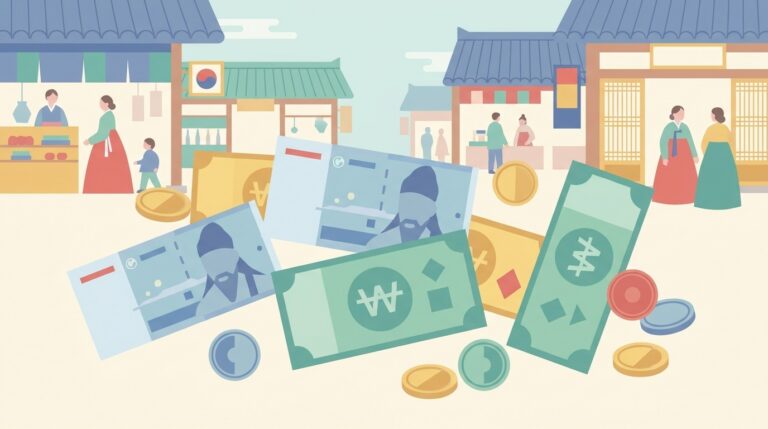
Master Korean Currency: How to Say ‘십만 원이에요 (It is 100,000 won)’ Without Panicking
Phase 1: Empathy (Story Opening)
안녕하세요! 매일한글 에디터입니다. (Hello! I’m your Daily Hangul editor.)
Picture this: You are walking through the trendy alleys of Hongdae. Neon signs are buzzing, street musicians are playing acoustic covers of your favorite BTS songs, and you spot the coziest oversized knit sweater displayed in a boutique window. You walk in, totally in your K-drama main-character energy, and check the price tag. Your eyes widen: 100,000원. All those zeroes blur together. Is that ten dollars? One hundred dollars? A thousand dollars?! You ask the shopkeeper the price, and she cheerily replies: “십만 원이에요 (Simman wonieyo)!” Your brain freezes. Where did ‘thousand’ go? What does ‘십 (sip)’ mean here?
If you’ve ever felt a sudden spike of anxiety at a Korean register, take a deep breath. You are not alone! Over 90% of our beginner learners tell us that reading numbers in Korean is their biggest hurdle. In English, numbers shift by thousands (1,000 / 1,000,000). But in Korean, numbers shift by ten-thousands (만 – man). Once you master this mental shift, shopping in Seoul becomes pure joy—no awkward pauses, no panic at the cashier. Let’s make you confident with Korean money today!
Phase 2: Core 3 Expressions Deep Dive
1. 십만 원이에요 (Simman wonieyo)
- Pronunciation:
Simman wonieyo(Think: ‘Sheem-mahn’ like ‘shimmy’ + ‘won’ like you won a prize + ‘ee-yehyo’) - Meaning: Literal: “It is ten-ten-thousands Won” | Actual Nuance: “It is 100,000 won (approx. $75 USD).”
- K-Culture Moment: Seen in shopping haul vlogs when an influencer picks up a must-have K-beauty set in Olive Young or a trendy blazer in Dongdaemun.
- Editor’s Insight: Due to nasal assimilation in Korean phonetics, 십 (sip) + 만 (man) turns into ‘심만 (sim-man)’. Don’t say ‘sip-man’! Let your lips press together smoothly.
- Situation Spectrum: Casual: ⚠️ | Semi-formal: ✅ | Formal: ✅
- 🤔 Think About It: Why does Korean group big money in units of 10,000 instead of 1,000? How does grouping numbers differently change the way we calculate value?
2. 얼마예요? (Eolmayeyo?)
- Pronunciation:
Eolmayeyo(Sounds like ‘Uhl-mah-yeh-yo’) - Meaning: Literal: “How much is it?” | Actual Nuance: “What is the price of this?”
- K-Culture Moment: The iconic line every tourist uses at Gwangjang Market when pointing at sizzling bindaetteok (mung bean pancakes).
- Editor’s Insight: This is polite, friendly, and universally applicable anywhere from traditional markets to department stores.
- Situation Spectrum: Casual: ⚠️ | Semi-formal: ✅ | Formal: ✅
- 🤔 Think About It: Notice how Korean lets you skip the subject (“this”) completely. What does this tell you about Korean context-focused communication?
3. 카드 돼요? (Kadeu dwaeyo?)
- Pronunciation:
Kadeu dwaeyo(Sounds like ‘Kah-deu dway-yo’) - Meaning: Literal: “Is card possible?” | Actual Nuance: “Do you accept credit/debit cards?”
- K-Culture Moment: When buying cute idol photocards or street socks in underground shopping malls where cash was historically favored.
- Editor’s Insight: Korea is nearly 100% cashless today, but asking this shows polite consideration before tapping your card.
- Situation Spectrum: Casual: ⚠️ | Semi-formal: ✅ | Formal: ✅
- 🤔 Think About It: In many Western countries, asking “Can I use a card?” sounds unnecessary at stores, but in Korea, it acts as a gentle conversational buffer.
Phase 3: Textbook Korean vs Real Korean
Situation 1: Asking the Price
- 📖 교과서 한국어 (Textbook): 이것의 가격은 얼마입니까? (Igeoseui gagyeogeun eolmaimnikka?) – “What is the price of this object?”
- 🗣️ 진짜 한국어 (Real-life): 이거 얼마예요? (Igeo eolmayeyo?) – “How much is this?”
- 💡 왜 다를까? (Why is it different?): Textbook phrases sound like an official military inspection. Real Koreans use the contraction 이거 (igeo) and the warm, polite -예요 (-yeyo) ending.
Situation 2: Stating 100,000 Won
- 📖 교과서 한국어 (Textbook): 일십만 원입니다 (Ilsimman wonimnida) – “It is one-hundred-thousand won.”
- 🗣️ 진짜 한국어 (Real-life): 십만 원이에요 (Simman wonieyo) or 십만이요 (Simman-iyo) – “It’s 100,000 won.”
- 💡 왜 다를까? (Why is it different?): In everyday speech, Koreans never say ‘일 (il – one)’ before ‘십만 (100,000)’ or ‘만 (10,000)’. You just start directly with ‘십만’!
Phase 4: K-Culture Deep Dive & Non-verbal Manners
4-1. 눈치 (Nunchi) & Gestures
When exchanging money or credit cards in Korea, never hand it over with one hand like tossing a frisbee. That can look dismissive. Instead, place your left hand gently under your right forearm or wrist while handing the card over with your right hand. Make brief, soft eye contact, and give a tiny nod. When the clerk hands the card back, receive it with both hands and say 감사합니다 (Gamsahamnida – Thank you).
4-2. Cultural Code Analysis: The Magic Unit ‘만 (Man – 10,000)’
Korea’s largest circulating paper bill is the 오만 원 (Oman won – 50,000 won) note, featuring Shin Saimdang. When you buy something that costs 십만 원 (100,000 won), you are holding just two yellow 50,000-won bills! Remember this mental shortcut: 1만 = 10,000 won (about $7.50 USD). Therefore, 10만 (십만) = 100,000 won (about $75 USD). Cross off four zeros to find the ‘만’ value!
Phase 5: Real-Life Roleplay Scenario
- Setting: A trendy vintage apparel boutique in Seongsu-dong.
- Character: Min-ji (민지), a friendly indie shop owner wearing stylish rimless glasses.
-
Turn 1 (You): 🎭 Touching the sleeve of a jacket and looking at Min-ji
저기요, 이 재킷 얼마예요? (Jeogiyo, i jaekit eolmayeyo?)
(Excuse me, how much is this jacket?) - Turn 2 (Min-ji): 🎭 Smiling warmly and checking the tag
아, 손님! 그거 십만 원이에요. (A, sonnim! Geugeo simman wonieyo.)
(Ah, dear customer! That one is 100,000 won.) - Turn 3 (You): 🎭 Surprised, checking your wallet
십만 원이요? 혹시 할인 돼요? (Simman woniyo? Hoksi harin dwaeyo?)
(100,000 won? By any chance, is there a discount?) - Turn 4 (Min-ji): 🎭 Gesturing toward the sign on the counter
현금으로 하시면 오천 원 깎아 드릴게요! (Hyeongeumeuro hasimyeon ocheon won kkakka deurilgeyo!)
(If you pay with cash, I will take 5,000 won off!) - Turn 5 (You): 🎭 Apologetic smile, holding your travel card
아, 현금이 없어요. 카드 돼요? (A, hyeongeumi eopseoyo. Kadeu dwaeyo?)
(Ah, I don’t have cash. Can I pay by card?) - Turn 6 (Min-ji): 🎭 Nodding and pointing to the card reader
네, 그럼요! 카드는 십만 원 결제할게요. (Ne, geureomyo! Kadeuneun simman won gyeoljehalgeyo.)
(Yes, of course! For card, I will process 100,000 won.) - Turn 7 (You): 🎭 Handing the card holding your wrist with your other hand
네, 여기 카드 있어요. (Ne, yeogi kadeu isseoyo.)
(Yes, here is my card.) - Turn 8 (Min-ji): 🎭 Handing back the card with both hands
결제 끝났습니다. 영수증 드릴까요? (Gyeolje kkeutnasseumnida. Yeongsujeung deurilkkayo?)
(Payment is complete. Would you like a receipt?)
🔀 Interactive Decision Point
How do you answer Min-ji’s question: “영수증 드릴까요? (Would you like a receipt?)”
* Choice A: “괜찮아요, 버려주세요.” (Gwaenchanayo, beoryeojuseyo.)
* Feedback (Best): Perfect! It means “It’s okay, please throw it away.” Natural and polite; most locals say this.
* Choice B: “싫어요!” (Sireoyo!)
* Feedback (Bad): Too blunt! It sounds like “I hate it!” or “No way!” which shocks the shopkeeper.
* Choice C: “네, 주세요.” (Ne, juseyo.)
* Feedback (Risk/Neutral): Totally fine if you need the receipt for tax refunds, but keep in mind you’ll have extra paper in your wallet!
Phase 6: 10-Second Emotion Shadowing Drill
Practice these lines out loud, pausing at the / and matching the emotion:
[😊 Inquiring & friendly]저기요, / 이거 얼마예요? (Jeogiyo, / igeo eolmayeyo?)[😮 Mildly surprised]십만 원이요? / 생각보다 괜찮네요! (Simman woniyo? / Saenggakboda gwaenchanneyo!) (100,000 won? It’s better than I thought!)[💳 Polite & gentle]카드 돼요? / 여기 있어요. (Kadeu dwaeyo? / Yeogi isseoyo.)
Phase 7: K-Culture Mini Dictionary
- 만 원 (Man won) | 10,000 Won | The fundamental benchmark bill in Korea (approx. $7.50 USD). Often used as slang for standard street shopping budgets.
- 영수증 (Yeongsujeung) | Receipt | You will hear “영수증 필요하세요? (Do you need a receipt?)” at every single convenience store and café.
- 일시불 (Ilssibul) | One-time payment (no installment) | When paying with a card for amounts over 50,000 won, cashiers frequently ask “일시불로 해드릴까요?” Just nod and say “네!”
- 계좌이체 (Gyejwa-iche) | Bank transfer | Very popular in night markets and pop-up booths where mobile direct payment apps like Toss or KakaoPay rule.
Phase 8: Traveler’s Survival Kit
Survival Expressions TOP 3
- 이거 주세요. (Igeo juseyo.) – [Pronunciation: Ee-geo joo-seh-yo] | Pro Tip: Point with an open palm at any item and say this.
- 영수증 버려주세요. (Yeongsujeung beoryeojuseyo.) – [Pronunciation: Yeong-soo-jeung buh-ryuh-joo-seh-yo] | Pro Tip: Use this to decline paper receipts smoothly.
- 봉투 필요해요. (Bongtu piryohaeyo.) – [Pronunciation: Bong-too pee-ryo-hae-yo] | Pro Tip: In Korea, plastic/paper bags cost 100~500 won by law. Say this if you need one.
Editor’s Travel Note
- Download essential tools: Prepare in advance by checking the Naver Map app download to check store locations and transit routes accurately.
- Cash vs Card: You barely need paper cash in Seoul except for topping up your T-money transit card and eating at street food stalls. For everything else, cards rule!
Phase 9: Going One Step Deeper
In English and many European languages, numbers jump by thousands: thousand, million, billion. But Korean follows the Sino-Korean East Asian counting system based on ten-thousand: 만 (10,000), 억 (100,000,000), and 조 (1,000,000,000,000). When Westerners see 100,000, they see “100 thousands”. A Korean sees 10,0000, which is “10 of the 10,000s” (십만).
This linguistic difference is not just math; it reflects how cultures categorize abundance. Don’t be discouraged if your brain takes a second to calculate. Even bilingual Koreans pause when translating large sums between Korean Won and US Dollars!
💬 Your Turn: Have you ever experienced a funny currency confusion while traveling or watching a K-drama? Share your story in the comments below!
Phase 10: FAQ & Avoiding Misunderstandings
Q: Why do people say ‘심만’ instead of ‘십만’?
A: In Korean phonetics, when a syllable ending with the ㅂ (b/p) sound meets a following syllable starting with ㅁ (m), the ㅂ assimilates into an ㅁ sound. Thus, 십 (sip) + 만 (man) naturally rolls off the tongue as ‘심만 (sim-man)’.
Q: Do I need to say ‘일십만 원’ for 100,000 won?
A: No! Saying ‘일 (il)’ before 10,000 (만) or 100,000 (십만) sounds like an automated bank machine or legal contract. Just say 십만 원 (simman won).
Q: What if an item costs 150,000 won? How do I say that?
A: Combine 100,000 (십만) + 50,000 (오만): 십오만 원이에요 (Sibo-man wonieyo)!
🚨 Common Mistakes Board
- Mistake: Pronouncing 십만 as “Ship-man” with hard stops.
Correct Action: Blend the lips together smoothly: “Sim-man”. - Mistake: Handing a credit card over with fingertips using one hand.
Correct Action: Use two hands or support your right arm with your left hand. - Mistake: Forgetting that bags cost money and waiting for the cashier to pack your items.
Correct Action: Ask for a bag first: “봉투 주세요 (Bongtu juseyo).”
Phase 11: Action Mission & Engagement
- 🥉 Bronze Mission (Solo): Stand in front of your mirror and practice saying: “이거 얼마예요? 십만 원이에요?” 5 times smoothly.
- 🥈 Silver Mission (Social): Record a 5-second audio snippet on your phone saying “카드 돼요?” and compare your intonation with a K-drama clip.
- 🥇 Gold Mission (Real Life): Next time you visit a Korean mart, restaurant, or website, spot an item over 100,000 won and pronounce its price aloud using “십만…”!
🎮 K-Culture Mission: Watch an episode of your favorite K-drama where characters go shopping or dining. Pay attention to the moment they hand over their black credit cards—listen for the words 결제 (payment) or 영수증 (receipt)!
Phase 12: Interactive Quiz Challenge
1. Situation Judgment: You want to pay for a 100,000-won jacket with your card. What is the most natural sentence to say?
– A) 이것을 십만 원에 주십시오.
– B) 십만 원이에요? 카드로 결제할게요.
– C) 일십만 원을 당신에게 드립니다.
2. Fill-in-the-Blank:
가: 저기요, 이 신발 얼마예요?
나: ________ 원이에요. (100,000 won)
(Hint: Do not include ‘일’!)
3. True or False:
In Korean stores, handing a card to the clerk using both hands is considered an outdated custom that young people avoid.
👉 Click to reveal answers & explanations!
- Answer: B | Explanation: “십만 원이에요? 카드로 결제할게요.” (100,000 won? I’ll pay by card) is natural, polite, and practical.
- Answer: 십만 (Simman) | Explanation: 100,000 is simply 십만, never 일십만 in casual/daily spoken Korean.
- Answer: False | Explanation: Handing items or cards with both hands (or supporting the arm) remains an active, cherished sign of daily respect and politeness in modern Korea!






