

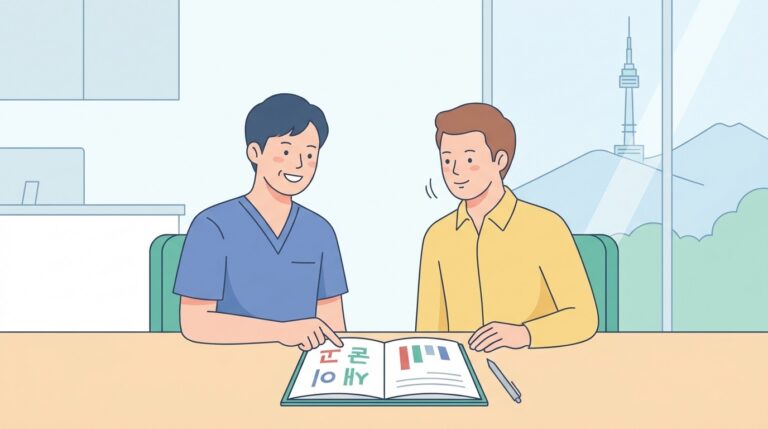
Decoding Your Korean Health Checkup: From Liver Enzymes to Doctor Consultations
Phase 1: Empathy (Story-Driven Opening)
안녕하세요! 매일한글 에디터입니다. Have you ever received a crisp registered envelope from the Korean postman or an alert from the National Health Insurance Service app and felt your heart sink? Opening the tri-fold paper only to see asterisks next to terms like 간 수치 (liver enzymes), LDL 콜레스테롤 (LDL cholesterol), or 용종 (polyp) is genuinely intimidating. In Korean dramas like Hospital Playlist, you often see hardworking characters nervously clutching their white checkup folders before sitting across from a warm yet firm family medicine doctor. As someone navigating the Korean medical system as an expat or traveler, medical jargon can feel like an entirely different language. Based on real-world experiences from hundreds of our learners in Korea, this intermediate guide equips you with authentic phrasing and cultural etiquette so you can walk into any local clinic (가정의학과) and review your results with total poise.
Phase 2: Top 3 Core Expressions
1. 추적 관찰이 필요합니다 (Chujeok gwanchari piryohamnida)
- Pronunciation: [Chu-jeok gwan-cha-ri pi-ryo-ham-ni-da] (Think of ‘Chu’ like a train’s ‘choo-choo’, ‘jeok’ like ‘juck’, and ‘gwanchal’ rhyming with ‘one call’ with a soft rolled r-sound).
- Meaning: Literally “Tracking observation is required,” but naturally means “We need to monitor this over time with follow-up tests.”
- K-Culture Moment: In medical or slice-of-life dramas, a doctor says this to reassure an anxious patient that an abnormality (like a tiny thyroid nodule or mild polyp) is not an emergency, but something to monitor.
- Editor’s Insight: Don’t panic when you hear 추적 관찰! It does not mean surgery is imminent. It means your doctor wants to see if the metric stabilizes or changes after 3, 6, or 12 months.
- Situation Spectrum:
- Casual: 🚫 (Medical terminology is too clinical for casual chit-chat unless quoting a doctor)
- Semi-formal: ⚠️ (Used when discussing your test results with coworkers: 추적 관찰해야 한대요)
- Formal: ✅ (Standard phrasing inside consultation rooms)
- 🤔 Think About It: Why does Korean medicine favor the proactive term 추적 관찰 (tracking observation) over passive watchful waiting? What does this reveal about Korea’s speed-driven, preventative healthcare mindset?
2. 간 수치가 약간 높게 나왔어요 (Gan suchiga yakgan nopge nawasseoyo)
- Pronunciation: [Gan su-chi-ga yak-gan nop-ge na-wa-sseo-yo] (Pronounce ‘Gan’ like ‘gun’, ‘su-chi’ like ‘sue-chee’, and ‘yakgan’ like ‘yuck-gahn’).
- Meaning: Literally “Liver numerical values came out slightly high,” meaning “My liver enzyme levels showed up slightly elevated.”
- K-Culture Moment: After a busy season of Korean company dinners (회식, hoeshik) packed with grilled pork belly and somaek (소맥), office workers in shows like Misaeng compare health checkup scores over coffee with this exact phrase.
- Editor’s Insight: Koreans frequently quantify physiological states as ‘수치’ (numerical levels/metrics). Whether it’s cholesterol (콜레스테롤 수치) or blood sugar (혈당 수치), phrasing it as ‘수치가 나왔다’ (the numbers came out) attributes the finding neutrally to the lab report.
- Situation Spectrum:
- Casual: ✅ (간 수치 좀 높게 나왔어)
- Semi-formal: ✅ (간 수치가 약간 높게 나왔어요)
- Formal: ✅ (간 수치가 다소 높게 측정되었습니다)
- 🤔 Think About It: In English, we often say “My liver tests were abnormal,” while Korean highlights the specific metrics (수치). How does focusing on measurable data shape personal health accountability?
3. 용종을 떼어냈으니 조직 검사 결과를 기다려 보세요 (Yongjongeul tteeonaesseuni jojik geomsa gyeolgwaleul gidaryeo boseyo)
- Pronunciation: [Yong-jong-eul tte-eo-nae-sseu-ni jo-jik geom-sa gyeol-gwa-reul gi-da-ryeo bo-se-yo] (Pronounce the double ‘tt’ in ‘tteo’ with crisp vocal tension like in ‘spit’, and ‘jojik’ like ‘jaw-jeek’).
- Meaning: Literally “We removed the polyp, so please wait for the tissue test results,” meaning “A polyp was excised during your endoscopy, so let’s await the biopsy report.”
- K-Culture Moment: Seen commonly when middle-aged drama protagonists complete their biennial endoscopy (내시경) and the doctor calmly updates the family in the recovery hall.
- Editor’s Insight: Notice the verb 떼어내다 (to pluck/detach). Korean medical discourse often uses tangible, physical action verbs rather than stiff Latinate terms (like ‘polypectomy’) when doctors speak to patients.
- Situation Spectrum:
- Casual: 🚫
- Semi-formal: ⚠️
- Formal: ✅
- 🤔 Think About It: Notice how the doctor softens the command by adding ‘기다려 보세요’ (~아/어 보세요, ‘try waiting’) instead of a harsh directive. How does this maintain empathy in a clinical setting?
Phase 3: Textbook Korean vs. Real Korean
Situation 1: Asking if your condition is dangerous
- 📖 교과서 한국어 (Textbook Korean): 이 질병은 저에게 치명적입니까? (Is this disease fatal to me?)
- 🗣️ 진짜 한국어 (Real Native Korean): 선생님, 이거 크게 걱정할 만한 건 아닌가요? (Seonsaengnim, igeo keuge geokjeonghal manhan geon aningayo? / Doctor, this isn’t something I need to worry heavily about, right?)
- 💡 왜 다를까?: Native speakers avoid theatrical words like ‘치명적’ (fatal) in routine checkups. Instead, they politely confirm reassurance using negative questions (~아닌가요?), giving the specialist a natural doorway to comfort them.
Situation 2: Asking when to schedule a follow-up test
- 📖 교과서 한국어 (Textbook Korean): 다음 진찰 일자는 언제입니까? (When is the subsequent medical examination date?)
- 🗣️ 진짜 한국어 (Real Native Korean): 언제쯤 다시 피검사 받아보면 될까요? (Eonjejjeum dasi pigeomsa badabomyeon doelkkayo? / Around when should I come back in for another blood test?)
- 💡 왜 다를까?: Real patients specify the exact procedure (like 피검사, blood test, or 초음파, ultrasound) and soften the timeline with ‘언제쯤’ (around when) and ‘~면 될까요?’ (would it work if…?).
Phase 4: K-Culture Deep Dive & Non-Verbal Manners
4-1. 눈치 (Nunchi) & Clinic Etiquette
When reviewing test papers with a doctor at a primary clinic (의원) or Family Medicine center (가정의학과):
* Two-Handed Document Respect: When presenting your paper report (결과표) or handing over your smartphone showing the health app summary, hold it with both hands (두 손으로 건네기) with the text oriented toward the doctor.
* Interactive Gaze: Watch the doctor’s monitor politely. When they point to an abnormal marker with their pen or mouse cursor, give a slight forward nod (고개 끄덕임) accompanied by a quiet ‘아, 네’ (Ah, yes) to acknowledge the data point without interrupting their analysis.
4-2. The Culture of Regular Checkups (국가건강검진)
In South Korea, preventive care is practically a communal rhythm. The National Health Insurance Service (NHIS) provides regular general screenings every one to two years based on your birth year. It is so ingrained that colleagues openly ask, “올해 건강검진 받았어?” (Did you get your checkup this year?). Because Korean urban life involves intense work hours and frequent dining out (회식), markers for fatty liver (지방간) and high cholesterol (고지혈증) are shared office topics rather than taboo medical secrets. Doctors treat these consultations as collaborative lifestyle coaching sessions.
Phase 5: Real-World Roleplay Scenario
Setting: Dr. Kim’s brightly lit Family Medicine clinic in Mapo-gu. Dr. Kim (김 원장님), a calm physician with gentle wire-rimmed glasses, rotates his computer screen to display your digital blood lab panel.
- Dr. Kim: 어서 오세요. 지난달에 받으신 종합검진 결과표 보면서 상담해 드릴게요. (Eoseo oseyo. Jinandare badeusin jonghapgeomjin gyeolgwapyo bomyeonseo sangdamhae deurilgeyo.)
- [🎭 Smiling gently while tapping open a PDF file on the monitor]
- “Welcome. Let’s look over the comprehensive checkup report you completed last month together.”
- Learner: 네, 원장님. 모바일 앱으로 먼저 봤는데 빨간 글씨가 좀 있어서 걱정돼요. (Ne, wonjangnim. Moba-il aebeuro meonjeo bwanneunde ppalgan geulssiga jom isseoseo geokjeongdwaeyo.)
- [🎭 Leaning forward slightly with an anxious, polite smile]
- “Yes, Doctor. I looked at it first on the mobile app, and I got worried because there were some numbers in red.”
- Dr. Kim: 전반적으로 양호하지만, 간 수치인 AST, ALT가 기준치보다 조금 높네요. (Jeonbanjeogeuro yanghohajiman, gan suchiin AST, ALTga gijunchiboda jogeum nopneyo.)
- [🎭 Circling the liver panel numbers with a stylus pen]
- “Overall it is quite good, but your liver enzymes AST and ALT are slightly above the reference range.”
- Learner: 최근에 야근이랑 회식이 잦았는데, 그것 때문일까요? (Choegeune yageun-irang hoesigi jajanneunde, geugeot ttaemun-ilkkayo?)
- [🎭 Placing hands neatly on knees]
- “I had frequent overtime work and company dinners lately; could it be because of that?”
- Dr. Kim: 네, 피로와 음주 영향이 큽니다. 그리고 위내시경에서 작은 용종 하나 떼어낸 건 단순 양성 용종이니 안심하세요. (Ne, pirowa eumju yeonghyang-i keumnida. Geurigo winaesigyeong-eseo jageun yongjong hana tteeonaen geon dansun yangseong yongjong-ini ansimhaseyo.)
- [🎭 Reassuring tone with an understanding nod]
- “Yes, fatigue and alcohol play a major role. Also, the small polyp removed during your gastroscopy is a benign polyp, so you can rest easy.”
- Learner: 다행이네요. 그럼 약을 따로 처방받아야 하나요? (Dahaeng-ineyob. Geureom yageul ttaro cheobangbada-ya hanayo?)
- [🎭 Shoulders relaxing visibly]
- “What a relief. Do I need a separate medication prescription then?”
- Dr. Kim: 지금은 약 드실 단계는 아니고요, 한 달간 금주하시고 3개월 뒤에 추적 관찰로 피검사 한 번 더 해보시죠. (Jigeumeun yak deusil danggyeneun anigoyo, han dalgan geumjuhasigo samgaewol dwie chujeok gwanchallo pigeomsa han beon deo haebosijyo.)
- [🎭 Handing over an appointment guidance slip]
- “You’re not at the stage of needing medication right now. Refrain from alcohol for a month, and let’s run another blood test in 3 months for follow-up observation.”
- Learner: 알겠습니다. 3개월 뒤에 다시 검사하러 올게요. 감사합니다! (Algetseumnida. Samgaewol dwie dasi geomsahareo olgeyo. Gamsahamnida!)
- [🎭 Standing up and bowing 15 degrees respectfully]
- “Understood. I will come back for the re-test in 3 months. Thank you!”
🔀 Interactive Decision Point
Suppose the doctor mentions: “콜레스테롤 수치도 경계선에 걸쳐 있네요.” (Your cholesterol is also right on the borderline). How do you respond?
- Option A: “저 바로 고지혈증 약 처방해 주세요!” (Prescribe me hyperlipidemia medication immediately!)
- Feedback: [Risk] Too rushed. At the borderline stage (경계), Korean doctors prefer lifestyle modification before prescribing lifelong statins.
- Option B: “식단 조절이랑 유산소 운동 먼저 해보고 재검받아도 될까요?” (Could I try diet adjustment and aerobic exercise first, then take a re-test?)
- Feedback: [Best] Shows proactive health agency while using exact medical Korean (식단 조절, 유산소 운동, 재검).
- Option C: “결과표가 잘못 나온 것 같은데요.” (I think the results sheet came out wrong.)
- Feedback: [Bad] Dismissive of the clinical laboratory and breaches medical rapport.
Phase 6: 10-Second Emotion Shadowing Drill
[🥺 초조하고 조심스럽게]
“선생님, / 결과표에 빨간 글씨가 / 큰 병은 아니겠죠?”
(Seonsaengnim, / gyeolgwapyoe ppalgan geulssiga / keun byeong-eun anigetjyo?)
“Doctor, / the red text on my report / isn’t anything serious, right?”-
[😮💨 안도하며 차분하게]
“단순 용종이라니 / 정말 다행이네요. / 안심이 돼요.”
(Dansun yongjong-irani / jeongmal dahaeng-ineyob. / Ansim-i dwaeyo.)
“Since it is just a simple polyp / what a relief. / I feel so relieved.” -
[💪 의지를 다지며 씩씩하게]
“3개월 동안 / 술 줄이고 운동해서 / 수치 꼭 낮춰 올게요!”
(Samgaewol dong-an / sul jurigo undonghaeseo / suchi kkok natchwo olgeyo!)
“During the next 3 months / I’ll cut down on alcohol and work out / to bring these numbers down!”
Phase 7: K-Culture Mini Dictionary
- 정상 B (경계) [Jeongsang B (Gyeonggye)] — Normal B (Borderline / Observation Required): On Korean health reports, results are categorized as 정상 A (optimal health), 정상 B (borderline lifestyle risk), and 질환 의심 (suspected illness). It signals “healthy now, but adjust your habits!”
- 추적 관찰 [Chujeok gwanchal] — Follow-up Clinical Monitoring: Periodic re-evaluation of borderline lab results or biopsied tissue after a set interval (typically 3 to 12 months).
- 재검사 / 재검 [Jaegeomsa / Jaegeom] — Re-test / Re-screening: Repeating a specific isolated test (such as blood or ultrasound) to verify whether abnormal spikes were temporary.
- 용종 절제술 [Yongjong jeoljjesul] — Polypectomy: The minor endoscopic removal of polyps in the stomach (위) or colon (대장) performed directly during checkup sedation.
Phase 8: Traveler & Resident Survival Kit
Survival Expressions TOP 3
- “공복 상태로 왔어요.” (Gongbok sangtaero wasseoyo.)
- Pro Tip: Blood draws for liver enzymes and cholesterol require fasting. Announce this at check-in so staff know your labs will be accurate.
- “등기우편 대신 모바일 앱으로 결과표 받을 수 있나요?” (Deunggi-upyeon daesin moba-il aebeuro gyeolgwapyo badeul su innayo?)
- Pro Tip: If you don’t want physical registered mail delivered to your door, request an encrypted PDF via KakaoTalk or email.
- “영문 결과지 발급도 가능한가요?” (Yeongmun gyeolgwaji balgeupdo ganeunghangayo?)
- Pro Tip: Essential if you need to submit checkup results to an overseas employer or visa office.
Editor’s Travel Note
When booking your consultation follow-up, avoid cold walk-ins during Monday mornings when clinics are packed. Search for clinics rated highly for gentle consultations using verified patient reviews via the Ddocdoc clinic reservation app download. Remember that primary consultations under the Korean National Health Insurance system (NHIS) are remarkably budget-friendly, often costing under 10,000 KRW for a follow-up review.
Phase 9: Deep Dive (한 발 더 깊이)
Korean medical culture exhibits a unique blend of extreme digital efficiency and paternalistic linguistic softening. While your lab results arrive as blunt statistical charts on your smartphone screen, the human interaction in the consultation room softens this blow. Doctors rarely tell patients bluntly that they are ill unless severe; instead, they frame findings through manageability: “관리하시면 됩니다” (You can manage it with care) or “조절해 봅시다” (Let’s adjust it together). Health is viewed not merely as an individual’s static state, but as an ongoing social calibration between work obligations, diet, and seasonal stress.
💬 Your Turn: Have you ever received blood test results in another country? How does the bedside manner of doctors in your home culture compare to the collaborative coaching style in Korea? Let us know in the comments below!
Phase 10: FAQ & Avoiding Pitfalls
Q: 건강검진 결과표에서 ‘질환 의심’이 나오면 바로 큰 병원에 가야 하나요?
A: Not necessarily. ‘질환 의심’ (suspected condition) simply indicates that a metric is outside the standard reference ceiling. First visit a local neighborhood internal medicine (내과) or family medicine clinic (가정의학과) for a secondary consultation (2차 검진) before considering a tertiary university hospital.
Q: 피검사 결과에서 간 수치는 어떤 약어로 표시되나요?
A: Look for AST (GOT), ALT (GPT), and 감마-GTP (γ-GTP). Elevations in ALT usually correlate with fatty liver or metabolic strain, while gamma-GTP frequently spikes with alcohol consumption or stress.
Q: 결과 상담을 받으러 갈 때 결과지를 꼭 인쇄해 가야 하나요?
A: If you are returning to the same clinic where you took the checkup, their internal electronic medical record (EMR) system already has your files. If you are consulting a different neighborhood doctor, bring either the paper booklet or display the original PDF on your mobile phone.
🚨 Common Mistakes TOP 3
- ❌ Mistake 1: Saying “저 암인가요?” (Do I have cancer?) immediately upon hearing the word ‘용종’ (polyp).
- Correct Action: Most gastric and colon polyps are completely benign. Calmly ask: “양성 용종인가요? 조직 검사 결과는 언제 나오나요?” (Is it a benign polyp? When will the biopsy results be available?).
- ❌ Mistake 2: Demanding prescription drugs when your cholesterol is marked ‘정상 B (경계)’.
- Correct Action: Say: “생활 습관 개선을 먼저 해보고 싶어요.” (I would like to try lifestyle improvements first).
- ❌ Mistake 3: Skipping follow-up because you feel healthy.
- Correct Action: Chronic metabolic changes rarely show early physical pain. Always honor the 추적 관찰 window recommended by your doctor.
Phase 11: Action Mission & Participation
- 🥉 Bronze Mission: Open your smartphone or notebook and write down the three core Korean health metrics: 간 수치 (liver levels), 콜레스테롤 (cholesterol), and 추적 관찰 (follow-up monitoring).
- 🥈 Silver Mission: Record an audio clip of yourself practicing the Phase 6 shadow drill sentence: “선생님, 결과표에 빨간 글씨가 큰 병은 아니겠죠?” Focus on maintaining natural polite intonation.
- 🥇 Gold Mission: Next time you visit a Korean clinic, ask your doctor at least one proactive question in Korean using “~경계선에 걸쳐 있는데 어떻게 관리할까요?” (It is on the borderline; how should I manage it?).
- 🎮 K-Culture Mission: Watch an episode of Hospital Playlist (슬기로운 의사생활) Season 1 and spot the scene where patients consult with the doctors in the outpatient clinic. Notice how often the doctors use the phrase “지켜봅시다” (let’s monitor it).
Phase 12: Interactive Quiz Challenge
Test your clinic instincts with these three quick checks!
- Situational Judgment: Your checkup results state that your liver enzymes are in the ‘정상 B’ range. What is the most culturally and medically appropriate question to ask your family medicine doctor?
- a) “당장 입원 수속 밟아주세요.” (Please start hospitalization paperwork immediately.)
- b) “몇 달 뒤에 재검사 받아보는 게 좋을까요?” (Would it be good to take a re-test in a few months?)
- c) “검사 기계가 고장 난 것 같아요.” (I think the testing machine was broken.)
🔍 Click to reveal Answer & Explanation
- Correct Answer: b
- Explanation: ‘정상 B’ represents borderline metrics where observation and lifestyle tweaks are warranted. Asking for a re-test timeframe (재검사) demonstrates mature, proactive medical communication.
- Fill in the Blank: Complete this common clinic question:
“용종을 떼어냈다고 들었는데, ______ 검사 결과는 언제 나오나요?” (I heard the polyp was removed; when will the biopsy result come out?)- Hint: Two syllables meaning tissue/biopsy.
🔍 Click to reveal Answer & Explanation
- Correct Answer: 조직 (조직 검사 = biopsy / histological exam).
- Explanation: Once a polyp is removed (용종 절제술), it is sent for tissue biopsy (조직 검사) to rule out dysplasia or malignancy.
- True or False Cultural Quiz:
In South Korea, foreign residents enrolled in the National Health Insurance (NHIS) are excluded from the free biennial general checkup system.- [True / False]
🔍 Click to reveal Answer & Explanation
- Correct Answer: False
- Explanation: Foreign registered residents enrolled in National Health Insurance (both workplace and local subscriber tiers) are entitled to the exact same biennial general health screening (일반건강검진) benefits as Korean citizens based on their birth year!







