

Phase 1: Empathy (Story-Driven Opening)
안녕하세요! 매일한글 에디터입니다. (Hello! I’m your Daily Hangul editor.)
Picture this: It’s 8:30 AM on a crisp Saturday morning outside the COEX Convention Center in Gangnam. You see a line winding around the block, dozens of trendy twenty-somethings clutching iced Americanos, checking their watches with eager anticipation. But they aren’t waiting for the drop of a new luxury sneaker or a K-Pop pop-up store. They are waiting for the doors to swing open at the Seoul International Book Fair. Welcome to the era of the literary “오픈런 (open-run).”
By 2:00 PM, your Instagram feed is flooded with aesthetic, pastel-toned snapshots. A warm cup of flat white, a textured paper bookmark resting across a clean page, and a single, poignant sentence underlined in pencil. Caption? Simply: “오늘의 한 줄 (Today’s line) #텍스트힙 #완독”.
If you have been studying Korean from standard B2 textbooks, you might find yourself baffled. You know the verb 독서하다 (dokseohada – to read books), but suddenly locals are talking about “텍스트힙 (Text-hip),” complaining about “도파밍 (Dopamine farming),” and making purchase decisions via “디토 소비 (Ditto consumption).” Why is reading a physical paper book suddenly the coolest flex in Seoul? As an intermediate learner navigating authentic Korean conversations, missing these cultural buzzwords can make you feel out of the loop even if your grammar is technically perfect.
Don’t worry—you’re in the right place! Today, based on feedback from hundreds of our intermediate students who felt overwhelmed by Seoul’s lightning-fast slang cycles, we will unpack this fascinating cultural movement. By the end of this guide, you won’t just understand these buzzwords—you’ll be able to drop them effortlessly in book cafes, analyze modern Korean consumer psychology, and post your own Text-hip aesthetic story like a true Seoulite.
Phase 2: Core Expressions Deep Dive
1. 텍스트힙 (Tekseuteu-hip)
- Pronunciation: [Tek-seu-teu-heep] (Think of saying “Text” with an extra soft vowel at the end, followed by the English word “Hip” as in hipster).
- Meaning: “Text-hip.” A portmanteau of Text (텍스트) and Hip (힙한). Literal: Cool text. Real Nuance: The cultural trend of viewing reading physical books, writing analog notes, and engaging with long-form print culture as aesthetically stylish, intellectually rebellious, and uniquely personal.
- K-Culture Moment: Seen frequently on YouTube study vlogs and idol Weverse updates. When a celebrity like BTS’s RM or an indie musician quietly posts a photo of an obscure poetry collection without any self-promotion, comments immediately flood in: “진짜 텍스트힙의 정석이다! (Jinjja tekseuteu-hibui jeongseogida! – Truly the textbook definition of Text-hip!)”
- Editor’s Insight: For decades, reading was associated in Korea with grueling academic study (공부) and entrance exam stress. Text-hip reclaims reading as self-care and an aesthetic identity counteracting shallow short-form video consumption.
- Situation Spectrum: Casual (✅) / Semi-formal (✅ – common in marketing and media essays) / Formal (⚠️ – use 문해력 증진 or 독서 문화 in academic papers).
- 🤔 Think About It: Does your native culture consider reading books a trendy “aesthetic,” or is it still categorized primarily as an introverted or purely academic hobby?
2. 오픈런 뛰다 (Opeun-reon ttwida)
- Pronunciation: [Oh-peun-reon ti-da] (Sounds like the English words “Open” + “Run” combined with the Korean verb ttwida, which sounds like “twee-da”).
- Meaning: Literal: To sprint at opening. Real Nuance: To arrive hours before a store, event, or cafe opens to line up and secure limited-edition merchandise, tickets, or exclusive independent publications.
- K-Culture Moment: Originally used for luxury Chanel bags or hyped bakery pop-ups in Seongsu-dong, the phrase is now universally used by book lovers: “도서전 한정판 북마크 사려고 아침부터 오픈런 뛰었어요! (Doseojeon hanjeongpan bungmakeu saryeogo achimbuteo opeunreon ttwieosseoyo! – I did an open-run from early morning just to buy the book fair’s limited edition bookmark!)”
- Editor’s Insight: Notice the use of the verb 뛰다 (to run). Koreans don’t just do (하다) an open-run; they sprint (뛰다) it. It emphasizes dedication, energy, and the communal rush of securing rare cultural goods.
- Situation Spectrum: Casual (✅) / Semi-formal (✅) / Formal (🚫 – use 개장 전 대기 in official business reports).
- 🤔 Think About It: How does your home country describe people camping outside retail stores? Does the concept extend beyond high-end fashion or sneakers into culture and arts?
3. 디토 소비 (Ditto So-bi)
- Pronunciation: [Dee-toh So-bee] (Ditto pronounced cleanly, followed by so as in “solar” and bi as in “bean”).
- Meaning: Literal: “Ditto” consumption. Real Nuance: Purchasing goods, books, or lifestyles by imitating and trusting the curated tastes of a specific influencer, artist, or independent curator rather than blindly following mass-market algorithmic reviews.
- K-Culture Moment: You walk into a cozy independent bookstore in Yeonnam-dong. On the table sits an essay with a handwritten staff note: “MD’s pick.” Shoppers buy it instantly without reading the blurb. Online, you’ll see captions like: “그 작가님 추천이라 디토 소비 완료! (Geu jakganim chucheon-ira ditto sobi wallyo! – It was that author’s recommendation, so Ditto consumption complete!)”
- Editor’s Insight: As people grow exhausted by fake product reviews and sponsored ads, “Ditto Consumption” represents a return to human trust. In the book world, readers ditto indie bookstore owners because they trust their sensibility.
- Situation Spectrum: Casual (✅) / Semi-formal (✅ – recognized consumer trend term) / Formal (✅ – standard business and marketing terminology).
- 🤔 Think About It: When was the last time you bought a book purely because someone with inspiring taste recommended it? That is pure Ditto consumption.
Phase 3: Textbook Korean vs. Real Korean
Situation 1: Explaining what you do on weekends
- 📖 교과서 한국어 (Textbook): 저는 주말마다 서점에 가서 독서를 즐깁니다. (Jeoneun jumalmada seojeome gaseo dokseoreul jeolgimnida. – I go to the bookstore every weekend and enjoy reading.)
- 🗣️ 진짜 한국어 (Real-World): 요즘 도파민 디톡스하려고 주말마다 독립서점 투어 다녀요. 완전 텍스트힙이죠? (Yojeum dopamin ditokseharyeogo jumalmada dongnipseojeom tueo danyeoyo. Wanjeon tekseuteu-hibijyo? – Lately, to do a dopamine detox, I’ve been doing indie bookstore tours every weekend. Totally Text-hip, right?)
- 💡 왜 다를까? (Why the difference?): While “독서를 즐깁니다” sounds polite, it reads like an essay written in 1995. Contemporary Koreans frame bookstore visits as conscious acts of unwinding (도파민 디톡스) and exploration (서점 투어).
Situation 2: Sharing your reaction to a striking book quote
- 📖 교과서 한국어 (Textbook): 이 책의 문장은 저에게 깊은 감동을 주었습니다. (I chaegui munjang-eun jeoege gipeun gamdong-eul jueosseumnida. – The sentences of this book gave me deep impression.)
- 🗣️ 진짜 한국어 (Real-World): 이 구절 읽고 머리 한 대 맞은 것 같았어요. 스토리 박제 각이에요! (I gujeol ilkgo meori han dae majeun geot gatasseoyo. Seutori bakje gagieyo! – Reading this line felt like a wake-up call to my head. It’s totally destined for my Instagram Story archive!)
- 💡 왜 다를까? (Why the difference?): Koreans rarely say “깊은 감동을 주었습니다” in daily chats. Idioms like “머리를 한 대 맞다” (struck by insight) and internet slang like “박제 각” (worthy of capturing/pinning forever) convey intense emotional resonance.
Phase 4: K-Culture Deep Dive & Non-Verbal Manners
4-1. 눈치 (Nunchi) & Independent Bookstore Etiquette
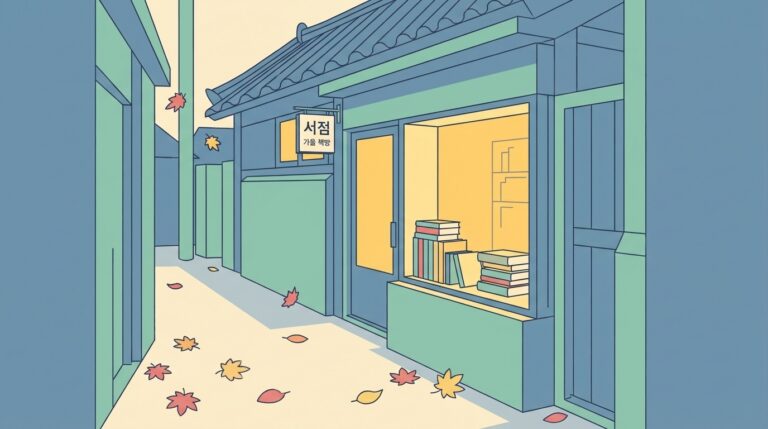
Visiting an independent bookstore (독립서점) in Seoul’s quiet alleys—such as in Seochon (서촌), Mangwon (망원), or Yeonhui-dong (연희동)—requires a fine-tuned level of situational awareness:
* The Shutter Sound Rule: Under Korean law, all domestic smartphone cameras emit a mandatory shutter sound to protect privacy. If you want to photograph an aesthetic book quote, do not fire off multiple loud clicks in a whisper-quiet bookshop. Use silent photo modes if permitted by the app, or ask the owner first: “사진 몇 장 찍어도 괜찮을까요? (Sajin myeot jang jjigeodo gwaenchaneulkkayo? – May I take a few photos?)”.
* The Browsing Posture: Respect the paper. Independent books often lack plastic shrink-wrap because owners want you to experience the tactile paper stock. When holding an open book, hold it with both hands from underneath without cracking the spine completely flat. If you decide not to buy, return it precisely to its display spot with the ribbon bookmark neatly tucked inside.
4-2. Cultural Code Analysis: The Text-Hip Renaissance
Why did reading books explode across Korean social media in 2024–2025? It is an explicit cultural backlash against 도파밍 (Dopaming / Dopamine Farming)—the relentless consumption of 15-second TikToks, YouTube Shorts, and Instagram Reels that leave people feeling mentally drained.
In Korean society, where hyper-speed and digital efficiency rule every corner of life, deliberately choosing a slow, unoptimized medium—like holding a 300-page translation of Albert Camus or a pocket-sized Korean indie poem—has become the ultimate flex of personal taste (취향). It shows mental stamina, stillness, and intentional living. When K-Pop idols like BTS or aespa members carry paperbacks onto airport departure gates, they aren’t merely reading; they are signaling mindful discernment.
Phase 5: Real-Life Roleplay Scenario
Setting: You (Jordan, an exchange student) and Minseo (민서, your book-loving Korean classmate) are sitting in a sunlit book cafe in Yeonnam-dong after surviving the morning rush at the Seoul International Book Fair.
- Turn 1 (Minseo):
- 🗣️ “조던, 아침부터 줄 서느라 진짜 고생 많았지? 그래도 한정판 도록 구해서 너무 행복해!”
- 🔤 (Jodeon, achimbuteo jul seoneura jinjja gosaeng manatji? Geuraedo hanjeongpan dorok guhaeseo neomu haengbokhae!)
- 🌐 “Jordan, you really went through a lot waiting in line since this morning, right? But I’m so happy we managed to grab the limited-edition catalog!”
- 🎭 Taking a deep sip of iced Americano and happily stroking the matte cover of her newly bought book.
- Turn 2 (Jordan):
- 🗣️ “맞아요! 책 사려고 아침 8시부터 오픈런 뛴 건 제 인생에서 처음이에요.”
- 🔤 (Majayo! Chaek saryeogo achim yeodeolssibuteo opeunreon ttwin geon je insaeng-eseo cheoeumieyo.)
- 🌐 “Totally! Running an open-run at 8 AM just to buy books was a first in my entire life.”
- 🎭 Grinning broadly, setting down a heavy tote bag filled with independent zines.
- Turn 3 (Minseo):
- 🗣️ “그치? 요즘 도파밍에 찌들어 살다가 이렇게 책 냄새 맡으니까 마음이 정화되는 느낌이야.”
- 🔤 (Geuchi? Yojeum dopaming-e jjideureo saldaga ireohge chaek naemsae mateunikka maeumi jeonghwadoeneun neukkim-iya.)
- 🌐 “Right? Living drowned in dopamine farming lately, smelling paper books like this feels like my soul is getting cleansed.”
- 🎭 Flipping gently to the first chapter of a poetry book.
- Turn 4 (Jordan):
- 🗣️ “민서 씨가 왜 텍스트힙에 진심인지 알 것 같아요. 디지털 화면보다 종이 넘기는 감성이 특별하네요.”
- 🔤 (Minseo ssiga wae tekseuteu-hibe jinsiminji al geot gatayo. Dijiteol hwamyeonboda jong-i neomgineun gamseong-i teukbyeolhaneyo.)
- 🌐 “I think I get why you’re so sincere about Text-hip, Minseo. The feeling of turning paper pages feels way more special than a digital screen.”
- 🎭 Examining the minimalist typography of an essay.
- Turn 5 (Minseo):
- 🗣️ “이 작가님 에세이 진짜 미쳤어… 이 구절 좀 봐봐. ‘침묵 속에서만 자라나는 문장들이 있다.’ 대박이지?”
- 🔤 (I jakganim esei jinjja micheosseo… I gujeol jom bwabwa. ‘Chimmuk sog-eseoman jarananeun munjangdeuri itda.’ Daebagiji?)
- 🌐 “This author’s essay is insane… Just read this line. ‘There are sentences that grow only in silence.’ Isn’t that incredible?”
- 🎭 Highlighting the line carefully with a soft pastel peach highlighter.
- Turn 6 (Jordan):
- 🗣️ “와, 머리 한 대 맞은 것 같아요. 저도 그 작가님 책 한 권 디토 소비해야겠어요.”
- 🔤 (Wa, meori han dae majeun geot gatayo. Jeodo geu jakganim chaek han gwon ditto sobihaeyagess-eoyo.)
- 🌐 “Wow, that really struck me. I definitely need to do some Ditto consumption and buy a copy of that author’s book too.”
- 🎭 Nodding thoughtfully while pulling out a pen.
- Turn 7 (Minseo):
- 🗣️ “좋아! 우리 인스타 스토리에 올릴 완독 인증 샷 각도 좀 잡아볼까?”
- 🔤 (Joha! Uri inseuta seutorie ollil wandok injeung syat gakdo jom jababolkka?)
- 🌐 “Awesome! Shall we frame a shot for our Instagram story to post a completed-reading certification?”
- 🎭 Arranging her coffee glass, bookmark, and journal neatly on the wooden table.
- Turn 8 (Jordan):
- 🗣️ “네! 감성 가득 담아서 한번 찍어볼게요.”
- 🔤 (Ne! Gamseong gadeuk damaseo hanbeon jjigeobolgeyo.)
- 🌐 “Yes! Let’s take a photo packed with aesthetic mood.”
- 🎭 Holding phone camera parallel to the table, adjusting the natural sunlight angle.
🔀 Interactive Decision Branch
What caption should Jordan post on his Instagram Story alongside the photo of the book quote?
- Choice A: “책 샀다. 너무 비싸다.” (Chaek satda. Neomu bissada. – Bought a book. Too expensive.)
- ❌ Result (Bad): Ruins the contemplative mood completely! Korean friends will think you were dragged there against your will or are completely indifferent to the experience.
- Choice B: “도파민 디톡스 시작! 오늘의 감성 한 줄 📚✨ #텍스트힙 #완독도전”
- 🌟 Result (Best): Spot on! It balances trendy cultural self-awareness (도파민 디톡스), uses the current cultural terminology (텍스트힙), and displays intellectual motivation (완독도전). Friends will reply with heart emojis and book recommendations.
- Choice C: “오픈런 뛰어서 산 책인데 읽을지는 솔직히 모르겠음 ㅋㅋ”
- ⚠️ Result (Risk): Humorous and honest, but borders on admitting you only bought the book for superficial bragging (허세). Best kept for a private Close Friends story.
Phase 6: 10-Second Emotion Shadowing Drill
Read these lines aloud, paying attention to emotional pacing and breath marks (/ indicates a natural pause):
- [✨ Softly amazed and deeply moved]
- “이 구절 / 진짜 마음에 와닿지 않아요? / 완전 텍스트힙 그 자체예요!”
- (I gujeol / jinjja maeume wadaatji anayo? / Wanjeon tekseuteu-hip geu jacheyeyo!)
- “Doesn’t this line / really touch your heart? / It is completely Text-hip itself!”
- [☕ Calming, grounded, and introspective]
- “요즘 도파밍에 지쳐서 / 주말에는 핸드폰 끄고 / 온전히 완독해보려고요.”
- (Yojeum dopaming-e jichyeoseo / jumareneun haendeupon kkeugo / onjeonhi wandokhaeboryeogoyo.)
- “Exhausted by dopamine farming lately / on weekends I’m turning off my phone / and aiming to finish a book completely.”
- [🏃♀️ Slightly out of breath, energized, and proud]
- “도서전 한정판 굿즈 사려고 / 아침 여덟 시부터 / 오픈런 뛰었잖아요!”
- (Doseojeon hanjeongpan gutjeu saryego / achim yeodeol ssibuteo / opeunreon ttwieotjanayo!)
- “To grab the limited-edition book fair merch / since eight in the morning / you know I ran an open-run!”
Phase 7: K-Culture Mini Dictionary
- 텍스트힙 (Tekseuteu-hip)
- Translation: Text-Hip (Literary Hipster aesthetic).
- Context: Used among 20s-30s in cafes, social media, and cultural columns to describe the lifestyle of valuing books, zines, and printed text over algorithmic feeds.
- 디토 소비 (Ditto So-bi)
- Translation: Ditto Consumption.
- Context: A marketing and lifestyle buzzword describing consumers who mirror the purchasing habits of trusted tastemakers or boutique brand curators.
- 도파밍 (Do-pa-ming)
- Translation: Dopamine Farming.
- Context: Slang combining Dopamine and Farming (gaming term). Refers to compulsively chasing quick hits of excitement through short-form videos and instant notifications.
- 완독 (Wan-dok)
- Translation: Complete Reading (Reading a book from cover to cover).
- Context: Frequently paired with “인증 (proof)” on Instagram (#완독인증) to mark personal discipline and reading milestones.
Phase 8: Traveler’s Survival Kit
Survival Expressions TOP 3
- “혹시 이 책갈피 증정용인가요, 아니면 판매용인가요?”
- (Hoksi i chaekgalpi jeungjeongyong-in-gayo, animyeon panmaeyong-in-gayo?)
- Pro Tip: Indie bookshops in Seoul frequently distribute free designer bookmarks at checkout. Asking politely prevents awkward moments.
- “여기서 조용히 사진 한두 장만 찍어도 될까요?”
- (Yeogiseo joyonghi sajin handu jangman jjigeodo doelkkayo?)
- Pro Tip: Independent bookstore owners deeply appreciate being asked before you snap photos of their curated shelves.
- “사장님 취향으로 한 권 추천해주실 수 있나요?”
- (Sajangnim chwihyang-euro han gwon chucheonhaejusil su innayo?)
- Pro Tip: The ultimate Ditto consumption line! Shop owners love sharing the story behind their chosen titles.
Editor’s Travel Note
- Mapping Hidden Gems: Forget generic book chains. Download the Naver Map app on iOS/Android and search keywords like
독립서점(Independent bookstore) or동네책방(Neighborhood bookstore) in neighborhoods like Seochon, Euljiro, or Mangwon-dong. - Card-Only Culture: 99% of indie book shops and popup booths at the Seoul International Book Fair do not accept physical cash. Ensure your overseas card supports contactless payment or IC chip insertion.
Phase 9: A Step Deeper (Humanities Essay)
In the world’s most wired country, where gigabit internet fills subway tunnels and groceries arrive at doors before dawn, why are young Koreans desperately clutching paper books and running open-runs for physical bookmarks?
South Korean youth live under relentless peer comparison and hyper-accelerated digital performance. In this environment, hyper-connectivity often feels like hyper-exhaustion. Diving into a physical book is not an escape into the past; it is a declaration of personal sovereignty. Paper demands stillness. It cannot send a notification, change its contrast, or track your clicks. By displaying a book quote on Instagram, readers aren’t merely showing off what they bought; they are signaling, “In a world racing toward zero attention span, I still control my own mind.”
💬 Your Turn: Have you ever experienced digital fatigue that made you turn to physical books or analog hobbies? How would you explain that feeling in Korean? Leave a comment below using the word 도파민 or 완독!
Phase 10: FAQ & Mistake Prevention
Q: Is “텍스트힙” considered an insulting or sarcastic term?
A: Not at all! While Korean internet culture occasionally creates sarcastic terms for pretentious behavior (like 허세 – heose), 텍스트힙 is viewed positively. It carries a cool, refreshing, and self-aware vibe that praises someone’s balanced lifestyle.
Q: Can I use “디토 소비” for purchasing groceries or daily necessities?
A: Usually, no. You wouldn’t use it for buying toilet paper or milk. It specifically applies to taste-based discretionary purchases—such as niche perfumes, fashion pieces, books, interior furniture, or artisan coffee beans.
Q: How do I reply if a Korean friend asks if I finished a book I posted online?
A: If you finished it: “네, 어젯밤에 드디어 완독했어요! (Yes, I finally finished reading it last night!)” If you’re still reading: “아직 읽는 중인데, 아껴 읽고 있어요. (I’m still in the middle of it; I’m reading it slowly to savor it.)”
🚨 Common Mistakes Alert
- Confusing 독서 (Dokseo) with 텍스트힙 (Text-hip): 독서 is the neutral activity of reading. 텍스트힙 is the social and aesthetic culture surrounding that activity. Saying “저는 텍스트힙을 좋아해요” sounds like you like the subculture, not necessarily the reading itself. Better: “저는 책 읽는 감성이 좋아서 텍스트힙 트렌드가 반가워요.”
- Using “오픈런” for standard everyday activities: You cannot “오픈런” a 24-hour convenience store. It strictly requires a scheduled opening time where scarcity or crowds exist.
- Shutter sounds in silence: Forgetting to silence notifications or snapping multiple loud photos in a tiny indie bookstore will earn you immediate, stern 눈치 (Nunchi) glares from patrons.
Phase 11: Action Missions
- 🥉 Bronze Mission (Solo Practice): Pick one sentence from an English or Korean book you are currently reading. Translate it into simple Korean, practice reading it aloud, and underline your favorite phrase in pencil.
- 🥈 Silver Mission (Social Media Challenge): Take a photo of your book and notebook with a hot drink. Post it to your Instagram or language study log with the hashtags
#텍스트힙 #DailyHangul #독서기록. - 🥇 Gold Mission (Real Interaction): Walk into a local Korean bookstore or cafe in Korea (or leave a comment on a Korean book YouTuber’s channel) and write: “추천해주신 책 덕분에 완독했어요. 완전 제 취향이에요! (Thanks to the book you recommended, I finished reading it cover to cover. It’s totally my taste!)”.
🎮 K-Culture Mission: Watch a recent vlog of an idol or actor (e.g., on YouTube or Weverse). Can you spot a book sitting on their bedside or coffee table? Look at the video comments to see if Korean fans use words like 텍스트힙, 취향, or 완독!
Phase 12: Interactive Quiz Challenge
1. Situational Judgment
You are visiting a small independent bookstore in Yeonhui-dong. You see a rare limited-edition zine recommended by your favorite graphic designer. Which phrase is the most natural to use at the checkout counter?
* (A) “이거 도파밍하려고 사요.”
* (B) “제가 좋아하는 디자이너님 추천이라 디토 소비하러 왔어요!”
* (C) “이 책 교과서 한국어예요?”
2. Fill-in-the-Blank
“주말마다 인스타그램 쇼츠 보느라 뇌가 피곤했는데, 핸드폰을 끄고 책을 읽으니까 진정한 ( ) 디톡스가 되는 것 같아요.”
* Hint: The brain chemical associated with short-term thrills.
3. True or False
- “텍스트힙 (Text-hip)” is a derogatory term used by older generations to mock younger Koreans who carry books without reading them. (True / False)
👉 Click here to reveal answers & explanations!
-
Answer: (B)
Explanation: Choosing a book because you trust a specific designer’s aesthetic is the classic textbook definition of 디토 소비 (Ditto Consumption). -
Answer: 도파민 (Dopamine)
Explanation: The full phrase is 도파민 디톡스 (Dopamine Detox), used to describe breaking away from instant digital stimulation. -
Answer: False
Explanation: 텍스트힙 is an empowering, self-positive cultural buzzword celebrated by both Gen Z and the publishing industry to describe making literature cool again!







