

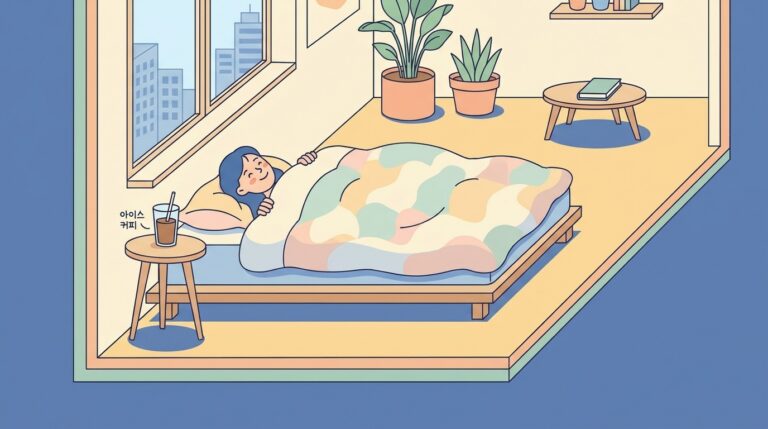
Horizontal Rest Days: The Korean Art of Guilt-Free Recharging
Phase 1: Empathy (Immersive Story Opening)
안녕하세요! 매일한글 에디터입니다. (Hello! It is your Daily Hangul editor.)
Picture this: It is 7:00 AM on a crisp Saturday morning in Seoul. For the past five days, your social feeds have been flooded with friends bragging about their God-saeng (갓생)—waking up at 5:00 AM for Miracle Mornings, hitting the gym before sunrise, polishing their Notion dashboards, and studying for foreign language certificates. You set your alarm intending to do the same. But when that alarm goes off, your body feels like lead. Your eyes refuse to open, and every muscle in your back begs for mercy.
Here is the secret nobody posts on LinkedIn: South Korea is exhausted. Alongside the hyper-driven hustle culture of God-saeng, an equally powerful cultural counterweight has exploded across Korea—the art of guilt-free, horizontal rest days (눕방 and 무계획 휴식). Many intermediate learners tell me: “Teacher, I know how to say I worked hard in Korean, but how do I tell my Korean coworkers that I spent my entire weekend glued to my bed without sounding irresponsible or lazy?”
This guide is crafted from real student dilemmas and authentic Seoul trend data. By the end of this lesson, you will master the modern B2-level slang and nuanced idioms that native Koreans use to celebrate doing absolutely nothing, turning passive rest into an art form.
Phase 2: Deep-Dive into 3 Essential Expressions
1. 침대와 한 몸이 되다 (Chimdaewa han mom-i doeda)
- Pronunciation: [chim-dae-wa han mom-i doe-da] (Think: chim as in chimney, dae as in day, and mom sounding like the English word “mom” with a crisp ‘m’)
- Meaning: Literal: “To become one body with the bed.” / Actual Nuance: To fuse with your mattress all day, completely surrendering any intention to stand up.
- K-Culture Moment: Frequently showcased on reality programs like I Live Alone (나 혼자 산다), when celebrities spend entire weekends under their duvets with remote controls and snacks within arm’s reach.
- Editor’s Insight: This is far more expressive than just saying “I slept a lot.” It frames staying in bed as a physical transformation of pure, unapologetic relaxation.
- Situation Spectrum: Casual: ✅ | Semi-formal: ✅ | Formal: 🚫
- 🤔 Think About It: In English, you might call yourself a “couch potato.” Why does the Korean phrase sound more like a poetic, peaceful symbiotic union with furniture?
2. 갓생 파업 (Gatsaeng paeop)
- Pronunciation: [gat-saeng pa-eop] (Sounds like got-sang followed by pah-up)
- Meaning: Literal: “God-life strike.” / Actual Nuance: Intentionally boycotting self-improvement routines to indulge in zero productivity.
- K-Culture Moment: A trending hashtag on Korean YouTube vlogs: “이번 주말은 갓생 파업합니다” (Going on a God-saeng strike this weekend).
- Editor’s Insight: God-saeng merges the English “God” with the Sino-Korean saeng (생, life). Declaring a paeop (파업, labor strike) shows that hustle culture has become so demanding that resting feels like taking collective industrial action!
- Situation Spectrum: Casual: ✅ | Semi-formal: ⚠️ | Formal: 🚫
- 🤔 Think About It: Why do young Koreans borrow industrial labor terminology to justify mental health days?
3. 방전되다 (Bangjeondoeda)
- Pronunciation: [bang-jeon-doe-da] (Pronounce bang like a door slam, jeon like John, and doe-da as dweh-dah)
- Meaning: Literal: “To be completely discharged / drained of battery.” / Actual Nuance: To experience total physical and cognitive burnout where your social battery hits 0%.
- K-Culture Moment: In the K-drama Summer Strike (아무것도 하고 싶지 않아), the protagonist lies flat on the floor after weeks of corporate pressure, whispering that she has completely run out of power.
- Editor’s Insight: Saying “피곤해요” (I’m tired) can sound like ordinary fatigue. 방전되다 communicates an objective mechanical shutdown—you are not lazy, your device simply needs a power outlet.
- Situation Spectrum: Casual: ✅ | Semi-formal: ✅ | Formal: ⚠️
- 🤔 Think About It: Do you view your human stamina like an electronic appliance? How does that change how you treat yourself when tired?
Phase 3: Textbook Korean vs. Real Korean
Situation 1: Explaining your weekend plan to stay home
- 📖 교과서 한국어: 저는 이번 주말에 집에서 편안하게 휴식을 취할 예정입니다. (Jeoneun ibeon jumare jibeseo pyeonanhage hyusigeul chwihal yejeong-imnida. / I plan to take a comfortable rest at home this weekend.)
- 🗣️ 진짜 한국어: 이번 주말엔 완전 방전이라 침대 밖으로 1밀리도 안 나갈 거예요. (Ibeon jumaren wanjeon bangjeon-ira chimdae bakkeuro il-milli-do an nagal geoyeyo. / I’m completely drained this weekend, so I won’t step even one millimeter out of bed.)
- 💡 왜 다를까?: “휴식을 취하다” sounds like an official HR memo. Native Koreans use visceral physical exaggerations (“not moving 1 millimeter”) to establish relatable emotional burnout with peers.
Situation 2: Describing how you spent your Sunday when asked on Monday
- 📖 교과서 한국어: 일요일에는 아무런 생산적인 활동을 하지 않았습니다. (Iryoil-eneun amureon saengsanjeogin hwaldong-eul haji anasseumnida. / On Sunday, I did not engage in any productive activities.)
- 🗣️ 진짜 한국어: 하루 종일 넷플릭스 보면서 뒹굴거렸어요. 완전 힐링 그 자체였어요! (Haru jong-il Netpeullikseu bomyeonseo dwinggulgoryeosseoyo. Wanjeon hilling geu jacheyeosseoyo! / I just rolled around watching Netflix all day. It was pure healing itself!)
- 💡 왜 다를까?: Admitting you did “no productive activities” in textbook phrasing can sound gloomy or apologetic. Framing it with the playful verb “뒹굴거리다” (rolling around) alongside “힐링” (healing) transforms laziness into a healthy, restorative indulgence.
Phase 4: K-Culture Deep Dive & Non-Verbal Manners
4-1. Nunchi & Body Language
When admitting in Korean society that you had a totally unproductive weekend, delivery is everything. If speaking to a senior manager (선배 or 부장님), maintain a humble, slightly sheepish posture—scratching the back of your neck (긁적긁적) with a polite grin when saying: “이번 주말엔 밀린 잠만 잤습니다” (I just caught up on sleep this weekend).
However, among peers and friends, own it! Slump your shoulders slightly, exhale a dramatic sigh of relief, and tap your chest to indicate your battery is recharging. Empathy in Korean corporate culture often blossoms over shared exhaustion.
4-2. Cultural Code: The ‘Nupbang’ Phenomenon & Delivery Culture
The concept of 눕방 (Nup-bang, lying-down broadcast) started with K-pop idols streaming late-night talks directly from their beds in pajamas to comfort overworked fans. This normalized lounging as a communal, therapeutic act.
Combined with Korea’s unmatched delivery apps (배달의민족) where you can order gourmet food, iced lattes, and convenience store snacks straight to your bedside table without uttering a single spoken word, the Korean home has become the ultimate temple for restorative hermit life (집콕).
Phase 5: Real-World Roleplay Scenario
Setting: Monday 9:00 AM at a design firm in Pangyo. Min-woo, an energetic coworker who routinely runs 10K marathons before work, approaches your desk holding a tumblr.
- 민우: 주말 잘 보냈어요? 날씨 진짜 좋던데 어디 야외로 다녀왔어요? (Jumal jal bonaesseoyo? Nalssi jinjja jotheonde eodi yawoero danyeowasseoyo?) [🎭 Leaning on the partition with a bright, curious smile] (Did you have a good weekend? The weather was great, did you go outdoors somewhere?)
- 학습자: 날씨는 좋았지만… 저는 이번 주말에 갓생 파업했어요. (Nalssineun joatjiman… jeoneun ibeon jumare gatsaeng paeop-haesseoyo.) [🎭 Chuckling softly, shaking head in mock surrender] (The weather was nice, but… I went on a God-saeng strike this weekend.)
- 민우: 갓생 파업이요? 설마 주말 내내 집에만 계셨던 거예요? (Gatsaeng paeop-iyo? Seolma jumal naene jibeman gyesyeotdeon geoyeyo?) [🎭 Widening his eyes with playful amusement] (A God-saeng strike? Don’t tell me you stayed home the entire weekend?)
- 학습자: 네, 주말 내내 침대와 한 몸이 되어서 넷플릭스만 정주행했어요. (Ne, jumal naene chimdaewa han mom-i doeeoseo Netpeullikseuman jeongjuhaenghaesseoyo.) [🎭 Leaning back in chair with a proud, content expression] (Yes, I became one body with my bed and binge-watched Netflix all weekend.)
- 민우: 와, 솔직히 너무 부러운데요? 저도 지난주 야근 때문에 완전 방전 상태였거든요. (Wa, soljiki neomu bureoundeyo? Jeodo jinanju yageun ttaemune wanjeon bangjeon sangtaeyeotgeodeunyo.) [🎭 Sighing deeply, shoulders dropping in solidarity] (Wow, to be honest I’m so jealous! I was completely out of battery too from last week’s overtime.)
- 학습자: 맞아요. 가끔은 아무 생각 없이 뒹굴거리는 시간이 보약이에요. (Majayo. Gakkeumeun amu saenggak eopsi dwinggulgorineun sigani boyagieyo.) [🎭 Handing Min-woo a vitamin pouch warmly] (Exactly. Sometimes rolling around without thinking about anything is the best medicine.)
- 민우: 진짜 공감해요. 저도 이번 주는 미라클 모닝이고 뭐고 눕방 예약해야겠어요. (Jinjja gonggamhaeyo. Jeodo ibeon juneun mirakeul moning-igo mwogo nupbang yeyakhaeyagess-eoyo.) [🎭 Laughing gratefully while accepting the vitamin] (I totally agree. Forget Miracle Morning this week, I need to book a horizontal rest day too.)
- 학습자: 꼭 그렇게 하세요! 민우 씨도 제대로 충전이 필요해 보여요. (Kkok geureoke haseyo! Min-woo ssido jedaero chungjeon-i piryohae boyeoyo.) [🎭 Giving an encouraging two-thumbs-up gesture] (Definitely do that! You look like you need a proper recharge as well, Min-woo.)
🔀 Interactive Decision Point
When Min-woo asks why you did not join the optional company weekend hiking club, what should you reply?
- Option A: “등산 갈 체력이 없어서 침대와 한 몸으로 방전 치료했어요.” (Deungsan gal cheryeog-i eopseoseo chimdaewa han momeuro bangjeon chiryohaesseoyo.)
- Option B: “등산은 너무 귀찮아서 그냥 잠만 잤어요.” (Deungsaneun neomu gwichanaseo geunyang jamman jasseoyo.)
- Option C: “주말에는 회사 사람들과 연락하고 싶지 않았어요.” (Jumareneun hoesa saramdeulgwa yeonrakhago sipji anasseoyo.)
Feedback:
* Option A (Best): Balances humor, honesty, and corporate etiquette by framing your absence as health recovery rather than disinterest.
* Option B (Risk): Using “귀찮아서” (too bothersome) sounds slightly uncaring or blunt in a Korean workplace context.
* Option C (Bad): While valid privately, expressing that you did not want contact with coworkers breaks standard Korean workplace social harmony (눈치).
Phase 6: 10-Second Emotion Shadowing Drill
Practice reading these sentences aloud, pausing precisely at the / marks and embracing the designated emotion markers:
[😩 Completely exhausted and drained voice]
“이번 주말엔 / 갓생 파업하고 / 침대와 한 몸이 될 거예요.” (Ibeon jumaren / gatsaeng paeop-hago / chimdaewa han mom-i doel geoyeyo.)-
[🛋️ Deeply relaxed, warm, and cozy tone]
“아무것도 안 하고 / 종일 뒹굴거리는 게 / 제일 행복해요.” (Amugeotdo an hago / jong-il dwinggulgorineun ge / jeil haengbokhaeyo.) -
[💪 Warmly consoling an overworked friend]
“너무 애쓰지 마요 / 가끔 푹 쉬는 게 / 진짜 갓생이에요!” (Neomu aesseuji mayo / gakkeum puk swineun ge / jinjja gatsaeng-ieyo!)
Phase 7: K-Culture Mini Dictionary
- 눕방 (Nup-bang) | Noun | Horizontal living / Bed-bound rest
- Usage: Combines 눕다 (to lie down) and 방송 (broadcast). Used casually to describe spending an entire day horizontal: “오늘 내 계획은 하루 종일 눕방이야.” (My plan today is an all-day horizontal rest.)
- 뒹굴거리다 (Dwing-gul-geo-ri-da) | Verb | To roll around idly
- Usage: Depicts lounging on the floor or under blankets with zero urgency. Great for describing relaxed Sundays without sounding defensive.
- 정주행 (Jeong-ju-haeng) | Noun / Verb | Binge-watching a series
- Usage: Originally referring to driving in the correct lane, it now means watching an entire drama season consecutively from episode 1 to the end.
- 충전 (Chung-jeon) | Noun | Recharging human energy
- Usage: Used identically to recharging a smartphone: “주말 동안 풀 충전하고 올게요!” (I will come back fully recharged over the weekend!)
Phase 8: Traveler’s Survival Kit
Top 3 Survival Phrases for Mindful Rest in Korea
- 조용히 쉴 만한 카페 있을까요? (Joyonghi swil manhan kape isseulkkayo?)
- Pro Tip: Use this when asking hotel concierges or locals for low-stimulation neighborhood spaces away from bustling tourist streets.
- 체크아웃 시간 연장 가능한가요? (Chekeu-aut sigan yeonjang ganeunghangayo?)
- Pro Tip: Perfect for boutique hotels when your body refuses to leave the bed on Sunday morning.
- 문 앞에 두고 벨 눌러주세요. (Mun ape dugo bel nulleojuseyo.)
- Pro Tip: Add this exact sentence in your hotel delivery instructions to receive room food drop-offs without awkward face-to-face small talk.
Editor’s Travel Note
When you are traveling through Korea and crave pure horizontal downtime, look for a local “Manhwa Cafe” (만화카페, comic book cafe) such as Nolsoop. You can locate nearby spots instantly by using the Naver Map navigation app download. These cafes offer private curtained cubicles with heated floor mats, pillows, charging ports, and snack service for less than 5,000 KRW an hour!
Phase 9: Going Deeper (Cultural Reflection)
South Korea’s socio-economic rise is famously powered by Ppalli-Ppalli (빨리빨리, hurry-hurry) culture and an intense drive for self-betterment. In recent years, young Koreans turned this discipline inward through the God-saeng lifestyle. Yet, the viral emergence of horizontal rest days and public “Space-Out Competitions” (멍때리기 대회) reveals a profound realization: continuous hyper-optimization without pause is unsustainable. Taking a horizontal day is no longer viewed as personal failure; it is an active survival mechanism. In Korean society today, learning how to stop has become the ultimate discipline.
💬 Your Turn: Have you ever felt guilty for having an “unproductive” weekend? What is your favorite way to spend a horizontal rest day? Let us know in the comments below!
Phase 10: FAQ & Common Mistakes
Q: Can I use “침대와 한 몸이 되다” during a job interview or formal meeting?
A: No. While it is acceptable with close colleagues over coffee, in formal interviews you should say: “주말에는 충분한 휴식을 취하며 재충전의 시간을 가졌습니다” (Over the weekend, I took sufficient rest to recharge myself).
Q: Is “갓생” (God-saeng) only about studying or making money?
A: Not at all! In modern Korean usage, God-saeng can simply mean tiny wholesome habits, such as drinking 2 liters of water, making your bed, or taking daily vitamins.
Q: Does telling my Korean friends “아무것도 안 했어요” (I did nothing) make me look bad?
A: It depends on your tone! If said gloomily, they might worry about you. But if you smile brightly and add “완전 힐링했어요!” (It was total healing!), they will applaud your restful weekend.
🚨 Common Mistakes Alert
- Confusing ‘방전’ (Discharge) with ‘충전’ (Charge): Saying “주말에 방전했어요” means you drained yourself over the weekend! Make sure to say “주말에 충전했어요” (I recharged) or “주말에 방전 상태였어요” (I was in a discharged state).
- Translating “Couch Potato” Literally: Saying “소파 감자예요” will only confuse Koreans. Use “집돌이” (homebody guy), “집순이” (homebody girl), or “침대와 한 몸이었어요.”
- Abruptly Saying “일하기 싫어요” (I hate working) on Monday: Replace this complaint with the much softer, socially savvy expression: “주말이 너무 순삭이었어요!” (The weekend passed by in the blink of an eye!).
Phase 11: Action Missions
- Bronze Mission (Solo Practice): Record a 10-second voice memo on your phone saying: “이번 주말은 갓생 파업하고 푹 쉴 거예요!”
- Silver Mission (Social Connection): Snap a cozy picture of your blankets, tea, or book, and post it with the Korean caption: “주말엔 침대와 한 몸 🛋️”
- Gold Mission (Real Interaction): When a Korean speaker asks you about your weekend plans this week, use the phrase “방전 치료” (burnout treatment) or “뒹굴거리다” naturally in conversation!
- 🎮 K-Culture Mission: Watch any weekend episode of the variety show Hangout with Yoo (놀면 뭐하니?) or I Live Alone and listen for cast members whining about their drained stamina.
Phase 12: Interactive Quiz Challenge
1. Situational Judgment:
Your Korean teammate looks pale and exhausted on Friday at 6:00 PM. Which encouragement sounds most natural and empathetic?
* A) 주말에 열심히 미라클 모닝 하세요!
* B) 주말 동안 갓생 파업하고 푹 충전하세요!
* C) 주말에도 생산적인 일을 해야 갓생이에요.
Click here for Answer & Explanation
Correct Answer: B
Explanation: Telling an already exhausted colleague to wake up at 5:00 AM (A) or be productive (C) induces unnecessary stress. Suggesting a “God-saeng strike” to recharge (B) shows genuine empathy and modern cultural awareness!
2. Fill in the Blank:
“일요일 내내 침대 밖으로 안 나가고 넷플릭스 보면서 완전 ( ____ )와 한 몸이 되었어요.”
Click here for Answer & Explanation
Correct Answer: 침대 (Chimdae)
Explanation: The full set idiom is “침대와 한 몸이 되다” (to become one body with the bed).
3. True or False Culture Check:
In modern Korea, the term “눕방” can only be used by professional K-pop idols while broadcasting live on camera. (True / False)
Click here for Answer & Explanation
Correct Answer: False
Explanation: While it originated as broadcast slang, ordinary Koreans routinely use “눕방” in casual everyday speech to describe their own guilt-free horizontal rest days at home!







