

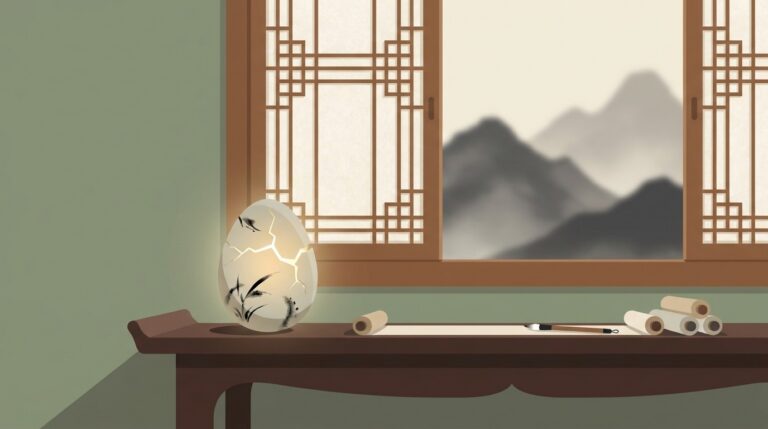
Phase 1: 공감 (Immersive Storytelling Opening)
안녕하세요! 매일한글 에디터입니다. (Hello! I’m your Daily Hangul editor.)
Have you ever hit that invisible glass ceiling in your Korean studies where textbooks simply stop helping? You know the exact grammar rules for every TOPIK level, you understand formal honorifics backwards and forwards, yet when you watch an intellectual period drama like Sungkyunkwan Scandal or listen to a veteran artisan in an Insadong atelier talking to their protégé, you feel completely locked out. You sit there wondering: Why does their conversation feel less like an exchange of data and more like a high-stakes, breathless spiritual dance?
One of our C2 learners, Elena, recently confessed her profound frustration to me. She was collaborating with a renowned master of traditional Korean mother-of-pearl lacquerware (najeonchilgi). She had spent six exhausting months practicing carving techniques in complete silence. Every time she asked for explicit technical guidance, the master merely looked at her work and offered an enigmatic smile. Elena felt abandoned—until one rainy afternoon, right when Elena’s chisel naturally found the precise grain of the wood without hesitation, the master stepped forward without a single word, placed his thumb exactly behind her blade, and gave it one firm, definitive tap. The shell snapped into pristine place. The master murmured, “이제 때가 되었구나.” (Ije ttaega doe-eotguna. / The time has finally arrived.)
That electrifying moment wasn’t passive teaching; it was a cosmic alignment. In classical Korean thought, this rare synchronicity is immortalized in the idiom 줄탁동시 (啐啄同時, Jultakdongsi)—the miraculous instant when a chick pecks from inside the shell (jul) and the mother hen taps from the outside (tak) at the exact same fraction of a second. This guide isn’t just about parsing archaic Hanja; it is your backstage pass to understanding the zenith of Korean pedagogical and artistic philosophy. Master this idiom and its siblings, and you will transform how you interpret Korean mentorship, scholarly grit, and creative breakthroughs.
Phase 2: 핵심 표현 3선 심층 분석 (Deep Dive: Top 3 Classical Idioms)
1. 줄탁동시 (啐啄同時)
- Pronunciation: [Jul-tak-dong-si] (jool-tahk-dong-shee — think of a rhythmic double click: jool, then a crisp snap tahk!)
- Meaning:
- Literal: Pecking from inside (jul) and tapping from outside (tak) simultaneously (dongsi).
- Nuanced: The ultimate pedagogical harmony; a breakthrough achieved only when a learner’s internal yearning meets a mentor’s impeccably timed intervention.
- K-Culture Moment: Picture the iconic relationship between Master Kim and his young surgeons in the acclaimed medical drama Dr. Romantic. Master Kim never spoon-feeds answers; he waits silently until the resident surgeon reaches the absolute limit of their own intellect and technique. The moment they make their breakthrough deduction, he steps in with the life-saving scalpel. That is pure 줄탁동시 (Jultakdongsi).
- Editor’s Insight: You cannot use this phrase when someone is simply “helping” someone else. If the student hasn’t pecked furiously from within first, the teacher’s external tap will only crush the embryo. Use this exclusively when both parties have exerted their utmost energy to trigger an epiphany.
- Situation Spectrum: Casual ⚠️ | Semi-formal ✅ | Formal ✅
- 🤔 Think About It: In Western paradigms, mentorship often celebrates the autonomous hero conquering obstacles via self-reliance. Why does Korean culture revere simultaneous mutual resonance over solitary triumph?
2. 청출어람 (靑出於藍)
- Pronunciation: [Cheong-chul-eo-ram] (chawng-chool-uh-rahm — sounds smooth and cascading, like dye washing through fresh water)
- Meaning:
- Literal: Blue dye comes from the indigo plant, yet it is bluer than the plant itself.
- Nuanced: The student surpasses the master in virtuosity, depth, or renown.
- K-Culture Moment: Think of legendary K-pop entertainment mogul Park Jin-young (JYP) reflecting on global megastar Rain, or iconic producer Bang Si-hyuk watching BTS conquer stadiums worldwide. When seasoned industry titans openly bow their heads to their former protégés on prime-time variety shows, critics universally declare: “완전 청출어람이네요! (Wanjeon cheongchuleoramineyo! / It is a complete case of the disciple outshining the master!)”
- Editor’s Insight: This phrase carries zero bitterness or generational jealousy in Korean cultural context. It represents the supreme glory of the teacher. If a Korean mentor says this to you, it is the ultimate, tear-inducing badge of honor.
- Situation Spectrum: Casual ⚠️ | Semi-formal ✅ | Formal ✅
- 🤔 Think About It: Does your native culture frame a student surpassing their mentor as a generational threat or as the highest fulfillment of pedagogical duty?
3. 교학상장 (敎學相長)
- Pronunciation: [Gyo-hak-sang-jang] (gyoh-hahk-sahng-jahng — strong, balanced syllables echoing reciprocal growth)
- Meaning:
- Literal: Teaching and learning nurture each other.
- Nuanced: Pedagogy is not a top-down monologue; the master grows in wisdom precisely by guiding the disciple.
- K-Culture Moment: Seen frequently in university laboratories in Pangyo’s tech corridors or graduate colloquiums in Sinchon. When a world-renowned senior professor publishes a landmark paper alongside a rookie graduate researcher and toasts at the hoesik (company dinner): “이번 프로젝트는 진정한 교학상장의 시간이었습니다.” (Ibeon peurojekteuneun jinjeonghan gyohaksangjang-ui sigan-ieosseumnida. / This project was truly a time of mutual elevation through teaching and learning.)
- Editor’s Insight: Use this expression when you want to express immense humility to a subordinate or student whose fresh, uninhibited perspective taught you something profound about your own craft.
- Situation Spectrum: Casual 🚫 | Semi-formal ✅ | Formal ✅
- 🤔 Think About It: How does viewing education as bilateral rather than hierarchical fundamentally alter the workplace dynamic between seniors (seonbae) and juniors (hubae)?
Phase 3: 교과서 한국어 vs 진짜 한국어 (Textbook vs. Real-World C2 Fluency)
Situation 1: Describing an intense intellectual breakthrough
- 📖 교과서 한국어 (Textbook Korean):
“드디어 제 힘으로 모든 이치를 깨달았습니다.”
(Deudieo je himeuro modeun ichireul kkaedarasseumnida. / I finally understood all principles through my own power.) - 🗣️ 진짜 한국어 (Authentic C2 Korean):
“스승님의 가르침과 제 고민이 맞아떨어져, 드디어 머릿속이 활연관통하는 기분이었어요.”
(Seoseungnim-ui gareuchimgwa je gomini mayateoreojyeo, deudieo meorissogi hwallyeongwantonghaneun gibunieosseoyo. / My mentor’s cue and my agonizing questions aligned, and it felt as though my entire mind experienced a sudden, lucid dawn.) - 💡 왜 다를까? (Why the difference?): Saying you solved everything entirely on your own sounds tone-deaf and arrogant in refined Korean intellectual circles. Natural C2 Korean acknowledges the catalyst and adopts vivid, sensory imagery of holistic enlightenment (hwallyeongwantong).
Situation 2: Praising an incredible mentor-mentee collaboration
- 📖 교과서 한국어 (Textbook Korean):
“교수님과 학생의 호흡이 매우 훌륭합니다.”
(Gyosunimgwa haksaeng-ui hoheubi maeu hullyunghamnida. / The breathing between the professor and student is very good.) - 🗣️ 진짜 한국어 (Authentic C2 Korean):
“이건 완벽한 줄탁동시예요. 한쪽의 일방적인 지도가 아니라 서로의 치열한 합이 빚어낸 성과죠.”
(Igeon wanbyeokhan jultakdongsieyo. Hanjjogui ilbangjeogin jidoga anira seoroui chiyeolhan habi bijeonaen seonggwajyo. / This is absolute jultakdongsi. It wasn’t one-sided instruction, but a milestone born of their fierce synchronization.) - 💡 왜 다를까? (Why the difference?): At an advanced level, moving beyond mundane words like “good breathing” (hoheup) to evocative conceptual idioms like “합이 빚어낸 성과” (a triumph sculpted by synchronicity) showcases genuine cultural sophistication.
Phase 4: K-Culture 딥다이브 & 비언어적 매너 (Deep Dive & Non-Verbal Nuance)
4-1. 눈치 (Nunchi) & Intellectual Posture
When engaging with Korean mentors, academic advisors, or traditional artisans, your non-verbal cues carry as much weight as your spoken words:
* The Anticipatory Silence (Yeobaek): Never interrupt a mentor’s pause with nervous chatter. In Western discourse, silence can feel like dead air; in Korean scholarly traditions, silence is the chamber where the jul (internal pecking) ripens. Nod gently with your shoulders slightly lowered, maintaining soft eye contact.
* Two-Handed Respect (Yangson Maneo): When presenting drafts, artwork, or even handing over a fountain pen for a signature, keep both elbows tucked near your ribs, left hand supporting your right wrist. This signals: My hands are physically restrained from ego; I receive your critique completely.
4-2. Cultural Code: The Joseon Scholar’s Ideal (Seonbi Jeongsin)
To understand why idioms like 줄탁동시 (Jultakdongsi) carry such immense cultural gravity, one must look at Joseon’s Seodang (village academies). Classical Confucian education rejected mechanical rote memorization. The teacher (Hunjangnim) was not an information dispenser; he was an existential tuning fork. A student would recite a single verse hundreds of times until their throat bled and their comprehension began to crack open internally. Only when the student asked a question born of pure cognitive desperation would the master utter a single sentence that triggered enlightenment. This reverence for exquisitely timed guidance remains woven into contemporary Korean graduate labs, culinary kitchens, and masterclasses.
Phase 5: 실전 롤플레이 시나리오 (Real-World Roleplay Scenario)
Setting: A serene, cedar-scented private research atelier in Bukchon. Late evening. Rain taps against traditional sliding paper doors (hanji). Professor Min, an exacting aesthetician and calligrapher, sits opposite you over steamy wild green tea.
- Professor Min: 찻잔을 내려놓으며 엄격한 눈빛으로 (Chasjaneul naeryeonoh-eumyeo eomgyeokhan nunbicheuro / Setting down his teacup, looking at you with rigorous intensity)
“자네가 제출한 이번 비평문 말일세. 문장은 유려하나, 정작 본인의 치열한 고뇌가 느껴지지 않더군.”
(Janega jechulhan ibeon bipyeongmun marilse. Munjangeun yuryeohana, jeongjak bonin-ui chiyeolhan gonaega neukkyeojiji anteogun. / “Regarding the critical treatise you submitted. The syntax is elegant, but I sense no fierce personal agony within it.”) -
You: 두 손을 무릎에 정갈하게 모으고 고개를 숙이며 (Du soneul mureupe jeonggalhage moeugo gogaereul sugimyeo / Placing both hands neatly on your lap, lowering your head respectfully)
“교수님, 제 학문적 깊이가 얕아 본질의 껍질을 깨지 못하고 있습니다.”
(Gyosunim, je hangmunjeok gipiga yata bonjil-ui kkeopjireul kkaeji mothago isseumnida. / “Professor, my scholarly depth is still shallow; I have been unable to crack the shell of its true essence.”) -
Professor Min: 미소를 살짝 머금고 차를 한 모금 마시며 (Misoreul saljjak meogeumgo chareul han mogeum masimyeo / Concealing a subtle smile, taking a sip of tea)
“스스로 껍질 안에 갇혀 있다는 것을 자각했으니, 절반은 온 셈이네.”
(Seuseuro kkeopjil ane gachyeo itdaneun geoseul jagakhaesseuni, jeolbaneun on semine. / “Since you have become conscious of your own entrapment inside the shell, you are already halfway there.”) -
You: 눈빛을 빛내며 질문을 던진다 (Nunbicheul binnaemyeo jilmuneul deonjinda / Eyes gleaming, leaning forward with measured focus)
“내부에서 치열하게 부딪쳐 왔습니다만, 마지막 한 획의 방향을 잡지 못하겠습니다.”
(Naebueseo chiyeolhage buditchyeo watseumnida-man, majimak han hoegui banghyangeul japji mothagesseumnida. / “I have been throwing myself against the inner walls fiercely, yet I cannot grasp the orientation of that final stroke.”) -
Professor Min: 붓을 집어 종이 위에 먹을 한 점 찍으며 (Buseul jibeo jongi wie meogeul han jeom jjigeumyeo / Picking up a brush, pressing a single dot of ink onto rice paper)
“완벽한 글씨는 힘을 주는 것이 아니라, 뺄 때 완성되는 법이지.”
(Wanbyeokhan geulssineun himeul juneun geosi anira, ppael ttae wanseongdoeneun beobiji. / “Flawless calligraphy is accomplished not by exerting force, but by knowing when to withdraw it.”) -
You: 가슴이 쿵 내려앉는 듯한 충격을 받은 표정으로 (Gaseumi kung naeryeoanjeun deuthan chunggyeogeul badeun pyojeong-euro / Looking completely thunderstruck with sudden realization)
“아… 제가 형태를 억지로 붙잡으려 했군요. 이제야 눈이 뜨입니다.”
(Ah… jega hyeongtaereul eokjiro butjabeuryeo haetgunyo. Ijeya nuni tteuimnida. / “Ah… I was desperately forcing the form to conform. My eyes are only now opening.”) -
Professor Min: 만족스럽게 고개를 끄덕이며 (Manjokseureopge gogaereul kkeodeogimyeo / Nodding with profound satisfaction)
“안에서 쪼는 소리가 명확했기에, 내 밖에서 가볍게 짚어줄 수 있었던 게야.”
(Aneseo jjoneun soriga myeonghwakhaetgie, nae bakkeseo gabyeopge jipeojul su isseotdeon geya. / “Because the sound of your inner pecking was unmistakable, I could lightly point the way from the outside.”) -
You: 깊이 허리를 숙여 절하며 (Gipi heorireul sugyeo jeolhamyeo / Bowing deeply from the waist)
“이것이 바로 줄탁동시의 가르침임을 잊지 않겠습니다, 교수님.”
(Igeosi baro jultakdongsi-ui gareuchim-imeul itji anketseumnida, gyosunim. / “I shall never forget that this is the true realization of jultakdongsi, Professor.”)
🔀 인터랙티브 분기점 (Interactive Choice)
How would you conclude this meeting to prove your C2 social and cultural competence?
- Choice A: “교수님, 제 논문 점수 좀 후하게 주시면 감사하겠습니다.”
(Professor, I would appreciate it if you could give my paper a generous grade.) - Choice B: “스승님께서 밖에서 두드려 주셨으니, 이제 제가 홀로 껍질을 완전히 부수고 나가겠습니다.”
(Master, since you tapped from the outside, I will now shatter the remaining shell entirely on my own and step out.) - Choice C: “다음에도 제가 막힐 때마다 이렇게 정답을 짚어주십시오.”
(Please point out the correct answers for me like this every time I get stuck in the future.)
Feedback:
* Choice A (Bad ❌): Destroys the sacred aesthetic atmosphere instantly with transactional greed. Prof. Min will likely revoke your atelier access.
* Choice B (Best ✅): Poetic, demonstrates true humility while asserting self-driven responsibility. It perfectly completes the classical jultakdongsi metaphor.
* Choice C (Risk ⚠️): Violates the fundamental spirit of Confucian self-cultivation. Suggests chronic intellectual dependency, signaling you never truly grasped the lesson.
Phase 6: 10초 감정 섀도잉 드릴 (10-Second Emotion Shadowing Drill)
Read aloud with exaggerated emotional immersion, paying heed to the caesura markings (/):
[😌 경건하고 깊은 깨달음으로 / With reverent, profound realization]
“스승님의 한마디에 / 막혔던 맥이 / 비로소 시원하게 뚫렸습니다.”
(Seuseungnim-ui hanmadie / makhyeotdeon maegi / biroso siwonhage ttullyeotseumnida. / At my master’s single utterance, my blocked channels finally opened with sheer clarity.)-
[🔥 벅차오르는 학구적 열정으로 / With surging scholarly passion]
“진정한 줄탁동시는 / 요행을 바라는 것이 아니라 / 안에서 피를 흘리며 껍질을 쪼아온 자만이 누리는 기적입니다!”
(Jinjeonghan jultakdongsineun / yohaengeul baraneun geosi anira / aneseo pireul heullimyeo kkeopjireul jjo-a-on jamani nurineun gijeogimnida! / True jultakdongsi is not born of wishful thinking; it is a miracle reserved exclusively for those who have pecked at the shell until they bled from within!) -
[🤝 겸허하고 감사에 찬 목소리로 / With humble, heartfelt gratitude]
“청출어람이라는 과찬에 부끄럽사오나, / 스승님의 교학상장 정신을 본받아 / 정진하겠습니다.”
(Cheongchuleoram-iraneun gwachane bukkeureopsaona, / seuseungnim-ui gyohaksangjang jeongsineul bonbada / jeongjinhagesseumnida. / Though I am humbled by your generous praise of surpassing the master, I will follow your spirit of mutual growth and dedicate myself further.)
Phase 7: K-Culture 미니 사전 (Mini Dictionary: 4 Essential Terms)
- 줄탁동시 (啐啄同時, Jultakdongsi) | Simultaneous Inner and Outer Resonance
Used in high-level business partnerships, academic breakthroughs, or theater rehearsals to describe the moment two synchronized forces achieve a historic leap. - 청출어람 (靑出於藍, Cheongchuleoram) | The Pupil Outshining the Mentor
Applied universally across arts, sports, and academia as the supreme compliment to a former protégé’s towering accomplishments. - 교학상장 (敎學相長, Gyohaksangjang) | Mutual Elevation Through Teaching
Commonly invoked in speeches by senior executives, master teachers, and professors when praising the innovative ideas brought forward by younger team members. - 활연관통 (豁然貫通, Hwallyeongwantong) | Sudden, Limitless Enlightenment
Describes that intoxicating “Eureka!” state where months of disjointed concepts suddenly snap together into a crystal-clear, unified vision.
Phase 8: 여행자를 위한 생존 키트 (Scholar & Explorer Survival Kit)
Cultural Explorer TOP 3 Expressions:
- “선생님의 작업 철학에서 깊은 울림을 받았습니다.”
(Seonsaengnim-ui jagyeop cheolhageseo gipeun ullimeul badatseumnida.)
Pro Tip: Use this when visiting traditional ceramic kilns in Icheon or paper-making workshops in Jeonju. It instantly marks you as a connoisseur rather than a superficial tourist. - “가르침을 받들어 더 정진하겠습니다.”
(Gareuchimeul batdeureo deo jeongjinhagesseumnida.)
Pro Tip: The ultimate closing remark when receiving constructive criticism or advice from a respected elder or artist. - “이 전시에서 두 거장의 줄탁동시를 목격한 기분입니다.”
(I jeonsieseo du geojang-ui jultakdongsireul mokgyeokhan gibunimnida.)
Pro Tip: Drop this line in the guestbook of a major dual-artist exhibition in Seoul Museum of Craft Art (SeMoCA).
Editor’s Cultural Travel Note:
If you want to experience the living atmosphere of traditional Korean scholarship, take the subway to Hyehwa Station and walk into the serene courtyards of 성균관 문묘 (Sungkyunkwan Munmyo). Sitting beneath its 500-year-old ginkgo trees will help you grasp why Joseon scholars spent decades pursuing mutual intellectual resonance. To map out nearby traditional craft workshops and quiet scholars’ tea houses across Jongno, make sure to utilize the 네이버 지도 앱 다운로드 rather than foreign navigation tools, which frequently mislabel historical pathways.
Phase 9: “한 발 더 깊이” (Reflective Humanities Essay)
In contemporary Western education, progress is frequently commodified: you pay tuition, you download data, you achieve certification. It is an algorithmic, individual transaction. But classical Korean pedagogy treats intellectual enlightenment as an ecological, near-spiritual communion. You cannot purchase 줄탁동시 (Jultakdongsi); you must suffer through the claustrophobia of your own ignorance until your beak aches against the interior shell. Only then does the mentor’s external tap transform from an unwelcome intrusion into a spark of life. This philosophy reminds us that mastery is not a solo sprint—it is a sacred dialogue across generations.
💬 Your Turn: Have you ever experienced a mentor whose timing was so uncanny it felt like jultakdongsi? Share your breakthrough stories in the comments below!
Phase 10: FAQ & 흔한 실수 (FAQ & Common Mistakes)
Q: Can I use 줄탁동시 (Jultakdongsi) to describe two friends collaborating on an ordinary task, like cooking dinner?
A: No. That would feel overly grandiose, like using a ceremonial samurai sword to peel a grape. For casual cooperative harmony, use natural phrasing like “합이 잘 맞다” (habi jal matda / our chemistry/timing is great) or “손발이 척척 맞다” (sonbari cheokcheok matda / our hands and feet work like clockwork). Save 줄탁동시 for pivotal, transformative milestones.
Q: Does 청출어람 (Cheongchuleoram) sound rude to the teacher if said by the student?
A: Absolute warning: Never apply 청출어람 to yourself! Saying “제가 우리 교수님보다 청출어람 했어요” (I surpassed my professor) sounds outrageously self-absorbed and offensive. It should only be uttered by the teacher about the student, or by an objective third party praising the lineage.
Q: What is the linguistic difference between 깨달음 (Kkaedareum) and 활연관통 (Hwallyeongwantong)?
A: Kkaedareum is pure Korean (sun-urimal) denoting any realization, large or small (e.g., realizing you left your stove on, or understanding an ethical lesson). Hwallyeongwantong is high-register Hanja literature, reserved for holistic macro-breakthroughs where diverse disparate fields or philosophical knots dissolve into utter clarity.
🚨 외국인 학습자의 흔한 실수 TOP 3 (Common Mistakes Board)
- The Premature External Tap: Touting jultakdongsi when the learner put in zero preliminary effort.
Correction: Acknowledge internal struggle (jul) first before crediting the mentor’s tap (tak). - Self-Proclaimed 청출어람: Bragging about exceeding a superior using this idiom.
Correction: Always praise the mentor’s generous groundwork: “스승님께서 길을 닦아주신 덕분입니다.” (It is thanks to my teacher paving the road.) - Using Classical Four-Character Idioms (Sajaseong-eo) in Everyday Texting: Dropping jultakdongsi in KakaoTalk group chats about casual weekend plans.
Correction: Keep sajaseong-eo for formal speeches, heartfelt thank-you letters, artistic critiques, or serious academic milestones.
Phase 11: 액션 미션 & 참여 유도 (Action Missions)
- 🥉 Bronze Mission (Solo Mastery): Recite the Phase 6 shadowing drill three times, focusing on capturing the profound pause between jul and tak.
- 🥈 Silver Mission (Community Engagement): Share a social media post highlighting your favorite Korean actor, artist, or teacher, captioning it with a formal sentence using 교학상장 or 청출어람.
- 🥇 Gold Mission (Real-World Application): Write a brief, formal note of gratitude to a mentor or advanced language partner utilizing the idiom 줄탁동시 (Jultakdongsi) to describe a specific breakthrough you shared.
- 🎮 K-Culture Mission: Watch an episode of a high-tension mentorship K-Drama (such as Dr. Romantic or Navillera). Identify the exact scene where the mentor refrains from assisting until the mentee initiates the breakthrough!
Phase 12: 인터랙티브 퀴즈 챌린지 (Interactive Quiz Challenge)
Q1. Situational Judgment: An apprentice potter has spent three sleepless nights attempting to throw a flawless porcelain moon jar. On the fourth dawn, just as the apprentice’s hands begin to shake at the final curve, the master artisan reaches out, steadies the clay with one finger, and lets the rim breathe into perfect proportion. Which idiom captures this moment?
* A) 일취월장 (Ilchwiwoljang)
* B) 줄탁동시 (Jultakdongsi)
* C) 동상이몽 (Dongsang-imong)
Q2. Fill-in-the-Blank: Complete the following formal dedication to a former teacher:
* “스승님의 깊은 헌신 덕분에 푸른 물이 쪽풀보다 더 짙어지는 (_______)의 은혜를 입었습니다.”
Q3. True or False: A student who wins first place at a national debate tournament can appropriately tell their debate coach: “선생님, 제가 오늘 청출어람 했습니다!”
👉 Click to view answers and detailed explanations
- A1: B) 줄탁동시 (Jultakdongsi) — The master’s intervention was exquisitely synchronized with the apprentice’s exhaustive, self-directed struggle.
- A2: 청출어람 (Cheongchuleoram) — The metaphor explicitly cites blue dye growing deeper than the indigo plant from which it emerged.
- A3: False (X) — While the coach could say this about the student, it is considered exceptionally impolite and narcissistic for the student to declare cheongchuleoram regarding their own triumph over their mentor.






