

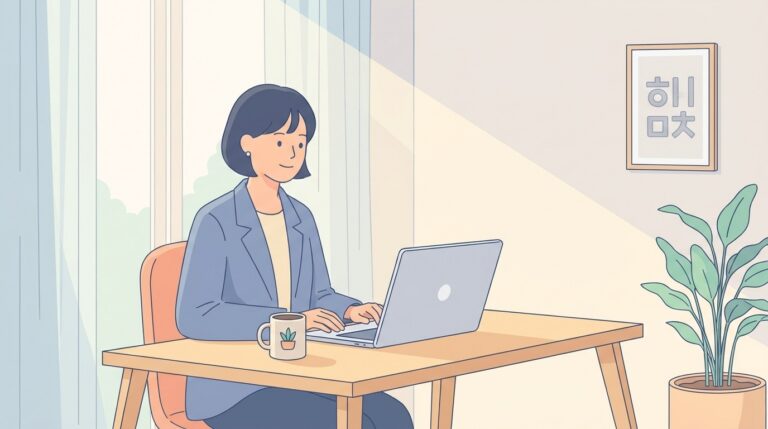
Master Korean Remote Work: Why Pajamas Ruin Your Productivity
Phase 1: Empathy (Story-Driven Opening)
안녕하세요! 매일한글 에디터입니다. (Hello! It is your Daily Hangul editor.)
Picture this: your alarm rings at 8:55 AM. You roll out of bed, grab your laptop with your eyes half-open, and join your morning Korean team check-in while still wrapped in fuzzy fleece pajamas. Your camera is conveniently turned off, your mic is muted, and your bed is serving as both your office chair and mattress. Sounds cozy, right? But by 2:00 PM, you realize you have checked Instagram twelve times, written half an email, and feel strangely drained.
If you have watched K-dramas like Misaeng or Start-Up, you know how much Korean professionals value sharp focus and clear boundaries between rest and duty. When our foreign students at Daily Hangul start working for Korean remote teams, their biggest struggle is rarely grammar—it is navigating the psychological transition between home and work life without sounding overly stiff or accidentally unprofessional in team chats. Today, we will explore the golden rule of remote work in Korea: dressing up, claiming your desk space, and boosting your productivity using authentic intermediate (B1) Korean expressions that will make your Korean colleagues nod in instant agreement.
Phase 2: Top 3 Core Expressions In-Depth
1. 옷을 갈아입다 (Oseul gara-ipda)
- Pronunciation: [O-seul ga-ra-ip-da] (Think of ‘gara’ like ‘garage’ without the -ge, smoothly gliding into ‘ip-da’ like taking a quick dip)
- Meaning: Literal: To change clothes | Real Nuance: To mentally switch gears from leisure mode to work mode by swapping outfits.
- K-Culture Moment: You will often hear Korean productivity YouTubers (Vloggers filming their ‘God-saeng’ daily routines) sigh as they discard sleepwear: “집에 있어도 옷을 갈아입어야 하루가 시작돼요” (Even at home, you have to change your clothes for the day to truly begin).
- Editor’s Insight: In Korean, the verb “갈아-” (gara-) implies replacing one thing with another of the same category (e.g., 갈아타다 for transferring subways). Saying “옷을 갈아입다” carries the subconscious weight of shedding your lazy self and stepping into your professional self.
- Situation Spectrum: Casual: ✅ | Semi-formal: ✅ | Formal: ✅
- 🤔 Think About It: Does changing physical clothes change your mental state in your culture, or do you view clothes purely as functional items?
2. 업무 효율이 올라가다 (Eommu hyoyuri ollagada)
- Pronunciation: [Eom-mu hyo-yu-ri ol-la-ga-da] (Pronounce ‘eom-mu’ like ‘umbrella’ cut short, and ‘hyoyur’ rhymes with pure)
- Meaning: Literal: Work efficiency goes up | Real Nuance: To get into the flow state where tasks get finished faster and better.
- K-Culture Moment: A project manager in a Pangyo IT startup approving flexible hybrid work says: “각자 업무 효율이 올라가는 환경에서 일합시다” (Let’s work in the environment where each person’s work efficiency peaks).
- Editor’s Insight: While textbook Korean teaches “일을 잘하다” (to do work well), intermediate professionals prefer “업무 효율” (work efficiency). Pairing it with “올라가다” (to rise) signals that you think strategically about team output.
- Situation Spectrum: Casual: ⚠️ | Semi-formal: ✅ | Formal: ✅
- 🤔 Think About It: In Korean workplace culture, efficiency is closely tied to showing consideration for team deadlines. How does your culture view productivity?
3. 정해진 자리에 앉다 (Jeonghaejin jarie anta)
- Pronunciation: [Jeong-hae-jin ja-ri-e an-ta] (Soft ‘j’ like ‘jump’, ‘anta’ sounds like ‘aunt’ followed by a crisp ‘ta’)
- Meaning: Literal: To sit in a designated/set seat | Real Nuance: Setting firm physical boundaries for focused work rather than drifting around the living room.
- K-Culture Moment: In Korean lifestyle programs showing interior design, creators emphasize setting up a “데스크테리어” (Deskterior) saying: “침대 말고 꼭 정해진 자리에 앉으세요” (Please sit at a designated spot instead of your bed).
- Editor’s Insight: “정해지다” comes from “정하다” (to decide) in passive form, meaning an established rule or routine. It highlights discipline and self-regulation without needing an external boss watching over you.
- Situation Spectrum: Casual: ✅ | Semi-formal: ✅ | Formal: ✅
- 🤔 Think About It: Why does designating a physical space hold so much psychological power in compact Korean urban living spaces?
Phase 3: Textbook Korean vs. Real Korean
Situation 1: Explaining your morning routine before logging on
- 📖 Textbook Korean: 저는 재택근무를 하기 전에 항상 옷을 갈아입습니다. (Jeoneun jaetaekgeunmureul hagi jeone hangsang oseul gara-ipseumnida.) – “I always change my clothes before doing telecommuting work.”
- 🗣️ Real Korean: 잠옷 벗고 외출복으로 갈아입어야 뇌가 깨요. (Jam-ot beotgo oechulbogeuro gara-ibeoya noega kkaeyo.) – “You’ve got to take off your pajamas and change into day clothes so your brain wakes up.”
- 💡 Why is it different? Real speakers rarely use heavy grammatical constructions like “-기 전에 항상” in casual watercooler talk. Instead, they use vivid physical metaphors like “뇌가 깨다” (the brain wakes up) and contrast “잠옷” (pajamas) with “외출복” (outdoor/street clothes).
Situation 2: Warning someone about working from bed or the couch
- 📖 Textbook Korean: 침대에서 근무하면 집중력이 저하될 수 있습니다. (Chimdae-eseo geunmuhamyeon jipjungnyeogi jeohadoel su itseumnida.) – “If you work on the bed, concentration power may deteriorate.”
- 🗣️ Real Korean: 침대에서 일하면 무조건 딴짓하다가 졸아요. (Chimdae-eseo ilhamyeon mujogeon ttanjithadaga jorayo.) – “If you work from bed, you will definitely mess around and end up dozing off.”
- 💡 Why is it different? Koreans frequently use colloquial terms like “딴짓하다” (to slack off / do unrelated tasks) and “무조건” (unconditionally / guaranteed) to share relatable human struggles rather than clinical corporate warnings.
Phase 4: K-Culture Deep Dive & Non-Verbal Manners
4-1. Nunchi & Remote Video Etiquette
Even in casual hybrid companies in Korea, video conferencing has unspoken rules rooted in Nunchi (눈치 – situational awareness):
* The “Upper Body Business” (상체 비즈니스): While you might wear comfortable sweatpants below the desk line, your top should always feature a neat collar or a tidy sweater. Showing up in an oversized rumpled t-shirt or tank top signals that you do not respect your colleagues’ work time.
* Camera Height & Eye Level: Looking down into your laptop camera makes you look slumped and disengaged. Prop your device on a laptop stand so you look straight ahead.
* The Continuous Micro-Nod: When a senior teammate or project lead speaks, Korean remote workers keep their microphones muted but constantly provide visual feedback through gentle head nods (끄덕임) and pleasant eye contact.
4-2. The “Deskterior” (데스크테리어) & “God-Saeng” (갓생) Trend
With limited square footage in Seoul studio apartments (원룸 – one-room), young Korean remote workers obsess over 데스크테리어 (Desk + Interior). Separating rest from hustle is an art form. You will find small wooden partitions, mood lighting, and monitor plants specifically designed to create a miniature corporate sanctuary at home. This feeds directly into the modern Korean cultural ideal of 갓생 (combining the English “God” with the Korean “Saeng”/life)—living an exceptionally disciplined, productive, and self-improving life despite working solo in your room.
Phase 5: Real-Life Roleplay Scenario
Setting: Slack huddle video call between Minho (a seasoned Korean UX lead in Gangnam) and Alex (a remote B1 Korean learner dialing in from home).
- Turn 1 (Minho): 알렉스 씨, 오늘 집에서 일하죠? 안색이 좀 피곤해 보여요. (Alex-ssi, oneul jibeseo ilhajyo? Ansaegi jom pigonhae boyeoyo.)
🎭 Leaning closer to his webcam with genuine concern, adjusting his headset.
(Alex, you are working from home today, right? Your complexion looks a bit tired.) -
Turn 2 (Alex): 네, 맞아요. 아침에 늦게 일어나서 잠옷 입은 채로 바로 앉았거든요. (Ne, majayo. Achime neutge ireonaseo jam-ot ibeun chaero baro anjatgeodeunyo.)
🎭 Sheepishly rubbing the back of his neck, smiling awkwardly.
(Yes, that’s right. I woke up late this morning and sat down right away in my pajamas.) -
Turn 3 (Minho): 아, 그러면 하루 종일 멍하고 능률도 안 올라요! (A, geureomyeon haru jong-il meonghago neungnyuldo an ollayo!)
🎭 Chuckling warmly while shaking his head in deep empathy.
(Ah, if you do that, you feel dazed all day and your productivity won’t pick up!) -
Turn 4 (Alex): 선배님은 재택근무할 때 어떻게 하세요? (Seonbaenimeun jaetaekgeunmuhal ttae eotteoke haseyo?)
🎭 Sitting upright and showing genuine curiosity.
(How do you handle it when you work from home, senior?) -
Turn 5 (Minho): 저는 아무리 귀찮아도 출근할 때처럼 아침에 옷을 갈아입어요. (Jeoneun amuri gwichanado chulgeunhal ttaecheoreom achime oseul gara-ibeoyo.)
🎭 Lightly tapping his crisp collared shirt with pride.
(No matter how lazy I feel, I change my clothes in the morning just like I’m heading to the office.) -
Turn 6 (Alex): 옷만 바꿔 입어도 진짜 집중이 잘 돼요? (Ongman bakkwo ibeodo jinjja jipjungi jal dwaeyo?)
🎭 Blinking in surprise, leaning toward the camera.
(Does just changing clothes really help you focus that well?) -
Turn 7 (Minho): 그럼요! 옷 갈아입고 정해진 책상에 딱 앉아야 업무 모드가 켜지거든요. (Geureomyo! Ot gara-ipgo jeonghaejin chaeksange ttak anjaya eommu modeuga kyeojigeodeunyo.)
🎭 Making a firm desk-slapping motion with an encouraging grin.
(Of course! Changing clothes and sitting firmly at a designated desk switches on your ‘work mode’.) -
Turn 8 (Alex): 저도 점심시간에 얼른 갈아입고 데스크 세팅 다시 해야겠어요! (Jeodo jeomsimsigane eolleun gara-ipgo deseukeu seting dasi haeyagetseoyo!)
🎭 Nodding decisively with newfound motivation.
(I should quickly change during lunch break and reset my desk setup too!)
🔀 Interactive Decision Point
How should Alex conclude the conversation with Minho before logging off for lunch?
- Choice A: “귀찮으니까 그냥 침대로 가서 잘래요.” (Gwichaneunikka geunyang chimdaero gaseo jallae-yo. – It’s a hassle, so I’ll just go sleep in bed.)
- Choice B: “조언 감사합니다! 오후엔 옷 갈아입고 빡집중 해볼게요.” (Joeon gamsahamnida! Ohuen ot gara-ipgo ppak-jipjung haebolgeyo. – Thanks for the advice! This afternoon I’ll change clothes and focus super hard.)
- Choice C: “출근 복장 규정을 회사 매뉴얼에서 찾아보겠습니다.” (Chulgeun bokjang gyujeongeul hoesa maenyueoreseo chajabogetseumnida. – I will search the company dress code policy manual.)
Feedback:
* Choice A (Bad): You sound dismissive, unmotivated, and unappreciative of your colleague’s advice. It creates a lazy impression.
* Choice B (Best): Friendly, professional, showing gratitude, and using natural workplace enthusiasm (“빡집중” = intense focus).
* Choice C (Risk): Way too rigid and formal for a casual, warm mentoring chat over Slack. Minho might wonder if you misunderstood his friendly tip as an official reprimand!
Phase 6: 10-Second Emotion Shadowing Drill
Read these out loud, pausing at the slashes (/) and matching the emotional cues!
[🔥 의욕 넘치게 - Determined & Driven]
아침에 / 옷을 깔끔하게 갈아입어야 / 업무 모드가 켜져요!
(Achime / oseul kkalkkeumhage gara-ibeoya / eommu modeuga kyeojyeoyo!)
(In the morning / you have to change into neat clothes / so work mode turns on!)-
[😅 찔리면서 공감하듯 - Sheepish & Relatable]
솔직히 / 침대에서 일하면 / 계속 딴짓하게 되더라고요.
(Soljiki / chimdae-eseo ilhamyeon / gyesok ttanjithage doedeoragoyo.)
(Honestly / if you work from bed / you end up constantly slacking off.) -
[💡 깨달음을 얻고 당차게 - Confident & Enlightened]
정해진 자리에 앉으니까 / 확실히 업무 효율이 / 쑥 올라가네요!
(Jeonghaejin jarie aneunikka / hwaksilhi eommu hyoyuri / ssuk ollaganeyo!)
(Since I sat at a designated spot / my work efficiency / definitely shot straight up!)
Phase 7: K-Culture Mini Dictionary
- 재택근무 (Jaetaekgeunmu) | Telecommuting / Work From Home. Composed of 在 (stay), 宅 (home), 勤務 (duty/work). Used in company announcements, employment contracts, and team calendar statuses.
- 데스크테리어 (Deseukeuterieo) | Deskterior (Desk + Interior). A modern Korean buzzword for styling your workstation with aesthetic mechanical keyboards, ergonomic risers, and mini succulents.
- 갓생 (Gatsaeng) | God-like productive life (God + 生). Used across Instagram and YouTube to describe waking up early, working systematically, exercising, and avoiding procrastination.
- 칼퇴 (Kaltoe) | Knife-sharp exit (칼 + 퇴근). Leaving work precisely the second your contracted hours end without lingering. Even when remote, logging off instantly at 6:00 PM is celebrated as “재택 칼퇴” (remote sharp exit).
Phase 8: Survival Kit for Remote Expats in Korea
Top 3 Survival Phrases for Work-From-Home Life
- “화면 공유 잘 보이시나요?” (Hwamyeon gong-yu jal boisinayo?)
- Meaning: Can everyone see my shared screen clearly?
- Pro Tip: Say this immediately after hitting “Share Screen” on Zoom before launching into your presentation.
- “잠시 마이크에 하울링이 있어서 껐다 켤게요.” (Jamsi maikeue haullingi isseoseo kkeotta kyeolkeyo.)
- Meaning: There’s some audio feedback/echo on my mic, so I’ll toggle it off and on.
- Pro Tip: Korean tech workers use the loanword “하울링” (howling) for audio echo.
- “오늘 개인 집중 업무 시간 가지겠습니다.” (Oneul gaein jipjung eommu sigan gajigesseumnida.)
- Meaning: I will be taking dedicated deep-work focus time today.
- Pro Tip: Post this in your team Slack channel to block calendar invites for 2-3 hours without seeming rude.
Editor’s Remote Work Travel Note
If working from your apartment gets suffocating, do what locals do: hit a specialized work-friendly cafe (작업하기 좋은 카페) in areas like Seongsu or Gangnam. Look for places with high tables, plentiful multi-taps (power outlets), and fast Wi-Fi. Always verify walking directions using a reliable map app—we recommend that you download the Naver Map application rather than Google Maps, which lacks real-time walking accuracy in Korea. At cafes, ordering one Americano per 2-3 hours of occupancy is considered standard politeness.
Phase 9: “One Step Deeper” (Cultural Reflection)
In traditional Korean corporate culture, the boundaries of the workplace were firmly anchored in physical collectivism: entering the building together, sharing lunch together, and attending team dinners (Hoeshik). When hybrid work abruptly dissolved these physical walls, Korean professionals experienced a sudden collapse between “공” (Gong – public duty) and “사” (Sa – private sanctuary). Putting on work clothes and sitting at a designated desk at home is not just about personal focus; it is a ritualistic recreation of that communal work boundary, allowing individuals to mentally protect their personal lives from being swallowed whole by endless domestic tasks.
💬 Your Turn: How do you separate your “Gong” (work self) from your “Sa” (private self) when working remotely? Do you have a strict ritual like brewing special coffee or wearing shoes inside your home office? Tell us in the comments below!
Phase 10: FAQ & Avoiding Misunderstandings
Q: Can I use “옷을 갈아입다” when talking to my CEO in an official meeting?
A: Yes! “옷을 갈아입다” is standard Korean and completely polite when combined with proper formal verb endings, such as “옷을 갈아입고 회의에 참석했습니다” (I changed clothes and attended the meeting). However, slang terms like “출근룩” (work outfit) should be reserved for casual chats with peer teammates.
Q: What is the difference between “효율” (hyoyul) and “능률” (neungnyul)?
A: Both mean efficiency or productivity, but “효율” (efficiency) focuses on getting maximum output with minimal input/time, while “능률” (productivity/capacity) focuses more on the speed and rhythm of getting work done smoothly.
Q: Is it considered rude to keep your camera turned off during Korean remote team syncs?
A: In most Korean companies, keeping your camera permanently turned off without explaining why can make you seem unenthusiastic or unapproachable. If your Wi-Fi is weak or you are unwell, say: “네트워크 사정으로 카메라는 끄고 참석하겠습니다” (Due to network conditions, I will participate with camera off).
🚨 Common Mistakes Warning Board
- Mistake 1: Saying “침대에서 일해요” (I work in bed) casually during a team standup.
- Why it’s risky: Colleagues may subconsciously assume you are disengaged, sleepy, or unmotivated.
- Correct Action: Say “홈오피스 환경을 다듬고 있어요” (I am refining my home office environment).
- Mistake 2: Using informal “갈아입어” without honorific endings when talking to a sunbae (senior).
- Why it’s risky: Dropping honorifics can feel abruptly disrespectful in professional settings.
- Correct Action: Always conjugate with “-어요” or “-습니다”: “갈아입었어요” or “갈아입겠습니다”.
- Mistake 3: Saying “일이 잘 돼요” exclusively.
- Why it’s risky: While correct, it sounds like elementary A1 Korean.
- Correct Action: Level up to B1 by saying “업무 효율이 확실히 올라가네요” (Work efficiency has definitely gone up).
Phase 11: Action Missions
- 🥉 Bronze Mission (Solo Shadowing): Stand in front of your mirror, fix your collar, and repeat this sentence 3 times with confidence: “정해진 책상에 앉아야 업무 효율이 올라가요!”
- 🥈 Silver Mission (Social Media Micro-Practice): Take a photo of your desk setup (even just your laptop and a mug). Post it on your Instagram Story or Korean study log with the caption: “오늘의 데스크테리어! 잠옷 벗고 열일 모드 돌입합니다 🔥” (Today’s Deskterior! Shedding pajamas and entering hard-work mode).
- 🥇 Gold Mission (Real Workplace Application): In your next Korean team chat, casual language exchange, or check-in message, use the phrase “업무 효율을 올리기 위해…” to explain one habit you practice.
- 🎮 K-Culture Mission: Watch an episode of a modern office K-drama or a Korean workplace YouTube vlog (V-log). Listen carefully for when someone says “효율” (efficiency) or complains about working from home!
Phase 12: Interactive Quiz Challenge
Test your knowledge with these three quick questions!
1. Situational Judgment:
You are talking to your Korean team manager who asks why your productivity dropped yesterday during WFH. Which response sounds most mature, natural, and accountable?
* (A) “침대에서 자면서 일해서 그런 것 같아요.” (I think it’s because I worked while sleeping in bed.)
* (B) “환경 분리가 안 돼서 집중이 덜 됐는데, 오늘은 정해진 책상에서 효율 높여보겠습니다.” (I had trouble focusing because my environment wasn’t separated, but today I’ll boost efficiency at my designated desk.)
* (C) “재택근무는 저랑 안 맞아서 못 하겠어요.” (Remote work doesn’t suit me so I can’t do it.)
2. Fill-in-the-Blank:
Complete the sentence with the correct natural particle and verb form:
“아침에 일어나서 외출복으로 옷을 ______ 업무 효율이 올라가요.”
* (A) 벗어야 (beoseoya)
* (B) 갈아입어야 (gara-ibeoya)
* (C) 버려야 (beoryeoya)
3. True or False:
In modern Korean culture, the concept of “데스크테리어” (Deskterior) only refers to expensive office chairs used exclusively inside high-rise corporate headquarters.
* (A) True
* (B) False
👉 Click to reveal answers & explanations!
- Answer: (B)
- Explanation: Choice B demonstrates self-awareness using intermediate vocabulary (“환경 분리” – environment separation, “정해진 책상” – designated desk, “효율” – efficiency). Choice A sounds shockingly careless, and Choice C sounds defeatist.
- Answer: (B) 갈아입어야
- Explanation: “옷을 갈아입다” means to change clothes. Combined with the conditional connector “-어야” (only if you change…), it forms the classic piece of productivity advice.
- Answer: (B) False
- Explanation: “데스크테리어” is widely practiced by home-office workers and students in their personal rooms to create an aesthetically pleasing, organized private workspace that boosts motivation!
- Explanation: “데스크테리어” is widely practiced by home-office workers and students in their personal rooms to create an aesthetically pleasing, organized private workspace that boosts motivation!







