

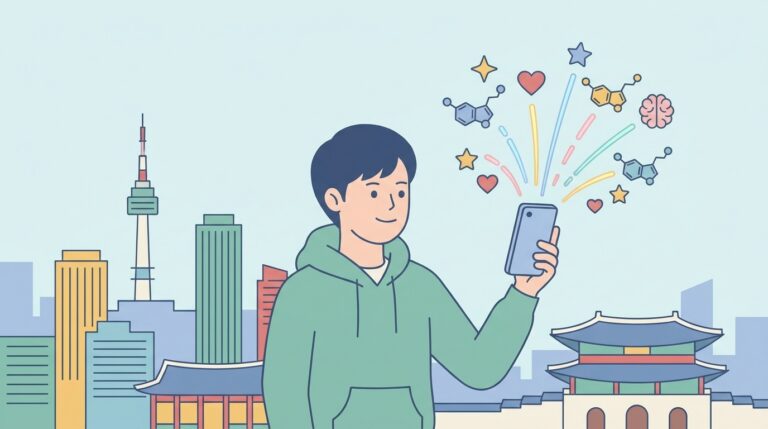
Phase 1: Empathy (Story-Driven Opening)
안녕하세요! 매일한글 에디터입니다. Have you ever found yourself lying in bed in the dead of night, your eyes burning, promising yourself just five more minutes—only to realize you’ve been aggressively swiping through 15-second YouTube Shorts and suspenseful clips of Korean survival shows for two straight hours? We’ve all been there! But here is the real puzzle: when your Korean friend asks what you did over the weekend, does your brain instantly default to robotic textbook phrases like “주말에 동영상을 시청했습니다” (I watched videos over the weekend)?
If that sounds familiar, do not worry. As your 10-year Korean cultural navigator, I see intermediate learners hit this exact linguistic wall every single week. Modern Korean internet culture evolves at lightning speed, blending English loanwords, gaming vernacular, and lifestyle psychology into viral buzzwords. In this guide, we are unpacking one of the absolute hottest buzzwords dominating Korean social feeds: 도파밍 (Dopaming). By understanding how Koreans fuse “dopamine” with “item farming” to describe our endless quest for quick thrillers and instant gratification, you won’t just memorize slang—you will unlock the exact mindset your Korean peers use to talk about trends, fatigue, and fun.
Phase 2: Core 3 Expressions In-Depth
1. 도파밍하다 (Dopaminghada)
- Pronunciation: [Do-pa-ming-ha-da] (Think of the word ‘dopamine’ chopped down to ‘dopa’, combined with the gaming term ‘farming’ as ‘ming’, and wrapped with the verb ending ‘hada’ like ‘ha-ha-ha’)
- Meaning: Literally “to farm dopamine”; practically, it means actively hunting for fun, micro-thrills, short-form content, or sensory stimuli to get an instant mood boost.
- K-Culture Moment: Seen non-stop in vlogs where creators spend a Saturday hitting three different aesthetic pop-up stores in Seongsu-dong, or when someone binges wild dating show clips like Transit Love (환승연애).
- Editor’s Insight: This word originates from the gaming term “farming” (grinding to collect rare items). In Korean slang, you aren’t harvesting wheat or gold coins—you are harvesting quick bursts of neurochemical happiness.
- Situation Spectrum: Casual ✅ | Semi-formal ⚠️ | Formal 🚫
- 🤔 Think About It: In English, we often say “doomscrolling” or “bingeing,” which carries a purely passive or negative undertone. Why do you think Korean youth framed this as “farming” (an active, task-oriented effort)?
2. 도파민 터지다 (Dopamin teojida)
- Pronunciation: [Do-pa-min teo-ji-da] (Pronounce ‘teo-ji-da’ with a soft ‘t’ like in ‘tub’, followed by ‘jee-dah’)
- Meaning: Literally “dopamine bursts/explodes”; used when an event, plot twist, or juicy gossip is wildly exciting, thrilling, or shocking.
- K-Culture Moment: Hearing your friend gasp while watching an intense match elimination on Culinary Class Wars (흑백요리사) and exclaiming that their heart is racing.
- Editor’s Insight: Koreans love using dynamic physical verbs like 터지다 (to burst) or 폭발하다 (to explode) to describe internal emotional rushes. Saying something is just “재미있다” (fun) simply doesn’t do justice to high-stakes K-content.
- Situation Spectrum: Casual ✅ | Semi-formal ⚠️ | Formal 🚫
- 🤔 Think About It: How does phrasing excitement as an involuntary biochemical surge change the way we express our emotional boundaries?
3. 뇌 빼고 보다 (Noe ppaego boda)
- Pronunciation: [Noe ppae-go bo-da] (Sound out ‘noe’ like ‘noh-eh’ spoken fast, ‘ppae’ as a tense double-P sound like in ‘spaghetti’, and ‘go bo-da’)
- Meaning: Literally “to watch with your brain taken out”; in everyday natural English: to turn your brain off and mindlessly binge something easy and entertaining.
- K-Culture Moment: When your roommate recommends a chaotic web-variety show on YouTube, assuring you that you don’t need to analyze the storyline at all.
- Editor’s Insight: After a brutal 10-hour day at a Korean office or cram school (hagwon), thinking deeply feels exhausting. This phrase explains the cultural craving for slapstick comedy, satisfying ASMR, or repetitive dance challenges.
- Situation Spectrum: Casual ✅ | Semi-formal ⚠️ | Formal 🚫
- 🤔 Think About It: Does your native culture celebrate “mindless entertainment” as a valid way to decompress, or is there a lingering guilt attached to turning off your brain?
Phase 3: Textbook Korean vs Real Korean
Situation 1: Describing a crazy, plot-twisting survival show
- 📖 교과서 한국어: “이 프로그램은 줄거리가 아주 흥미진진해서 감동적이에요.” (I peurogeuraemeun julgeoriga aju heungmijin-jinhaeseo gamdongjeog-ieyo. / This program has a very exciting plot and is deeply moving.)
- 🗣️ 진짜 한국어: “이 서바이벌 진짜 반전 대박이라 도파민 제대로 터져요!” (I seobaibeol jinjja banjeon daebag-ira dopamin jedaero teojyeoyo! / This survival show has crazy plot twists, my dopamine is seriously exploding!)
- 💡 왜 다를까? Textbook Korean leans on descriptive, literary adjectives like 흥미진진하다 (exciting/suspenseful). Real-world Gen Z and Millennial Koreans use sensory, hyper-expressive slang like 도파민 터지다 to communicate raw, physical hype.
Situation 2: Explaining why you stayed up until 3 AM scrolling phone screens
- 📖 교과서 한국어: “어젯밤에 짧은 동영상을 연속으로 시청했습니다.” (Eojetbame jjjalbeun dongyeongsangeul yeonsog-euro sicheonghaetseumnida. / Last night, I viewed short videos continuously.)
- 🗣️ 진짜 한국어: “어제 쇼츠 보면서 도파밍하느라 새벽 세 시에 잤잖아요.” (Eoje syocheu bomyeonseo dopaminghaneura saebyeok se sie jatjanayo. / I was farming dopamine watching Shorts yesterday, so I ended up sleeping at 3 AM.)
- 💡 왜 다를까? Instead of formally categorizing your media habits, native speakers use 도파밍 playfully with the causative ending -느라 to justify late-night distractions with self-deprecating humor.
Phase 4: K-Culture Deep Dive & Non-Verbal Manners
4-1. 눈치 (Nunchi) & Body Gestures
When using slang like 도파민 터진다, body language is half the message! Native speakers rarely deliver this line with a straight face.
* The Sensation Tap: Lightly tapping the side of your temple with your index finger or clutching your chest playfully as if your heart rate just skyrocketed creates immediate social rapport.
* The Guilty Smirk: When confessing to 도파밍, shrug your shoulders slightly and avert your eyes with a shy smile. It signals social self-awareness (눈치)—acknowledging that while you wasted time, you are in on the joke.
4-2. Culture Code: The Rise of Pop-Up Stores & Survival Frenzy
Why has 도파밍 exploded across South Korea right now? It goes hand-in-hand with two major cultural phenomena: the Seongsu-dong Pop-Up Culture and K-Survival Content.
In hyper-dense urban Seoul, waiting in line for two hours to experience a 10-minute branded pop-up booth, take four-cut photos (인생네컷), and receive a limited-edition sticker is considered prime 도파밍. Young Koreans aren’t just buying items; they are actively collecting bite-sized sensations to break up stressful work routines. Similarly, Korean reality shows deliberately edit dramatic cliffhangers every ten minutes—triggering constant 도파민 releases that keep audiences hooked until daybreak.
Phase 5: Real-World Roleplay Scenario
Setting: You are sitting at a trendy bakery cafe in Seongsu-dong with your Korean colleague, Minji (민지), on a Saturday afternoon. Both of you have iced Americanos on the table.
- Turn 1 (Minji): 너 어제 새로 나온 연애 예능 봤어? 완전 난리 났잖아! (Neo eoje saero naon yeonae yeneung bwasseo? Wanjeon nanli natjan-a! / Did you watch that new dating show that came out yesterday? It was absolute chaos!) 🎭 Leaning forward over the table, eyes wide with excitement.
- Turn 2 (You): 아직 못 봤어요. 어제 피곤해서 일찍 잤거든요. 그렇게 재미있어요? (Ajik mot bwasseoyo. Eoje pigonhaeseo iljjik jatgeodeunyo. Geureoke jaemi-isseoyo? / I haven’t seen it yet. I was tired yesterday so I went to bed early. Is it that good?) 🎭 Tilting your head with genuine curiosity.
- Turn 3 (Minji): 재미있는 수준이 아니야. 어제 출연자들 싸우는데 진짜 도파민 터지더라! (Jaemi-inneun sujuni aniya. Eoje chul-yeonjadeul ssa-uneunde jinjja dopamin teojideora! / ‘Good’ isn’t even the word. When the contestants fought yesterday, my dopamine seriously exploded!) 🎭 Clutching her cheeks with both hands.
- Turn 4 (You): 도파민 터질 정도예요? 저도 요즘 쇼츠로 도파밍만 하고 있었는데 오늘 봐야겠네요. (Dopamin teojil jeongdo-yeyo? Jeodo yojeum syocheuro dopamingman hago isseonneunde oneul bwayagetneyo. / Enough to make dopamine burst? I’ve only been dopamine farming with Shorts lately, I guess I have to watch it today.) 🎭 Laughing softly while taking a sip of coffee.
- Turn 5 (Minji): 꼭 봐! 근데 그거 틀면 새벽까지 뇌 빼고 보게 되니까 내일 출근 조심해. (Kkok bwa! Geunde geugeo teulmyeon saebyeokkkaji noe ppaego boge doenikka naeil chulgeun josimhae. / Definitely watch it! But if you turn it on, you’ll end up mindlessly bingeing until dawn, so be careful about work tomorrow.) 🎭 Wagging her finger in a mock warning.
- Turn 6 (You): 이미 글렀어요. 성수동 팝업 스토어 돌고 집 가서 바로 정주행할 거예요. (Imi geulleosseoyo. Seongsu-dong pab-eop seuto-eo dolgo jip gaseo baro jeongjuhaenghal geoyeyo. / It’s already too late. I’m going to hit the Seongsu pop-up stores, go home, and marathon it right away.) 🎭 Grinning determinedly.
- Turn 7 (Minji): 와, 오늘 너 완전 제대로 도파밍 데이네! 기대된다! (Wa, oneul neo wanjeon jedaero dopaming deine! Gidaedoenda! / Wow, today is a total Dopaming Day for you! Can’t wait!) 🎭 Clapping her hands together once.
- Turn 8 (You): 오늘 잠은 다 잤네요. 내일 출근해서 졸면 깨워주세요! (Oneul jameun da jatneyo. Naeil chulgeunhaeseo jolmyeon kkaewojuseyo! / Guess sleep is out of the question tonight. If I doze off at work tomorrow, please wake me up!) 🎭 Chuckling warmly together.
🔀 Interactive Decision Point
How would you reply to Minji in Turn 4 if you wanted to keep the banter going?
- Option A: “도파민 터진다는 게 뭐예요? 사전에 없는 단어인데요.” (Dopamin teojindaneun ge mwoyeyo? Sajeone eomneun daneo-indeyo. / What does dopamine bursting mean? It’s not in the dictionary.)
- Option B: “도파민 터질 정도예요? 저도 오늘 밤에 뇌 빼고 도파밍 좀 해야겠네요!” (Dopamin teojil jeongdo-yeyo? Jeodo oneul bame noe ppaego dopaming jom haeyagetneyo! / To the point of dopamine bursting? Looks like I need to turn my brain off and do some dopamine farming tonight!)
- Option C: “도파민은 신경전달물질이라서 함부로 터지면 위험하지 않아요?” (Dopamineun sin-gyeongjeondalmuljil-iraseo hamburo teojimyeon wiheomhaji anayo? / Dopamine is a neurotransmitter, so isn’t it dangerous if it bursts around recklessly?)
Feedback Analysis:
* Option A (Bad): Killing the conversational vibe. Pointing out that natural slang isn’t in standard dictionaries creates academic stiffness.
* Option B (Best): Perfect balance! You validated her slang (도파민 터지다) and chained it naturally with 도파밍 and 뇌 빼고 보다 like a native B2 speaker.
* Option C (Risk): Taking hyperbole literally can come across as overly critical or socially awkward (눈치 없는 태도).
Phase 6: 10-Second Emotional Shadowing Drill
Read these lines aloud, pausing at the slashes (/), and mimic the emotional tags:
[🔥 짜릿하고 격앙된 톤 / Excited & Hyped]
“어제 그 결승전 봤어? / 진짜 긴장감 때문에 / 도파민 제대로 터지더라!”
(Eoje geu gyeolseungjeon bwasseo? / Jinjja ginjanggam ttaemune / dopamin jedaero teojideora!)
“Did you see that final match yesterday? / Seriously, because of the suspense / my dopamine exploded completely!”-
[😅 살짝 찔리고 민망한 톤 / Playfully Sheepish]
“주말 내내 / 침대에서 뇌 빼고 / 도파밍만 하다가 시간 다 갔어.”
(Jumal naenae / chimdae-eseo noe ppaego / dopamingman hadaga sigan da gasseo.)
“All weekend long / lying in bed with my brain off / I just farmed dopamine until time slipped away.” -
[🤩 기대에 찬 호기심 / Eager & Curious]
“성수동에 새로 생긴 팝업스토어 가면 / 완전 도파밍 각 아니야?”
(Seongsu-donge saero saenggin pab-eopseuto-eo gamyeon / wanjeon dopaming gak aniya?)
“If we go to that new pop-up store in Seongsu / isn’t that totally ripe for some dopamine farming?”
Phase 7: K-Culture Mini Dictionary
-
도파민 디톡스 (Dopamin Ditokseu)
- Translation: Dopamine Detox
- Usage: Often declared on Sunday nights when someone feels completely drained from digital overstimulation: “나 내일부터 스마트폰 끄고 도파민 디톡스 할 거야.” (I’m turning off my smartphone and doing a dopamine detox starting tomorrow.)
- 팝업 스토어 투어 (Pab-eop Seuto-eo Tueo)
- Translation: Pop-up Store Tour
- Usage: The physical counterpart to digital dopamine farming. Visiting brand exhibition pop-ups in Hongdae or Seongsu to grab aesthetic photos and free merch.
- 숏폼 중독 (Syot-pom Jungdok)
- Translation: Short-form Content Addiction
- Usage: A widely relatable social phenomenon describing the endless scroll through TikTok, Instagram Reels, and YouTube Shorts.
- 자극적이다 (Jageukjeogida)
- Translation: Highly stimulating / Sensational / Provocative
- Usage: Originally used for spicy food, now widely used to describe spicy storylines, intense variety shows, or loud music: “이 드라마 너무 자극적이라 계속 보게 돼.” (This drama is so sensational that I can’t stop watching.)
Phase 8: Traveler’s Survival Kit
Top 3 Survival Expressions
- “요즘 한국에서 제일 핫한 팝업 스토어가 어디예요?”
(Yojeum hangug-eseo jeil hat-han pab-eop seuto-eoga eodiyeyo? / Where is the hottest pop-up store in Korea these days?)- Pro Tip: Use this at trendy hotel concierges or with young local baristas in Mapo or Seongdong districts.
- “줄 서서 기다릴 만한 가치가 있어요?”
(Jul seoseo gidaril manhan gachiga isseoyo? / Is it worth waiting in line for?)- Pro Tip: Pop-ups and viral bakeries often have 90-minute queues. Asking this helps you figure out if it’s true dopamine farming or just hype.
- “뇌 빼고 편하게 구경하기 좋아요.”
(Noe ppaego pyeonhage gugyeonghagi joayo. / It’s great for just browsing casually without thinking hard.)- Pro Tip: Perfect when recommending light shopping areas like underground mall arcades or cosmetic flagship stores.
Editor’s Travel Note
If you want to experience real-world 도파밍 in Seoul, you cannot rely solely on walking in. Most viral spots use digital waiting lists. Make sure you complete the 캐치테이블 앱 다운로드 before heading out to reserve waiting tickets at trendy pop-ups and restaurants. Additionally, check real-time crowd heatmaps by opening the 네이버 지도 앱 다운로드 to see which neighborhood alleys in Seongsu are currently buzzing.
Phase 9: “One Step Deeper” (Reflective Thought)
In contemporary Korea, the rapid transition from collective industry to hyper-connected digital living has generated unique cultural pressures. Terms like 도파밍 reflect not merely an obsession with smartphones, but an adaptive mechanism: in an intensely competitive society where long-term rewards like homeownership or career stability can feel distant, micro-doses of instant pleasure become affordable, immediate self-care. Language mirrors reality—by adopting 도파밍, young Koreans transform passive exhaustion into an active game, finding agency even inside 15-second video clips.
💬 Your Turn: What is your ultimate “도파밍” method when you are physically tired from work or studies? Do you binge Korean reality shows, wander city alleys, or scroll through Shorts? Share your experience in Korean in the comments below!
Phase 10: FAQ & Avoiding Misunderstandings
Q: Can I use “도파밍” in a professional business presentation or job interview?
A: No! 도파밍 is an informal neologism (신조어). While marketing teams might casually analyze “MZ세대의 도파밍 트렌드” (The Dopaming trend of the MZ generation) in market reports, using it in an interview to describe your personal hobbies will sound unprofessional. Stick to “트렌드 탐색” (trend exploration) or “미디어 콘텐츠 감상” (media content appreciation) in formal contexts.
Q: Does “도파민 터지다” only apply to positive situations?
A: Not always! While it usually indicates extreme excitement or entertainment, it can also describe situations packed with juicy drama, outrageous scandals, or nerve-wracking suspense that keep your eyes glued to the screen.
Q: What is the grammatical difference between “도파밍” and “도파민”?
A: 도파민 (Dopamine) is the noun referring to the chemical neurotransmitter. 도파밍 (Dopaming) is the coined compound noun blending dopamine + farming. You can make it a verb by adding -하다 (도파밍하다), but you cannot say 도파민하다.
🚨 Common Mistakes Alert
- Mistake: Saying “오늘 날씨가 너무 좋아서 도파민해요.” (Incorrect)
- Correction: “오늘 날씨가 좋아서 기분이 너무 상쾌해요.” Dopaming is not a substitute for feeling pleasant or calm; it requires an intense stimulus or active search for thrills.
- Mistake: Confusing 도파민 터지다 with 화가 터지다 (exploding in anger).
- Correction: When furious, use 열받다 or 뚜껑 열리다. 도파민 터지다 is strictly about thrilling stimulation.
- Mistake: Using 뇌 빼고 보다 when talking to university professors or older bosses.
- Correction: This slang is strictly casual. In polite company, say “부담 없이 가볍게 즐겨 봤습니다” (I enjoyed it lightly without burden).
Phase 11: Action Missions
- 🥉 Bronze Level: Stand in front of your mirror and practice the Shadowing Drill sentence: “이 서바이벌 진짜 도파민 터져요!” three times with the hand gesture.
- 🥈 Silver Level: Find a YouTube Shorts or Instagram Reel about a Korean variety show or food challenge, and leave a comment in Korean: “이 영상 보니까 도파민 제대로 터지네요!”
- 🥇 Gold Level: During your next language exchange or chat with a Korean friend, casually ask: “요즘 도파밍할 만한 재미있는 콘텐츠 있어요?” (Do you have any fun content recommendations for dopamine farming these days?).
- 🎮 K-Culture Mission: Search the hashtag
#도파밍or#도파민on Instagram or YouTube and take note of what visual images Koreans associate with this buzzword!
Phase 12: Interactive Quiz Challenge
Test your real-world cultural fluency!
- Context Check: Which of the following activities is the best example of “도파밍”?
- (A) Reading a 400-page historical philosophy treatise silently in a quiet library.
- (B) Visiting three trendy pop-up stores in one afternoon to collect free stickers and sample spicy street snacks.
- (C) Meditating alone with your eyes closed for 40 minutes in a dark room.
- Fill in the Blank: Fill in the blank using the most natural modern Korean slang:
“어제 퇴근하고 너무 피곤해서 아무 생각 없이 쇼츠 보면서 [ ] 했어요.” -
True or False: True or False? Saying “뇌 빼고 봤어요” means you underwent brain surgery and could not see the screen.
👉 Click to reveal answers & explanations!
- Answer: (B)
- Explanation: Dopaming is all about seeking out instant, fun, sensory hits and micro-gratifications—like hopping around exciting pop-up stores in hot districts.
- Answer: 도파밍 (or 뇌 빼고 도파밍)
- Explanation: “어제 퇴근하고 너무 피곤해서 아무 생각 없이 쇼츠 보면서 도파밍했어요.” (Yesterday after work I was so tired that I mindlessly watched Shorts and farmed dopamine.)
- Answer: False
- Explanation: It is a playful slang idiom meaning you turned off your active analytical thinking to mindlessly consume light, entertaining content!
- Explanation: It is a playful slang idiom meaning you turned off your active analytical thinking to mindlessly consume light, entertaining content!







