

Phase 1: Empathy & Immersion Opening
안녕하세요! 매일한글 에디터입니다. (Hello! It’s your Daily Hangul editor.)
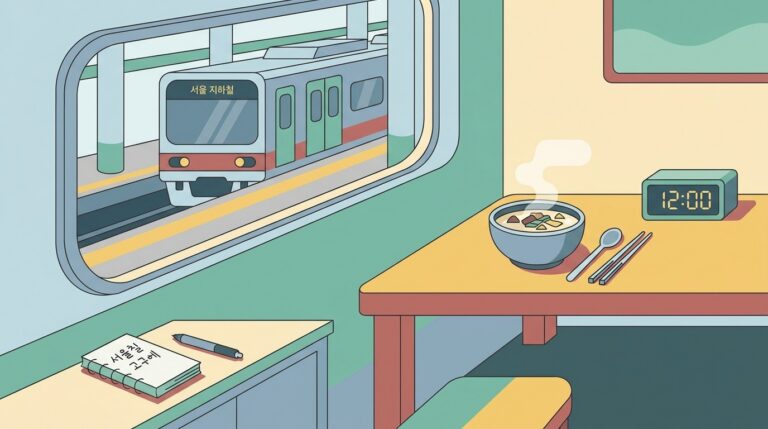
Picture this: You step into a cozy, bustling Gukbap (hot soup with rice) restaurant in Jongno, Seoul during the peak weekday lunch rush at 12:15 PM. You pull out a wooden chair, mutter your order to the passing server, and reach under the table drawer to grab stainless steel chopsticks. Before you have even poured iced corn silk tea into your metal cup—thud. A boiling stone pot filled with savory pork broth sits directly in front of you. You glance down at your smartphone lock screen: barely three minutes have passed since you walked through the sliding door.
Outside, you hop on the subway. The electronic overhead display does not say “Next train arriving shortly.” It indicates the incoming train will pull up in exactly 1 minute and 20 seconds—and it halts right on the yellow safety line down to the second. Ultra-fast 5G streams high-definition videos smoothly while you zip under the Han River. Welcome to Korea’s iconic 빨리빨리 (Ppalli-Ppalli, “Hurry, Hurry”) phenomenon!
For many intermediate learners and international visitors, this blistering pace feels like pure sci-fi sorcery, but it can also induce sudden performance anxiety. “Do I have to gulp down this boiling stew immediately?” “Is it rude if I linger at the table?” Based on real feedback from hundreds of our language learners navigating everyday life in Seoul, this guide unpacks how Korean efficiency creates supreme comfort, teaches you natural B1-level spoken expressions, and shows you how to find mindful Yeoyu (여유, slowness and breathing room) in a hyper-speed society.
Phase 2: Core Expressions Deep Dive
1. 벌써 나왔어요? (Beolsseo nawasseoyo?)
- Pronunciation: [Beol-sseo na-wa-sseo-yo] (Sounds like: bowl-sir now-wah-saw-yo)
- Meaning: Literal: “Did it come out already?” | Real Nuance: “Wow, that was unbelievably fast! I’m pleasantly astonished by your speed.”
- K-Culture Moment: Seen frequently in everyday sitcoms and office K-dramas like Misaeng or Business Proposal, where busy team members order hearty lunch stews and chuckle in admiration as dishes appear almost instantly.
- Editor’s Insight: This phrase doubles as a heartwarming compliment to the restaurant owner (Sajangnim). It signals that you appreciate their swift kitchen work rather than merely taking it for granted.
- Situation Spectrum: Casual: ✅ | Semi-formal: ✅ | Formal: ⚠️
- 🤔 Think About It: In many Western dining establishments, food arriving within three minutes might imply pre-packaged reheating. In Korea, speed at soup and noodle places signifies extreme ingredient freshness and kitchen mastery. How is speed viewed in your local dining culture?
2. 천천히 주세요 (Cheoncheonhi juseyo)
- Pronunciation: [Cheon-cheon-hi ju-se-yo] (Sounds like: chun-chun-hee joo-say-yo)
- Meaning: Literal: “Please give it slowly.” | Real Nuance: “Please take your time; there is absolutely no rush!”
- K-Culture Moment: In comforting slice-of-life dramas like Hospital Playlist, doctors stopping by the hospital cafeteria during an overcrowded shift warmly say this phrase to cafeteria staff to ease their workload.
- Editor’s Insight: This is the ultimate linguistic antidote to Ppalli-Ppalli. Whenever an elderly vendor or visibly rushed barista looks stressed, delivering this line with a soft smile instantly melts social tension.
- Situation Spectrum: Casual: ✅ | Semi-formal: ✅ | Formal: ✅
- 🤔 Think About It: Can slowing down a conversation be an act of social consideration? How do you courteously tell service staff to take their time in your mother tongue?
3. 시간 딱 맞춰 왔어요 (Sigan ttak matchwo wasseoyo)
- Pronunciation: [Si-gan ttak mat-chwo wa-sseo-yo] (Sounds like: she-gahn ttak maht-chwo wah-saw-yo — pronounce the ‘ttak’ with a sharp, crisp tongue-click)
- Meaning: Literal: “I came having fitted the time exactly.” | Real Nuance: “I arrived right on the dot thanks to perfect transit timing!”
- K-Culture Moment: Meeting a friend right in front of Hongdae Station Exit 9, holding an iced americano, panting with a celebratory grin because the bus-to-subway transfer synced to the exact minute.
- Editor’s Insight: The mimetic adverb 딱 (ttak) signifies a snappy, precise fit. Incorporating words like 딱 into your conversational repertoire instantly elevates your Korean from textbook-robotic to authentic B1 fluency.
- Situation Spectrum: Casual: ✅ | Semi-formal: ✅ | Formal: ⚠️
- 🤔 Think About It: When transit is tracked in single-minute increments on mobile screens, our psychological definition of punctuality changes. Does hyper-precise public transport make people more or less patient?
Phase 3: Textbook Korean vs. Real Korean
Situation 1: Calling a server at a fast-moving Korean restaurant
- 📖 교과서 한국어: “여기 주문을 받아주시겠습니까?” (Yeogi jumuneul badajusigesseumnikka? / Would you please take our order here?)
- 🗣️ 진짜 한국어: “사장님, 주문할게요~!” (Sajangnim, jumunhalgeyo~! / Boss, we are ready to order!) or simply press the table call-bell (띵동!).
- 💡 왜 다를까? Textbook Korean teaches polite interrogatives that feel far too long and formal for a noisy, bustling restaurant floor. Real Koreans catch the server’s attention with a crisp title (Sajangnim or Imo-nim) or use the push-button installed right on the table.
Situation 2: Inquiring about incoming transit arrival
- 📖 교과서 한국어: “대중교통이 몇 시에 도착합니까?” (Daejunggyotong-i myeot sie dochakhapnikka? / At what hour will public transit arrive?)
- 🗣️ 진짜 한국어: “지하철 몇 분 뒤에 와요?” (Jihacheol myeot bun dwie wayo? / How many minutes until the subway arrives?)
- 💡 왜 다를까? Because Korean smart bus stops and subway platforms display real-time countdown clocks, locals ask about arrival in elapsed minutes rather than referencing the static clock timetable.
Phase 4: K-Culture Deep Dive & Non-Verbal Manners
4-1. 눈치 (Nunchi) & Gestures in Fast Dining
In a lightning-fast Korean eatery, Nunchi (quick situational intuition) ensures a smooth experience.
1. The Hidden Cutlery Drawer: Never sit waiting for servers to bring silverware. Look under the rim of your table; you will find a slide-out drawer loaded with chopsticks, spoons, and napkins.
2. The Napkin Base: When dining with companions, setting a clean napkin under their spoon and chopsticks demonstrates attentive, caring etiquette.
3. Payment Posture: When heading to the register, hold your credit card or mobile phone in both hands, angled toward the cashier. Having your payment ready before the bill total is read out honors the staff’s rhythm.
4-2. Cultural Code Analysis: The Engine of Rapid Progress
Why did Korea become so fast? The Ppalli-Ppalli drive originated during the rapid post-war industrialization of the late 20th century, known as the Miracle on the Han River. Speed was synonymous with survival, economic competitiveness, and national pride.
Today, this historical momentum translates into ultra-efficient everyday infrastructure: dawn parcel deliveries (Saebyeok Baesong), high-speed rail lines connecting the country in under three hours, and dining spots that prepare nutritious meals faster than drive-thrus. Yet, younger Koreans are consciously counter-balancing this momentum through quiet cafe cultures, scenic walks along the Cheonggyecheon stream, and weekend chabak (car camping).
Phase 5: Real-World Roleplay Scenario
Setting: A popular traditional Dwaejigukbap (pork soup) restaurant near Gwanghwamun during busy lunch hour.
Characters:
* Minji (민지): The warm, lightning-fast restaurant owner (Sajangnim).
* Alex (알렉스): An international professional and intermediate Korean learner.
- Turn 1 (Alex): 🎭 [두리번거리며 식당 안으로 들어선다] 사장님, 돼지국밥 하나 주세요! (Sajangnim, dwaejigukbap hana juseyo! / Boss, one pork soup please!)
- Turn 2 (Minji): 🎭 [주문지에 체크하며 반찬 접시를 순식간에 놓는다] 네, 국밥 하나요! 깍두기 모자라면 셀프바 이용해요~ (Ne, gukbap hanayo! Kkakdugi mojaramyeon selpeuba iyonghaeyo~ / Yes, one gukbap! If you run out of radish kimchi, feel free to use the self-bar~)
- Turn 3 (Alex): 🎭 [테이블 옆 서랍에서 수저를 꺼내며 시계를 확인한다] 벌써 주문 들어갔네… (Beolsseo jumun deureogatne… / The order is already in the kitchen…)
- Turn 4 (Minji): 🎭 [김이 모락모락 나는 뚝배기를 3분 만에 탁 내려놓으며] 뜨거우니까 조심해요! 맛있게 드셔요~ (Tteugeounikka josimhaeyo! Mas-itge deusyeoyo~ / Watch out, it’s very hot! Enjoy your meal~)
- Turn 5 (Alex): 🎭 [동그란 눈으로 뚝배기를 바라보며 감탄한다] 와, 벌써 나왔어요? 진짜 빠르네요! (Wa, beolsseo nawasseoyo? Jinjja ppareuneyo! / Wow, did it come out already? That’s really fast!)
- Turn 6 (Minji): 🎭 [호탕하게 웃으며 공깃밥 뚜껑을 열어준다] 한국 식당은 스피드가 생명이잖아! 천천히 꼭꼭 씹어 먹어요~ (Hanguk sikdang-eun seupideuga saengmyeong-ijanh-a! Cheoncheonhi kkokkkok ssibeo meogeoyo~ / In Korean restaurants, speed is life! But take your time and chew well~)
- Turn 7 (Alex): 🎭 [국물을 한 숟가락 맛보고 고개를 끄덕인다] 국물이 진짜 깊고 진해요. 잘 먹겠습니다! (Gukmuri jinjja gipgo jinhaeyo. Jal meokgetseumnida! / The soup is truly rich and savory. I will eat well!)
- Turn 8 (Minji): 🎭 [만족스러운 미소를 띠며 행주로 옆 테이블을 닦는다] 입에 맞아서 다행이네! 필요한 거 있으면 언제든 불러요! (Ibe maj-aseo dahaeng-ine! Piryohan geo isseumyeon eonjedeun bulleoyo! / Glad it suits your taste! Call me whenever you need anything!)
🔀 Interactive Decision Branch
Minji sees that you’ve finished your bowl cleanly and walks by: “더 필요한 건 없어요?” (Do you need anything else?)
- Choice A: “네, 다 먹었습니다! 바로 계산해 드릴게요.” (Yes, I’m all done! I’ll pay right away at the counter.)
- Feedback (Best): 🌟 Outstanding! Walking up to the register with your payment card shows top-notch awareness (Nunchi) during busy lunch turns.
- Choice B: “여기서 커피 한잔 마시면서 책 좀 읽을게요.” (I’ll drink a coffee and read a book here for a while.)
- Feedback (Bad): ❌ Culturally awkward! Traditional meal spots with queues outside expect seats to clear once eating finishes. Head to a dedicated study cafe instead.
- Choice C: “빨리 계산이나 해줘요!” (Hurry up and ring me up!)
- Feedback (Risk): ⚠️ Impolite! While efficiency is normal, bluntly barking imperative orders sounds abrasive to hardworking staff.
Phase 6: 10-Second Emotion Shadowing Drill
Practice these lines out loud. The slash mark (/) denotes a natural rhythmic pause.
[😲 눈이 동그래지며 깜짝 놀란 톤으로]
벌써 / 나왔어요? / 진짜 신기하다!
(Beolsseo / nawasseoyo? / Jinjja sin-gihada! / It arrived already? That’s truly amazing!)-
[😊 다정하고 배려 깊은 온화한 톤으로]
바쁘시니까 / 천천히 / 주셔도 괜찮아요.
(Bappeusinikka / cheoncheonhi / jusyeodo gwaenchanh-ayo. / Since you’re busy, it’s completely fine to take your time.) -
[😎 경쾌하고 자신감 넘치는 뿌듯한 톤으로]
지하철 환승 / 딱 맞춰서 / 약속 시간에 도착했어!
(Jihacheol hwanseung / ttak matchwoseo / yaksok sigane dochakhaesseo! / Timed the subway transfer right on the dot and arrived right on schedule!)
Phase 7: K-Culture Mini Dictionary
- 빨리빨리 (Ppalli-ppalli): Lit. “Hurry, hurry.” The cultural ethos prioritizing rapid execution, automated coordination, and zero wasted minutes in services and everyday life.
- 눈치 (Nunchi): Lit. “Eye-measure.” The intuitive social tact required to assess surroundings, such as locating self-service side dish counters or knowing when to yield your seat.
- 띵동 (Tting-ddong): The universal onomatopoeia for the chime produced by wireless call buttons fastened to restaurant dining tables in Korea.
- 환승할인 (Hwanseung-harin): Transit Transfer Discount. The integrated public transit fare mechanism granting free or discounted connections between subways and buses if boarded within 30 minutes.
Phase 8: Traveler’s Survival Kit
Top 3 Survival Phrases
- “저기요, 계산할게요.” (Jeogiyo, gyesanhalgeyo. / Excuse me, I will settle the bill.)
- Pro Tip: Say this while walking directly toward the register terminal near the entryway.
- “포장되나요?” (Pojangdoenayo? / Can this be packaged for takeout?)
- Pro Tip: Even full-course soup and barbecue houses can seal food in airtight containers in under three minutes.
- “몇 분 걸려요?” (Myeot bun geollyeoyo? / How many minutes will it take?)
- Pro Tip: Excellent for asking bus drivers, coffee shops, or repair kiosks to budget your tight schedule.
Editor’s Travel Note
- Navigation Guide: For precise public transit countdowns down to the exact second, install the Naver Map Navigation App instead of standard international map programs.
- Smart Payment: Pick up a reusable transit card (T-Money or Climate Card). Always tap your card upon exiting the bus rear door; failing to tap will disqualify you from the automatic transfer discount window!
Phase 9: “One Step Deeper”
Korea’s relentless Ppalli-Ppalli tempo constructed lightning-fast gigabit connectivity, rapid postal services, and unmatched urban transit. However, living at top speed inherently creates mental exhaustion if left unchecked. That is why modern Korean culture cherishes its counter-balance: Yeoyu (여유). Whether it is seeking solace in a silent hanok cafe, enjoying a solo meditation walk in the mountains surrounding Seoul, or spending hours chatting over roasted tea, Koreans balance external efficiency with mindful internal rest. Speed keeps society humming, but intentional slowness preserves the spirit.
💬 Your Turn: Have you ever experienced an astonishing moment of Korean speed, or did the fast pace catch you off guard? Share your funny or surprising story in the comments below!
Phase 10: FAQ & Mistake Prevention
Q: Is it considered bad manners to eat slowly when a restaurant serves food in under 5 minutes?
A: Absolutely not! The food is cooked swiftly for your comfort, not to shove you out the door. You are entirely welcome to savor every bite at your own pace. The only minor courtesy is avoiding long phone browsing sessions once your plates are empty if people are standing in line outside.
Q: Why do Korean table drawers contain paper napkins, spoons, and chopsticks?
A: To save floor space and streamline operations! Instead of staff walking back and forth resetting tables during rush hours, customers serve themselves and their companions directly from the drawer under the tabletop.
Q: Can I shout out loud across the restaurant to ask for the bill?
A: Most casual Korean dining spots handle payments at the front checkout counter near the front exit door. Simply stand up, take your table receipt slip, and walk to the register.
🚨 흔한 실수 (Common Mistakes) Checklist
- Mistake: Waiting idly at your table for a server to bring your utensils.
- Correct Action: Slide open the hidden wooden drawer attached beneath the table rim!
- Mistake: Handing your payment card across the table expecting server processing.
- Correct Action: Walk over to the payment register situated by the entrance counter.
- Mistake: Forgetting to tap your transit card when getting off a public bus.
- Correct Action: Always tap out at the exit turnstile or door scanner to secure free transfer credits.
Phase 11: Action Mission & Engagement
- 🥉 Bronze Mission (Solo Practice): Stand before a mirror and practice saying: “와, 벌써 나왔어요? 감사합니다!” with an energetic, impressed facial expression three times.
- 🥈 Silver Mission (Social Share): Snap a photo of a rapid meal or a punctual transit screen, upload it to social media, and tag us with: “#DailyHangul 시간 딱 맞춰 왔어요!”
- 🥇 Gold Mission (Real-world Challenge): Next time you visit a Korean eatery or cafe, warmly tell the busy staff: “천천히 주셔도 괜찮아요~” (It’s okay to take your time) and observe their relieved smile!
- 🎮 K-Culture Mission: Watch any modern workplace K-drama episode and count how many times characters grab an iced americano to-go within a 60-second scene!
Phase 12: Interactive Quiz Challenge
Q1. Situational Judgment
You sit down at a traditional soup house, and the boiling meal arrives in three minutes. What is the most natural, friendly intermediate Korean reaction?
* A) 왜 이렇게 빨라요? 무서워요.
* B) 와, 벌써 나왔어요? 맛있게 먹겠습니다!
* C) 늦게 주셔서 대단히 감사합니다.
Q2. Fill-in-the-Blank
When the transit app states that the bus arrives at 1:15 PM and you step off at 1:15 PM sharp, you say:
“약속 장소에 시간 [ ] 맞춰 왔어요!”
* A) 딱 (ttak)
* B) 멍 (meong)
* C) 쾅 (kwang)
Q3. True or False
In Korea, public transport transfers are free or discounted as long as you board your transfer vehicle within 30 minutes of tapping out.
* (True / False)
👉 Click here to reveal answers and explanations!
- Q1 Answer: B (와, 벌써 나왔어요? 맛있게 먹겠습니다!)
Explanation: Expressing bright appreciation for the fast service honors the staff’s hard work. Option A sounds accusatory, and Option C incorrectly claims the food was late. - Q2 Answer: A (딱 / ttak)
Explanation: The native adverb 딱 implies hitting an exact, snug point in time or measurement. - Q3 Answer: True
Explanation: The metropolitan transit network calculates a unified distance fare provided you swipe into your transfer route within the standard 30-minute window (extended to 60 minutes late at night).







