

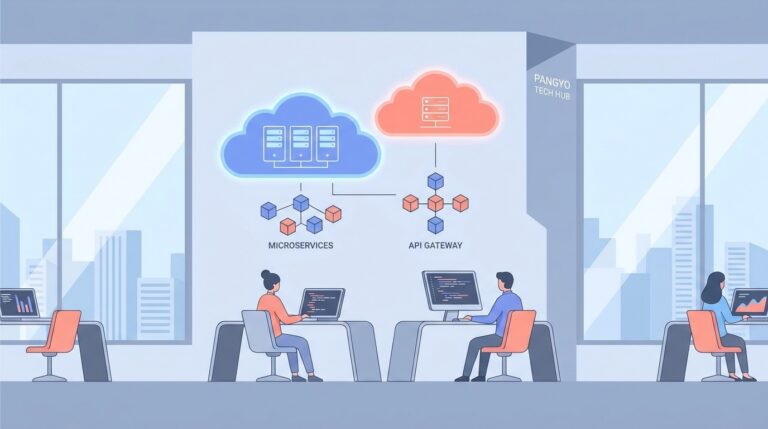
Surviving the Traffic Avalanche: How to Pitch Cloud-Native Decoupling in C1 Business Korean
Phase 1: 공감 (Story-Driven Opening)
안녕하세요! 매일한글 에디터입니다.
Imagine this familiar nightmare: It is 7:59 PM on a Thursday. You are sitting in an open-plan engineering hub in Pangyo Techno Valley—the Silicon Valley of South Korea. The office air is thick with the scent of roasted Maxim Mocha Gold and cold brew from the ground-floor Mega Coffee. In exactly sixty seconds, the ticketing portal opens for the world tour of the biggest K-pop idol group on the planet. Millions of fans worldwide hit refresh simultaneously. Suddenly, the monitoring dashboard lights up like a fiery red Christmas tree. But here is the tragedy: it is not just the ticketing engine that buckles under the load. Because of legacy monolithic ties, the user authentication pipeline chokes, the payment gateway stalls, and even completely unrelated customer support boards freeze into an unresponsive white screen.
Your CTO walks up behind your chair, arms folded, watching latency charts skyrocket, and asks with cold, quiet urgency: “지금 결제망까지 왜 다 같이 멈춘 겁니까?” (Why is the entire payment network down with it right now?)
If you have worked in tech, you know that sheer technical prowess is only half the battle. When enterprise platforms undergo cloud-native transformation in Korea, communicating architectural decoupling, fault tolerance, and domain isolation requires sophisticated, high-register Korean. One former learner—a principal systems architect from Seattle working at a Korean hyper-scale e-commerce firm—confided in me: “I knew Kubernetes and domain-driven design inside out, but in architecture review boards, I kept sounding like a novice developer because I didn’t know how Korean teams articulate fault isolation.”
Today, we will master the exact C1-level enterprise Korean expressions needed to say: “We decoupled servers by domain so traffic spikes never crash the whole platform.” Let’s make sure your architectural vision commands the respect it deserves in any Korean boardroom.
Phase 2: 핵심 표현 3선 심층 분석 (Deep Dive: Top 3 Core Expressions)
1. 특정 기능에 트래픽이 몰려도 전체 서비스가 다운되지 않도록 도메인별로 아키텍처를 분리했습니다.
- Pronunciation: [Teuk-jeong gi-neung-e teu-rae-pi-gi mol-lyeo-do jeon-che seo-bi-seu-ga da-un-doe-ji an-to-rok do-me-in-byeol-lo a-ki-tek-cheo-reul bun-ri-haet-seum-ni-da.] (Intuitive: “Took-jeong gee-neung-eh tew-ray-pick-ee mole-lyuh-do john-cheh suh-bee-soo-ga down-dweh-jee ahn-toe-rok doe-may-in-byuhl-low ah-key-tek-chuh-reul boon-lee-hat-soom-nee-dah”)
- Meaning: Literal: “Even if traffic gathers on a specific feature, so that the entire service does not go down, we separated the architecture by domain.” → Nuanced C1 Interpretation: “We decoupled our architecture across distinct business domains to ensure targeted traffic surges do not trigger platform-wide outages.”
- K-Culture Moment: Think of an episode of Start-Up (스타트업) or Search: WWW (검색어를 입력하세요 WWW) when a sudden breaking celebrity scandal causes millions of concurrent searches, yet the portal’s shopping and email tabs continue running seamlessly.
- Editor’s Insight: The connective particle
-도록(to ensure/so that) paired with-별로(categorized by/per) elevates your phrasing from casual junior tech talk to authoritative enterprise design register. It frames the engineering decision not as an accidental fix, but as a deliberate architectural hedge. - Situation Spectrum: Casual 🚫 | Semi-formal ⚠️ | Formal ✅
- 🤔 Think About It: In Korean tech organizations, passive phrasing (“서버가 터졌다” – “the server blew up”) suggests unavoidable helplessness, while active causative structures (“분리했습니다”, “설계했습니다”) signal direct ownership and executive confidence. How does your native language handle ownership of technical failure?
2. 트래픽 폭주로 인한 장애 전파를 방지하기 위해 서킷 브레이커를 적용했어요.
- Pronunciation: [Teu-rae-pik pok-ju-ro in-han jang-ae jeon-pa-reul bang-ji-ha-gi wi-hae seo-kit beu-rei-keo-reul jeok-yong-haess-eo-yo.] (Intuitive: “Tew-ray-pick poke-joo-row een-hahn jahng-eh john-pah-reul bahng-jee-hah-ghee wee-heh suh-kit brew-ray-kuh-reul juck-yong-hat-uh-yo”)
- Meaning: Literal: “To prevent disability propagation caused by traffic runaway, we applied circuit breakers.” → Nuanced C1 Interpretation: “We implemented automated circuit-breaking patterns to actively isolate cascading failures triggered by traffic spikes.”
- K-Culture Moment: During peak Lunar New Year train reservation drops (코레일 명절 예매 대란), the booking domain enters read-only or queueing mode rather than dragging down the entire KTX schedule display.
- Editor’s Insight: Notice 장애 전파 (Jang-ae jeon-pa): Jang-ae (system failure/incident) + Jeon-pa (propagation/transmission). This is the gold-standard phrase used by SRE (Site Reliability Engineering) teams at Naver, Kakao, and Coupang when discussing cascading blast radiuses.
- Situation Spectrum: Casual ⚠️ | Semi-formal ✅ | Formal ✅
- 🤔 Think About It: Notice the compound Hanja word 폭주 (暴走 – Pok-ju), literally meaning “violent running.” In Korean, extreme traffic isn’t just “heavy” (많은 트래픽); it is perceived as an uncontrollable runaway train that must be physically restrained.
3. 티켓팅 트래픽 때문에 결제망까지 뻗어버리는 사태는 막아야죠.
- Pronunciation: [Ti-ket-ting teu-rae-pik ttae-mu-ne gyeol-je-mang-kka-ji ppeod-eo-beo-ri-neun sa-tae-neun mag-a-ya-jyo.] (Intuitive: “Tea-kett-ing tew-ray-pick teh-moon-eh gyuhl-jay-mahng-kkah-jee ppuhd-uh-buh-ree-noon sah-teh-noon mahg-ah-yah-jyo”)
- Meaning: Literal: “We definitely must stop the catastrophe where even the payment network stretches out and collapses due to ticketing traffic.” → Nuanced C1 Interpretation: “We absolutely cannot afford a worst-case scenario where ticketing queues knock out our core transaction settlement engine.”
- K-Culture Moment: Overheard during a high-stakes war room sprint in Yeouido or Pangyo between lead developers debugging a flash sale release.
- Editor’s Insight: The verb 뻗다 (Ppeot-da) originally means to stretch out one’s limbs from utter exhaustion and pass out. In Korean developer slang, it is the visceral, everyday equivalent of a complete server crash or hard freeze. Ending with -막아야죠 (-mag-a-ya-jyo) builds collegial consensus and mutual professional empathy.
- Situation Spectrum: Casual ✅ | Semi-formal ✅ | Formal ⚠️
- 🤔 Think About It: Why do Korean tech teams use expressive body metaphors (뻗다 – to collapse, 터지다 – to burst) inside high-stress engineering environments? It diffuses panic through shared emotional resonance.
Phase 3: 교과서 한국어 vs 진짜 한국어 (Textbook vs. Real Native Korean)
Situation 1: Explaining that a server crashed due to sudden traffic
- 📖 교과서 한국어: 트래픽 증가로 인해 웹 서버의 동작이 중단되었습니다. (Web server operations were suspended due to traffic increase.)
- 🗣️ 진짜 한국어: 오픈하자마자 트래픽이 미친 듯이 몰려서 결제 쪽 서버가 완전히 뻗어버렸어요. (As soon as we launched, insane traffic poured in and the payment server completely crashed out.)
- 💡 왜 다를까?: In real Korean engineering war rooms, sterile terminology like “동작이 중단되었습니다” sounds like a textbook translation. Real engineers use dynamic verbs like “몰리다” (to surge/flock) and “뻗어버리다” (to pass out/crash hard).
Situation 2: Proposing domain isolation to prevent shared downtime
- 📖 교과서 한국어: 각 기능을 독립적으로 구성하여 장애 발생을 억제해야 합니다. (Each feature must be composed independently to suppress incidents.)
- 🗣️ 진짜 한국어: 장애가 옆 동네로 안 번지게 도메인 단위로 깔끔하게 쪼개고 서킷 브레이커 걸어 둬야 합니다. (We need to slice it neatly by domain and set up circuit breakers so the failure doesn’t spread next door.)
- 💡 왜 다를까?: Native Korean architects frequently use spatial metaphors like “옆 동네” (the neighboring village/domain) and “쪼개다” (to split/slice cleanly) rather than stiff academic jargon to illustrate microservice decoupling.
Phase 4: K-Culture 딥다이브 & 비언어적 매너 (Cultural Nuances & Engineering Etiquette)
4-1. 눈치 (Nunchi) & Non-Verbal Posture in Technical Debates
When presenting a decoupling refactor to senior Korean directors, technical logic alone does not win the room. In enterprise Korean IT culture:
* The “Pencil Resting” Cue: If an executive places their digital stylus or ballpoint pen gently onto their notebook and leans slightly back, stop reciting technical specifications immediately. This non-verbal cue indicates they are worried about cost explosion (인프라 비용) or delivery timelines (오픈 일정). Reframe your pitch: “장기적으로는 인프라 비용 절감과 무중단 배포(Zero-downtime deployment) 효과를 가져옵니다.”
* Gaze & Head Tilt: Never stare directly and unblinkingly into an executive’s eyes while defending an architectural proposal. Maintain soft eye contact, tilting your head slightly downward when acknowledging a risk they raise (“네, 지적해 주신 레이턴시 지연 문제는 캐싱 레이어로 보완할 계획입니다”).
4-2. The “Blackout Trauma” in Korean Tech Culture
Ever since the historic 2022 South Korean data center fire that halted nationwide messaging, mobility, and payments, enterprise Korean IT has elevated 장애 격리 (Fault Isolation) and 이중화 (Redundancy) from engineering preferences to board-level fiduciary duties. In Korean tech discourse, proposing a cloud-native transformation is no longer just about agile shipping; it is framed around societal continuity and user trust. Showing that your domain decoupling prevents a failure in marketing promos from halting basic identity verification will instantly earn you the highest nod of approval in Korean corporate IT.
Phase 5: 실전 롤플레이 시나리오 (Enterprise Architecture Review)
Setting: A glass-walled conference room at an entertainment-tech enterprise in Pangyo. Architecture diagrams cover the whiteboard.
Characters:
* 알렉스 (Alex): Principal Cloud Architect (Expats leading the cloud-native migration).
* 민우 팀장 (Team Lead Min-woo): Platform Engineering Lead (Detail-oriented, risk-averse, highly respected).
— dialogue start —
민우 팀장: 🎭 화이트보드의 단일 모놀리스 다이어그램을 심각한 표정으로 펜으로 톡톡 두드리며
알렉스 님, 지난번 굿즈 드롭 때 결제 서버가 먹통 되면서 장바구니랑 마이페이지까지 싹 닫혔잖아요. 이번 컴백 티켓팅도 이 상태로 갈 겁니까?
(Alex-nim, jinanbeon gutjeu deuropeu ttae gyeolje seobeoga meoktong doemyeonseo jangbagunirang maipeijikkaji ssak dachyeotjanayo. Ibeon keombaek tikettingdo i sangtaero gal geomnikka?)
“Alex, during the last merchandise drop, the payment server went totally dead and dragged down the cart and my-page with it. Are we really going into this comeback ticketing in the same state?”
알렉스: 🎭 새로운 마이크로서비스 설계 도면을 태블릿 화면에 띄워 민우 팀장 쪽으로 부드럽게 밀며
그 문제 때문에 고민 많으셨죠? 그래서 특정 기능에 트래픽이 폭주해도 전체 서비스가 멈추지 않게 도메인별로 서버를 완전히 분리했습니다.
(Geu munje ttaemune gomin maneusyeotjyo? Geuraeseo teukjeong gineunge teuraepigi pokjuhaedo jeonche seobiseuga meomchuji anke domeinbyeollo seobeoreul wanjeonhi bullihaetseumnida.)
“You’ve been losing sleep over that, right? That’s why we’ve completely decoupled servers by domain so targeted traffic spikes will never bring down the entire platform.”
민우 팀장: 🎭 팔짱을 끼고 도면을 유심히 들여다보며 고개를 갸우뚱한다
도메인 분리요? 말은 좋은데, 티켓팅 트래픽이 인증 서버나 이벤트 브로커 쪽으로 몰려버리면 결국 병목 생기는 건 매한가지 아닌가요?
(Domein bulliyo? Mareun joeunde, tiketting teuraepigi injeung seobeona ibenteu beurokeo jjogeuro mollyeobeorimyeon gyeolguk byeongmok saenggineun geon maehan-gaji anin-gayo?)
“Domain decoupling? Sounds great, but if ticketing traffic surges into the auth server or event broker, doesn’t that end up causing the exact same bottleneck?”
알렉스: 🎭 자신감 있으면서도 차분한 목소리로 화이트보드 중앙에 서킷 브레이커 아이콘을 그리며
맞습니다. 그래서 병목 가능성을 차단하려고 티켓팅과 인증 도메인 사이에 비동기 메시지 큐랑 서킷 브레이커를 걸어 뒀어요.
(Matseumnida. Geuraeseo byeongmok ganeungseong-eul chadanharyeogo tiketting-gwa injeung domein saie bidonggi mesiji kyurang seokit beureikeoreul georeo dwoesseoyo.)
“Spot on. To preempt that exact bottleneck, we implemented asynchronous message queues and circuit breakers between the ticketing and identity domains.”
민우 팀장: 🎭 안경을 고쳐 쓰며 흥미롭다는 듯 상체를 테이블 쪽으로 기울인다
서킷 브레이커요? 그럼 티켓팅 쪽 요청이 임계치를 넘으면 대기열로 바로 우회되나요?
(Seokit beureikeoyo? Geureom tiketting jjok yocheong-i imgyechireul neomeumyeon daegiyeollo baro uhoedoenayo?)
“Circuit breakers? So if ticketing requests exceed the threshold, they get instantly routed into a virtual waiting queue?”
알렉스: 🎭 고개를 끄덕이며 태블릿의 부하 테스트 시뮬레이션 지표를 짚어 보여준다
네, 티켓팅 쪽에 수백만 명이 몰려 장애가 나더라도, 메인 커머스와 커뮤니티 피드는 지연 없이 100% 정상 작동합니다.
(Ne, tiketting jjoge subaekman myeong-i mollyeo jangg-aega nadeorado, mein keomeoseuwa keomyuniti pideuneun jiyeon eopsi baek-peosenteu jeongsang jakdonghamnida.)
“Exactly. Even if millions swarm ticketing and trigger an incident there, the main commerce store and community feeds operate 100% normally without latency.”
민우 팀장: 🎭 비로소 안도하는 미소를 지으며 무릎을 탁 친다
이야, 장애 격리가 확실하네요. 이 아키텍처라면 이번 아이돌 컴백 때 밤새 모니터링하면서 가슴 졸일 일은 없겠습니다.
(Iya, jangg-ae gyeorriga hwaksilhaneyo. I akitekcheoramyeon ibeon aidol keombaek ttae bamsae monitoringhamyeonseo gaseum joril ireun eopgetseumnida.)
“Wow, that is rock-solid fault isolation. With this architecture, we won’t be pulling all-nighters clutching our chests in panic during this comeback.”
알렉스: 🎭 미소를 지으며 노트북을 닫고 정중하게 눈인사를 건넨다
팀장님 덕분에 엣지 케이스까지 꼼꼼히 잡았습니다. 바로 카나리 배포(Canary Deployment) 파이프라인 돌려 두겠습니다.
(Timjangnim deokbune etji keiseukkaji kkomkkomhi jabatsseumnida. Baro kanari baepo paipeurain dollyeo dugetseumnida.)
“Thanks to your sharp feedback, Team Lead, we caught all edge cases. I’ll trigger the canary deployment pipeline immediately.”
— dialogue end —
🔀 인터랙티브 분기점 (Interactive Branching Decision)
Imagine Min-woo asks: “What happens if AWS Seoul Region suffers a sudden network zone brownout during the drop?” How do you respond?
- Option A: “그건 클라우드 벤더사 문제니까 저희가 책임질 부분은 아니라고 봅니다.” (That’s a cloud vendor issue, so I don’t think it’s our responsibility.)
- ❌ Risk Feedback: Terrible answer. In Korean corporate culture, deflecting mission-critical platform resilience onto third-party providers signals a complete lack of engineering accountability (책임 회피).
- Option B: “멀티 리전 액티브-액티브 구성까지 고려했으나, 현재 예산 범위 내에서는 멀티 AZ 자동 페일오버로 가용성을 확보했습니다.” (We considered multi-region active-active setups, but within our current budget, we secured high availability via multi-AZ automated failover.)
- 🏆 Best Choice: Superb C1 balance. It demonstrates strategic realism, acknowledges financial trade-offs, and validates rigorous disaster-recovery engineering.
- Option C: “아, 설마 그런 일이 일어나겠어요? 한국 리전은 엄청 안정적입니다.” (Oh, surely that wouldn’t happen? The Korea region is super stable.)
- ⚠️ Bad Choice: Overly casual and overly optimistic. Disregarding disaster recovery makes leadership view you as unprepared for enterprise scale.
Phase 6: 10초 감정 섀도잉 드릴 (10-Second Emotion Shadowing Drill)
Practice matching the cadence, micro-pauses (/), and emotional color of high-level engineering meetings:
- [😎 자신감 넘치고 든든하게 – Confident & Reassuring]
- 특정 기능에 / 트래픽이 폭주해도 / 전체 서비스가 멈추지 않게 / 도메인별로 서버를 분리했습니다.
- (Teuk-jeong gi-neung-e / teu-rae-pi-gi pok-ju-hae-do / jeon-che seo-bi-seu-ga meom-chu-ji an-ke / do-me-in-byeol-lo seobeoreul bun-ri-haet-seum-ni-da.)
- [🧐 분석적이고 빈틈없이 – Analytical & Sharp]
- 장애 전파를 원천 차단하기 위해 / 비동기 큐와 / 서킷 브레이커 패턴을 / 적극 도입했습니다.
- (Jang-ae jeon-pa-reul won-cheon cha-dan-ha-gi wi-hae / bi-dong-gi kyu-wa / seo-kit beu-rei-keo pae-teon-eul / jeok-geuk do-ip-haet-seum-ni-da.)
- [🤝 안도하며 공감대를 형성하듯 – Relieved & Empathetic]
- 티켓팅 때문에 / 온 사이트가 뻗어버려서 / 밤샘 대응하는 일은 / 이제 진짜 없어야죠.
- (Ti-ket-ting ttae-mu-ne / on sai-teu-ga ppeod-eo-beo-ryeo-seo / bam-saem dae-eung-ha-neun ir-eun / i-je jin-jja eops-eo-ya-jyo.)
Phase 7: K-Culture 미니 사전 (Mini Tech Dictionary)
- 먹통 (Meok-tong) | Complete freeze / unresponsive system
- Usage: Originating from traditional ink-line pots that run black and opaque, this is the most common colloquial word in Korean offices for systems that freeze without returning an error.
- 병목 현상 (Byeong-mok hyeon-sang) | Bottleneck effect
- Usage: Widely used in architecture reviews to denote database throughput choke points or unscalable third-party API dependencies.
- 가용성 (Ga-yong-seong) | System Availability / Uptime metric
- Usage: Formal Hanja business term (可用性). Used constantly when pitching SLA targets (“99.99% 가용성을 보장합니다”).
- 삽질 (Sap-jil) | Fruitless / unproductive struggle (literally: pointless shoveling)
- Usage: Highly authentic informal dev slang used when debugging dead-ends for hours (“라이브러리 버전 충돌 때문에 사흘 내내 삽질했네요”).
Phase 8: 여행자를 위한 생존 키트 (Tech Professional Survival Kit)
If you are traveling to Korea for on-site tech deployments or visiting partner offices in Pangyo or Gangnam, keep these expressions ready:
- Top 1: 와이파이 접속이 불안정한데, 개발자용 내부망 SSID 좀 알려주시겠어요? (The Wi-Fi connection is unstable; could you share the internal developer SSID?)
- Romanization: Wa-i-pa-i jeop-sog-i bul-an-jeong-han-de, gae-bal-ja-yong nae-bu-mang SSID jom al-lyeo-ju-si-get-seo-yo?
- Pro Tip: Korean tech offices have ultra-strict zero-trust security. Asking for the developer network (내부망) saves hours of guest-portal registration.
- Top 2: 오늘 배포는 무중단으로 진행되나요, 아니면 점검 공지 띄워야 하나요? (Is today’s deployment a zero-downtime release, or do we need to post a scheduled maintenance notice?)
- Romanization: O-neul bae-po-neun mu-jung-dan-eu-ro jin-haeng-doe-na-yo, a-ni-myeon jeom-geom gong-ji tti-wo-ya ha-na-yo?
- Pro Tip: Use this to clarify deployment windows before your team goes out for post-sprint Korean BBQ.
- Top 3: 방화벽 포트 오픈 신청 결재는 어디서 올리면 되나요? (Where do I submit the approval form for firewall port openings?)
- Romanization: Bang-hwa-byeok po-teu o-peun sin-cheong gyeol-jae-neun eo-di-seo ol-li-myeon doe-na-yo?
- Pro Tip: Korean corporate IT revolves around 결재 (Gyeol-jae – administrative approval workflows). Asking this early makes you look deeply experienced in local corporate procedures.
- Editor’s Travel Note: Moving around tech corridors in Pangyo or Teheran-ro is best navigated via the official 네이버 지도 앱 다운로드 rather than international map tools. For checking local cloud infrastructure telemetry during your travel, bookmark the official AWS 한국 리전 모니터링 가이드 to monitor live latency across Seoul data centers.
Phase 9: “한 발 더 깊이” (Cultural Insights & Critical Thinking)
In Western engineering culture, architectural debates frequently honor the “radical candor” principle—ideas are attacked relentlessly in isolation from the person presenting them. However, in Korean enterprise environments, technical proposals are deeply intertwined with 체면 (Che-myeon – face/social dignity) and collective team harmony. When proposing an overhaul from monolith to cloud-native microservices, framing the legacy architecture as “잘못된 설계” (flawed design) implicitly criticizes the veteran developers who originally built it to keep the company alive during early startup years. Sophisticated C1 professionals frame transformation not as a correction of past mistakes, but as an inevitable evolution driven by unprecedented business success (“기존 아키텍처가 회사 성장을 잘 견뎌준 덕분에, 이제 다음 스케일업 단계로 나아갈 수 있게 되었습니다”).
💬 Your Turn: Have you ever navigated a major technical pivot where interpersonal politics mattered just as much as system latency? How does your workplace culture handle refactoring legacy systems without bruising engineering egos?
Phase 10: FAQ & 오해 방지 (FAQ Schema)
Q: Is it rude to use English technical loanwords like “트래픽” (Traffic) or “서버 분리” (Server separation) in formal presentations?
A: Not at all! In fact, Korean IT terminology is a seamless hybrid of English loanwords and high-register Hanja. Words like 아키텍처 (Architecture), 트래픽 (Traffic), and 배포 (Deployment – Hanja) coexist in virtually every sentence. However, do not conjugate English verbs directly into Korean (e.g., avoid saying “디커플링했어요” in formal boards; use “도메인별로 분리/격리했습니다” instead).
Q: What is the exact nuance difference between “서버가 터졌다” and “서버가 뻗었다”?
A: Both are colloquial developer idioms. 터졌다 (burst/exploded) emphasizes the moment of catastrophic overload—the sudden massive wave of inbound traffic blowing past capacity. 뻗었다 (stretched out/fainted) highlights the aftermath of sustained unresponsive paralysis—the server is completely hung, threads are locked, and no packets are returning.
Q: How do I address senior developers during technical arguments without sounding confrontational?
A: Attach the professional honorific -님 (-nim) to their name or use their functional title: 팀장님 (Team Lead), 수석님 (Principal), or 아키텍트님 (Architect). Preface dissenting architectural opinions with softening cushion words such as “말씀해 주신 관점도 타당하지만…” (The perspective you mentioned is valid, however…) before delivering your counter-proposal.
🚨 흔한 실수 (Common Mistakes) 경고판
- Saying “서버가 죽었습니다” (The server died) in front of executive stakeholders.
- Correct Action: Replace with formal incident terminology: “서버 인스턴스에 장애가 발생했습니다” (An incident occurred on the server instance) or “응답 지연이 발생하고 있습니다” (Response delays are occurring).
- Confusing “격리” (Isolation) with “제거” (Removal).
- Correct Action: When decoupling systems, say “장애 격리” (Fault isolation), not “장애 제거” (Elimination of failure). Senior Korean architects know failure is inevitable; resilience lies in isolation.
- Overusing casual banter (뻗다/터지다) in official C-level reporting documentation.
- Correct Action: In Slack or verbal stand-ups, 뻗었다 is fine. In official post-mortems (장애 보고서), write “서비스 불가 상태 (Service Unavailable)” or “시스템 불능 상태”.
Phase 11: 액션 미션 & 참여 유도 (Action Missions)
- 🥉 Bronze Mission (Solo Practice): Read the Phase 6 shadowing drill out loud three times while timing yourself. Focus on keeping your pitch flat and confident on the phrase: 도메인별로 아키텍처를 분리했습니다.
- 🥈 Silver Mission (Social / Peer Share): Write down your current work platform’s architecture in 1 simple Korean sentence in the comments below (e.g., “저희 플랫폼은 데이터베이스 부하를 줄이기 위해 캐시 레이어를 추가했습니다”).
- 🥇 Gold Mission (Real-World Deployment): In your next standup, pull request review, or tech sync with Korean developers, use either “장애 격리” (fault isolation) or “도메인 분리” (domain decoupling) naturally in context.
- 🎮 K-Culture Mission: Watch an episode of a Korean workplace tech series (like Start-Up or Search: WWW). Keep your ears open for the words 트래픽 (Traffic), 서버 (Server), and 터지다 (to burst). When you hear one, screenshot the subtitle and reflect on whether they used formal or informal registers!
Phase 12: 인터랙티브 퀴즈 챌린지 (Interactive Quiz Challenge)
1. 상황 판단 퀴즈 (Situational Judgment)
During a sprint retro, you need to inform the VP of Technology that yesterday’s ticketing promo failed to bring down the payment engine because you isolated the domains. Which phrase commands the highest professional authority?
* (A) 티켓팅 터졌는데 결제 서버는 안 죽고 잘 버텼습니다.
* (B) 특정 도메인에 트래픽이 집중되었으나, 아키텍처 격리 설계를 통해 결제망 전파를 차단했습니다.
* (C) 서버가 뻗지 않도록 마이크로서비스를 열심히 쪼갰습니다.
🔍 정답 및 해설 보기 (Click to reveal answer)
정답: (B)
* 해설: Option (B) uses sophisticated executive terminology (특정 도메인에 트래픽 집중, 아키텍처 격리 설계, 전파 차단). Option (A) is too casual for a VP report (터졌는데, 안 죽고), while (C) sounds like an informal developer chat rather than a professional architecture post-mortem.
2. 빈칸 채우기 퀴즈 (Fill-in-the-Blank)
다음 문장의 빈칸에 들어갈 가장 적절한 기술 용어는?
* “트래픽 폭주로 인한 장애가 다른 서비스로 ( )되지 않도록 서킷 브레이커를 도입했습니다.”
* (힌트: ‘번지거나 퍼짐’을 뜻하는 고급 한자어)
🔍 정답 및 해설 보기 (Click to reveal answer)
정답: 전파 (Jeon-pa – Propagation)
* 해설: In high-level enterprise architecture, the spreading of downtime across microservices is specifically designated as 장애 전파 (Incident propagation). The full sentence translates to: “We introduced circuit breakers to prevent incidents caused by traffic surges from propagating to other services.”
3. True / False 문화 퀴즈 (Cultural T/F)
- 문제: In Korean IT post-mortems (장애 회고), it is customary and encouraged to publicly single out the individual developer whose commit crashed the cluster to demonstrate accountability.
🔍 정답 및 해설 보기 (Click to reveal answer)
정답: False (X)
* 해설: Blameless post-mortems (비난 없는 회고 문화) are heavily emphasized across leading Korean tech companies (such as Toss, Woowa Brothers, and Kakao). Failures are attributed to system gaps and automated pipeline deficiencies, not individual character faults. Pointing fingers violates corporate 눈치 (Nunchi) and breaks psychological safety.







