

Conquering Korea’s Highest Peak: The Hallasan Summit Certificate & That Unforgettable Pride
Phase 1: Empathy (Welcome to the Peak!)
안녕하세요! 매일한글 에디터입니다. (Hello! This is your Daily Hangul editor.)
Imagine this: It is 5:30 AM in Jeju Island. The island air is crisp and salty, and you are standing at the entrance of the Seongpanak trail, hiking poles in hand and your Hallasan National Park QR reservation permit loaded on your phone. You have spent the last four hours pacing your breath across volcanic rocks, climbing through subalpine fir forests, and feeling your legs burn. Then, suddenly, the tree line breaks. Ahead lies the majestic Baengnokdam crater lake, bathed in morning sunlight. You’ve reached the highest point in South Korea—1,947 meters above sea level!
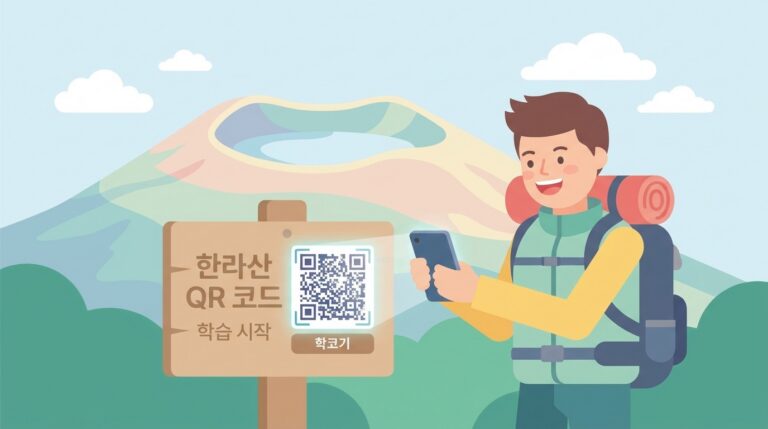
As you catch your breath, you notice a small wooden post with a QR code surrounded by ecstatic hikers snapping selfies. You take out your phone, upload your GPS-verified summit photo to the park’s official portal, and watch the digital “등정 인증서” (Summit Certificate) appear on your screen. That wave of sheer, goosebump-inducing accomplishment hits you: “I really did this.”
Many intermediate Korean learners know how to say “I climbed a mountain” (등산했어요), but they freeze when trying to express that deeper, emotional sense of hard-won personal pride or when navigating the technical steps of claiming their official certificate at the peak. This guide is crafted directly from real hiker feedback and Daily Hangul community stories to help you navigate Hallasan and Olle Trail like a seasoned local hiker.
Phase 2: Core Expressions in Depth
Here are three indispensable expressions you will need at the summit of Hallasan:
1. 정상에 도착했어요! (Jeongsang-e dochakaesseoyo!)
- Pronunciation: [Jeong-sang-eh doh-chahk-hae-ssuh-yo] (Think “Jung” as in psychologist Carl Jung + “sang” as in singing a song)
- Meaning: Literal: “I have arrived at the summit!” / Real Nuance: A triumphant declaration of completing a rigorous ascent.
- K-Culture Moment: In outdoor variety shows like 2 Days & 1 Night or hiking vlogs on YouTube, celebrities drop their backpacks, look at the panoramic view, and shout this phrase with arms spread wide.
- Editor’s Insight: “정상” (Jeongsang) literally means “summit” or “top” (頂上). Unlike simply saying “다 왔어요” (We are all here), using “정상” emphasizes that you conquered the physical peak.
- Situation Spectrum:
- Casual: 정상 도착했어! (Jeongsang dochakhaesseo!) ✅
- Semi-formal: 정상에 도착했어요! (Jeongsang-e dochakaesseoyo!) ✅
- Formal: 정상에 무사히 도착했습니다! (Jeongsang-e musahi dochakhaessseumnida!) ✅
- 🤔 Think About It: In English, we often say “I made it to the top!” highlighting personal action (“I made it”). Korean focuses on reaching the focal landmark itself (“정상에 도착”). How does naming the summit shift the focus toward the mountain?
2. 인증서 발급받으려면 어떻게 해요? (Injeungseo balgeupbadeuryeomyeon eotteoke haeyo?)
- Pronunciation: [In-jeung-suh bahl-geup-bah-deu-ryuh-myeon uh-tteo-keh hae-yo?] (Think “In” + “jung” + “sir”, followed by “bahl-geup” sounding like “ball-goop”)
- Meaning: Literal: “If I intend to be issued the certificate, what should I do?” / Real Nuance: A polite, practical way to ask rangers or fellow hikers how to trigger the digital summit certificate process.
- K-Culture Moment: At Hallasan’s summit, park rangers often stand near the certification markers to help hikers who are confused about phone GPS settings.
- Editor’s Insight: The B1 grammar pattern
-(으)려면(short for-(으)려고 하면) expresses an intention (“if you want to / in order to”). Combining it with발급받다(to be issued an official document) marks you as someone with strong real-world communicative competence. - Situation Spectrum:
- Casual: 인증서 어떻게 받아? (Injeungseo eotteoke bada?) ⚠️ (Use only with close peers)
- Semi-formal: 인증서 발급받으려면 어떻게 해요? (Injeungseo balgeupbadeuryeomyeon eotteoke haeyo?) ✅
- Formal: 인증서 발급 절차를 여쭤봐도 될까요? (Injeungseo balgeup jeolchareul yeojjwobwado doelkkayo?) ✅
- 🤔 Think About It: Why does Korean frequently combine passive and active nuances in administrative words like “발급받다” (literally: to receive what has been issued)?
3. 정말 뿌듯해요! (Jeongmal ppudeuthaeyo!)
- Pronunciation: [Jeong-mahl ppoo-deut-hae-yo] (Pronounce the double ‘pp’ with tight, popping lips—like ‘spoon’ without the ‘s’, and ‘deut’ rhyming with ‘soot’)
- Meaning: Literal: “I feel very proud/fulfilled!” / Real Nuance: An overflowing, warm, internal satisfaction that comes from overcoming a steep personal trial through your own effort.
- K-Culture Moment: Used constantly in K-Dramas when a character finishes a difficult project, bakes their first successful cake for someone they love, or runs a marathon.
- Editor’s Insight: English speakers often translate “proud” into “자랑스러워요” (Jarangseureowoyo). However, “자랑스럽다” often carries an external or comparative sense (bragging rights, being proud of your child or country). When you accomplish a difficult personal feat in private or public, Koreans almost exclusively use “뿌듯하다”!
- Situation Spectrum:
- Casual: 완전 뿌듯해! (Wanjeon ppudeuthae!) ✅
- Semi-formal: 정말 뿌듯해요! (Jeongmal ppudeuthaeyo!) ✅
- Formal: 진심으로 뿌듯하고 보람찹니다. (Jinsimeuro ppudeuthago boramchamnida.) ✅
- 🤔 Think About It: Notice how “뿌듯하다” requires no external praise. Why do you think Korean has a distinct word for self-directed emotional fulfillment?
Phase 3: Textbook Korean vs. Real-World Korean
| Situation | 📖 Textbook Korean | 🗣️ Real-World Korean (B1) | 💡 Why It Differs |
|---|---|---|---|
| 1. Announcing summit victory | 저는 산꼭대기에 도착했습니다. (Jeoneun sankkokdaegi-e dochakhaessseumnida.) |
드디어 완등했어요! / 해냈다! (Deudi-eo wandeunghaesseoyo! / Haenaetta!) |
Textbooks use literal descriptive words like “산꼭대기” (mountain treetop). Real hikers use the sports term “완등” (complete ascent) or the emotional victory cry “해냈다!” (I pulled it off!). |
| 2. Expressing satisfaction | 기분이 아주 자랑스럽습니다. (Gibuni aju jarangseureopseumnida.) |
평생 잊지 못할 만큼 뿌듯해요! (Pyeongsaeng itji mothal mankeum ppudeuthaeyo!) |
Saying “기분이 자랑스럽습니다” sounds unnatural and overly self-aggrandizing. The B1 grammar -ㄹ 만큼 (to the extent of) combined with “뿌듯하다” creates genuine warmth. |
Phase 4: K-Culture Deep Dive & Non-Verbal Manners
4-1. Summit Etiquette & The Baengnokdam Photo Line
Reaching the peak of Hallasan means encountering the famous photo queue for the summit rock engraved with “한라산 백록담 1947M”. During peak seasons, hikers wait 30 to 45 minutes in sub-zero wind just for one photo.
* The Reciprocal Courtesy: Never take a selfie alone without scanning the people behind you. Turn around with a warm smile and ask: “사진 찍어드릴까요?” (Sajin jjigeodeurilkkayo? – Shall I take your photo?). They will enthusiastically take yours in return, often directing you into better lighting!
* Speed is Respect: Have your camera app open and gloves unfastened before reaching the stone. Linger for only 3 to 4 snaps, bow slightly with a nod (“감사합니다!”), and step aside to let the next hiker stand.
4-2. The “Deungsan” Culture Craze & The Digital Certificate
In Korea, hiking (등산, Deungsan) is no longer just a hobby for retirees in neon windbreakers. It has evolved into a massive youth culture trend centered around self-care, mindfulness, and the “#오하운” (오늘 하루 운동 – Today’s Workout) aesthetic.
The digital 등정 인증서 (Summit Certificate) system on Hallasan represents Korea’s seamless digital infrastructure (IT 강국). To prevent fraud, the park’s website requires your smartphone GPS to verify that you are physically within 1 km of the crater before you can upload your summit photo. Showing that printed or digital certificate at the bottom ranger station earns you a gorgeous, embossed physical paper certificate for 1,000 KRW—a prized souvenir for your travel journal!
Phase 5: Real-World Roleplay Scenario
Setting: The brisk, windy summit of Hallasan, right beside the Baengnokdam crater wooden barrier. Minho, a friendly local Korean hiker in his late 20s, sees you struggling with your phone screen.
- 민호 (Minho): 바람이 진짜 많이 불죠? 정상 사진 찍어드릴까요?
(Barami jinjja mani buljyo? Jeongsang sajin jjigeodeurilkkayo?)
“The wind is really blowing, isn’t it? Shall I take a summit photo for you?”
🎭 Smiling while offering both hands forward to hold your phone. -
You: 네, 부탁드려요! 한 장만 찍어주세요.
(Ne, butakdeuryeoyo! Han jangman jjigeojuseyo.)
“Yes, please! Just one shot would be great.”
🎭 Handing over your phone carefully while standing beside the summit post. -
민호 (Minho): 하나, 둘, 셋! 김치~ 와, 진짜 잘 나왔어요! 확인해 보세요.
(Hana, dul, set! Kimchi~ Wa, jinjja jal nawasseoyo! Hwaginhae boseyo.)
“One, two, three! Kimchi~ Wow, it turned out really well! Check it out.” -
You: 우와, 감사합니다! 그런데 등정 인증서 발급받으려면 어떻게 해요?
(Uwa, gamsahamnida! Geurende deungjeong injeungseo balgeupbadeuryeomyeon eotteoke haeyo?)
“Wow, thank you! But if I want to get the summit certificate issued, what should I do?”
🎭 Pointing quizzically toward the QR code on the post. -
민호 (Minho): 아! 여기 QR코드 찍으시고요, 방금 찍은 사진을 홈페이지에 올리시면 돼요. 위치 정보(GPS) 켜셨어요?
(A! Yeogi QR-kodeu jjigeusigoyo, banggeum jjigeun sajineul hompe-iji-e ollisimyeon dwaeyo. Wichi jeongbo(GPS) kyeosyeosseoyo?)
“Ah! Just scan this QR code, and upload the photo we just took to the website. Did you turn on your location (GPS)?” -
You: 아, GPS 켜고 바로 신청했어요! 승인 완료됐네요.
(A, GPS kyeogo baro sincheonghaesseoyo! Seung-in wanryodwaenneyo.)
“Ah, I turned on GPS and applied right away! It’s already approved.” -
민호 (Minho): 축하드려요! 내려가서 매표소 기계에서 출력하시면 돼요. 엄청 뿌듯하시죠?
(Chukhadeuryeoyo! Naeryeogaseo maepyoso gigye-eseo chullyeokhasimyeon dwaeyo. Eomcheong ppudeuthasijyo?)
“Congratulations! When you descend, you can print it at the ticket machine. Feels super rewarding, right?” -
You: 네! 평생 잊지 못할 만큼 뿌듯해요!
(Ne! Pyeongsaeng itji mothal mankeum ppudeuthaeyo!)
“Yes! I feel so proud, it’s something I will never forget for the rest of my life!”
🎭 Beaming with both hands clenched in quiet triumph.
🔀 Interactive Decision Point
Suppose Minho asks if you want him to take another photo of you holding your trekking poles vertically:
- Option A: “괜찮아요, 추우실 텐데 얼른 찍으세요!” (Gwaenchanayo, chuusil tende eolleun jjigeuseyo!)
👉 Best Choice! Empathic and polite. Acknowledges the cold temperature and tells the other person to take their turn. - Option B: “아니요, 됐습니다.” (Aniyo, dwaessseumnida.)
👉 Risk! Grammatically correct, but sounds abrupt, dismissive, and cold in an outdoor communal setting. - Option C: “나 사진 싫어해요.” (Na sajin sireohaeyo.)
👉 Bad Choice! Drops into rude informal speech (반말) with a stranger, creating awkward tension.
Phase 6: 10-Second Emotional Shadowing Drill
Practice breathing life into your Korean by syncing pauses (/) and emotional tone indicators.
[😮💨 Breathless yet amazed]
드디어 / 정상에 / 도착했어요!
(Deudi-eo / jeongsang-e / dochakaesseoyo!)
“Finally / at the summit / I’ve arrived!”-
[🙋 Confident and inquiring]
인증서 발급받으려면 / 여기서 / 신청하면 돼요?
(Injeungseo balgeupbadeuryeomyeon / yeogiseo / sincheonghamyeon dwaeyo?)
“If I want the certificate issued / from here / do I apply?” -
[🥹 Deep, heartfelt emotion]
힘들었지만, / 평생 잊지 못할 만큼 / 뿌듯해요!
(Himdeureotjiman, / pyeongsaeng itji mothal mankeum / ppudeuthaeyo!)
“It was tough, but / enough to remember for a lifetime / I feel so proud!”
Phase 7: K-Culture Mini Dictionary
| No | Word (Hangul + Romanization) | English Translation | Real-Life Application |
|---|---|---|---|
| 1 | 완등 (Wandeung) | Complete Ascent / Full Climb | Used when you complete an entire mountain course without turning back early. Example: 한라산 완등 성공! (Successfully completed Hallasan climb!). |
| 2 | 등정 인증서 (Deungjeong Injeungseo) | Summit Certificate | Official government-backed proof of reaching the peak. Issued digitally or as a physical paper certificate at Jeju national park centers. |
| 3 | 백록담 (Baengnokdam) | White Deer Lake (Crater) | The volcanic crater lake atop Hallasan. Culturally revered; seeing it clearly without mist is considered an auspicious sign of good fortune. |
| 4 | 뿌듯하다 (Ppudeuthada) | Fulfilled / Warmly Accomplished | A psychological state describing self-generated pride after overcoming personal adversity. Central to understanding modern Korean mental health and exercise culture. |
Phase 8: Traveler’s Survival Kit
Top 3 On-the-Trail Survival Phrases
- 안전 산행 하세요! (Anjeon sanhaeng haseyo!)
Pro Tip: Greet passing hikers on narrow trails with this phrase. It means “Have a safe hike!” and immediately endears you to local trail veterans. - 여기서 정상까지 얼마나 걸려요? (Yeogiseo jeongsang-kkaji eolmana geollyeoyo?)
Pro Tip: Use this when you reach the Samgakbong shelter or Jindallae-bat shelter to verify if you can beat the strict summit cutoff gate. - 인증서 키오스크 어디에 있어요? (Injeungseo kioseukeu eodi-e isseoyo?)
Pro Tip: At the bottom entrance (Seongpanak or Gwaneumsa visitor center), say this to locate the automated printing kiosk.
Editor’s Travel Note: Hallasan Logistics
- Trail Reservation: Hallasan requires advance bookings for the two summit routes (Seongpanak and Gwaneumsa). Always secure your spot through the official Hallasan National Park Trail Reservation System at the beginning of the previous month.
- Strict Cut-Off Times: You will be stopped at intermediate checkpoints (e.g., Jindallae-bat on Seongpanak) if you do not pass by 12:00 PM (winter) or 12:30 PM (spring/autumn). Start before 7:00 AM!
- Battery Warning: Freezing winds at the summit drain smartphone batteries within minutes. Keep your phone inside your jacket pocket with a portable power bank, because without GPS location active on your phone, you cannot trigger the certificate portal!
Phase 9: Going One Step Deeper (Humanities Essay)
In Western individualist psychology, pride is frequently articulated as outward triumph: “I conquered this mountain.” In Korean culture, however, nature is rarely something humans “conquer” (정복 is used humorously, but traditional philosophy views mountains as places where one tests and humbles oneself).
When a Korean hiker whispers “뿌듯하다” upon gazing into Baengnokdam, they are not bragging to the mountain; they are acknowledging an internal dialogue. 뿌듯함 is the feeling of filling an empty spiritual vessel through discipline, perseverance, and respect for the trail. By mastering this expression, you step out of the tourist mentality and enter the shared emotional rhythm of Korean outdoor culture.
💬 Your Turn: What is one challenge in your life that gave you that deep feeling of 뿌듯함? Tell us your story in the comments below using the phrase: “[Activity]을/를 끝내고 정말 뿌듯했어요!”
Phase 10: FAQ & Common Pitfalls
Q: Can I get the Hallasan summit certificate if my photo doesn’t have GPS metadata?
A: Unfortunately, no. The official Hallasan verification server checks the EXIF location metadata of the uploaded photo to ensure it was taken within a tight radius of the summit coordinates. Make sure “Location Tags / GPS” are toggled ON in your phone’s camera settings before you start climbing.
Q: Can foreigners use the QR certificate system without a Korean phone number?
A: Yes! The system allows foreign visitors to register via passport number or email address, so you do not need a domestic Korean mobile carrier (PASS verification) to generate your digital summit certificate.
Q: Is there a fee to get the physical summit certificate?
A: Applying on the website is completely free and yields a downloadable image. If you want the embossed physical paper certificate printed at the base kiosk, there is an administrative fee of 1,000 KRW (credit cards, T-Money, and mobile pay accepted; cash is generally not accepted at automated kiosks).
🚨 Common Mistakes Alert
- Mistake: Using “자랑스러워요” when talking about your own hike.
Correct Action: Say “뿌듯해요!” Reserve “자랑스러워요” when praising someone else (e.g., 우리 딸 자랑스럽다 – “I’m proud of my daughter”). - Mistake: Forgetting to download the QR reservation code before entering the mountain where cell signals can flicker.
Correct Action: Screenshot both your park reservation barcode and trail map in advance. - Mistake: Calling out “야호!” (Yahoo!) at the peak.
Correct Action: Yelling Yaho on Korean mountains is now strongly discouraged to protect native wildlife and ensure tranquility. Keep celebrations quiet and courteous.
Phase 11: Action Missions
- 🥉 Bronze Mission (Solo Shadowing): Stand up, take a deep breath, and practice shouting with joy: “정상에 도착했어요! 해냈다!” three times with authentic intonation.
- 🥈 Silver Mission (Social Media): Post your latest workout or study milestone on your Instagram Story and caption it: “오늘 목표 달성! 완전 뿌듯해요 ✨”.
- 🥇 Gold Mission (Real Trail Challenge): On your next trip to Korea (whether it’s Hallasan, Bukhansan, or Jeju Olle Trail), approach another hiker at a scenic viewpoint and offer: “사진 찍어드릴까요?”
🎮 K-Culture Mission: Watch an episode of a Korean travel variety show (such as tvN’s Europe Outside Your Tent or an outdoor episode of I Live Alone). Listen for the moment someone says “뿌듯하다” after cooking a meal or setting up camp. Note down the exact context!
Phase 12: Interactive Quiz Challenge
Test your new skills! Tap each box below to see if your intuition is spot-on.
Quiz 1. Situation Judgment
You have reached the summit of Hallasan, and an elderly hiker smiles at you warmly while wiping sweat from their forehead. What is the most natural, respectful phrase to say to them?
* (A) 나 도착했어, 밥 줘.
* (B) 정말 대단하세요! 안 힘드세요?
* (C) 완등 축하드립니다! 정말 뿌듯하시죠?
👉 Click to reveal Answer & Explanation
Correct Answer: (C)
Explanation: (C) warmly congratulates them on completing the climb (완등 축하드립니다) and brings up the authentic cultural feeling of self-accomplishment (뿌듯하시죠?). Option (A) is rude, and (B) awkwardly focuses on physical fatigue rather than shared celebration.
Quiz 2. Fill-in-the-Blank
Complete the sentence using the intermediate grammar pattern for expressing intention (“in order to / if you want to”):
- “정상에서 인증서를 __________(발급받다) 어떻게 해야 해요?”
👉 Click to reveal Answer & Explanation
Correct Answer: 발급받으려면
Explanation: When attaching the intention grammar -(으)려면 to 발급받다 (which ends in a consonant ㄷ), we add -으려면. Thus, 발급받- + -으려면 = 발급받으려면 (“If you want to be issued…”).
Quiz 3. True or False Cultural Check
- Statement: When you reach Baengnokdam on Hallasan, it is standard polite etiquette to save your spot in the rock photo line by putting your trekking poles down while you eat lunch nearby.
👉 Click to reveal Answer & Explanation
Correct Answer: FALSE
Explanation: Saving spots with gear while stepping away is strictly considered bad trail etiquette (민폐). Hikers must stay physically in the single file line, moving forward step by step until their turn arrives.







