

The Secret Behind Hip Seoul: How Ongojisin Shapes Modern Korean Aesthetics
Phase 1: Empathy (Immersive Storytelling Opening)
안녕하세요! 매일한글 에디터입니다. (Hello! It’s your Daily Hangul editor.)
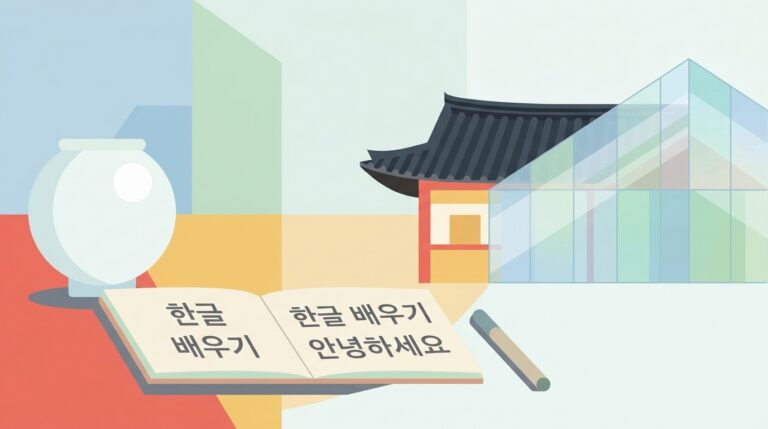
Imagine stepping inside a serene flagship showroom in Bukchon or an avant-garde concept store in Seongsu-dong. Around you are exposed concrete walls and ultra-contemporary brushed steel fixtures. Yet, sitting gracefully on an acrylic pedestal is an asymmetrical white porcelain Moon Jar (Dalhangari), illuminated by sunlight filtering through traditional wooden lattice screens (Changhoji). To an untrained eye, this contrast looks like striking futuristic minimalism. But when a Korean creative director surveys the room, they smile and call it: 온고지신 (Ongojisin).
Many of our advanced C1 learners tell us: “I know all the everyday vocabulary to express ‘neat’ or ‘modern’, but when art, branding, and traditional architecture collide in K-culture, I feel tongue-tied.” You recognize that Korea’s contemporary creative explosion—from BTS music video aesthetics and modern Hanbok to award-winning interior architecture—is rooted in something ancient, yet you lack the precise, philosophical Korean lexicon to critique it with nuance. This guide is crafted from a decade of navigating Seoul’s creative landscape and mentoring design researchers. By mastering these expressions, you will graduate from simply labeling things as “예쁘다 (pretty)” to dissecting Korean aesthetics with genuine cultural authority.
Phase 2: Top 3 Core Expressions in Depth
1. 온고지신 (溫故知新) / 옛것을 익혀 새것을 알다
- Pronunciation: On-go-ji-sin (Sounds like “Own-go-jee-sheen”, pronounced with even, deliberate cadence) / Yet-geo-seul i-kyeo sae-geo-seul al-da
- Meaning: Literal: Warming up (revisiting) the old to discover the new. | Nuance: True innovation is not born in a vacuum; it flourishes when ancestral wisdom and cultural DNA are reinterpreted to shape the future.
- K-Culture Moment: Seen frequently in interviews when K-pop creative directors explain stage costumes that reconstruct centuries-old royal robes into cyberpunk streetwear.
- Editor’s Insight: Do not confuse this with simple retro nostalgia (Bokgo / 복고). While Bokgo seeks sentimental comfort in past trends, Ongojisin is an active, progressive creative philosophy that launches the old into tomorrow.
- Situation Spectrum: Casual ⚠️ | Semi-formal ✅ | Formal ✅
- 🤔 Think About It: Does your native language view tradition as something static confined to museums, or as an active catalyst for modern innovation?
2. 여백의 미를 살리다 (Yeobaeg-ui mireul sallida)
- Pronunciation: Yeo-bae-gui mee-reul sal-lee-da (Fluid liaison: Yeo-bae-gui)
- Meaning: Literal: To bring alive the beauty of empty margins/space. | Nuance: Intentionally withholding decorative clutter so that the open, negative space allows breathing room, contemplation, and natural resonance.
- K-Culture Moment: Architectural critiques in Korean lifestyle magazines describing minimalist Hanok-inspired cafes that refuse to crowd their interiors with tables.
- Editor’s Insight: In Western graphic design, “white space” is often an operational tool for readability. In Korean aesthetics, Yeobaek (여백) is a living entity—it represents atmospheric pause, natural airflow, and the viewer’s emotional participation.
- Situation Spectrum: Casual ✅ | Semi-formal ✅ | Formal ✅
- 🤔 Think About It: How does perceiving “emptiness” as active and fertile change how you organize your own living space or creative work?
3. 은근한 멋이 배어 나오다 (Eungeunhan meosi baeeo naoda)
- Pronunciation: Eun-geun-han meo-si bae-eo na-o-da (Soft nasal “eun”, with meos-i flowing smoothly into meosi)
- Meaning: Literal: A subtle, quiet charm/dignity seeps out. | Nuance: Understated elegance that does not shout for attention, but reveals deep sophistication gradually over time.
- K-Culture Moment: Used by Korean fashion critics discussing luxury craft designs—such as unglazed earthenware or natural persimmon-dyed linen—that exude effortless depth.
- Editor’s Insight: Koreans traditionally frown upon superficial ostentation (Yoran-hada / 요란하다). The highest compliment for someone’s style or artwork is that dignity “seeps out” (배어 나오다) organically like ink into Hanji paper.
- Situation Spectrum: Casual ✅ | Semi-formal ✅ | Formal ✅
- 🤔 Think About It: Why does modern Seoul luxury lean toward tactile, earthen, and quiet tones rather than blaring golden logos?
Phase 3: Textbook Korean vs. Real Korean
Situation 1: Describing a boutique cafe blending Hanok with modern glass
- 📖 교과서 한국어 (Textbook): 이 카페는 옛날 한옥과 현대 건축을 결합해서 아주 예쁩니다. (I kape-neun yennal hanok-gwa hyeondae geonchuk-eul gyeolhaphaeseo aju yeppeumnida. / This cafe is very pretty because it combines old Hanok and modern architecture.)
- 🗣️ 진짜 한국어 (Real Native): 전통 서까래를 그대로 살려서 모던함 속에 고즈넉한 멋이 흐르네요. (Jeontong seoggarae-reul geudaero sallyeoseo modeonham soge gojeuneokhan meosi heureuneyo. / By preserving the traditional wooden rafters, a tranquil, timeless elegance flows within the modern aesthetic.)
- 💡 왜 다를까? (Why is it different?): C1-level natural Korean avoids generic adjectives like “예쁘다 (pretty)” or sterile verbs like “결합하다 (combine)”. Instead, native speakers specify architectural features (서까래) and emotional textures (고즈넉하다).
Situation 2: Praising modern mother-of-pearl crafts
- 📖 교과서 한국어 (Textbook): 옛날 공예 방식을 사용해서 새롭게 만들었습니다. (Yennal gongye bangsik-eul sayonghaeseo saeropge mandeureosseumnida. / It was newly made using old craft methods.)
- 🗣️ 진짜 한국어 (Real Native): 전통 나전칠기를 현대적 감각으로 감쪽같이 재해석했네요. 촌스럽기는커녕 세련미가 넘쳐요. (Jeontong najeonchigi-reul hyeondaejeok gamgageuro gamjjokgachi jaehaeseokhaenneyo. Chonseureopgineunkeonyeong seryeonmiga neomchyeoyo. / They flawlessly reinterpreted traditional mother-of-pearl lacquerware with modern sensibility. Far from dated, it exudes pure sophistication.)
- 💡 왜 다를까? (Why is it different?): Advanced natural critique utilizes comparative connectors like “-기는커녕 (far from being…)” and expressive adverbs like “감쪽같이 (flawlessly/seamlessly)” to emphasize transformative design.
Phase 4: K-Culture Deep Dive & Non-Verbal Manners
4-1. 눈치 (Nunchi) & Gestures in Heritage Spaces
When visiting high-end Korean heritage spaces, craft studios in Insadong, or modern gallery cafes, non-verbal posture sets the tone before words are spoken:
* The Reverent Step-Back: When evaluating a design piece incorporating traditional craftsmanship (such as an onggi jar or celadon cup), never lean in abruptly or point aggressively with an index finger. Take half a step back, gently clasp both hands in front of you, and tilt your head slightly. This non-verbally acknowledges the “breathing space” (여백) of the object.
* Two-Handed Tactile Contact: If permitted to hold artisanal goods, always support the base with your left hand while wrapping your right hand softly around the contour. This honors the artisan’s labor and signals that you understand the object’s cultural weight.
4-2. Cultural Code Analysis: The Hanok-Renaissance & Modern K-Pop Aesthetics
Consider music videos from groups like BTS (IDOL at Gyeongbokgung Palace) or BLACKPINK’s modern Hanbok ensembles at Coachella. They do not merely wear costumes; they perform an act of 온고지신 (Ongojisin). Western media often categorizes fashion in linear timelines: old is obsolete, new is progressive. In Korean thought, inspired by cyclic seasonal views, tradition is a living palette.
Moreover, Korean aesthetics celebrate 해학 (Haehak – affectionate humor/whimsy). Notice how traditional Joseon folk paintings (Minhwa) depict tigers not as ferocious beasts, but with playful, cross-eyed expressions. Today, this exact spirit of Haehak fuels modern graphic characters (like Kakao Friends or modern street art in Euljiro), blending deadpan satire with profound cultural warmth.
Phase 5: Real-World Roleplay Scenario
Setting: An avant-garde design consultancy studio in Hannam-dong, Seoul. You (Alex) are reviewing upcoming cosmetic packaging concepts with Director Min-woo, an exacting K-heritage design visionary.
- 민우 팀장: 이번 K-뷰티 라인업 패키지 시안, 어떻게 보셨어요? 전통 한지 질감을 차용했는데 어색하지 않을까요? (Ibeon K-byuti rain-eop paekiji sian, eotteoke bosyeosseoyo? Jeontong hanji jilgkam-eul chayonghaenneunde eosaekhaji aneulkkayo? / How did you find the packaging mockups for our new K-beauty line? We borrowed traditional Hanji paper textures; does it feel out of place?)
- 알렉스: [🎭 시안을 양손으로 가만히 쓸어내리며] 한지의 결을 살리되 아크릴 소재와 매치하니 온고지신의 정수가 느껴집니다. (Hanji-ui gyeol-eul sallidoe akeuril sojae-wa maechihani ongojisin-ui jeongsu-ga neukkyeojimnida. / [Gently smoothing over the mockup with both hands] Preserving the Hanji grain while matching it with acrylic captures the very essence of Ongojisin.)
- 민우 팀장: 오, 온고지신이라는 표현을 아시네요? 자칫 옛것의 진부한 답습으로 보일까 염려했거든요. (O, ongojisin-iraneun pyohyeon-eul asineyyo? Jachit yetgeot-ui jinbuhan dapseup-euro boilkka yeomryeohaetgeodeunyo. / Oh, you know the term Ongojisin? I was worried it might come across as an uninspired rehash of the past.)
- 알렉스: 전혀요. 화려한 그래픽을 덜어내고 여백의 미를 극대화해서 오히려 미래적인 분위기마저 풍깁니다. (Jeonhyeoyo. Hwaryeohan geuraepik-eul deoreonaego yeobaeg-ui mireul geukdaehwahaeseo oihiryeo miraejeogin bunwigi-majeo punggimnida. / Not at all. By peeling away flashy graphics and maximizing negative space, it actually carries an almost futuristic aura.)
- 민우 팀장: [미소를 지으며 고개를 끄덕인다] 맞아요. 우리 선조들이 추구했던 자연주의가 사실 가장 지속가능한 모더니즘이죠. (Majayo. Uri seonjodeuri chuguhaetdeon jayeonjuuiga sasil gajang jisokganeunghan modeonijeum-ijyo. / [Nodding with a satisfied smile] Exactly. The naturalism our ancestors pursued is, in fact, the most sustainable modernism.)
- 알렉스: 디테일에서도 은근한 멋이 배어 나와서 해외 바이어들에게도 깊은 인상을 줄 것 같습니다. (Diteil-eseodo eungeunhan meosi baeeo nawaseo haeoe baieodeuregedo gipeun insang-eul jul geot gatseumnida. / Subtle elegance seeps through every detail, so I believe it will leave a profound mark on international buyers too.)
- 민우 팀장: 알렉스 씨의 심미안 덕분에 방향성에 확신이 서네요. 타이포그래피 위치만 살짝 다듬어 볼까요? (Aellekseu ssi-ui simmian deokbune banghyangseong-e hwaksini seoneyo. Taipogeuraepi wichi-man saljjak dadeumeo bolkkayo? / Thanks to your aesthetic judgment, I feel confident about our direction. Shall we refine the typography placement slightly?)
- 알렉스: 좋습니다. 한글 자음의 기하학적 곡선을 살려 절제된 미를 연출해 보시죠. (Joeusseumnida. Hangeul jaeum-ui gihahakjeok gokseon-eul sallyeo jeoljedeon mireul yeonchulhae bosijyo. / Sounds great. Let’s showcase the geometric curves of Hangeul consonants to achieve a restrained aesthetic.)
🔀 Interactive Branching Points
- Option A: “전통 문양을 더 크고 화려하게 꽉 채워 넣는 게 K-스타일 아닐까요?” (Wouldn’t packing it full of bigger, flashy traditional patterns be more K-style?)
- Feedback: 🚫 Risk! This reduces nuanced Korean design to souvenir-shop kitsch, directly violating the core principle of Yeobaek (negative space).
- Option B: “여백을 살리면서 조선 백자의 절제된 곡선미를 포인트로 두면 좋겠습니다.” (It would be great to maintain empty space while spotlighting the restrained curves of Joseon white porcelain.)
- Feedback: 🏆 Best! Demonstrates deep aesthetic comprehension and proposes actionable design balance.
- Option C: “전통적인 건 식상하니 그냥 서구식 미니멀리즘 폰트로 덮어버리죠.” (Traditional elements are boring, so let’s just cover it with Western minimalist fonts.)
- Feedback: ⚠️ Bad. Disregards the project’s K-heritage identity and misses the creative synergy of Ongojisin.
Phase 6: 10-Second Emotion Shadowing Drill
Practice these lines with rhythm, pausing at / and embodying the emotional marker:
- [🧐 깊이 감탄하며 / With thoughtful admiration]
옛것의 숨결을 품되 / 현대적인 세련미를 잃지 않는 것이 / 바로 온고지신의 매력이죠.
(Yetgeot-ui sumgyeor-eul pumdoe / hyeondaejeogin seryeonmireul ilchi anneun geosi / baro ongojisin-ui maeryeok-ijyo.)
“Embracing the breath of the past / without losing modern sophistication / is the true charm of Ongojisin.” -
[🎨 섬세하고 진중하게 / Delicate and poised]
화려하게 채우기보다 / 여백의 미를 살릴 때 / 비로소 공간에 숨통이 트여요.
(Hwaryeohage chaeugiboda / yeobaeg-ui mireul sallil ttae / biroso gonggan-e sumtong-i teuyeoyo.)
“Rather than filling space flashily / when we honor the beauty of empty margins / the room can finally breathe.” -
[✨ 은은한 미소로 / With a subtle, confident smile]
요란하지 않아도 / 시선을 오래 머물게 하는 / 은근한 멋이 배어 나오네요.
(Yoranhaji anado / siseon-eul orae meomulge haneun / eungeunhan meosi baeeo naoneyo.)
“Even without being loud / a subtle elegance seeps through / holding one’s gaze for a long time.”
Phase 7: K-Culture Mini Dictionary
- 온고지신 (Ongojisin)
- Translation: Inheriting ancient wisdom to innovate for tomorrow.
- Practical Usage: Used in business strategy, product design, and artistic statements when classical Korean roots form the backbone of modern products.
- 여백의 미 (Yeobaeg-ui mi)
- Translation: The beauty of negative space / intentional void.
- Practical Usage: Essential in interior design, UI/UX critique, flower arrangement (Kkotgoji), and layout discussions to praise uncluttered elegance.
- 해학 (Haehak)
- Translation: Affectionate satire, whimsical humor that overcomes sorrow.
- Practical Usage: Used in literary, film, and theatrical reviews to distinguish Korean dark comedy and affectionate caricatures from biting cynicism.
- 고즈넉하다 (Gojeuneokhada)
- Translation: Serene, peacefully antique, calmly secluded.
- Practical Usage: The quintessential descriptor for strolling through quiet palaces at dusk, staying in an old Hanok, or enjoying temple grounds.
Phase 8: Survival Kit for Travelers & Culture Seekers
Top 3 Survival Expressions
- “이 공간은 전통 요소를 어떻게 현대적으로 재해석했나요?”
(I gonggan-eun jeontong yoso-reul eotteoke hyeondaejeog-euro jaehaeseokhaennayo?)
Pro Tip: Use this at museum architecture tours or boutique hotels to spark profound conversations with docents. - “전통 공예 기법을 살린 현대적인 소품을 추천해 주시겠어요?”
(Jeontong gongye gibeop-eul sallin hyeondaejeogin sopum-eul chucheonhae jusigesseoyo?)
Pro Tip: Essential when shopping at craft fairs or the National Museum shop for elevated souvenirs beyond tourist trinkets. - “복잡하지 않고 여백의 미가 돋보여서 마음이 편안해지네요.”
(Bokjaphaji anko yeobaeg-ui miga dotboyeoseo maeumi pyeonanhaejineyyo.)
Pro Tip: A graceful compliment to offer cafe owners or art gallery curators upon entry.
Editor’s Travel Note
When hunting for Ongojisin design hotspots in Seoul, do not rely on standard international search engines. Open the Naver Map app and bookmark neighborhoods where centuries collide: Samcheong-dong, Seochon, and the alleyways behind Euljiro 3-ga. For mobile public transit, load your digital T-money card or register modern contactless transit on your smartphone, and consider downloading the official National Museum of Korea exhibition guide before viewing the iconic Room of Quiet Contemplation (Sayu-ui Bang).
Phase 9: “한 발 더 깊이” (Deep Cultural Reflection)
Traditional Korean architecture never fought against the land. Rather than flattening hills or cutting tree trunks straight, Joseon carpenters bent wooden rafters according to the natural curve of the timber—a philosophy known as 자연주의 (Naturalism / Natural Compliance). Korean modernism does not dominate nature; it frames it. The window of a Hanok is called a Chagyeong (차경)—literally “borrowing the scenery.” When you gaze through a minimalist opening in a modern Seoul cafe and see a persimmon tree framed like a painting, you are experiencing this timeless dialogue between humanity and landscape.
💬 Your Turn: Look around the room you are sitting in right now. Does it lean toward filling every inch, or does it leave room for Yeobaek (negative space)? Leave a comment below using the phrase “여백의 미” to describe your personal aesthetic!
Phase 10: FAQ & Common Misconceptions
Q: Is 온고지신 (Ongojisin) the same thing as the English phrase “Retro” or 복고 (Bokgo)?
A: No. Bokgo (retro) is about nostalgia—reproducing the exact look, sound, or fashion of past decades (like 90s streetwear). Ongojisin is fundamentally evolutionary: it extracts the inner philosophical or craft foundation of heritage and builds a completely modern, forward-facing outcome that couldn’t have existed in the past.
Q: Can 여백의 미 (Yeobaeg-ui mi) only be applied to traditional paintings?
A: Absolutely not! Today, Korean creative directors use it to describe everything from clean typography and music compositions that use strategic silence, to high-end gastronomy where dishes are plated with purposeful restraint.
Q: Isn’t using four-character idioms (사자성어) like 온고지신 too pretentious for daily speech?
A: At C1 level, using Ongojisin in creative, cultural, or business presentations shows deep cultural literacy. However, with casual friends at a street pojangmacha, use descriptive phrases like “옛것을 세련되게 바꿨다” to sound naturally relaxed.
🚨 흔한 실수 (Common Mistakes) Checklist
- ❌ Mistake 1: Describing antique, traditional architecture as “낡았다 (ragged/worn out)”.
- ➡️ Correct Action: Use “예스럽다 (quaintly vintage)” or “고풍스럽다 (classically antique/dignified)”.
- ❌ Mistake 2: Equating Korean 해학 (Haehak) with slapstick comedy (개그/코미디).
- ➡️ Correct Action: Understand that Haehak contains empathy and pathos beneath humor—use it when discussing bittersweet storytelling.
- ❌ Mistake 3: Treating 여백 (negative space) as a design flaw that needs to be filled up.
- ➡️ Correct Action: Frame it positively: “여백을 살리다 (bringing negative space to life)” rather than “비어 있다 (it’s empty)”.
Phase 11: Action Missions
- 🥉 Bronze Mission (Solo Practice): Stand in front of your mirror or open a voice recorder. Recite the 3 shadowing sentences from Phase 6, focusing on smooth consonant liaison in yeobaeg-ui and meosi.
- 🥈 Silver Mission (Social Sharing): Snap a photo of your favorite minimalist notebook, ceramic mug, or interior corner. Post it on your social media story with the Korean caption: “작지만 은근한 멋이 배어 나오는 공간. #여백의미”.
- 🥇 Gold Mission (Real Life Execution): The next time you visit a Korean museum, gallery, or Hanok-style restaurant, strike up a conversation with the staff or host using the phrase: “전통적인 감각과 현대적인 모던함이 온고지신으로 잘 어우러졌네요.”
- 🎮 K-Culture Mission: Watch a music video by a contemporary Korean artist (e.g., Agust D’s Daechwita or Kingdom’s heritage concept stages) and identify two instances where ancestral motifs undergo Ongojisin transformation.
Phase 12: Interactive Quiz Challenge
1. Context Assessment
A boutique fashion brand in Seoul takes discarded Hanbok silk fabric, dyes it with plant-based indigo, and cuts it into contemporary oversized trench coats. Which phrase most accurately critiques this creative endeavor?
* (A) 단순한 복고풍 유행을 답습했다.
* (B) 옛것의 가치를 살려 새롭게 탄생시킨 온고지신의 결정체다.
* (C) 여백의 미를 무시하고 화려함만 강조했다.
🔍 정답 확인 (Click to reveal answer & explanation)
정답: (B)
해설: Upcycling traditional Hanbok silk into high-fashion trench coats is the very textbook definition of Ongojisin (drawing modern inspiration from the old to create a progressive new form), not merely following a simple retro trend (A) or misusing negative space (C).
2. Fill-in-the-Blank
완벽하게 채워 넣기보다는 비어 있는 공간의 호흡을 중요하게 생각하는 한국 전통 디자인의 핵심 철학은 ( __________ )의 미학이다.
🔍 정답 확인 (Click to reveal answer & explanation)
정답: 여백 (Yeobaek)
해설: ‘여백의 미’는 억지로 공간을 장식하지 않고 남겨진 빈 곳에서 아름다움과 호흡을 느끼는 한국 고유의 미학적 개념입니다.
3. True / False Cultural Fact
“In Korean aesthetic evaluation, a style that is immediately loud, flashy, and intensely decorated is considered the highest form of ‘은근한 멋’ (Eungeunhan meot).” [ True / False ]
🔍 정답 확인 (Click to reveal answer & explanation)
정답: False
해설: ‘은근한 멋’은 겉으로 요란하게 드러나지 않고, 시간이 지날수록 은은하고 깊이 있게 배어 나오는 절제된 멋을 뜻합니다. 화려하고 요란한 스타일과는 상반되는 가치입니다.







