

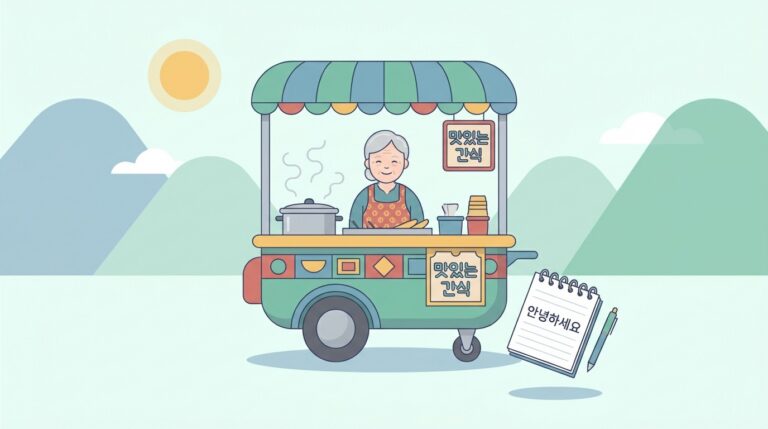
Say It Like a Native: The Secret to Warm Korean Pronunciation and Calling ‘Halmeoni’
Phase 1: Empathy (Real-Life Opening)
안녕하세요! 매일한글 에디터입니다.
Picture this: You are wandering through the bustling alleys of Gwangjang Market in Seoul on a crisp autumn evening. The intoxicating aroma of sizzling mung bean pancakes and sweet honey hotteok fills the chilly air. You approach a small stall run by an elderly lady with a bright floral visor and silver hair tied in a neat bun. You want to greet her warmly. You took notes in your beginner class, so you open your mouth: “HAL… MEO… NI!”
Suddenly, the word sounds chunky, loud, and strangely robotic in your throat. You freeze. Did it sound disrespectful? Why did it feel like three separate wooden blocks hitting the floor instead of that melodious, tender word you always hear in warm K-dramas like Hometown Cha-Cha-Cha or When the Camellia Blooms?
If you have ever tripped over batchim (final consonants) or hesitated to call an older person in Korea because you were terrified of mispronouncing it or causing offense, take a deep breath. You are definitely not alone! In fact, over 80% of our beginner students report feeling intimidated by pronouncing consecutive consonant sounds smoothly.
In this guide, we are not just memorizing sterile vocabulary. You will learn the exact acoustic secret to blending the liquid ‘ㄹ’ (rieul) into ‘ㅁ’ (mieum) effortlessly, discover when and how to address Korean elders without feeling awkward, and unlock the cultural superpower of Korean warmth (Jeong). By the time you finish this 5-minute read, you will be able to stroll into any local stall in Korea and greet an elder with authentic confidence and a warm smile!
Phase 2: Core Expressions Deep Dive
Let’s break down the essential building blocks for this situation. Notice how each expression connects sound and heart.
1. 할머니 (Halmeoni)
- Pronunciation: [Halmeoni] (Sound analogy: imagine saying “calm money” very gently, but replace the ‘c’ with a soft ‘h’—hahl-muh-nee)
- Meaning: Grandmother (Literal) vs. “Sweet grandmother / elder lady” (Everyday Warm Nuance)
- K-Culture Moment: In K-dramas, when an orphaned lead character wanders into a cozy market, the elderly street vendor pats their hand and says, “Eat up, my child.” The character softly replies, “할머니… (Halmeoni…)” with teary gratitude.
- Editor’s Insight: You do not have to be blood-related to use this word! While Western cultures rarely call a strange senior citizen “grandmother,” in Korea, calling an elder vendor “할머니” bridges generations instantly.
- Situation Spectrum: Casual: ✅ | Semi-formal: ✅ | Strict Business Formal: ⚠️ (Use ‘어르신’ [Eoreusin] in corporate settings)
- 🤔 Think About It: Why does Korean society comfortably use intimate family titles for neighborhood merchants? What does this say about how Koreans view community compared to your native culture?
2. 할머니, 안녕하세요! (Halmeoni, annyeonghaseyo!)
- Pronunciation: [Halmeoni, annyeonghaseyo!] (Sound analogy: Hahl-muh-nee, ahn-nyung-hah-seh-yoh)
- Meaning: “Grandmother, hello!” (Literal) vs. “Hello ma’am, wishing you peace!” (Polite Everyday Greeting)
- K-Culture Moment: The heartwarming neighborhood scenes in Reply 1988, where kids run through the alley greeting every elder sitting on the wooden benches outside their gates.
- Editor’s Insight: The tone makes all the difference here. Rather than a flat, robotic greeting, let your pitch rise slightly at the end of 할머니~ before gently lowering into 안녕하세요.
- Situation Spectrum: Casual: ⚠️ | Semi-formal: ✅ | Formal: ✅
- 🤔 Think About It: Notice that you put the title first before the greeting. How does placing someone’s social identity ahead of your greeting change the feeling of respect?
3. 할머니, 많이 파세요! (Halmeoni, mani paseyo!)
- Pronunciation: [Halmeoni, mani paseyo!] (Sound analogy: Hahl-muh-nee, mah-nee pah-seh-yoh)
- Meaning: “Grandmother, sell a lot!” (Literal) vs. “I wish you great business today!” (Heartfelt Parting Blessing)
- K-Culture Moment: When a warm customer pays for street food or fresh fruit at a traditional market stall and leaves with a bow, wishing the owner a prosperous day.
- Editor’s Insight: This is the ultimate insider phrase! Foreign travelers often say “안녕히 계세요” (goodbye), which is polite, but telling a vendor “많이 파세요!” instantly makes their face light up with an ear-to-ear grin.
- Situation Spectrum: Casual: ⚠️ | Semi-formal: ✅ | Formal: ✅
- 🤔 Think About It: Why do you think Korean wishing-well phrases often focus on abundance and commerce rather than just “have a nice day”?
Phase 3: Textbook Korean vs. Real Korean
Let’s see how textbook Korean sounds compared to what real Koreans actually say on the street:
Situation 1: Calling out to order food at a traditional stall
- 📖 Textbook Korean: 저기요, 주문할게요. (Jeogiyo, jumunhalgeyo. – Excuse me, I will order.)
- 🗣️ Real Korean: 할머니~ 여기 떡볶이 일인분 주세요! (Halmeoni~ yeogi tteokbokki il-inbun juseyo! – Grandma~ One serving of tteokbokki here, please!)
- 💡 Why the difference?: 저기요 sounds functional and a bit cold in a cozy mom-and-pop stall. Calling her 할머니 with a gentle melody instantly invites warmth and might even earn you an extra scoop of fish cakes!
Situation 2: Asking if a seat is available near an elder
- 📖 Textbook Korean: 여기 앉아도 됩니까? (Yeogi anjado doemnijkka? – Is it permissible to sit here?)
- 🗣️ Real Korean: 할머니, 여기 앉아도 돼요? (Halmeoni, yeogi anjado dwaeyo? – Grandma, may I sit here?)
- 💡 Why the difference?: The formal -mnikka ending sounds like an official military inspection. Beginners often overuse it. The polite -a/eo dwaeyo ending combined with a friendly smile sounds respectful yet approachable.
Phase 4: K-Culture Deep Dive & Non-Verbal Manners
4-1. Nunchi (눈치) & Body Language
When speaking to an elderly person in Korea, pronunciation is only half the magic; your body tells the rest of the story:
* The Two-Handed Habit: Whenever you hand cash, a debit card, or receive a bag of snacks, always support your right wrist or forearm with your left hand, or hold the item with both hands. Giving or taking with just one limp hand can look dismissive.
* The Soft 15-Degree Bow: You do not need to drop to the floor. A gentle dip of your neck and shoulders at about 15 to 30 degrees while saying 할머니, 안녕하세요 shows deep humility.
* Eye Contact Nunchi: Do not hold an intense, unblinking Western boardroom stare. Soften your gaze toward their shoulder or collarbone level while speaking, smiling gently with your eyes.
4-2. Cultural Code: The Magic of “Jeong” (정) and Age Sensitivity
In Korea, elderly women who have weathered decades of historic modern change are affectionately considered the matriarchs of street food and comfort cooking. However, here is a golden tip: Only call someone 할머니 if they are clearly in their late 60s, 70s, or older.
If a market lady is in her 50s or looks energetic and middle-aged, calling her 할머니 will trigger an instant internal sigh! In that case, the magic word is 이모 (Imo – Auntie) or 사장님 (Sajangnim – Boss/Proprietor). Reading the room (Nunchi) before choosing between 이모 and 할머니 is the mark of a true Korean culture master.
Phase 5: Real-Life Roleplay Scenario
Setting: A tiny, steamy bungeoppang (fish-shaped pastry) cart under an orange street tent near Jongno 3-ga on a cold evening.
Characters:
* Halmeoni (Park Sun-ja, 74): Wearing a thick woolen vest, expertly flipping crispy pastries on an iron mold.
* Alex (A1 Korean learner): Rubbing cold hands together, wanting to order two warm pastries.
Turn 1
Alex: 🎭 (Approaching with a polite 15-degree bow, voice soft and friendly)
할머니, 안녕하세요!
(Halmeoni, annyeonghaseyo!)
"Grandmother, hello!"

Turn 2
Halmeoni: 🎭 (Looks up, wiping flour from her hands, smiling broadly)
어머, 안녕! 총각 추운데 어서 와. 붕어빵 줄까?
(Eomeo, annyeong! Chonggak chuunde eoseo wa. Bungeoppang julkka?)
"Oh my, hello! Come in out of the cold, young man. Would you like some fish bread?"

Turn 3
Alex: 🎭 (Pointing gently with both hands toward the red bean pastries)
네! 팥 붕어빵 두 개 주세요.
(Ne! Pat bungeoppang du gae juseyo.)
"Yes! Two red bean pastries, please."

Turn 4
Halmeoni: 🎭 (Placing three piping hot pastries into a brown paper bag with tongs)
자, 여기 세 개 가져가. 하나는 서비스야!
(Ja, yeogi se gae gajyeoga. Hananeun seobiseuya!)
"Here, take three. One is on the house!"

Turn 5
Alex: 🎭 (Eyes lighting up with surprised gratitude)
우와, 할머니 감사합니다!
(Uwa, halmeoni gamsahamnida!)
"Wow, grandma, thank you so much!"

Turn 6
Alex: 🎭 (Extending 2,000 KRW cash with both hands)
여기 이천 원이에요.
(Yeogi icheon-won-ieyo.)
"Here is 2,000 won."

Turn 7
Halmeoni: 🎭 (Accepts the bill with a gentle nod and pats Alex's arm)
따뜻할 때 얼른 먹어, 감기 조심하고!
(Ttatteushal ttae eolleon meogeo, gamgi josimhago!)
"Eat it while it's hot, and don't catch a cold!"

Turn 8
Alex: 🎭 (Taking a step back, bowing respectfully with a big smile)
네, 할머니 많이 파세요!
(Ne, halmeoni mani paseyo!)
"Yes, grandmother, sell lots today!"
🔀 Interactive Branching Moment
Imagine after Turn 4, the grandma handed you the bag with an extra pastry. How should you react?
- Choice A: Say “안 돼 (An dwae – No you can’t)” and take out extra money to pay for the third one.
- Choice B: Smile warmly, clasp both hands, say “우와, 할머니 최고예요! 감사합니다!” and accept with both hands.
- Choice C: Take the bag with one hand while checking your smartphone with the other, saying nothing.
Feedback:
* Choice A [Risk]: While honest, aggressively refusing the free pastry (deom) rejects her affectionate gesture of Jeong. It makes the grandma feel awkward!
* Choice B [BEST]: Perfect! Acknowledging her kindness enthusiastically makes her day, and accepting with two hands honors the relationship.
* Choice C [Bad]: Disrespectful! Ignoring an elder who just gave you a gift breaks every rule of Korean etiquette.
Phase 6: 10-Second Emotion Shadowing Drill
Read these aloud while mimicking the emotion and respecting the pause slashes (/):
[😊 Warm and affectionate]
할머니~ / 안녕하세요!
(Halmeoni~ / annyeonghaseyo!)
Editor’s cue: Glide the ‘Hal’ into ‘meo’ like melted butter. No jerky stops!-
[🥺 Heartfelt and genuinely touched]
우와… / 할머니, / 정말 감사해요!
(Uwa… / halmeoni, / jeongmal gamsahaeyo!)
Editor’s cue: Drop your shoulders and let a breath of pure gratitude out on ‘정말’. -
[☀️ Bright and cheerful blessing]
날씨 추운데 / 할머니, 많이 파세요!
(Nalssi chuunde / halmeoni, mani paseyo!)
Editor’s cue: Keep the energy upbeat and vibrant on ‘많이 파세요!’.
Phase 7: K-Culture Mini Dictionary
-
할머니 (Halmeoni)
- Meaning: Grandmother / Elderly female stranger.
- Real-life use: Used to address women approximately 65-70+ years old in neighborhood, market, or family settings with deep warmth.
- 정 (Jeong)
- Meaning: Deep communal affection, emotional bond, and unspoken care.
- Real-life use: The intangible feeling when a market vendor gives you free food or when a Korean neighbor checks if you have eaten.
- 덤 (Deom)
- Meaning: A free extra item or bonus portion given out of generosity.
- Real-life use: At traditional produce and street food stalls, getting an extra tangerine or pancake represents deom.
- 어르신 (Eoreusin)
- Meaning: Respected elder (Honorific term).
- Real-life use: A formal, deeply polite title used in subway cars, community centers, or news broadcasts when referring to seniors whose exact kinship relation is not personal.
Phase 8: Traveler’s Survival Kit
Top 3 Survival Expressions for Traditional Markets
- 할머니, 이거 얼마예요? (Halmeoni, igeo eolmayeyo?)
- Meaning: Grandma, how much is this?
- Pro Tip: Point right at the item with your open palm facing upward rather than an aggressive single index finger.
- 할머니, 카드 돼요? (Halmeoni, kadeu dwaeyo?)
- Meaning: Grandma, do you take cards?
- Pro Tip: Many tiny street carts only take cash or account transfers. Having a few 1,000 KRW bills ready is always welcome.
- 할머니, 진짜 맛있어요! (Halmeoni, jinjja masisseoyo!)
- Meaning: Grandma, this is truly delicious!
- Pro Tip: Say this while taking your second bite. Watch her instantly offer you more soup or napkins!
Editor’s Travel Note
- Navigation Guide: When exploring traditional market alleys in Seoul, Google Maps often gets lost. We strongly recommend downloading the Naver Map app for walking directions in traditional alleys to find hidden gem food carts.
- Cash is King: While almost all stores in Seoul take credit cards, tiny elderly vendors operate on slim margins. Keep 5,000 to 10,000 KRW in cash in your pocket when visiting traditional outdoor markets.
Phase 9: “One Step Deeper” (Reflective Essay)
In many Western cultures, addressing an unfamiliar older adult on the street as “grandmother” would sound bizarre, if not mildly insulting. Yet in Korea, kinship terminology expands outward to wrap the entire neighborhood into an extended family unit.
When you utter the word 할머니, you are not identifying a biological ancestor; you are acknowledging a shared cultural narrative of respect, maternal survival, and community warmth. By stepping across that linguistic bridge, you stop being a detached tourist and become a welcome guest in their world.
💬 Your Turn: Does your native language have words that allow you to address strangers as family? How does calling an elder “Grandmother” make you feel? Share your thoughts in the comments below!
Phase 10: FAQ & Avoiding Misunderstandings
Q: What if the woman looks to be around 55 or 60? Should I still call her 할머니?
A: No, absolutely avoid that! If an elder woman feels you are aging her prematurely, she won’t be happy. If she looks under 65, use 이모 (Imo – Auntie) or 사장님 (Sajangnim – Boss/Store owner). When in doubt, always default to a younger title!
Q: Why do people pronounce 할머니 with a soft transition instead of a sharp pause?
A: In Korean phonology, when the bottom consonant ‘ㄹ’ meets the nasal consonant ‘ㅁ’, your tongue smoothly slides along the roof of your mouth without blocking the airflow completely. Don’t say “Hal! Meo! Ni!”—think of it as singing one continuous word: Hahl-meo-ni.
Q: Can I use 할머니 in a modern high-end department store or hospital?
A: In modern, professional environments, it is much more polite and appropriate to use 손님 (Sonnim – Customer) or refer to older patients/patrons as 어르신 (Eoreusin – Respected Elder). Save 할머니 for traditional markets, neighborhoods, and close family contexts.
🚨 Common Mistakes Warning Board
- Mistake: Calling a middle-aged restaurant lady “할머니”
- Why it hurts: She will feel perceived as very old.
- Correct Action: Call her 이모님 (Imo-nim) or 사장님 (Sajangnim).
- Mistake: Handing cash with one hand while looking away
- Why it hurts: It appears arrogant and disrespectful to Korean elders.
- Correct Action: Hold your payment with both hands and make gentle eye contact with a slight head bow.
- Mistake: Pronouncing the ‘ㄹ’ like an American hard ‘R’
- Why it hurts: Saying “Har-meo-ni” makes the word sound muffled and unnatural.
- Correct Action: Touch the tip of your tongue lightly behind your upper front teeth, just like a soft ‘L’ in calm.
Phase 11: Action Mission & Engagement
Ready to put your learning into practice? Take on today’s Daily Hangul Challenge:
- 🥉 Bronze Level (Solo Practice): Record a 10-second voice memo saying “할머니, 안녕하세요!” with a smooth, flowing liaison between 할 and 머. Listen back to ensure it doesn’t sound choppy!
- 🥈 Silver Level (Social Learning): Leave a comment below introducing your favorite Korean dish you want to order from a 할머니.
- 🥇 Gold Level (Real-World Action): The next time you visit a Korean bakery, restaurant, or trip to Seoul, greet an elder vendor using two hands and the greeting “할머니, 많이 파세요!”
🎮 K-Culture Mission: Watch an episode of Reply 1988 or Hometown Cha-Cha-Cha. Listen closely to how the main characters pronounce 할머니. Can you catch how their intonation rises when they call her warmly?
Phase 12: Interactive Quiz Challenge
Test your knowledge with these three rapid-fire questions!
Question 1: Situational Judgment
You walk into a quiet Gimbap shop in Seoul. The lady behind the counter appears to be in her mid-50s, wearing stylish sneakers and an apron. What is the most culturally savvy way to address her?
* A) 할머니! (Halmeoni!)
* B) 사장님~ (Sajangnim~) or 이모님~ (Imo-nim~)
* C) 야! (Ya!)
👉 Click here to reveal the answer!
Correct Answer: B
Explanation: Calling a woman in her 50s 할머니 will break her heart! Always use 사장님 (Boss) or 이모님 (Auntie) for middle-aged women running eateries. 야! is extremely rude slang used only with peers or younger childhood friends.
Question 2: Fill-in-the-Blank
When leaving a traditional market stall, what is the insider blessing you can give an elderly vendor to wish them great sales?
“할머니, _____ 파세요! (Halmeoni, _____ paseyo!)”
👉 Click here to reveal the answer!
Correct Answer: 많이 (Mani – a lot)
Explanation: 많이 파세요! literally means “Sell a lot!” It is the most beloved Korean greeting when parting from market vendors.
Question 3: True or False (Manners & Pronunciation)
True or False: When handing money to a grandmother at a street cart, it is completely acceptable and polite to hand the bill with only your left hand as long as you say “thank you.”
👉 Click here to reveal the answer!
Correct Answer: False!
Explanation: In Korean etiquette, using one hand—especially when offering payment to an elder—can appear casual and dismissive. Always hand money with both hands or support your right wrist with your left hand.







