

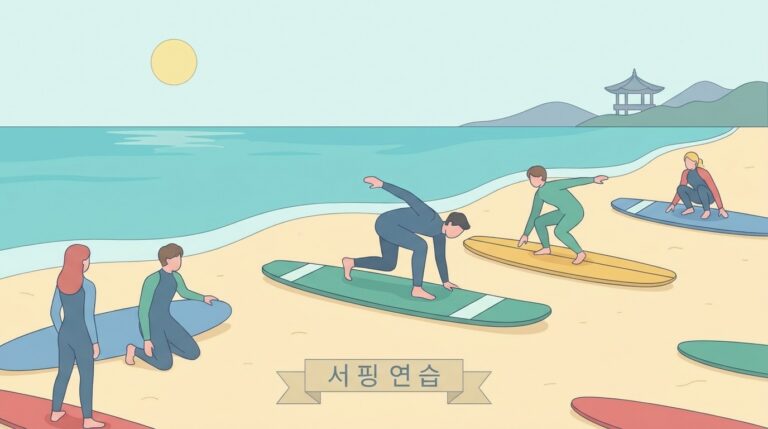
Master Korean Surf Drills on the Sand: Safety Briefings and Pop-Up Action
Phase 1: 공감 (Story-Driven Opening)
안녕하세요! 매일한글 에디터입니다.
Imagine this: you are standing under the blazing summer sun on Jukdo Beach in Yangyang (양양), often dubbed the surf capital of Korea. The salty breeze whips through your hair, and you are surrounded by colorful boards planted firmly in the golden sand. You came ready to glide across the East Sea like a cool K-drama lead, but before anyone even touches the water, the instructor blows a sharp whistle and hands you a clipboard titled “안전 서약서” (Safety Waiver). Next thing you know, you are lying flat on your stomach on an abrasive foam surfboard, baking in the midday heat, desperately trying to coordinate your arms and feet while the instructor shouts rapid-fire commands: “패들링, 패들링! 자, 테이크오프!”
Many of our intermediate learners tell us: “I studied grammar for two years, but when the surf instructor shouted on the windy beach, I completely froze! I didn’t know whether to jump up or sign my name!” You are not alone. Marine sports in Korea have their own dynamic rhythm, blending international surf jargon with sharp, encouraging Korean imperatives. In this guide, built from real beachside training sessions and feedback from hundreds of our global learners, you will master the exact phrases you need to breeze through safety briefings, understand sand drills (지상 훈련), and jump to your feet with total confidence.
Phase 2: 핵심 표현 3선 심층 분석
1. 엎드려서 패들링할게요 (Eopdeuryeoseo paedeulling-halgeyo)
- Pronunciation: [Eop-deu-ryeo-seo pae-deul-ling-hal-ge-yo] (Sounds like up-dew-ryuh-suh followed by paddling with a crisp Korean ‘p’ and ‘-hal-geh-yo’)
- Meaning: Literal: “I will lie prone and paddle.” | Real Nuance: “Get down on your stomach on the board, and let’s start paddling together!”
- K-Culture Moment: On variety shows like I Live Alone (나 혼자 산다), when cast members head out to Gangwon-do for summer retreats, the patient yet strict surf coach inevitably barks this exact phrase during the land-based warm-up.
- Editor’s Insight: The connective
-어서/아서expresses sequential action—first you lie down flat (엎드리다), and then you paddle. In surf instruction, instructors often soften commands using-할게요(“We will do this”) to sound friendly yet decisive. - Situation Spectrum:
- Casual (to a surfing buddy): 엎드려서 패들링해! (Eopdeuryeoseo paedeulling-hae!) ✅
- Semi-formal (to/from instructor): 엎드려서 패들링할게요. (Eopdeuryeoseo paedeulling-halgeyo.) ✅
- Formal (official safety broadcast): 엎드린 자세로 패들링을 실시해 주십시오. (Eopdeurin jasero paedeullingeul silshihae jusipsio.) ⚠️
- 🤔 Think About It: Notice how English instructors say “Paddle out!”, focusing on the movement forward, while Korean instructors emphasize body posture first (
엎드려서). Why do you think Korean sport instructions prioritize body positioning before the actual movement?
2. 구령에 맞춰서 테이크오프 해보세요 (Guryeong-e matchwoseo teikeu-opeu haeboseyo)
- Pronunciation: [Gu-ryeong-e mat-chwo-seo te-i-keu-o-peu hae-bo-se-yo] (Think of goo-ryung-eh, then match-wo-suh, followed by the loanword take-off + hae-bo-seh-yo)
- Meaning: Literal: “Try doing a takeoff in rhythm with the call.” | Real Nuance: “When I count ‘one, two, pop!’, jump to your feet on the board in one smooth motion!”
- K-Culture Moment: Seen frequently in sports-themed YouTube vlogs where Korean celebrities visit Yangyang or Jeju Island. The trainer claps rhythmically (“하나, 둘, 셋!”) before demanding an explosive pop-up.
- Editor’s Insight:
구령(cadence/count) stems from collective training culture. Korean instructors heavily rely on synchronized counts (구령) to ensure everyone moves with the same explosive timing before hitting turbulent waves. - Situation Spectrum:
- Casual: 구령에 맞춰서 뛰어봐! (Guryeong-e matchwoseo ttwieobwa!) ⚠️
- Semi-formal: 구령에 맞춰서 테이크오프 해보세요. (Guryeong-e matchwoseo teikeu-opeu haeboseyo.) ✅
- Formal: 교관의 구령에 맞춰 동작을 실시하십시오. (Gyogwan-ui guryeong-e matchwo dongjageul silshihasipsio.) 🚫 (Too military-like for casual surfing)
- 🤔 Think About It:
맞추다means “to match” or “to synchronize.” Korean communal activities often highlight synchronicity over solo improvisation. How does synchronizing with a count make sports learning feel different from independent trial-and-error?
3. 서약서에 서명해 주세요 (Seoyakseo-e seomyeonghae juseyo)
- Pronunciation: [Seo-yak-seo-e seo-myeong-hae ju-se-yo] (Rhymes roughly with suh-yahk-suh-eh, then suh-myung-hae joo-seh-yo)
- Meaning: Literal: “Please sign the pledge document.” | Real Nuance: “Please sign this safety briefing and liability waiver before we head down to the beach.”
- K-Culture Moment: Before paragliding over Danyang or scuba diving off Jeju’s Seogwipo coast, every adventure travel reality show features the nervous cast sitting around a wooden desk filling out this solemn document.
- Editor’s Insight: While English-speaking regions use the term “liability waiver,” Korean resorts use
안전 서약서(Safety Pledge/Vow) or동의서(Consent Form). The word서약carries a psychological undertone of mutual responsibility and personal commitment to safety rules, rather than merely relinquishing legal liability. - Situation Spectrum:
- Casual: 여기에 이름 써줘. (Yeogie ireum sseojwo.) ⚠️ (Too informal for legal agreements)
- Semi-formal: 서약서에 서명해 주세요. (Seoyakseo-e seomyeonghae juseyo.) ✅
- Formal: 본 안전 서약서의 내용을 숙지하신 후 서명해 주시기 바랍니다. (Bon anjeon seoyakseo-ui naeyong-eul sukjihasin hu seomyeonghae jusigi baramnida.) ✅
- 🤔 Think About It: Why does Korean administration frame safety paperwork as a
서약(pledge/promise to follow rules) rather than solely focusing on financial/legal disclaimers? What does that say about social trust?
Phase 3: 교과서 한국어 vs 진짜 한국어
Situation 1: Asking the instructor to check your pop-up posture on the sand
- 📖 교과서 한국어: 제 서핑 자세가 올바른지 확인해 주시겠습니까? (Je seoping jasega olbareunji hwaginhae jusigesseumnikka? – “Would you please verify whether my surfing posture is correct?”)
- 🗣️ 진짜 한국어: 코치님, 제 테이크오프 자세 한번만 봐주실 수 있어요? (Kochinim, je teikeu-opeu jase hanbeonman bwajusil su isseoyo? – “Coach, could you check my pop-up posture just once?”)
- 💡 왜 다를까? Textbook Korean teaches stiff, formal verbs like
확인하다(to verify). On the beach, calling your instructor코치님(Coach) or강사님(Instructor) and using봐주세요(please take a look for me) feels naturally polite, warm, and proactive.
Situation 2: Acknowledging you understand the safety guidelines
- 📖 교과서 한국어: 저는 모든 안전 수칙을 완벽하게 이해하였습니다. (Jeoneun modeun anjeon suchigeul wanbyeokhage ihae-hayeosseumnida. – “I have comprehended all safety protocols flawlessly.”)
- 🗣️ 진짜 한국어: 네, 수칙 다 확인했고 바로 서명할게요! (Ne, suchik da hwaginhaetgo baro seomyeong-halgeyo! – “Yes, I’ve checked all the rules and I’ll sign right away!”)
- 💡 왜 다를까? Saying
완벽하게 이해하였습니다sounds like a written test certification. Real speakers express compliance warmly with다 확인했고 바로 서명할게요, showing both understanding and eagerness to get started.
Phase 4: K-Culture 딥다이브 & 비언어적 매너
4-1. 눈치 (Nunchi) & Sand-Drill Body Language
When participating in beach training on a Korean shore, eyes and body orientation matter just as much as spoken Korean.
* The Two-Handed Marker: When handing back the clipboard with your 안전 서약서, always pass it using both hands (두 손) or with your right hand supported lightly at the wrist by your left forearm. In sandy, breezy conditions, this prevents paper from flying away while honoring standard Korean hospitality etiquette.
* The Sand Sync (Nunchi): Don’t stand idle while others are paddling prone. When the coach shouts commands, drop your gaze down toward the center stringer of your surfboard. Avoid staring directly into fellow learners’ eyes if they tumble into the sand; instead, clap encouragingly and shout: “파이팅!” (Paiting! / Fighting!).
4-2. Culture Code Analysis: Yangyang and the “Surfing Lifestyle”
Until a decade ago, surfing was considered an exotic niche in Korea. Today, Yangyang’s Hajodae and Jukdo beaches have exploded into hip cultural landmarks, often called “Surfy Beach.” Young Koreans treat surfing not just as an extreme sport, but as an aesthetic lifestyle that embodies slow living, craft beer culture, and beach cleanups.
However, Korean beach operations are strictly regulated by the Korea Coast Guard (해양경찰). Signing waivers and undergoing mandatory land drills on the sand for at least 20 to 30 minutes is not optional—it is required by local safety ordinances. Approaching this land practice with enthusiasm instead of treating it as a delay to water time earns you immense respect from your local Korean surf coaches.
Phase 5: 실전 롤플레이 시나리오
Setting: Min-woo, an energetic local surf coach with sun-bleached hair and zinc sunscreen across his nose, is conducting ground training on Jukdo Beach with Alex, an intermediate learner.
Characters:
* Min-woo (민우 코치): Passionate surf coach who takes land pop-ups very seriously.
* Alex (알렉스): Enthusiastic traveler who wants to catch waves without wipeouts.
- Turn 1 (Min-woo):
- Korean: 자, 바다 들어가기 전에 모래 위에서 테이크오프 먼저 10번 연습할게요!
- Romanization: Ja, bada deureogagi jeone morae wieseo teikeu-opeu meonjeo yeol-beon yeonseeup-halgeyo!
- English: Alright, before we head into the ocean, we will practice pop-ups on the sand 10 times first!
🎭 행동 지문:(바닥에 놓인 소프트보드를 가리키며 호각을 분다 / Points at the foam board on the sand and blows his whistle)
- Turn 2 (Alex):
- Korean: 네! 먼저 보드 위에 엎드려서 패들링 자세 잡으면 되나요?
- Romanization: Ne! Meonjeo bodeu wieseo eopdeuryeoseo paedeulling jase jabeumyeon doenayo?
- English: Yes! Should I first lie prone on the board and get into paddling position?
🎭 행동 지문:(보드 중앙에 가슴을 대고 엎드리며 코치를 쳐다본다 / Lies down chest-first in the middle of the board and looks at the coach)
- Turn 3 (Min-woo):
- Korean: 맞아요! 가슴을 보드에서 살짝 들고, 시선은 바닥 말고 정면을 보세요.
- Romanization: Majayo! Gaseumeul bodeueseo saljjak deulgo, siseoneun badak malgo jeongmyeoneul boseyo.
- English: Exactly! Lift your chest slightly off the board, and look straight ahead, not down at the sand.
🎭 행동 지문:(알렉스의 등 쪽으로 다가와 허리 각도를 손으로 짚어준다 / Steps toward Alex’s back and lightly gestures toward the lower back angle)
- Turn 4 (Alex):
- Korean: 이렇게요? 생각보다 허리랑 팔에 힘이 많이 들어가네요.
- Romanization: Ireohgeyo? Saenggakboda heorirang pare himi mani deureoganeyo.
- English: Like this? It takes a lot more effort in my back and arms than I expected.
🎭 행동 지문:(팔을 크게 저으며 허리를 꼿꼿이 세우려고 애쓴다 / Paddles with big strokes while striving to keep the upper back arched)
- Turn 5 (Min-woo):
- Korean: 아주 좋아요! 제가 “하나, 둘, 셋!” 외치면 손으로 보드를 밀면서 발을 가슴 쪽으로 끌어당기세요.
- Romanization: Aju joayo! Jega “hana, dul, set!” oechimyeon soneuro bodeureul milmyeonseo bareul gaseum jjogeuro kkeureodang-giseyo.
- English: Very good! When I shout “one, two, three!”, push the board with your hands and pull your feet up toward your chest.
🎭 행동 지문:(모래 위에서 순식간에 일어서며 완벽한 테이크오프 시범을 보인다 / Pops up instantly on the sand to demonstrate a flawless stance)
- Turn 6 (Alex):
- Korean: 구령 들리면 바로 일어설게요. 코치님, 제 발 위치 한번만 봐주실 수 있어요?
- Romanization: Guryeong deullimyeon baro ireoseolgeyo. Kochinim, je bal wichi hanbeonman bwajusil su isseoyo?
- English: As soon as I hear the count, I’ll pop up. Coach, could you check my foot placement once?
🎭 행동 지문:(숨을 고르며 코치의 구령을 기다린다 / Catches breath while awaiting the coach’s call)
- Turn 7 (Min-woo):
- Korean: 자, 준비하시고… 하나, 둘, 셋, 테이크오프!
- Romanization: Ja, junbihasigo… hana, dul, set, teikeu-opeu!
- English: Ready… One, two, three, takeoff!
🎭 행동 지문:(박수를 짝 치며 큰 목소리로 호령한다 / Claps hands firmly and shouts out the cadence)
- Turn 8 (Alex):
- Korean: 얍! 오, 이번엔 보드 중심에 발이 제대로 놓인 것 같아요!
- Romanization: Yap! O, ibonen bodeu jungsime bari jedaero noin geot gat-ayo!
- English: Hup! Oh, this time I think my feet landed right on the surfboard’s sweet spot!
🎭 행동 지문:(낮은 기마자세로 균형을 잡으며 환하게 웃는다 / Balances in a low athletic squat and beams with a grin)
🔀 인터랙티브 분기점 (Interactive Choice)
After Alex lands the sand pop-up, Coach Min-woo wipes sweat from his forehead and asks:
“알렉스 씨, 서약서에 있는 리슈코드(Leash Cord) 안전 수칙도 다 읽으셨죠?” (Alex, you read the leash cord safety rule on the waiver, right?)
How should Alex respond?
- Choice A: “네, 리슈코드가 발목에 잘 묶여 있는지 확인했고, 물속에서도 절대 풀지 않을게요!” (Ne, risyukodeuga balmoge jal mukyeo inneunji hwaginhaetgo, mulsogeseodo jeoldae pulji aneulgeyo!)
- Choice B: “바다에선 귀찮으니까 파도 탈 때 그냥 풀면 안 돼요?” (Bada-eseon gwichaneunikka pado tal ttae geunyang pulmyeon an dwaeyo?)
- Choice C: “서약서 글씨가 너무 많아서 그냥 이름만 대충 썼어요.” (Seoyakseo geulssiga neomu manaseo geunyang ireumman daechung sseosseoyo.)
Feedback:
* Selection A (Best): 🌟 Outstanding! You validated safety compliance, proved you understood the waiver, and showed deep respect for water safety. Min-woo will gladly give you priority wave pushes!
* Selection B (Risk): ⚠️ Extreme danger! Unhooking a leash cord turns the surfboard into a 7-foot missile on crowded Korean beaches. The coach will give you a firm safety scolding before allowing you near the break.
* Selection C (Bad): 🚫 Disrespectful. Admitting you signed legal documents carelessly makes you look reckless. In Korea, taking safety waivers lightly is a red flag for tour operators.
Phase 6: 10초 감정 섀도잉 드릴
Practicing out loud with emotional intent cements muscle memory much faster than silent reading. Match the emotion and follow the / pause markers!
[🔥 비장하고 집중해서 / Solemn and deeply focused]- 모래 위에서 / 자세를 완벽하게 잡아야 / 파도 위에서 / 안 넘어져요.
- (Morae wieseo / jasereul wanbyeokhage jabaya / pado wieseo / an neomeojyeoyo.)
- “You have to lock in the posture on the sand / so you won’t fall / once you’re on the wave.”
[😊 기쁘고 활기차게 / Upbeat and energizing]- 코치님 구령에 맞춰서 / 다 같이 / 테이크오프 연습해 볼까요?
- (Kochinim guryeong-e matchwoseo / da gachi / teikeu-opeu yeonseubhae bolkkayo?)
- “Shall we practice the pop-up all together / to the coach’s count?”
[🌊 시원하고 자신감 넘치게 / Cool and full of surf stoke]- 패들링 힘차게 하고 / 파도 오면 / 바로 일어설 준비 완료!
- (Paedeulling himchage hago / pado omyeon / baro ireoseol junbi wallyo!)
- “Paddle with power / and when the swell hits / ready to pop up instantly!”
Phase 7: K-Culture 미니 사전
- 지상 훈련 (Jisang Hun-ryeon) | Ground / Land Drills
In sports, this refers to rehearsing movements on dry land before testing them in real environments. In Korean surfing, spending 20 minutes on지상 훈련on the sand is considered the mark of a reputable school. -
테이크오프 (Teikeu-opeu) | Surf Pop-Up (Takeoff)
The sudden transition from lying flat while paddling to standing sideways in an athletic surfing stance. Koreans universally use this English loanword rather than a coined Hangul equivalent. -
안전 서약서 (Anjeon Seoyakseo) | Safety Pledge / Liability Agreement
The mandatory paperwork signed prior to high-risk leisure activities (paragliding in Danyang, scuba in Jeju, or surfing in Yangyang) detailing personal medical history, liability acknowledgement, and obedience to coaches. -
리슈코드 (Risyukodeu) | Surfboard Leash Cord
The urethane cord securing the surfer’s ankle to the tail of the board. Surf instructors repeatedly stress: “리슈코드는 생명줄입니다” (Your leash cord is your lifeline).
Phase 8: 여행자를 위한 생존 키트
서바이벌 표현 TOP 3
-
서약서 어디에 서명하면 되나요?
Romanization: Seoyakseo eodie seomyeonghamyeon doenayo?
Pro Tip: Use this at the surf shop counter. Point politely with two hands toward the signature line. -
모래 위에서 자세 한 번만 다시 보여주세요.
Romanization: Morae wieseo jase han beonman dasi boyeojuseyo.
Pro Tip: If the pop-up foot motion felt too swift during the group drill, ask this. Korean coaches love attentive students who ask for technical re-demonstrations. -
패들링할 때 손가락은 모아야 하죠?
Romanization: Paedeulling-hal ttae songarageun moaya hajyo?
Pro Tip: Yes! Keeping fingers cupped/closed scoops more water. Asking technical confirmation in Korean earns instant street cred with instructors.
Editor’s Travel Note
- Booking Beach Transit: Getting to Yangyang from Seoul is easiest using the dedicated summer shuttle buses. You can check schedules and book through 네이버 지도 앱 다운로드 or search for “양양 서프 서핑 버스” on the express bus app.
- Digital Waivers & Identification: Almost all modern surf academies in Yangyang, Jeju, and Busan (Songjeong Beach) have switched to tablet-based electronic waivers. Bring your passport or Alien Registration Card (ARC), as Korean law requires matching ID verification with signed safety forms.
Phase 9: “한 발 더 깊이” (생각 질문)
In Western surf culture, surfing is often romanticized as ultimate personal freedom—just you, a solitary board, and the vast wilderness of the sea. However, when you step onto a Korean beach, you immediately notice a distinct layer of communal safety and collective duty. Group warm-ups are performed in unison, counts (구령) are shouted together, and safety waivers (서약서) are phrased as solemn commitments to maintain harmony and protect fellow beachgoers. This reflects Korea’s overarching civic mindfulness: individual enjoyment should never compromise collective safety.
💬 Your Turn: In your home country, do sports lessons emphasize individual exploration first, or synchronized group drills? How did you feel the first time you practiced sports movements in sync with others?
Phase 10: FAQ & 오해 방지
Q: Can I skip the ground training on the sand if I already know how to surf?
A: Generally, no! Even if you are an experienced surfer, Korean surf schools require all group session participants to participate in 지상 훈련 (sand drills) for insurance compliance. If you want to skip the sand lesson, you must book “보드 렌탈만” (Board Rental Only) and show proof of prior experience.
Q: What should I call the instructor? Is “선생님” okay or should I use “코치님”?
A: Both are grammatically correct and polite! However, on the beach, 코치님 (Coach) or 강사님 (Instructor) is far more natural and common than 선생님. Younger instructors in Yangyang love being addressed as 코치님!
Q: Does signing an “안전 서약서” mean the surf school takes zero responsibility if I get hurt?
A: No. The waiver acknowledges that surfing is inherently an adventure sport involving waves and ocean conditions. However, Korean commercial maritime safety laws still require all registered surf schools to hold mandatory commercial safety insurance covering student injuries caused by equipment failure or coach negligence.
🚨 흔한 실수 (Common Mistakes) 경고판
- Mistake: Shouting “서명했어요!” while waving the clipboard single-handedly from across the sand.
- Correct Action: Walk over to the instructor or front desk and hand the paper with both hands saying: “여기 서명했습니다!” (Yeogi seomyeong-haesseumnida!)
- Mistake: Saying “일어났어요!” instead of “테이크오프 했어요!” during surf talk.
- Correct Action: While
일어나다means to stand up, surfers specifically refer to popping up on a board as테이크오프(Takeoff). Using the specific term makes your conversation authentic.
- Correct Action: While
- Mistake: Looking down at your feet on the board while practicing prone paddling.
- Correct Action: Korean coaches will constantly remind you: “시선 정면!” (Look forward!). Keep your chin lifted and gaze fixed on the horizon.
Phase 11: 액션 미션 & 참여 유도
- 🥉 Bronze Mission (Solo Practice): Lie down on your living room rug or yoga mat. Practice lying prone, paddling with cupped hands, and popping up into a low surfing stance 5 times while shouting the cadence out loud: “하나, 둘, 셋, 테이크오프!”
- 🥈 Silver Mission (Social Audio Challenge): Record a 10-second voice memo practicing the phrase: “코치님, 구령에 맞춰서 테이크오프 연습해 볼게요!” Share it in your study group or save it in your notes app.
- 🥇 Gold Mission (Real Life / Beach Visit): Visit a water sports center, surfing shop, or diving club in Korea (or leave a Korean comment on a Korean surf school’s Instagram page). Ask: “초보자도 지상 훈련 받고 바다 들어갈 수 있나요?” (Can beginners enter the ocean after receiving ground training?)
🎮 K-Culture Mission: Search YouTube for “양양 서핑 브이로그” (Yangyang Surfing Vlog). Watch the first 5 minutes of any video and spot how many times the surf instructor shouts “패들링” or “일어서세요” during sand practice!
Phase 12: 인터랙티브 퀴즈 챌린지
Q1. Situational Judgment:
You are lying prone on your surfboard on the sand. The coach wants to check your posture before waves approach. What is the most polite and natural way to ask for feedback in real Korean?
(A) 내 자세가 좋은지 나쁜지 당장 평가해라.
(B) 코치님, 제 테이크오프 자세 한번만 봐주실 수 있어요?
(C) 서핑 서약서에 제가 이미 사인했습니다.
Q2. Fill-in-the-Blank:
Complete the coach’s instruction:
“제 ________에 맞춰서 하나, 둘, 셋 하면 일어나세요!”
(Hint: The word for rhythmic verbal count/cadence)
Q3. True or False:
In Korean leisure sports, an 안전 서약서 is purely a legal contract where participants give up all human rights, and instructors do not care whether you read it or not. (T/F)
👉 Click to reveal answers & explanations!
-
Q1 Answer: (B)
Explanation: (B) uses the natural, respectful phrasing “코치님, 제 … 자세 한번만 봐주실 수 있어요?” Option (A) uses rude impolite imperatives, and (C) is completely irrelevant to checking body posture. -
Q2 Answer: 구령 (Guryeong)
Explanation:구령is the vocal count (like “하나, 둘, 셋!”) used by coaches to coordinate simultaneous physical execution. -
Q3 Answer: False (F)
Explanation: An안전 서약서in Korea emphasizes personal and mutual commitment to collective safety regulations. Reputable schools take great care to explain the rules before allowing students into the sea.







