

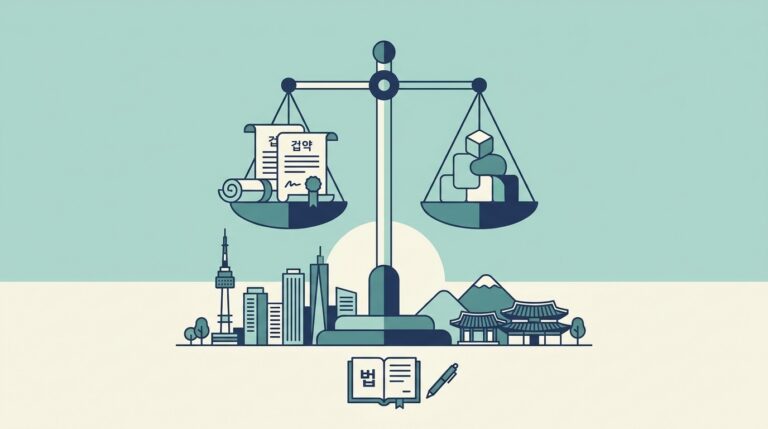
Balancing Contractual Justice: Understanding Good Faith and Changed Circumstances in Korean Civil Law
Phase 1: 공감 (Story-Driven Opening)
안녕하세요! 매일한글 에디터입니다.
If you have ever watched the acclaimed legal drama Hyena or observed the real-world high-profile disputes rocking the K-pop entertainment industry, you know that a signed contract is not always the end of the legal story in South Korea. Picture this: A talented independent indie producer signs an exclusive multi-year licensing contract with a major media conglomerate. On paper, both parties sat across a glass conference table in Gangnam, agreed to the terms, and stamped their registered personal seals (dojang). Classic Western classical liberal contract theory screams pacta sunt servanda—agreements must be kept, and freedom of contract reigns supreme!
Yet, fast-forward two years: algorithmic streaming monopolies drastically alter market valuations, the platform leverages its massive distribution channel to demand unilateral revisions, and the creator is suffocated by extreme liquidated damages. Is the creator bound to financial ruin simply because they “freely” signed the document?
Modern Korean civil jurisprudence provides a resounding, sophisticated answer: No. Behind the veil of formal freedom of contract lies crippling information asymmetry (jeongbo bidaeching) and severe disparities in bargaining power (gyoseopryeok gyeokcha). Today’s Korean civil law does not view contractual freedom as an absolute, untouchable idol. Instead, contemporary civil jurisprudence actively tempers rigid contractual formalisms with substantive justice (siljiljeok jeong-ui), invoking the bedrock doctrine of Good Faith (sin-uiseongsil-ui wonchik) and the dynamic relief valve known as Rebus Sic Stantibus or the Principle of Changed Circumstances (sajeongbyeon-gyeong-ui wonchik).
Whether you are preparing for the Korean Bar, navigating cross-border M&A in Seoul, drafting executive agreements, or simply aiming for absolute C2-level conceptual mastery of Korea’s legal and socio-political landscape, this guide is designed for you. Based on feedback from legal practitioners, advanced scholars, and foreign corporate counsel working in Korea, we will explore the high-register lexicon and nuanced socio-legal mindset that govern modern Korean contractual fairness. Let us dive in!
Phase 2: 핵심 표현 3선 심층 분석 (Deep Dive: Top 3 Core Legal Concepts)
1. 신의성실의 원칙 (Sin-uiseongsil-ui wonchik)
- Pronunciation: [Sin-ui-seong-sil-ui won-chik] (Sound analogy: Imagine whispering “seen-we-sung-sheel” followed by a crisp “one-cheek”)
- Meaning: Principle of Good Faith and Fair Dealing (Article 2, Paragraph 1 of the Korean Civil Act). Literally “Principle of Faithfulness and Sincerity.”
- K-Culture Moment: In courtroom K-dramas like Vincenzo or Law School, whenever an unscrupulous corporate conglomerate hides predatory terms behind microscopic fine print, the passionate attorney slams their brief on the bar and declares that such formalistic reliance constitutes an abusive violation of this fundamental norm.
- Editor’s Insight: Often abbreviated in Korean legal practice simply as 신칙 (Sinchik). This is not merely a moral platitude; it functions as an overarching constitutional-level mandate across private law. It dictates that every legal right must be exercised, and every obligation fulfilled, in a manner that honors mutual trust and substantive fairness.
- Situation Spectrum: Casual 🚫 | Semi-formal ⚠️ | Formal ✅ (Strictly suited for formal negotiations, court briefs, and academic legal essays).
- 🤔 Think About It: Does your native legal system prioritize literal enforcement of text over good-faith relational fairness, or does it empower judges to rewrite unconscionable contractual consequences?
2. 사정변경의 원칙 (Sajeongbyeon-gyeong-ui wonchik)
- Pronunciation: [Sa-jeong-byeon-gyeong-ui won-chik] (Sound analogy: “sah-jung-byun-gyung” flowing into “one-cheek”)
- Meaning: Principle of Change in Circumstances (Clausula Rebus Sic Stantibus).
- K-Culture Moment: Seen frequently in real estate investment or commercial lease disputes following unprecedented economic shocks (such as pandemic restrictions or historic urban redevelopments). A tenant or contractor argues that the foundational realities underpinning the contract have completely collapsed through no fault of their own.
- Editor’s Insight: For decades, the Korean Supreme Court maintained an extraordinarily conservative stance toward rescinding contracts based on changed circumstances out of fear of destabilizing legal predictability (beopjeok anjeongseong). However, recent landmark jurisprudence increasingly recognizes that forcing a party to remain bound when the fundamental premise has evaporated violates the good faith doctrine.
- Situation Spectrum: Casual 🚫 | Semi-formal ⚠️ | Formal ✅ (Essential for commercial arbitration, lease negotiations, and legal drafting).
- 🤔 Think About It: How does this balance between legal stability (beopjeok anjeongseong) and contractual justice (gyeyak jeong-ui) mirror the societal tension between order and empathy in modern Korea?
3. 실질적 정의와 교섭력의 불균형 (Siljiljeok jeong-ui-wa gyoseopryeok-ui bulgyunhyeong)
- Pronunciation: [Sil-jil-jeok jeong-ui-wa gyo-seop-ryeok-ui bool-gyun-hyeong] (Sound analogy: “seel-jeel-juck jung-ee wah gyo-sup-ryuk-ee bool-gyoon-hyung”)
- Meaning: Substantive justice and the disparity (imbalance) in bargaining power.
- K-Culture Moment: Prominently discussed in investigative documentaries like SBS Unanswered Questions (Geugeot-i Algo Sipda) regarding unfair standard-form agency contracts or franchise supply chain abuse (gapjil).
- Editor’s Insight: At the C2 level, using siljiljeok jeong-ui demonstrates an acute understanding of modern socio-legal transformation. It emphasizes that blind adherence to “formal equality” (hyeongsikjeok pyeongdeung) actually perpetuates exploitation when one party holds monopolistic informational or financial leverage.
- Situation Spectrum: Casual 🚫 | Semi-formal ⚠️ | Formal ✅ (The gold standard for policy debates, legal symposiums, and high-stakes executive dialogue).
- 🤔 Think About It: Why does modern Korean law view state judicial intervention not as an infringement on liberty, but as a prerequisite for genuine human freedom?
Phase 3: 교과서 한국어 vs 진짜 한국어 (Textbook vs. Real-World Legal Discourse)
Situation 1: Arguing that a contract clause is excessively unilateral and unconscionable
- 📖 교과서 한국어 (Textbook Korean):
“이 계약 조항은 일방적이라서 무효라고 생각합니다.”
(I think this contract clause is one-sided, so it is invalid.) - 🗣️ 진짜 한국어 (Real-World High-Register Korean):
“해당 특약은 구조적 정보 비대칭을 악용한 조항으로, 신의칙상 현저히 형평을 잃어 무효에 해당합니다.”
(Hae-dang teuk-yak-eun gu-jo-jeok jeong-bo bi-dae-ching-eul ak-yong-han jo-hang-eu-ro, sin-ui-chik-sang hyeon-jeo-hi hyeong-pyeong-eul ilh-eo mu-hyo-e hae-dang-ham-ni-da. / “This special covenant exploits a structural information asymmetry and is void under the principle of good faith for grossly undermining equitable fairness.”) - 💡 왜 다를까? (Why the difference?):
Textbook Korean uses juvenile verbs like saenggakamnida (I think) and ambiguous adjectives like ilbangjeok (one-sided). Elite legal and business communication requires precise jurisprudential tests, specifically referencing structural imbalances (gujojeok jeongbo bidaeching) and the equitable standard of good faith (sin-uichik).
Situation 2: Demanding contract modification due to macro-level environmental collapse
- 📖 교과서 한국어 (Textbook Korean):
“상황이 많이 바뀌었으니 계약 조건을 바꿔 주세요.”
(The situation changed a lot, so please change the contract terms.) - 🗣️ 진짜 한국어 (Real-World High-Register Korean):
“계약 성립 당시 예견할 수 없었던 현저한 사정변경이 발생한 바, 급부와 반대급부 간의 실질적 등가성을 회복하기 위한 조건 재교섭을 요청합니다.”
(Gye-yak seong-nip dang-si ye-gyeon-hal su eop-seot-deon hyeon-jeo-han sa-jeong-byeon-gyeong-i bal-saeng-han ba, geup-bu-wa ban-dae-geup-bu gan-ui sil-jil-jeok deung-ga-seong-eul hoe-bok-ha-gi wi-han jo-geon jae-gyo-seop-eul yo-cheong-ham-ni-da. / “As an extraordinary change of circumstances unforeseen at the contract’s inception has arisen, we formally request renegotiation to restore substantive equivalence between performance and counter-performance.”) - 💡 왜 다를까? (Why the difference?):
In high-stakes commercial disputes, you must demonstrate legal rigor. Invoking geupbu-wa banda-geupbu-ui deunggaseong (the equivalence between performance and counter-performance) grounds your claim firmly in established civil doctrine rather than appearing as emotional pleading.
Phase 4: K-Culture 딥다이브 & 비언어적 매너 (Cultural Deep Dive & Etiquette)
4-1. 눈치 (Nunchi) & Non-Verbal Etiquette in High-Stakes Negotiations
When negotiating contentious contractual terms in Korea, raw legal aggression is viewed as a sign of intellectual deficiency rather than strength. A master negotiator utilizes strategic nunchi:
* The Document Delivery Gesture: When submitting a contested addendum or contractual objection, always present the folder using both hands, thumbs securing the upper margins with a slight downward inclination of the head (approx. 15 degrees). This non-verbally signals: “I am asserting legal doctrine, not personal animosity.”
* Reading Strategic Silence: If opposing senior counsel closes the contractual folder and slightly tilts their head while exhaling softly (“Haa… geu bun-bun-eun…”), do not interrupt with rapid-fire legal counterarguments. This physical posture indicates internal recognition of your substantive justice claim, but an existential conflict with their institutional internal approvals. Allow a 3-second silence before offering a face-saving procedural pathway.
4-2. Cultural Code Analysis: The Fall of Gapjil and Standard Agency Forms
In Korea, the tension between formal contractual freedom and substantive justice has manifested intensely within the entertainment sector. For decades, rookie artists signed long-term agreements colloquially labeled noye gyeyak (slave contracts). Major agencies justified them under freedom of contract: “Both parties agreed, and the agency assumed massive early investment risks.”
However, the Fair Trade Commission (공정거래위원회) and the judiciary intervened, establishing standard form exclusive contracts (pyojun jeonsok gyeyakseo). This state intervention was celebrated culturally because Korean civil consciousness places profound value on social equity and moral reciprocity. In the popular imagination—exemplified in dramas such as Queenmaker or corporate webtoons—unrestrained contractual dominance without good faith is recognized as gapjil (abuse of power by the dominant party). Thus, invoking substantive justice aligns directly with modern Korea’s pervasive cultural crusade for institutional fairness.
Phase 5: 실전 롤플레이 시나리오 (Real-World Roleplay Simulation)
Setting: A minimalist, wood-paneled executive conference room on the 38th floor of a high-rise in Yeouido, Seoul.
Characters:
* Director Park (박 이사): Senior in-house counsel for a major web-platform conglomerate, representing established corporate legal stability.
* Attorney Min-woo (민우 변호사): Outside legal counsel representing an independent digital content production studio.
- Turn 1 (Director Park):
민우 변호사님, 계약서 제14조를 보시면 납기 지연에 따른 위약벌 규정이 명시되어 있습니다. 계약 자유의 원칙상 문언 그대로 이행되어야 합니다.
(Min-u byeon-ho-sa-nim, gye-yak-seo je-sip-sa-jo-reul bo-si-myeon nap-gi ji-yeon-e tta-reun wi-yak-beol gyu-jeong-i myeong-si-doe-eo it-seum-ni-da. Gye-yak ja-yu-ui won-chik-sang mun-eon geu-dae-ro i-haeng-doe-eo-ya ham-ni-da.)
🎭 [Tapping the glossy printed contract firmly with his Montblanc fountain pen, eyes locked with unyielding composure]
“Attorney Min-woo, if you look at Article 14 of the contract, the penalty clause for delayed delivery is explicitly stated. Under the principle of freedom of contract, it must be executed verbatim according to the text.” -
Turn 2 (Attorney Min-woo):
이사님 말씀도 일리가 있습니다만, 형식적 문언에만 매몰되는 것은 현대 민법의 본령인 실질적 정의에 부합하지 않습니다.
(I-sa-nim mal-ssum-do il-li-ga it-seum-ni-da-man, hyeong-sik-jeok mun-eon-e-man mae-mol-doe-neun geos-eun hyeon-dae min-beop-ui bon-ryeong-in sil-jil-jeok jeong-ui-e bu-hap-ha-ji an-seum-ni-da.)
🎭 [Holding the document steadily with both hands, nodding respectfully before delivering a measured response]
“Director Park, your point is well-taken, but becoming entirely buried in formal phrasing fails to conform with substantive justice—the true essence of modern civil jurisprudence.” -
Turn 3 (Director Park):
하지만 법적 안정성을 도외시한 채 당사자가 자발적으로 날인한 계약의 구속력을 흔든다면, 거래 질서 자체가 훼손되지 않겠습니까?
(Ha-ji-man beop-jeok an-jeong-seong-eul do-oe-si-han chae dang-sa-ja-ga ja-bal-jeok-eu-ro nal-in-han gye-yak-ui gu-sok-ryeok-eul heun-deun-da-myeon, geo-rae jil-seo ja-che-ga hwe-son-doe-ji an-gess-seum-ni-kka?)
🎭 [Leaning back slightly, crossing his arms with a skeptical furrow of his brow]
“However, if we compromise the binding force of a contract voluntarily stamped by the parties while disregarding legal stability, would that not undermine transactional order itself?” -
Turn 4 (Attorney Min-woo):
물론 법적 안정성은 존중되어야 합니다. 그러나 이번 사안은 플랫폼 측의 일방적인 알고리즘 개편이라는 불가항력적 사정변경에서 비롯되었습니다.
(Mul-ron beop-jeok an-jeong-seong-eun jon-jung-doe-eo-ya ham-ni-da. Geu-reo-na i-beon sa-an-eun peul-laet-pom cheuk-ui il-bang-jeok-in al-go-ri-deum gae-pyeon-i-ra-neun bul-ga-hang-ryeok-jeok sa-jeong-byeon-gyeong-e-seo bi-rot-doe-eot-seum-ni-da.)
🎭 [Maintaining steady, polite eye contact, laying out the comparative analytics data gently on the table]
“Of course legal stability must be respected. However, this issue stems from an act of force majeure—a drastic change of circumstances caused by your platform’s unilateral algorithmic restructuring.” -
Turn 5 (Director Park):
알고리즘 최적화는 통상적인 사업 환경의 변화일 뿐입니다. 이를 사정변경으로까지 포섭하기에는 법리적 무리가 있어 보이는데요.
(Al-go-ri-deum choe-jeok-hwa-neun tong-sang-jeok-in sa-eop hwan-gyeong-ui byeon-hwa-il ppun-im-ni-da. I-reul sa-jeong-byeon-gyeong-eu-ro-kka-ji po-seop-ha-gi-e-neun beop-ri-jeok mu-ri-ga it-seo bo-i-neun-de-yo.)
🎭 [Taking off his glasses, wiping them methodically as a tactical pause to recalculate]
“Algorithm optimization is merely an ordinary shift in the business environment. Subsuming this under the doctrine of changed circumstances appears legally excessive.” -
Turn 6 (Attorney Min-woo):
통상적 범위를 넘어선 중대한 정보 비대칭 상태에서 체결되었고, 현 상태의 강요는 신의칙상 감내할 수 없는 현저한 불공정을 초래합니다.
(Tong-sang-jeok beom-wi-reul neo-meo-seon jung-dae-han jeong-bo bi-dae-ching sang-tae-e-seo che-gyeol-doe-eot-go, hyeon sang-tae-ui gang-yo-neun sin-ui-chik-sang gam-nae-hal su eop-neun hyeon-jeo-han bul-gong-jeong-eul cho-rae-ham-ni-da.)
🎭 [Speaking with quiet conviction, placing his index finger gently beside the critical clause]
“The agreement was executed under critical information asymmetry exceeding reasonable scope, and enforcing it now causes gross, intolerable unfairness under the principle of good faith.” -
Turn 7 (Director Park):
그렇다면 민우 변호사님 측에서 생각하시는 합리적인 절충선은 구체적으로 무엇입니까?
(Geu-reoh-da-myeon min-u byeon-ho-sa-nim cheuk-e-seo saeng-gak-ha-si-neun hap-ri-jeok-in jeol-chung-seon-eun gu-che-jeok-eu-ro mu-eot-im-ni-kka?)
🎭 [Putting his glasses back on and leaning forward with both hands on the table, signaling a shift toward compromise]
“Then, Attorney Min-woo, what specific, reasonable compromise does your side envision?” -
Turn 8 (Attorney Min-woo):
위약벌 조항을 면제하고, 변화된 시장 환경에 맞추어 상호 급부의 균형을 도모하는 변경 합의서 체결을 제안합니다.
(Wi-yak-beol jo-hang-eul myeon-je-ha-go, byeon-hwa-doen si-jang hwan-gyeong-e mat-chueo sang-ho geup-bu-ui gyun-hyeong-eul do-mo-ha-neun byeon-gyeong hap-ui-seo che-gyeol-eul je-an-ham-ni-da.)
🎭 [Offering a crisp, warm, and professional smile, extending the revised memorandum of understanding]
“We propose waiving the penalty clause and executing an amended agreement that restores equilibrium between reciprocal obligations to reflect the transformed market reality.”
🔀 인터랙티브 분기점 (Interactive Decision Point)
Imagine Director Park hesitates after Turn 8. How should Attorney Min-woo close the argument?
- Choice A (Aggressive Litigious Route): “합의하지 않으시면 공정거래위원회 제소 및 민법상 불공정 법률행위 소송을 즉각 제기하겠습니다.” (If you don’t settle, we will immediately file a complaint with the Fair Trade Commission and initiate litigation for unfair legal acts under civil law.)
- Choice B (Doctrinal & Relational Balance Route): “소송을 통한 승패보다는, 장기적 파트너십과 신의칙에 기반한 자율적 조정이 양사 모두의 법적 리스크를 최소화하는 길입니다.” (Rather than winning or losing through litigation, voluntary mediation rooted in long-term partnership and good faith minimizes legal risk for both companies.)
- Choice C (Passive Deferential Route): “저희 제작사가 형편이 너무 어려우니, 대기업의 너그러운 배려를 간곡히 부탁드립니다.” (Our production studio is in dire financial straits, so we earnestly beg for the generous consideration of a major conglomerate.)
Analysis & Feedback:
* Choice A: [Risk] While asserting legal remedies is legitimate, dropping an immediate adversarial ultimatum in a Korean boardroom terminates relational harmony and causes the conglomerate’s legal team to entrench their formal defenses.
* Choice B: [Best!] Perfect C2 socio-legal balance! It highlights procedural rationality, risk mitigation, and the core philosophy of sin-uichik while preserving corporate face and mutual strategic interests.
* Choice C: [Bad] Subverting rigorous legal rights into emotional begging (eup-so) destroys your bargaining leverage and concedes that your civil law claims lack structural validity.
Phase 6: 10초 감정 섀도잉 드릴 (10-Second Emotional Shadowing Drill)
Practice reading these sentences aloud, adhering strictly to the emotional markers and natural breath pauses (/):
[⚖️ 단호하고 논리정연하게 - Firm and Razor-Sharp Logic]
“형식적 계약의 자유만을 고수하는 것은 / 실질적 정의를 훼손하고 / 당사자 간의 구조적 불평등을 방치하는 결과를 초래합니다.”
(Hyeong-sik-jeok gye-yak-ui ja-yu-man-eul go-su-ha-neun geos-eun / sil-jil-jeok jeong-ui-reul hwe-son-ha-go / dang-sa-ja gan-ui gu-jo-jeok bul-pyeong-deung-eul bang-chi-ha-neun gyeol-gwa-reul cho-rae-ham-ni-da.)
“Adhering solely to formal freedom of contract / undermines substantive justice / and results in leaving structural inequality between parties unaddressed.”-
[🤝 온건하면서도 설득력 있게 - Measured, Conciliatory, and Persuasive]
“사정변경의 원칙을 적용하여 / 급부와 반대급부 사이의 등가성을 회복하는 것이야말로 / 진정한 신의성실의 구현입니다.”
(Sa-jeong-byeon-gyeong-ui won-chik-eul jeok-yong-ha-yeo / geup-bu-wa ban-dae-geup-bu sa-i-ui deung-ga-seong-eul hoe-bok-ha-neun geos-i-ya-mal-lo / jin-jeong-han sin-ui-seong-sil-ui gu-hyeon-im-ni-da.)
“Applying the doctrine of changed circumstances / to restore equivalence between performance and counter-performance / is the true realization of good faith.” -
[🏛️ 중후하고 무게감 있게 - Authoritative, Gravitas-Laden Judiciousness]
“법적 안정성이라는 미명 하에 / 정보 비대칭으로 인한 불공정을 묵인하는 판결은 / 사법의 신뢰를 무너뜨립니다.”
(Beop-jeok an-jeong-seong-i-ra-neun mi-myeong ha-e / jeong-bo bi-dae-ching-eu-ro in-han bul-gong-jeong-eul muk-in-ha-neun pan-gyeol-eun / sa-beop-ui sin-roe-reul mu-neo-tteu-rim-ni-da.)
“Judgments that tolerate unfairness born of information asymmetry / under the pretext of legal stability / erode public confidence in the judiciary.”
Phase 7: K-Culture 미니 사전 (Mini-Dictionary of Critical Legal Terms)
-
갑을관계 (Gabeul-gwangye)
- Literal Translation: Relationship between Party Alpha (Gap) and Party Beta (Eul).
- Contextual Meaning: The stark structural and socio-economic hierarchy between the dominant contracting entity (Gap) and the dependent, vulnerable contractor (Eul). While the terms originate neutrally from the Ten Heavenly Stems (Cheongan), it culturally signifies the battleground against arbitrary coercion.
- 계약자유의 원칙 (Gyeyak-jayu-ui wonchik)
- Literal Translation: Principle of Freedom of Contract.
- Contextual Meaning: The bedrock pillar of private autonomy (sajeok jachi) derived from 19th-century German pandectist jurisprudence, entitling parties to conclude contracts, select counterparts, and determine content freely—now understood in Korea as conditional upon ethical constraints.
- 실질적 정의 (Siljiljeok jeong-ui)
- Literal Translation: Substantive Justice.
- Contextual Meaning: A concept counteracting mere procedural or formal legality (hyeongsikjeok beopchi). It empowers adjudicators to inspect the concrete socio-economic reality of the parties to ensure the outcome is genuinely moral, equitable, and protective of human dignity.
- 약관규제법 (Yakkwan-gyuje-beop)
- Literal Translation: Act on the Regulation of Terms and Conditions.
- Contextual Meaning: Korea’s powerful statutory weapon against take-it-or-leave-it adhesion contracts. Under this law, any clause unilaterally favoring the enterprise or unfairly restricting consumer/partner rights is deemed null and void pursuant to the overarching doctrine of good faith.
Phase 8: 여행자를 위한 생존 키트 (Expat & Traveler Survival Kit)
Even non-lawyers routinely encounter Korean civil law realities—most notably when signing employment agreements, private academy (hagwon) contracts, or residential real estate leases (jeonse / wolse).
Survival Expressions TOP 3:
- “계약서 문언 중 수정이 필요한 특약 사항이 있습니다.”
(Gye-yak-seo mun-eon jung su-jeong-i pil-yo-han teuk-yak sa-hang-i it-seum-ni-da.)
Pro Tip: Use this when reviewing a lease or work agreement to politely flag unilateral liability clauses without sounding confrontational. -
“이 조항은 상호 대등한 교섭에 기초한 것으로 보기 어렵습니다.”
(I jo-hang-eun sang-ho dae-deung-han gyo-seop-e gi-cho-han geos-eu-ro bo-gi eo-ryeop-seum-ni-da.)
Pro Tip: A sophisticated, indisputable objection to raise when an employer or landlord adds unanticipated restrictive covenants after initial terms were verbally agreed upon. -
“사정변경에 따른 보증금 및 차임 조정을 협의하고 싶습니다.”
(Sa-jeong-byeon-gyeong-e tta-reun bo-jeung-geum mit cha-im jo-jeong-eul heop-ui-ha-go sip-seum-ni-da.)
Pro Tip: Crucial for commercial tenants or apartment renters facing localized macroeconomic downturns or neighborhood property devaluation seeking lawful rent adjustments.
Editor’s Living Note:
When signing residential or business agreements in South Korea, never rely solely on a PDF signature or verbal goodwill. Always cross-reference statutory protections via the official Korea National Legal Information Center mobile search portal, and ensure that real estate leases receive an official 확정일자 (Hwakjeong-ilja / Confirmed Fixed Date) at the local community service center (Jumin Center) on the very day of signing to guarantee your statutory priority repayment rights (useon-byeonje-gwon) against competing creditors.
Phase 9: “한 발 더 깊이” (Reflective Humanities Essay)
The Korean Synthesis of Law and Relational Justice
In Western classical legal philosophy, the sanctity of promises is frequently perceived as an extension of individualist autonomy: you are an atomic individual, you exercised your sovereign will, and you must bear the consequences. However, Korean civil jurisprudence has undertaken a profound cultural and constitutional evolution. Rooted in both traditional communitarian norms of reciprocal humaneness (In / 仁) and Article 119, Paragraph 2 of the Korean Constitution—which explicitly mandates state regulation and coordination to prevent market domination and maintain economic democratization—Korean private law refuses to detach contracts from morality.
To the Korean legal mind, a contract that ignores an overwhelming disparity in bargaining power is not a manifestation of freedom, but a perversion of it. The principle of good faith (sin-uiseongsil) is therefore the judiciary’s dynamic spiritual instrument: it transforms formal, cold, black-letter statutes into living, breathing justice. By insisting that rights cannot be exercised without consideration for the other party’s vulnerability, modern Korean law harmonizes the predictability demanded by a world-class capitalist powerhouse with the profound moral obligation of collective coexistence.
💬 Your Turn:
Does your home country prioritize strict adherence to written contractual text even when external circumstances change radically, or does your legal system allow judges to rewrite or terminate agreements to achieve substantive justice? Share your perspectives in the comments below!
Phase 10: FAQ & 흔한 실수 방지 (FAQ & Common Mistakes)
Q: Can an ordinary citizen or business simply walk away from a contract by invoking the Principle of Changed Circumstances (사정변경의 원칙)?
A: No. The Korean Supreme Court (Daebewon) establishes exceptionally strict criteria for unilateral contract cancellation under changed circumstances: (1) The change must be significant and unforeseen by both parties at contract execution; (2) The change must not be attributable to the party invoking the doctrine; and (3) Enforcing the original terms verbatim would severely contradict the principle of good faith and lead to intolerable, manifest injustice.
Q: What is the legal relationship between the Principle of Good Faith (신의성실의 원칙) and the prohibition of abuse of rights (권리남용금지의 원칙)?
A: They are twin sides of the same legal coin under Article 2 of the Korean Civil Act. Paragraph 1 establishes the positive obligation to exercise rights and execute duties in good faith (sin-uiseongsil), while Paragraph 2 enacts the negative ceiling: “No right shall be abused.” If a creditor exercises a legitimate formal right solely to inflict injury upon a debtor without substantial benefit to themselves, it is struck down as an abuse of rights.
Q: Does the Act on the Regulation of Terms and Conditions apply to bespoke, individualized contracts between two large corporations?
A: No. The Act specifically targets standard-form adhesion contracts (yakkwan) drafted in advance by one party for execution with multiple counterparts without meaningful bilateral negotiation. Bespoke negotiated contracts between commercial entities are governed directly by general Civil Act doctrines, particularly Article 103 (Anti-Public Policy / Good Morals) and Article 2 (Good Faith).
🚨 흔한 실수 (Common Mistakes) Warning Board:
- Mistake 1: Conflating Wiyak-geum (Liquidated Damages / 위약금) with Wiyak-beol (Civil Penalty / 위약벌).
- Correct Action: Korean courts possess discretionary authority to reduce excessively high liquidated damages under Article 398 of the Civil Act. However, a strict Wiyak-beol (punitive penalty) cannot be judicially adjusted downward unless the clause itself is invalidated entirely for violating public policy (Article 103) or good faith.
- Mistake 2: Assuming “silence” or non-response in Korean commercial correspondence equals legal rejection.
- Correct Action: Under Korean commercial law (Sangbeop Article 53), if a merchant receives an offer within the scope of regular business from someone with whom they maintain continuous commercial transactions, failure to dispatch a rejection without delay is legally construed as an acceptance of the offer (seungnak ui-je).
- Mistake 3: Believing that unregistered verbal modifications invalidate written contracts.
- Correct Action: Korean civil law embraces consensualism (bul-yosik haeng-wi), meaning contracts are legally binding upon mutual assent without formal deeds, unless subject to specific statutory formalities. Always execute written addenda (byeon-gyeong hap-ui-seo) to prevent subjective evidential disputes.
Phase 11: 액션 미션 & 참여 유도 (Action Missions)
- 🥉 Bronze Mission (Solo Practice): Read the Phase 6 Emotional Shadowing Drill aloud three times. Focus on shifting your tone seamlessly from clinical legal precision to persuasive, dignified advocacy.
- 🥈 Silver Mission (Analytical Review): Find a bilingual English-Korean standard terms of service (such as your streaming subscription or employment terms) and identify one clause that balances risk or reflects the regulation of unfair terms.
- 🥇 Gold Mission (Real-World Application): Write a 4-sentence conceptual paragraph in Korean analyzing a recent public contractual controversy using the key expressions: 신의성실의 원칙, 사정변경, and 실질적 정의.
- 🎮 K-Culture Mission: Watch an episode of a Korean legal K-drama (Extraordinary Attorney Woo, Vincenzo, or Hyena) and spot the moment a character protests an unequal agreement by appealing to human equity over black-letter formalism.
Phase 12: 인터랙티브 퀴즈 챌린지 (Interactive Quiz Challenge)
Test your C2 mastery with these three high-level challenges!
Question 1: Situation Judgment
A commercial lease agreement contains an absolute waiver clause stating: “The tenant waives all rights to demand rent reductions or terminate this contract under any future economic, legal, or societal conditions whatsoever.” Due to unexpected, government-mandated zoning bans lasting over two years, the tenant’s business is entirely shut down. The landlord insists on full rent payments citing the waiver. What is the most accurate assessment under contemporary Korean civil jurisprudence?
- (A) The waiver is completely valid because freedom of contract overrides all statutory considerations.
- (B) The waiver is categorically valid because both parties were registered business entities.
- (C) The clause may be deemed invalid or restricted under the Principle of Good Faith and the Doctrine of Changed Circumstances, as holding the tenant to the absolute waiver imposes an unconscionable burden that destroys substantive equivalence.
👉 Click to reveal Answer & Detailed Explanation
Correct Answer: (C)
Explanation: Korean civil jurisprudence does not permit advance waivers of fundamental legal protections if enforcing such waivers violates Article 2 (Good Faith) or public order. When extraordinary external factors completely destroy the possibility of leasehold enjoyment through no fault of the tenant, enforcing an absolute waiver amounts to an impermissible abuse of rights.
Question 2: Fill-in-the-Blank
Complete the following high-level legal assertion with the appropriate jurisprudential terminology:
“형식적 계약 자유의 원칙만을 절대시할 경우, 당사자 간의 현저한 ( )와 교섭력의 불균형으로 인해 경제적 약자가 일방적인 불이익을 감수하게 되는 폐단이 발생합니다.”
- (A) 물권변동 (Mul-gwon-byeon-dong)
- (B) 정보 비대칭 (Jeong-bo bi-dae-ching)
- (C) 취소권 행사 (Chwi-so-gwon haeng-sa)
👉 Click to reveal Answer & Detailed Explanation
Correct Answer: (B) 정보 비대칭 (Information Asymmetry)
Explanation: Jeongbo bidaeching (Information Asymmetry) pairs directly with gyoseopryeok-ui bulgyunhyeong (disparity in bargaining power) to describe the structural reality that modern civil jurisprudence seeks to rectify through substantive fairness.
Question 3: True / False Cultural Legal Quiz
True or False: Under current Korean Supreme Court precedent, the doctrine of changed circumstances (sajeongbyeon-gyeong-ui wonchik) can NEVER be used to terminate or modify an ordinary commercial contract, because legal stability (beopjeok anjeongseong) is an absolute constitutional imperative that overrides judicial equity.
- (A) True
- (B) False
👉 Click to reveal Answer & Detailed Explanation
Correct Answer: (B) False
Explanation: While historically conservative, modern Korean Supreme Court jurisprudence explicitly recognizes sajeongbyeon-gyeong-ui wonchik as a valid general legal doctrine derived directly from Article 2 of the Civil Act. When strict adherence to a contract creates manifest unconscionability due to fundamental, unforeseen shifts, termination or renegotiation is judicially recognized.






