

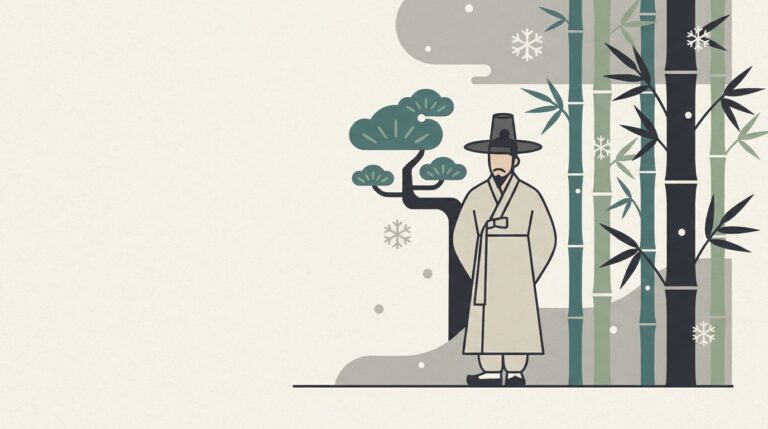
The Moral Spine of Korea: Master the Untamed Classical Idioms of Scholarly Integrity
Phase 1: Empathy (Immersion Opening)
안녕하세요! 매일한글 에디터입니다. (Hello! This is your Daily Hangul editor.)
Picture this quintessential K-Drama scene: Late at night, inside a dimly lit VIP room of a traditional Hanok restaurant in Jongno. A powerful conglomerate chairman slides an envelope across the wooden table to an incorruptible prosecutor. The camera zooms in on the prosecutor’s eyes. He doesn’t flinch. Instead of cursing or raising his voice, he quietly straightens his spine, pushes the envelope back with two fingers, and mutters a quiet, four-character phrase that instantly freezes the air.
If you have ever watched critically acclaimed Korean investigative thrillers like Stranger (비밀의 숲) or sweeping sageuk masterworks like Six Flying Dragons, you know this exact goosebump-inducing moment. But here is the genuine pain point our C2 advanced learners constantly bring to my desk: “I can discuss politics and economy in fluent Korean, but the moment the conversation shifts to fundamental principles, intellectual integrity, or unyielding moral standards, my vocabulary collapses into basic textbook adjectives like ‘정직하다’ (to be honest) or ‘착하다’ (to be nice). How do native Korean intellectuals express that fierce, unbending moral spine without sounding like an ancient encyclopedia?”
Understanding and using the idioms of scholarly integrity—the historic Seonbi (선비) ethos—is the ultimate linguistic gateway to Korea’s intellectual elite. These idioms are not dead historical relics buried in classical Chinese scripts; they are the living moral compass invoked in modern Supreme Court rulings, high-stakes boardroom negotiations, and national editorial columns. Drawing from over a decade of guiding high-level professionals, diplomats, and passionate K-culture enthusiasts, this guide will equip you to wield these powerhouse idioms naturally, with the exact gravitas and cultural finesse of a native speaker.
Phase 2: Core Expressions Deep Dive
1. 송죽지절 (松竹之節)
- Pronunciation: [Song-juk-ji-jeol] (Think of the crisp snaps: Song as in song, juk like ‘jook’, ji like ‘gee’, jeol like ‘jolt’ without the ‘t’)
- Meaning: Literal: “The integrity of the pine and bamboo.” Nuance: Unwavering loyalty and principle that remains vibrant green and steadfast even in the harshest winter blizzards.
- K-Culture Moment: Evoked when a principled journalist or statesman refuses to bow to authoritarian censorship, remaining true to their core ethos while others flip-flop.
- Editor’s Insight: In Korean cultural semiotics, the evergreen pine tree (소나무) and the resilient bamboo (대나무) never lose their color in frost. Using 송죽지절 elevates your compliment from merely saying someone is “consistent” to acknowledging that their soul cannot be bought by seasonal winds of power.
- Situation Spectrum: Casual 🚫 | Semi-formal ⚠️ | Formal/Intellectual ✅
- 🤔 Think About It: In your native culture, what natural element symbolizes incorruptible human virtue? Why did the Joseon literati choose evergreen flora rather than cold stone or unyielding iron?
2. 백절불굴 (百折不屈)
- Pronunciation: [Baek-jeol-bul-gul] (Sounds like Beck-jyeol-bool-gool with a crisp, firm ending)
- Meaning: Literal: “Bent a hundred times, but never yielding.” Nuance: Indomitable spirit; an ethical tenacity that refuses to capitulate despite endless systemic pressure or physical exhaustion.
- K-Culture Moment: Used to describe grassroots social advocates, whistleblowers, or independent founders who defy overwhelming chaebol monopolies.
- Editor’s Insight: Pay attention to the Hanja character 屈 (굴 – to yield/kneel). Koreans place extraordinary value on 기개 (unbroken spirit). When an organization or leader faces scandal, a leader who demonstrates 백절불굴의 의지 (an indomitable will) commands deep generational respect.
- Situation Spectrum: Casual ⚠️ | Semi-formal ✅ | Formal/Speech ✅
- 🤔 Think About It: Is unyielding persistence always viewed as a virtue in your home culture, or is pragmatic compromise praised more? Where does modern Korean society draw the boundary between stubbornness (고집) and 백절불굴?
3. 청렴결백 (淸廉潔白)
- Pronunciation: [Cheong-nyeom-gyeol-baek] (Flows smoothly with nasal assimilation: Cheong-nyum-gyeol-beck)
- Meaning: Literal: “Clear, unblemished, pure, and white.” Nuance: Impeccable fiscal honesty and untainted personal conscience; clean hands free of dirty money or illicit favors.
- K-Culture Moment: Frequently appears in ministerial confirmation hearings, legal press conferences, or prestigious biographical tributes to public servants who lived austere lives.
- Editor’s Insight: Do not confuse this with financial poverty. 청렴결백 is an active, chosen virtue. A person can handle billions of won in public funds, yet if their accounting is transparent down to a single won, they are celebrated as 청렴결백한 공직자 (an incorruptible public official).
- Situation Spectrum: Casual ⚠️ | Semi-formal ✅ | Formal/Legal ✅
- 🤔 Think About It: In modern corporate governance, compliance is often framed as an institutional system. How does the concept of personal 결백 (spotless conscience) alter the weight of individual responsibility in Korean workplaces?
Phase 3: Textbook Korean vs. Real Korean
Situation 1: High-stakes business or legal negotiation rejecting an unethical compromise
- 📖 교과서 한국어 (Textbook Korean): 저는 뇌물을 받지 않고 저의 원칙을 지키겠습니다. (Jeoneun noemureul batji anko jeoui wonchigeul jikigesseumnida. / I will not take bribes and will protect my principles.)
- 🗣️ 진짜 한국어 (Real Korean): 눈앞의 실리 때문에 선비의 지조를 버릴 순 없죠. 청렴결백하게 정면돌파하겠습니다. (Nunapui sillid ttaemune seonbiui jijoreul beoril sun eopjyo. Cheongnyeomgyeolbaek-hage jeongmyeondolpahagesseumnida. / I cannot abandon a scholar’s conviction for short-term gain. I will push through head-on with clean hands.)
- 💡 왜 다를까? (Why the shift?): Simply saying you won’t take a bribe sounds defensive, as if taking it were an active debate. Invoking 선비의 지조 and 청렴결백 anchors your refusal in historical moral pride, instantly elevating your personal boundary into an untouchable cultural standard.
Situation 2: Describing a legendary mentor or colleague known for strict ethics
- 📖 교과서 한국어 (Textbook Korean): 그 선배님은 매우 정직하고 고집이 셉니다. (Geu seonbaenimeun maeu jeongjikhago gojibi semnida. / That senior is very honest and stubborn.)
- 🗣️ 진짜 한국어 (Real Korean): 그 선배는 완전 대쪽 같은 사람이라, 사적 타협은 꿈도 못 꿔요. (Geu seonbaeneun wanjeon daejjok gateun saram-ira, sajeok tahyeobeun kkumdo mot kkkwoyo. / That senior is completely like split bamboo; you can’t even dream of a backchannel compromise.)
- 💡 왜 다를까? (Why the shift?): “고집이 세다” carries an abrasive, childish connotation of being unreasonable. The idiomatic native expression 대쪽 같다 (straight as split bamboo) captures the refined elegance of moral rigidity that Koreans admire.
Phase 4: K-Culture Deep Dive & Non-Verbal Manners
4-1. 눈치 (Nunchi) & Incorruptible Posture
When discussing ethical boundaries in Korea, non-verbal cues carry ninety percent of the sentence’s weight:
* The Unmoving Center (단전의 무게): Do not shift your weight between your feet or fidget with pens when declaring an ethical stance. A true Seonbi posture requires lowering your center of gravity, sitting upright with your shoulder blades relaxed but your spine straight as a die (허리를 곧게 펴다).
* Gaze Dynamics: Hold direct, level eye contact. Looking down or breaking eye contact rapidly when refusing an unethical request signals hesitation or complicity under Korean nunchi conventions. A calm, unwavering gaze accompanied by a single, deliberate nod communicates absolute finality without unnecessary hostility.
4-2. Culture Code: The Immortal ‘Seonbi’ Archetype in Modern K-Media
Why are K-Drama fans worldwide captivated by figures like prosecutor Hwang Si-mok in Stranger or legal avengers in modern webtoons? Because they embody modern incarnations of the Joseon 청백리 (Cheongbaengni – Incorruptible Officials). In a contemporary global society often cynical about corporate corruption, the dramatic archetype of the lone scholar holding the line against royal decrees or mega-corporations appeals directly to the Korean collective conscience. This cultural dynamic traces back to the 16th-century Sarim scholars who were willing to endure deadly royal purges (사화) rather than rubber-stamp unethical monarchical excess.
Phase 5: Real-World Roleplay Scenario
Setting: The corner office of a major financial regulatory firm in Yeouido, Seoul. Director Min, a powerful executive with deep political ties, is privately pressuring Senior Auditor Alex (the learner) to strike a damaging audit finding from the final quarterly disclosure.
Characters:
* 민 이사 (Director Min): An experienced, silver-tongued corporate veteran who believes everything has a price tag.
* 알렉스 (Alex – You): A meticulous senior compliance director known for uncompromising dedication to international audit ethics.
[민 이사]: 알렉스 팀장, 이번 분기 감사 보고서에 적힌 해외 페이퍼컴퍼니 관련 건 말입니다... 굳이 그렇게 날카롭게 적을 필요가 있을까요? 융통성을 좀 발휘해 보시죠.
(Alex timjang, ibeon bungi gamsa bogoseoe jeokhin haeoe peipeokeompeoni gwanryeon geon marimnida... guji geureoke nalkaropge jeogeul piryoga isseulkkayo? Yungtongseongeul jom balhwihae bosijyo.)
[Director Min]: Team Leader Alex, regarding that offshore shell company item in this quarter's audit report... Do we really need to phrase it so harshly? Let's show a bit of corporate flexibility.

[알렉스]: 🎭 (찻잔을 천천히 내려놓으며 차분한 눈빛으로) 이사님, 감사의 본질은 수치를 투명하게 드러내는 데 있습니다. 본 사안은 묵과할 수 없습니다.
(Isanim, gamsaui bonjireun suchireul tumyeonghage deureonaeneun de isseumnida. Bon saaneun mukgwahal su eopseumnida.)
[Alex]: 🎭 (Sets down the teacup slowly, meeting eyes with calm intensity) Director, the essence of an audit is to reveal figures transparently. We cannot turn a blind eye to this issue.

[민 이사]: 하하, 알렉스 팀장. 맑은 물에는 물고기가 살지 않는 법이에요. 이번 일만 적당히 덮어주면, 다음 인사 때 본사 핵심 요직을 보장하겠습니다.
(Haha, Alex timjang. Malgeun mul-eneun mulgogiga salji anneun beobieyo. Ibeon ilman jeokdanghi deopeojumyeon, daeum insa ttae bonsa haeksim yojigeul bojanghagesseumnida.)
[Director Min]: Haha, Alex. You know fish cannot survive in water that is too clear. Just smooth this one issue over, and I will personally guarantee your seat in the headquarters' executive lineup next shuffle.

[알렉스]: 🎭 (허리를 곧게 펴고 단호하고 정중한 어조로) 과분한 제안이십니다만, 송죽지절(松竹之節)의 마음을 잃고 얻은 자리는 제게 아무런 가치가 없습니다.
(Gwabunhan jeanisimnida-man, songjukjijeorui maeumeul ilko eodeun jarineun jege amureon gachiga eopseumnida.)
[Alex]: 🎭 (Straightens spine, speaking with resolute yet courtly politeness) That is a generous offer, sir, but a position gained by discarding the integrity of pine and bamboo holds zero value for me.

[민 이사]: 🎭 (얼굴이 굳어지며) 정말 대쪽 같으시네... 이 바닥이 그렇게 호락호락하지 않을 텐데요? 후회하지 않겠습니까?
(Jeongmal daejjok gateusine... I badagi geureoke horakhorakhaji aneul tende-yo? Huhoehaji ankkesseumnikka?)
[Director Min]: 🎭 (Face hardening) You really are like unyielding split bamboo... This industry won't treat you kindly for this. Won't you regret it?

[알렉스]: 백절불굴(百折不屈)이라 했습니다. 원칙을 지키다 겪는 어려움이라면 기꺼이 감내하겠습니다.
(Baekjeolbulgul-ira haesseumnida. Wonchigeul jikida gyeongneun eoryeoum-iramyeon gikkoi gamnaehagesseumnida.)
[Alex]: As the ancient saying goes: unbroken through a hundred trials. If this hardship is the cost of upholding core principles, I will shoulder it willingly.

[민 이사]: 🎭 (한숨을 깊게 내쉬며 서류철을 덮는다) 허, 알렉스 팀장 앞에서는 어떤 로비도 안 통하는군요. 청렴결백(淸廉潔白)하시니 더는 말리지 않겠습니다.
(Heo, Alex timjang apeseoneun eotteon robido an tonghaneungunyo. Cheongnyeomgyeolbaek-hasini deoneun malliji ankkesseumnida.)
[Director Min]: 🎭 (Sighs deeply, closing the audit folder) Ha, it seems no lobby can penetrate Team Leader Alex. Your hands are spotless and uncompromising, so I shall push you no further.

[알렉스]: 🎭 (정중하게 가벼운 목례를 하며) 원칙대로 보고서를 상정하겠습니다. 이해해 주셔서 감사합니다.
(Wonchikdaero bogoseoreul sangjeonghagesseumnida. Ihaehae jusyeoseo gamsahamnida.)
[Alex]: 🎭 (Offers a measured, respectful formal bow) I will submit the report strictly according to standard protocol. Thank you for your understanding.
🔀 Interactive Decision Point: Director Min tests you one last time!
Director Min leans forward and says: “정말 회사의 미래보다 본인의 원칙이 더 중요합니까?” (Is your personal principle truly more important than this company’s future?)
- Option A: “회사의 백년대계 또한 청렴결백(淸廉潔白)한 원칙 위에서만 바로 설 수 있다고 믿습니다.” (I believe the company’s hundred-year foundation can only stand upright upon unblemished integrity.)
- Option B: “이사님, 지금 저 협박하시는 겁니까? 감사 기준 위반으로 고발하겠습니다!” (Director, are you threatening me right now? I will report you for compliance violation!)
- Option C: “음… 그렇다면 이번 한 번만 약한 수준의 권고 조치로 수정해 볼까요?” (Well… should we soften it to a minor advisory warning just this once?)
Feedback Guide:
* Option A (Best – Master Level 🌟): Perfect C2 intellectual mastery! You reframe corporate longevity through the philosophical lens of 청렴결백, transforming your refusal into an act of true organizational loyalty.
* Option B (Risk – Emotional Overreaction ⚠️): While legally accurate, aggressively escalating into accusations breaks kyoyang (교양 – intellectual restraint) and instantly burns all strategic leverage in Korean executive culture.
* Option C (Bad – Ethical Capitulation 🚫): You broke the seal. The moment you show compromise, your authority as an auditor is completely extinguished.
Phase 6: 10-Second Emotion Shadowing Drill
Practice speaking these high-impact sentences aloud with the designated emotional cadence. Pay close attention to pauses marked by /.
[🔥 단호하고 절제된 무게감으로 / Resolute & Restrained Gravity]
눈앞의 / 사사로운 이익을 위해 / 선비의 지조를 버리는 일은 / 결코 없을 것입니다.
(Nunapui / sasaroun i-igeul wihae / seonbiui jijoreul beorineun ireun / gyeolko eopseul geosimnida.)
I will never / discard the scholar’s unyielding conviction / for the sake of petty, / short-term personal gain.-
[🏛️ 침착하고 흔들림 없는 당당함으로 / Calm & Unshakeable Dignity]
백 번을 꺾일지언정 / 불의 앞에서는 / 백절불굴의 자세로 / 임하겠습니다.
(Baek beoneul kkeokkiljieonjeong / burui apeseoneun / baekjeolbulgurui jasaero / imhagesseumnida.)
Even if broken a hundred times, / before injustice, / I shall confront it with an / indomitable, unyielding spirit. -
[🌿 담백하고 티 없는 결백함으로 / Pristine & Unclouded Serenity]
제 양심은 / 한 점 부끄럼 없이 / 언제나 청렴결백합니다.
(Je yangsimeun / han jeom bukkeureom eopsi / eonjena cheongnyeomgyeolbaekhamnida.)
My personal conscience / stands completely untainted, / without a single speck of shame, / forever clean and upright.
Phase 7: K-Culture Mini Dictionary
-
대쪽 같다 (Daejjok gatda)
- Translation: To be like straight-split bamboo.
- Usage: Highly complimentary idiom describing a person whose moral principles are so straight and crisp that neither threats nor massive bribes can introduce a single curve into their decisions.
- 선비 정신 (Seonbi Jeongsin)
- Translation: The Spirit of the Seonbi (Joseon Classical Scholar).
- Usage: Refers to intellectual self-discipline, lifelong learning, civil courage, and the moral duty to speak truth to supreme authority regardless of personal safety.
- 지조 (Jijo)
- Translation: Moral constancy / Unswerving fidelity to one’s beliefs.
- Usage: Frequently contrasted with 변절 (apostasy/betrayal). Used when analyzing politicians, artists, or public intellectuals who refuse to alter their core philosophy to match prevailing trends.
- 청백리 (Cheongbaengni)
- Translation: An incorruptible official of pure public service.
- Usage: A high-level title historically awarded during the Joseon dynasty to officials renowned for zero embezzlement. In modern business, it denotes leaders who refuse kickbacks and preserve unblemished fiscal governance.
Phase 8: Traveler’s Cultural Survival Kit
If you are traveling in Korea to explore historical centers of learning like Sungkyunkwan University in Seoul, Dosan Seowon in Andong, or Gyeongbokgung Palace, these phrases unlock deep conversations with docents and traditional artisans.
- Top 1: 선비들의 대쪽 같은 기개가 느껴지는 공간이네요.
(Seonbideurui daejjok gateun gigaega neukkyeojineun gongganineyo.)
“This space truly radiates the unyielding, bamboo-like spirit of the classical Joseon scholars.”
Pro Tip: Drop this while touring a traditional wooden pavilion; cultural guides will treat you as an esteemed scholar of Korean history. -
Top 2: 옛 선현들의 청렴결백한 삶을 본받고 싶습니다.
(Yet seonhyeondeurui cheongnyeomgyeolbae-khan sarmeul bonbatgo sipseumnida.)
“I aspire to emulate the pristine and incorruptible lives led by the ancient sages.”
Pro Tip: Wonderful when signing a guestbook at historic Confucian academies (서원). -
Top 3: 비바람에도 흔들리지 않는 송죽지절의 지조가 아름답습니다.
(Bibaramedo heundeulliji anneun songjukjijeorui jijoga areumdapsumnida.)
“The beauty of unwavering pine-and-bamboo integrity, unshaken by wind and rain, is deeply moving.”
Pro Tip: The ultimate phrase when admiring classical Korean ink paintings (사군자 – Four Gracious Plants) at museum exhibitions. -
Editor’s Travel Note: To walk the genuine spiritual trail of Joseon’s scholars, plan a cultural excursion outside Seoul. Download the high-speed transit timetable on the 코레일 KTX 예매 공식 사이트 and take a one-hour train to Andong to explore Dosan Seowon. While navigating the complex historical alleyways around Sungkyunkwan’s ancient shrine in Seoul, rely on the 네이버 지도 앱 다운로드 to uncover quiet traditional tea rooms where local historians gather.
Phase 9: “One Step Deeper” (Philosophical Reflection)
In Western philosophical traditions, integrity is often theorized through individual autonomy and personal rights. In contrast, the Korean scholarly tradition conceives incorruptibility not merely as a personal virtue, but as the moral backbone that sustains the cosmic and social order. A Joseon scholar who submitted an unyielding memorial to the King—often carrying their own funeral coffin to the palace gates to prove their readiness to die for their words—believed that if the intellectual elite surrendered to material temptation, the moral fabric of society (기강) would collapse.
When modern Koreans describe someone as having 선비의 지조, they are recognizing a rare individual who places their sacred duties to conscience above biological self-preservation and monetary advancement.
💬 Your Turn: Have you ever encountered a moment in your professional or academic life where remaining true to your principles required significant sacrifice? How would you describe that experience using the concept of 백절불굴? Share your story in the comments below!
Phase 10: FAQ & Mistake Prevention
Q: Can I use idioms like 백절불굴 and 청렴결백 in lighthearted, everyday casual situations?
A: Use extreme caution! Because these four-character idioms (사자성어) carry deep historical weight and ethical gravity, dropping 청렴결백 when splitting a casual dinner bill with close friends at a chicken joint sounds either humorously melodramatic or overly pedantic. Reserve them for professional reviews, intellectual exchanges, serious philosophical discussions, or self-introductions in formal interviews.
Q: What is the exact nuance difference between 지조 (Jijo) and 절개 (Jeolgae)?
A: While often used together as a compound (지조와 절개), 지조 (志操) emphasizes the internal moral will and intellectual constancy over time, whereas 절개 (節개) highlights the sharp, knife-like fidelity displayed during a critical moment of temptation or mortal threat.
Q: Why do Koreans refer specifically to bamboo as “대쪽” rather than just “대나무”?
A: A mature bamboo culm is perfectly tubular, but when split vertically, it splits in an absolute, razor-straight line without deviating a millimeter. Hence, 대쪽 symbolizes a character that admits no crooked curves, compromises, or lateral distortion in judgment.
🚨 Common Mistakes Warning Board
- Mistake 1: Pronouncing 백절불굴 as [Baek-jeol-bool-gool] without consonant tension.
- Correct Action: Ensure the final consonant flow matches native phonetic rules. The transition between 절 and 불 should feel crisp and grounded, maintaining the tension of the indomitable spirit it describes.
- Mistake 2: Conflating 청렴 (incorruptibility) with voluntary ascetic poverty.
- Correct Action: A wealthy entrepreneur can be celebrated as 청렴결백 if their wealth is earned transparently and audited impeccably. It refers to purity of source, not the absence of capital.
- Mistake 3: Using idioms to arrogantly lecture superiors.
- Correct Action: Describing yourself as 대쪽 같다 can sound self-aggrandizing. Instead, apply 대쪽 같다 to respected mentors, while applying 백절불굴의 마음가짐으로 임하겠습니다 (I will approach this with an indomitable mindset) to yourself to display humble resolve.
Phase 11: Action Missions & Community Engagement
- 🥉 Bronze Mission (Solo Mastery): Stand in front of your mirror with an upright posture. Practice the Phase 6 shadowing drill three times with deliberate breathing and steady eye contact.
- 🥈 Silver Mission (Social Engagement): Write a short paragraph on your social media or language exchange journal describing your favorite character in a Korean drama using 송죽지절 or 백절불굴.
- 🥇 Gold Mission (Real-world Implementation): In your next business meeting, Korean essay, or high-level speaking practice, replace the mundane phrase “원칙을 지키겠습니다” with “청렴결백한 자세로 투명하게 처리하겠습니다”.
- 🎮 K-Culture Mission: Watch an episode of a political thriller or legal K-drama (Secret Forest, Chief of Staff, or Queenmaker). Listen closely for words containing 절 (節), 조 (操), or 결백 (潔白) and jot down the context!
Phase 12: Interactive Quiz Challenge
1. Scenario Judgment Challenge
Which response demonstrates the most sophisticated C2 Korean when an auditor discovers a suspicious ledger entry and refuses an under-the-table gift from a board member?
* A) 아이고, 이렇게 귀한 돈을 주시면 안 되죠! 다음엔 소고기 사주세요.
* B) 눈앞의 편의를 위해 송죽지절(松竹之節)의 원칙을 저버릴 수는 없습니다. 정식 절차대로 감사하겠습니다.
* C) 저는 그냥 평범한 직원이니까 다른 부서장님과 상의해 보시는 게 어떨까요?
정답 확인하기 (Click to reveal answer)
정답: B
* 해설: Option B is a masterpiece of C2 executive communication. It gracefully declines illicit overtures while upholding institutional authority through the classical metaphor of evergreen pine and bamboo. Option A is corrupt; Option C shows cowardice.
2. Fill-in-the-Blank Challenge
Complete the following formal corporate address:
“어떠한 외압과 시련이 닥치더라도, 우리 연구팀은 ( )의 기개로 타협 없이 진실만을 규명할 것입니다.”
(No matter what external pressure or trials strike, our research team will uncover the truth without compromise through a spirit of indomitable fortitude.)
정답 확인하기 (Click to reveal answer)
정답: 백절불굴 (Baekjeolbulgul)
* 해설: To describe a team standing tall against external pressure and relentless systemic trials without breaking, 백절불굴 (unbending despite a hundred fractures) is the most prestigious and natural idiom.
3. True / False Cultural Insight
Statement: In modern Korean corporate and political discourse, classical idioms such as 청렴결백 and 송죽지절 are strictly obsolete and considered awkward if spoken by anyone under sixty.
정답 확인하기 (Click to reveal answer)
정답: False (X)
* 해설: Far from being obsolete, these idioms serve as high-impact linguistic weapons in contemporary Korean society. They are routinely featured in prime-time news headlines, national address speeches, and prestigious investigative journalism to summarize moral stances with unforgettable punchiness.






