

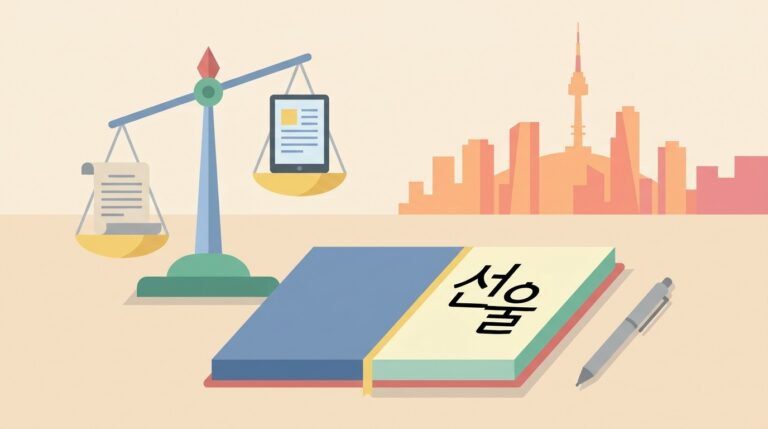
Phase 1: Empathy & Story Immersion
안녕하세요! 매일한글 에디터입니다. (Hello! This is your Daily Hangul editor.)
Imagine this scenario straight out of a relatable K-Drama: You have finally settled into a cozy officetel near Hongdae or signed up for a sleek, high-end fitness center in Gangnam. Three months in, your employer suddenly transfers you overseas. You pack your bags, head to the front desk with a polite smile, and request a partial refund on the remaining nine months. The manager points to an obscure, microscopic line printed at the very bottom of your application form: ‘어떤 경우에도 환불 불가 및 민형사상 이의 제기 금지’ (Under no circumstances shall refunds be issued, and no civil or criminal objections may be raised).
Your stomach drops. Did signing that piece of paper truly strip you of all consumer rights? For advanced learners living, working, or doing business in Korea, this is a rite of passage—the confrontation with contractual rigidity versus substantive fairness. In Western legal traditions, the principle of pacta sunt servanda (agreements must be kept) often casts a long shadow. But under Korean civil jurisprudence, contracts do not exist in a moral vacuum. Today, we delve into the sophisticated legal architecture of 신의성실의 원칙 (Principle of Good Faith), 사정변경의 원칙 (Doctrine of Changed Circumstances), and how the 약관규제법 (Standardized Contracts Act) empowers consumers by automatically rendering unfair, one-sided boilerplate terms null and void.
Phase 2: Core Expressions Deep Dive
1. 신의성실의 원칙 / 신의칙 (Sin-ui-seong-sil-ui won-chik / Sin-ui-chik)
- Pronunciation: [Sin-ui-seong-si-rui won-chik] (Think: Sheen-we-sung-sheel-we won-cheek)
- Meaning: Literal: “Principle of good faith and sincerity” | Nuance: The overarching legal standard in Korean Civil Act Article 2 that demands rights be exercised and obligations fulfilled in mutual honesty, fairness, and trust.
- K-Culture Moment: In courtroom dramas like One Dollar Lawyer (천원짜리 변호사), the protagonist attorney often dismantles a predatory corporate agreement by exclaiming that the clause violates “신의칙” (the contracted short form of the doctrine).
- Editor’s Insight: In legal discourse and elevated business negotiations, native speakers almost always abbreviate this to 신의칙 (Sin-ui-chik). It acts as an equitable emergency brake whenever strict adherence to a contract’s literal text would result in glaring, unconscionable injustice.
- Situation Spectrum:
- Casual: 🚫 (Sounds like you swallowed a legal treatise)
- Semi-formal: ⚠️ (Use during serious dispute discussions)
- Formal / Legal: ✅ (Essential in negotiations, written protests, and legal pleadings)
- 🤔 Think About It: In your legal culture, can a judge override a signed contract purely on an abstract standard of “good faith” and “equity,” or is formal text strictly king?
2. 독소 조항 (Dok-so jo-hang)
- Pronunciation: [Dok-so jo-hang] (Think: Doke-so joh-hahng)
- Meaning: Literal: “Poisonous clause” | Nuance: A toxic, highly biased boilerplate stipulation inserted into an agreement that unfairly strips one party of fundamental statutory protections.
- K-Culture Moment: Frequently heard in investigative journalism programs like PD Note (PD수첩) when exposing unfair trainee entertainment agency contracts, famously referred to in Korea as 노예계약 (slave contracts).
- Editor’s Insight: While 조항 (clause) is standard legal phrasing, prefixing it with 독소 (poison) transforms it into a poignant, critical critique. When auditing a contract with a Korean counterparty, identifying a 독소 조항 marks you as an articulate professional who cannot be easily bullied.
- Situation Spectrum:
- Casual: ⚠️ (Used metaphorically when discussing restrictive rules)
- Semi-formal: ✅ (Standard in corporate audits and commercial evaluations)
- Formal: ✅ (Standard terminology in regulatory filings and dispute petitions)
- 🤔 Think About It: Why does the Korean language personify unfair terms with the word “poison” (독) rather than simply calling them “invalid clauses” (무효 조항)?
3. 공정을 잃은 조항은 무효입니다 (Gong-jeong-eul ireun jo-hang-eun mu-hyo-im-ni-da)
- Pronunciation: [Gong-jeong-eul ireun jo-hang-eun mu-hyo-im-ni-da] (Think: Gong-jung-eul ee-run joh-hang-un moo-hyo-im-nee-dah)
- Meaning: Literal: “Clauses that have lost fairness are void.” | Nuance: Under Article 6 of the Standardized Contracts Act, terms unfairly disadvantageous to the customer are deemed to violate good faith and are automatically rendered legally invalid.
- K-Culture Moment: Picture an aggrieved tenant calmly quoting this exact line to an unreasonable landlord who attempts to withhold an entire security deposit for minor wall scuffs.
- Editor’s Insight: This phrase shifts you from a complaining consumer to an assertive legal rights-holder. By stating that the clause is void (무효) by operation of law—rather than asking for a favor—you change the entire bargaining dynamic.
- Situation Spectrum:
- Casual: 🚫 (Too confrontational and textbook-like for friends)
- Semi-formal: ⚠️ (Appropriate when written in formal dispute emails)
- Formal: ✅ (Indispensable in administrative appeals and contractual disputes)
- 🤔 Think About It: Notice the verb phrase 공정을 잃다 (to have lost fairness). It treats fairness as an inherent attribute that the clause departed from, placing the fault entirely on the contract drafter.
Phase 3: Textbook Korean vs. Real Korean
Scenario 1: Objecting to an unreasonable cancellation penalty
- 📖 교과서 한국어 (Textbook Korean):
“이 계약서 조항은 부당하므로 환불을 요청합니다.”
(I request a refund because this contract clause is unjust.) - 🗣️ 진짜 한국어 (Real Native Korean):
“약관규제법상 고객에게 일방적으로 불리한 면책 조항은 신의칙에 반해 무효로 알고 있습니다.”
(Under the Standardized Contracts Act, clauses that unilaterally disadvantage consumers and exempt business liability are void against good faith.) - 💡 왜 다를까? (Why the difference?):
Saying a clause is simply “unjust” (부당하다) sounds like a subjective emotional complaint. Invoking the statutory framework (약관규제법) and the established doctrine of good faith (신의칙) instantly shifts the conversation to statutory non-compliance.
Scenario 2: Seeking contract revision due to drastic unexpected events (Rebus Sic Stantibus)
- 📖 교과서 한국어 (Textbook Korean):
“상황이 바뀌었으니 계약 내용을 바꿔주세요.”
(Circumstances have changed, so please modify the contract contents.) - 🗣️ 진짜 한국어 (Real Native Korean):
“당초 예상치 못한 현저한 사정변경이 발생한 만큼, 신의성실의 원칙에 따라 계약 조건의 재협의가 불가피합니다.”
(Given the occurrence of an unforeseen, substantial change in circumstances, renegotiation of contract terms is inevitable in accordance with the principle of good faith.) - 💡 왜 다를까? (Why the difference?):
In Korean corporate culture and higher-level dispute resolution, one does not casually ask to change terms. Citing 현저한 사정변경 (substantial change in circumstances) signals a sophisticated awareness of civil jurisprudence.
Phase 4: K-Culture Deep Dive & Non-Verbal Manners
4-1. 눈치 (Nunchi) & Tactical Body Language in Korean Disputes
When challenging a contract in Korea, aggression guarantees resistance. The art of asserting your rights lies in ‘외유내강’ (gentle on the outside, steel on the inside).
* Vocal Tone & Posture: Lower your vocal pitch slightly and maintain a steady, unhurried cadence. Rapid, high-pitched speech signals emotional distress, whereas measured, deliberate speech conveys legal confidence.
* Eye Contact: Maintain steady eye contact without glaring. Avoid crossing your arms; keep your hands resting naturally on the table or hold the contract document with both hands (양손 매너) when pointing out specific clauses.
* The Linguistic Cushion: Never open with direct accusation. Precede your challenge with an acknowledgment: “관리자님의 입장은 충분히 이해합니다만…” (I completely understand your position as the manager, however…). This provides face-saving space (체면) while introducing your non-negotiable legal position.
4-2. Cultural Code Analysis: The Legacy of “Slave Contracts” (노예계약)
Why is Korea’s 약관규제법 (Standardized Contracts Regulation Act) among the most robust in the world? Historically, rapid post-war industrialization produced large corporate conglomerates (재벌) and monopolistic service providers that imposed take-it-or-leave-it boilerplate agreements onto ordinary citizens.
A watershed cultural turning point occurred in the late 2000s within the K-Pop industry, when high-profile boy group members sued major agencies over 13-year exclusive agreements with astronomical termination penalties. The public rallied around the concept that an agreement violating basic human dignity and economic equity is fundamentally void under 신의칙. The Korea Fair Trade Commission (공정거래위원회) stepped in, formulating standard contract models (표준약관). In modern Korea, the principle that contractual stability must not eclipse human justice is a deeply embedded sociopolitical consensus.
Phase 5: Real-Life Roleplay Scenario
Setting: The sleek managerial office of Apex Fitness Studio in Gangnam, Seoul.
Characters:
* Manager Park (박 실장): A polite yet unyielding customer service manager trained to cite company internal policies.
* Learner (나): An expat professional relocating abroad on short notice, holding a 12-month prepaid gym contract.
— Dialogue (8 Turns) —
- 나:
“실장님, 해외 발령으로 인해 부득이하게 중도 해지 및 잔여 대금 환급을 요청하고자 합니다.”
(Sil-jang-nim, hae-oe bal-ryeong-eu-ro in-hae bu-deuk-i-ha-ge jung-do hae-ji mit jan-yeo dae-geum hwan-geub-eul yo-cheong-ha-go-ja ham-ni-da.)
“Manager Park, due to an unavoidable overseas dispatch, I must request early termination and a refund of the remaining balance.”
🎭 Hands the official company dispatch letter across the table with both hands. -
박 실장:
“고객님, 가입 당시 서명하신 회원 약관 제7조에 ‘중도 해지 시 일체 환불 불가’라고 명시되어 있어 규정상 어렵습니다.”
(Go-gaek-nim, ga-ip dang-si seo-myeong-ha-sin hoe-won yak-gwan je-chil-jo-e ‘jung-do hae-ji si il-che hwan-bul bul-ga’ra-go myeong-si-doe-eo isseo gyu-jeong-sang eo-ryeop-seumnida.)
“Customer, Article 7 of our member agreement, which you signed upon enrollment, clearly states ‘No refunds under any circumstances upon early cancellation,’ so our policy prohibits this.”
🎭 Taps the fine print at the bottom of the laminated contract. -
나:
“그 조항은 인지하고 있습니다만, 약관규제법 제6조에 따르면 고객의 해제권을 원천 배제하거나 과도한 위약벌을 부과하는 조항은 신의칙에 반하여 무효입니다.”
(Geu jo-hang-eun in-ji-ha-go isseum-ni-da-man, yak-gwan-gyu-je-beop je-yuk-jo-e tta-reu-myeon go-gaek-ui hae-je-gwon-eul won-cheon bae-je-ha-geo-na gwa-do-han wi-yak-beor-eul bu-gwa-ha-neun jo-hang-eun sin-ui-chi-ge ban-ha-yeo mu-hyo-im-ni-da.)
“I recognize that clause; however, under Article 6 of the Standardized Contracts Act, terms that categorically exclude a customer’s right to rescind or impose excessive penalties are void as contrary to good faith.”
🎭 Speaks in a calm, measured tone, maintaining gentle eye contact. -
박 실장:
“하지만 자필 서명까지 하셨는데, 이제 와서 약관 자체를 무효라고 하시면 저희 센터 입장에서도 곤란합니다.”
(Ha-ji-man ja-pil seo-myeong-kka-ji ha-syeot-neun-de, i-je wa-seo yak-gwan ja-che-reul mu-hyo-ra-go ha-si-myeon jeo-hui sen-teo ip-jang-e-seo-do gon-ran-ham-ni-da.)
“Still, you personally signed it. If you claim the boilerplate term itself is void now, it puts our fitness center in a very difficult spot.” -
나:
“민법상 사정변경의 원칙과 공정거래위원회 표준약관 가이드라인을 고려해 주십시오. 저는 정당한 위약금 공제 후 잔액 반환을 희망합니다.”
(Min-beop-sang sa-jeong-byeon-gyeong-ui won-chik-gwa gong-jeong-geo-rae-wi-won-hoe pyo-jun-yak-gwan ga-i-deu-ra-in-eul go-ryeo-hae ju-sip-si-o. Jeo-neun jeong-dang-han wi-yak-geum gong-je hu jan-aek ban-hwan-eul hui-mang-ham-ni-da.)
“Please consider the civil law doctrine of changed circumstances and the Fair Trade Commission’s standard contract guidelines. I am only requesting the return of the balance after deducting the legitimate statutory cancellation fee.”
🎭 Places a printed copy of the Fair Trade Commission standard refund policy beside the contract. -
박 실장:
“원칙상 안 되는 부분이지만… 해외 이주라는 특수 사정이 있으시니 다시 검토해 보겠습니다.”
(Won-chik-sang an doe-neun bu-bun-i-ji-man… hae-oe i-ju-ra-neun teuk-su sa-jeong-i iss-eu-si-ni da-si geom-to-hae bo-get-seumnida.)
“Strictly speaking it is against our principles, but… since you have the unique circumstance of overseas relocation, let me re-examine this.” -
나:
“합리적인 중재안을 검토해 주셔서 감사합니다. 원만한 해결을 위해 본사와 상의 후 연락 주시기 바랍니다.”
(Hap-ri-jeok-in jung-jae-an-eul geom-to-hae ju-syeo-seo gam-sa-ham-ni-da. Won-man-han hae-gyeol-eul wi-hae bon-sa-wa sang-ui hu yeon-rak ju-si-gi ba-ram-ni-da.)
“Thank you for considering a reasonable compromise. For an amicable resolution, please contact me after consulting your headquarters.”
🎭 Gives a polite 15-degree nod of gratitude. -
박 실장:
“네, 공정위 위약금 기준을 산정하여 오늘 중으로 처리 내역을 문자로 안내해 드리겠습니다.”
(Ne, gong-jeong-wi wi-yak-geum gi-jun-eul san-jeong-ha-yeo o-neul jung-eu-ro cheo-ri nae-yeok-eul mun-ja-ro an-nae-hae deu-ri-get-seumnida.)
“Understood. We will calculate the statutory cancellation deduction according to Fair Trade Commission guidelines and text you the refund breakdown today.”
🔀 Interactive Decision Fork
If the manager steadfastly insists: “본사 지침이라 법적으로 가셔도 1원도 환불 못 드립니다” (It’s HQ policy; even if you take legal action, we cannot refund a single won), what is your best response?
- Option A: “그럼 여기서 경찰 부르고 인터넷 커뮤니티에 이 센터 갑질 다 폭로할 겁니다!” (Then I’ll call the police right here and expose this gym’s abuse of power online!)
- Outcome: Bad. Calling the police for a civil contract dispute is an administrative dead end, and public defamation threats (명예훼손죄) expose you to criminal counter-suits under Korean law.
- Option B: “소비자분쟁해결기준을 위반한 약관 조항이므로, 한국소비자원 피해구제 신청 및 공정거래위원회 불공정약관 심사 청구를 진행하겠습니다.” (Since this clause violates consumer dispute resolution standards, I will proceed with a dispute redress filing with the Korea Consumer Agency and report an unfair boilerplate term review to the Fair Trade Commission.)
- Outcome: Best! Calm, highly targeted administrative pressure. Businesses dread formal Fair Trade Commission inquiries far more than empty shouting matches.
- Option C: “알겠습니다. 제 사정이니까 그냥 남은 개월 수 날리겠습니다.” (Understood. Since it’s my personal issue, I will just forfeit the remaining months.)
- Outcome: Risk. You needlessly surrender hard-earned money and normalize unlawful corporate boilerplate practices.
Phase 6: 10-Second Emotion Shadowing Drill
Read each sentence aloud, breathing and pausing exactly at the slashes (/), capturing the emotional nuance in brackets.
[⚖️ 확고하고 차분하게 - Firm & Collected]
“약관에 명시되어 있더라도 / 신의칙에 반하는 독소 조항은 / 법적으로 효력이 없습니다.”
(Yak-gwan-e myeong-si-doe-eo iss-deo-ra-do / sin-ui-chi-ge ban-ha-neun dok-so jo-hang-eun / beop-jeok-eu-ro hyo-ryeok-i eop-seumnida.)
“Even if stated in the boilerplate terms / toxic clauses violating good faith / hold zero legal validity.”-
[🧐 예리하면서도 정중하게 - Incisive yet Polite]
“예기치 못한 사정변경이 발생했으므로 / 상호 신뢰를 바탕으로 / 계약 해지를 요청드립니다.”
(Ye-gi-chi mot-han sa-jeong-byeon-gyeong-i bal-saeng-haess-eu-mru-ro / sang-ho sin-roe-reul ba-tang-eu-ro / gye-yak hae-ji-reul yo-cheong-deu-rim-ni-da.)
“Because an unforeseen change of circumstances has occurred / on the basis of mutual trust / I request termination of the agreement.” -
[🛡️ 단호하게 선을 그으며 - Resolutely Setting Boundaries]
“공정을 잃은 면책 조항은 / 약관규제법에 의거하여 / 당연 무효임을 분명히 밝힙니다.”
(Gong-jeong-eul ireun myeon-chaek jo-hang-eun / yak-gwan-gyu-je-beop-e ui-geo-ha-yeo / dang-yeon mu-hyo-im-eul bun-myeong-hi bal-kim-ni-da.)
“Exemption clauses that have abandoned fairness / pursuant to the Standardized Contracts Act / are plainly null and void as a matter of law.”
Phase 7: K-Culture Mini Dictionary
-
약관 (約款, Yak-gwan)
Standardized Terms / Boilerplate Contract | A pre-formulated agreement prepared by one party in advance to enter into contracts with numerous counterparties without individual negotiation. -
독소 조항 (毒素 條項, Dok-so jo-hang)
Toxic Clause / Trap Provision | A hidden, disproportionately severe provision in a standardized contract that deprives the economically weaker party of statutory defenses or imposes unfair liabilities. -
사정변경 (事情變更, Sa-jeong-byeon-gyeong)
Change of Circumstances (Rebus Sic Stantibus) | A fundamental rule of civil equity providing that if the factual foundation upon which a contract was formed alters drastically and unforeseeably, terms may be modified or canceled. -
부당이득 반환 (不當利得 返還, Bu-dang-i-deuk ban-hwan)
Restitution of Unjust Enrichment | The legal demand to recover financial benefits or payments retained by another party without legitimate legal cause (e.g., reclaiming illegal forfeiture fees).
Phase 8: Traveler and Expat Survival Kit
Top 3 Consumer Protection Survival Phrases
-
“공정거래위원회 표준약관 기준대로 처리해 주세요.”
(Gong-jeong-geo-rae-wi-won-hoe pyo-jun-yak-gwan gi-jun-dae-ro cheo-ri-hae ju-se-yo.)
“Please process this in accordance with the Fair Trade Commission’s standard contract guidelines.”
Pro Tip: This one phrase tells commercial managers you know government-endorsed refund brackets. -
“계약 당시 이 조항에 대해 구체적인 설명을 듣지 못했습니다.”
(Gye-yak dang-si i jo-hang-e dae-hae gu-che-jeok-in seol-myeong-eul deut-ji mot-haess-seumnida.)
“I was never provided an explicit explanation of this clause at the time of signing.”
Pro Tip: Under the Standardized Contracts Act, businesses have an affirmative duty to explain important clauses (명시·설명의무). Failure to do so bars them from asserting the clause! -
“한국소비자원에 피해구제를 접수하겠습니다.”
(Han-guk-so-bi-ja-won-e pi-hae-gu-je-reul jeop-su-ha-get-seumnida.)
“I will lodge a consumer dispute mediation claim with the Korea Consumer Agency.”
Pro Tip: Mentioning this step often resolves deadlocks before any formal paperwork is filed.
Editor’s Life & Legal Note
- Consumer Hotline 1372: Dial
1372from anywhere in Korea (without an area code) to access the integrated consumer counseling network. - Online Portal: Bookmark the 한국소비자원 피해구제 신청 웹사이트 for streamlined online dispute filing.
- Fair Trade Commission Standard Terms: Visit the 공정거래위원회 표준약관 양식 조회 서비스 to verify legal refund schedules for gyms, tutoring academies (학원), and rental properties.
Phase 9: “One Step Deeper” (Reflective Essay)
In Western common law traditions, the written page reigns supreme: “You signed it; you should have read the fine print.” However, Korean civil jurisprudence, heavily influenced by continental European codification yet deeply colored by indigenous communal norms (정 and 상부상조), adopts a more protective stance toward the consumer. In Korea, contractual stability (법적 안정성) is never elevated to an absolute deity that tramples individual concrete justice (구체적 타당성).
The legal doctrine of 신의성실의 원칙 (Good Faith) functions as a societal pact: economic power does not grant unilateral license to trap another in an unconscionable agreement. When the law declares toxic boilerplate clauses void, it asserts that genuine economic stability can only flourish when the vulnerable party is shielded from systemic unfairness.
💬 Your Turn: Have you ever encountered a contract clause that felt undeniably unfair or predatory? How would that scenario be handled under the laws of your home country compared to Korea’s Standardized Contracts Act? Let’s discuss in the comments below!
Phase 10: FAQ & Common Mistakes
Q: If I signed a digital contract or initialed a check-box online without reading, can I still claim the clause is void?
A: Yes! The Standardized Contracts Act (약관규제법) applies equally to digital terms of service and clickwrap agreements. Furthermore, businesses have an affirmative statutory obligation to explicitly highlight and explain significant terms. If a clause unfairly limits consumer withdrawal rights, your digital signature cannot magically transform an invalid toxic clause into a legally enforceable one.
Q: Does the Principle of Changed Circumstances (사정변경의 원칙) apply to everyday price fluctuations?
A: No. The bar for 사정변경 is intentionally set high to safeguard contractual reliability. Normal market fluctuations, predictable economic shifts, or subjective personal regrets do not qualify. It requires an extraordinary, objective, and unforeseeable disruption—such as sudden cross-border military conflicts, catastrophic natural disasters, or unprecedented pandemic lockdowns.
Q: What is the difference between rescission (해제) and termination (해지) in Korean contracts?
A: Precision matters here! 해제 (Hae-je) dissolves a contract retroactively to day one, triggering mutual restitution of benefits (원상회복의무), as in canceling a purchase of goods. 해지 (Hae-ji) terminates an ongoing, continuous contract (such as an office lease, gym membership, or subscription) prospectively from that moment forward, requiring pro-rata settlements.
🚨 Common Mistakes Warning Board
- Mistake: Shouting emotional accusations like “사기꾼이에요!” (You are scammers!).
Correct Action: Avoid criminal allegations unless genuine fraud occurred. Instead, cite statutory standards: “약관규제법 제6조 위반 소지가 큽니다.” (This likely violates Article 6 of the Standardized Contracts Act.) - Mistake: Assuming private contract terms always outrank government laws.
Correct Action: Remember that mandatory consumer protection statutes (강행규정) override contradictory private boilerplate terms automatically. - Mistake: Withholding all communication or canceling payments without a formal written notice of termination.
Correct Action: Always send a verifiable written notification—such as an email or certified mail (내용증명)—specifying the date and grounds of cancellation under 사정변경 or statutory refund rights.
Phase 11: Action Missions
- 🥉 Bronze Mission (Solo Shadowing): Record yourself reading the three sentences from Phase 6, paying sharp attention to the rhythm pauses marked by
/and embodying the confident, measured tone of a legal negotiator. - 🥈 Silver Mission (Contract Audit): Pull up a Korean service agreement you recently accepted (e.g., your telecom app, a delivery platform, or a rental contract). Find one boilerplate clause (약관 조항) and summarize in Korean whether it upholds 신의성실의 원칙.
- 🥇 Gold Mission (Community Advocate): Share your newfound understanding in a Korean language study group or expat forum: explain how Korean law invalidates 독소 조항 using at least three core legal terms learned in this unit.
- 🎮 K-Culture Mission: Watch an episode of a legal K-Drama (such as Hyena, Law School, or One Dollar Lawyer). Listen attentively for the words 신의칙, 무효, or 약관 and note the dramatic context in which they are deployed!
Phase 12: Interactive Quiz Challenge
Test your mastery of Korean civil law and consumer defense principles with this three-part challenge!
1. Situation Judgment:
You signed up for an 8-month intensive Korean academy course. After 2 weeks, an emergency requires you to move. The academy points to a clause: “본 학원 약관에 의거, 개강 이후 어떠한 사유로도 수강료 환불은 불가합니다.” (Pursuant to academy terms, tuition is non-refundable under any circumstances once classes begin.) How should you respond?
* A) Silently accept the loss because you signed the agreement.
* B) Threaten to break their classroom desks until they pay.
* C) Politely inform them that under the Standardized Contracts Act and the Hagwon Regulation Act (학원법), clauses completely prohibiting refunds are null and void against good faith, and request a pro-rata refund.
2. Fill in the Blank:
계약 체결 당시 전혀 예견할 수 없었던 중대한 환경 변화가 발생하여 기존 계약을 그대로 유지하는 것이 현저히 부당한 경우, 우리 민법은 (________)의 원칙을 적용하여 계약의 해지 또는 변경을 인정합니다.
(When an unforeseeable, critical change in circumstances occurs making adherence to the original contract blatantly unfair, Korean Civil Act recognizes contract modification or termination applying the doctrine of ________.)
3. True or False:
True or False: If a customer signs a standardized contract containing a toxic clause, Korean courts will automatically uphold the clause simply because “freedom of contract” (계약자유의 원칙) takes absolute priority over everything else.
👉 Click here to reveal answers and detailed explanations!
Answers & Explanations:
1. Answer: C.
Explanation: The Act on the Establishment and Operation of Private Teaching Institutes and Extracurricular Lessons (학원법) and the Standardized Contracts Act deem blanket “no-refund” terms completely void. You are legally entitled to receive tuition back for the remaining course duration!
2. Answer: 사정변경 (사정변경의 원칙 / Rebus Sic Stantibus).
Explanation: This doctrine balances strict legal stability with tangible equity when foundational conditions experience extraordinary disruption.
3. Answer: False.
Explanation: Freedom of contract is constrained by mandatory statutes (강행규정) and the overarching Principle of Good Faith (신의성실의 원칙). Toxic clauses that arbitrarily strip consumers of basic rights are void under Korean civil jurisprudence.






