

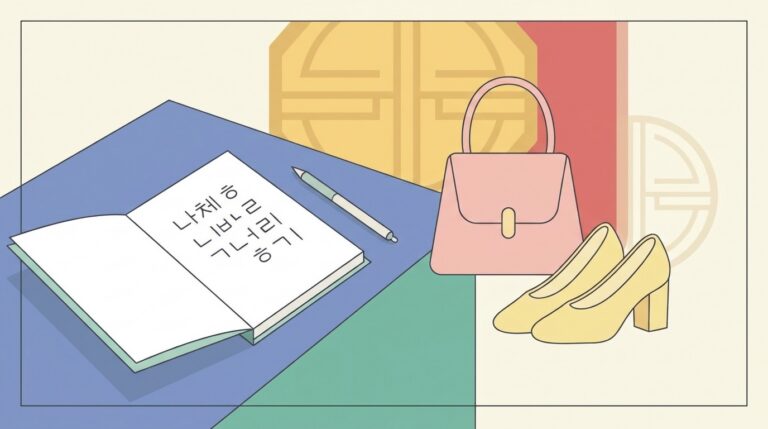
Phase 1: Empathy & Storytelling Opening
안녕하세요! I’m your Daily Hangul editor and your personal Korean cultural navigator! Imagine this: you are walking through the ultra-trendy streets of Seongsu-dong, Seoul’s buzzing fashion hub. You step into an aesthetically pleasing designer boutique. Soft indie music plays, warm ambient lights hit the sleek concrete walls, and sitting on a minimalist pedestal is the bag. It’s gorgeous, but you wonder: Can I wear this as an everyday shoulder bag, or does the strap extend into a casual crossbody? And how does it feel when carried?
You catch the eye of the friendly boutique staff walking toward you with a polite smile. Suddenly, your mind freezes. You know the word 가방 (gabang – bag), but how on earth do you ask about two-way straps without awkwardly gesturing with your arms like a confused flight attendant? Don’t worry! Every single Korean learner has stood in those exact shoes—wondering whether to say 입다 (ipda), 신다 (sinda), or 메다 (meda). Today, we are going to master this exact shopping scenario together so you can shop like a savvy Seoulite with zero anxiety!
Phase 2: Core Expressions Deep Dive
1. 이 가방은 어깨에 멜 수도 있고 크로스로도 멜 수 있어요. (I gaban-eun eokkae-e mel sudo itgo keuroseu-rodo mel su isseoyo.)
- Pronunciation: ee gah-bahng-eun uh-kkae-eh mel soo-doh eet-goh keu-roh-seu-roh-doh mel soo eess-uh-yoh (Sounds like ‘mel’ as in ‘melt’, but crisp and short!)
- Meaning: Literal: “This bag can be carried on the shoulder, and also can be carried as a crossbody.” / Nuance: “You can wear this bag both as a shoulder bag and as a crossbody.”
- K-Culture Moment: You will hear boutique staff in Hongdae or Hannam-dong proudly highlight this feature because multi-way bags (2-way bags) are considered the ultimate practical staple in Korean daily street fashion.
- Editor’s Insight: Notice the verb 메다 (meda). In English, you ‘wear’ or ‘put on’ clothes, shoes, hats, and bags alike. In Korean, bags that hang from straps use 메다. The pattern -(으)ㄹ 수도 있고 -(으)ㄹ 수도 있어요 is a fantastic A2 pattern meaning “You can do [A], and you can also do [B].”
- Situation Spectrum: Casual: ✅ | Semi-formal: ✅ | Formal: ✅
- 🤔 Think About It: Why does Korean have completely different verbs for putting on a bag (메다), putting on shoes (신다), and putting on clothes (입다)? What does this tell us about the sensory attention Korean pays to physical body contact?
2. 혹시 다른 색상도 착용해 볼 수 있나요? (Hoksi dareun saeksang-do chagyonghae bol su innayo?)
- Pronunciation: hohk-shee dah-reun saek-sahng-doh chah-gyong-hae bohl soo een-nah-yoh (The ‘hok’ rhymes with ‘oak’, and ‘si’ is gentle like ‘she’)
- Meaning: Literal: “By any chance, can I also try wearing other colors?” / Nuance: “Could I try this on in the other colors too?”
- K-Culture Moment: Seen frequently in K-Dramas whenever the female or male lead is shopping for a transformational date outfit and the stylist offers to pull out the ivory, beige, and charcoal options from the back inventory.
- Editor’s Insight: Starting your question with 혹시 (hoksi – by any chance) instantly softens your tone by 50%! It transforms a direct demand into a polite, considerate Korean inquiry.
- Situation Spectrum: Casual: ⚠️ | Semi-formal: ✅ | Formal: ✅
- 🤔 Think About It: How does polite hesitation (using words like 혹시) reflect the collective Korean retail etiquette of minimizing burden on staff?
3. 착용감이 정말 편하고 가벼워요. (Chagyonggam-i jeongmal pyeonhago gabyeowoyo.)
- Pronunciation: chah-gyohng-gahm-ee jung-mahl pyuhn-hah-goh gah-byuh-woh-yoh
- Meaning: Literal: “The wearing sensation is really comfortable and light.” / Nuance: “It feels so lightweight and comfortable to wear/carry!”
- K-Culture Moment: You’ll hear beauty and fashion YouTubers repeat this phrase constantly during “What’s in My Bag” and seasonal OOTD (Outfit of the Day) try-on vlogs.
- Editor’s Insight: The word 착용감 (chagyonggam) combines ‘wear’ (착용) and ‘feeling’ (감). You can use it for both shoes (cushioning and fit) and bags (strap comfort against your shoulder).
- Situation Spectrum: Casual: ✅ | Semi-formal: ✅ | Formal: ✅
- 🤔 Think About It: Korean product reviews obsess over 감 (gam)—the subjective, tactile feeling. How does your native language describe the ‘feel’ of an accessory?
Phase 3: Textbook Korean vs. Real-World Korean
Situation 1: Asking if a bag has multiple styling options
- 📖 교과서 한국어 (Textbook): 이 가방은 다용도로 착용 가능합니까? (I gaban-eun dayongdoro chagyong ganeunghamnikka? – “Is this bag usable for multipurpose wearing?”)
- 🗣️ 진짜 한국어 (Real-World): 이거 숄더랑 크로스 둘 다 돼요? (Igeo syoldeorang keuroseu dul da dwaeyo? – “Does this work as both a shoulder and crossbody bag?”)
- 💡 왜 다를까? (Why the difference?): Real shoppers in Korea love concise, energetic speech. Instead of formal Sino-Korean vocabulary (착용 가능), native speakers use loanwords (숄더, 크로스) combined with the versatile verb 되다 (dwoeda – to work/to be possible).
Situation 2: Expressing that shoes don’t hurt your feet
- 📖 교과서 한국어 (Textbook): 이 구두는 착용감이 매우 우수합니다. (I guduneun chagyonggam-i maeu usuhapnida. – “These dress shoes have excellent wearability.”)
- 🗣️ 진짜 한국어 (Real-World): 발 하나도 안 아프고 진짜 편해요! (Bal hanado an apeugo jinjja pyeonhaeyo! – “My feet don’t hurt at all, they’re super comfy!”)
- 💡 왜 다를까? (Why the difference?): Rather than stiff descriptive adjectives, Koreans express comfort by highlighting the absence of pain (발 안 아파요) paired with the emotional booster 진짜 (jinjja – really).
Phase 4: K-Culture Deep Dive & Non-Verbal Manners
4-1. Nunchi & Retail Body Language
When testing bags and shoes in Korea, your non-verbal cues matter just as much as your spoken words!
* The Bag Courtesy: In independent design shops, bags on display often have delicate leather straps. Always ask permission before swinging a display bag over your shoulder: lightly gesture toward the bag, make eye contact, and say, “한번 메봐도 돼요? (Hanbeon mebwado dwaeyo? – May I try carrying this?)”.
* The Shoe Etiquette: If trying on shoes, never step on the sales floor with bare feet. Ask for a disposable foot sock (페이크 삭스 or 덧신) if you are wearing sandals, and use the provided shoehorn (구두주걱 – gudu-jugeok) so you don’t bend the heel counter.
4-2. Trend Spotlight: “Kku-An-Kku” and the Two-Way Bag Phenomenon
Korean everyday fashion is defined by 꾸안꾸 (kku-an-kku)—short for 꾸민 듯 안 꾸민 듯 (looking chic without appearing to have tried too hard). This aesthetic favors minimalist silhouettes that effortlessly transition from a subway commute to an aesthetic cafe in Hannam. This is why 2-way bags (shoulder and crossbody) rule Korean street style: cross-body for busy shopping trips on the weekend, and clean shoulder carry for trendy dinners.
Phase 5: Real-Life Roleplay Scenario
Setting: A sunlit concept store in Seongsu-dong. Minimalist racks, scented ceramic displays, and boutique staff member Minji welcoming you.
- Minji (Staff): 어서 오세요! 천천히 구경하세요. (Eoseo oseyo! Cheoncheonhi gugyeonghaseyo.)
🎭 Smiles warmly, bows lightly from behind the counter.
(Welcome! Please feel free to look around at your own pace.) -
You (Customer): 저기요, 이 가방 한번 메봐도 돼요? (Jeogiyo, i gabang hanbeon mebwado dwaeyo?)
🎭 Gently points index finger toward the leather tote bag on display.
(Excuse me, may I try slinging this bag on?) -
Minji (Staff): 네, 편하게 메보세요! (Ne, pyeonhage meboseyo!)
🎭 Steps forward and unhooks the strap carefully to hand it to you.
(Yes, please feel free to try it on!) -
You (Customer): 생각보다 정말 가볍네요! (Saenggakboda jeongmal gabyeomneyo!)
🎭 Lifts the bag onto one shoulder and checks the full-length mirror.
(It’s much lighter than I expected!) -
Minji (Staff): 맞아요. 이 가방은 어깨에 멜 수도 있고 크로스로도 멜 수 있어요. (Majayo. I gaban-eun eokkae-e mel sudo itgo keuroseu-rodo mel su isseoyo.)
🎭 Demonstrates how to adjust the buckle pin on the side strap.
(That’s right. This bag can be worn on the shoulder or as a crossbody.) -
You (Customer): 혹시 다른 색상도 있나요? (Hoksi dareun saeksang-do innayo?)
🎭 Tilts head curiously with a polite smile.
(Do you happen to have this in other colors as well?) -
Minji (Staff): 네! 블랙이랑 버터 옐로우 색상도 있어요. (Ne! Beullaek-irang beoteo yellou saeksang-do isseoyo.)
🎭 Opens a neat lower cabinet drawer to show the alternative colors.
(Yes! We have it in black and butter yellow as well.) -
You (Customer): 버터 옐로우 색상으로 보여주세요! (Beoteo yellou saeksang-euro boyeojuseyo!)
🎭 Nods appreciatively with excitement.
(Please show me the butter yellow one!)
🔀 Interactive Decision Point
You want to see if the bag has enough inner pockets for your phone and passport before buying. What do you say?
- Option A: “이거 열어봐도 괜찮아요?” (Igeo yeoreobwado gwaenchanhayo?)
- Option B: “야, 가방 속 보여줘.” (Ya, gabang sok boyeojwo.)
- Option C: “안에 지퍼가 있어요? 없어요?” (Ane jipeoga isseoyo? Eopseoyo?)
Feedback:
* Option A is BEST! Perfect A2 polite phrasing. It politely asks “Is it okay if I open this?” Staff will happily open and show you the compartments.
* Option B is BAD! Highly rude! 야 (ya) is an informal, disrespectful call only used between close friends, and 보여줘 drops polite honorifics.
* Option C has RISK. Grammatically correct, but sounds blunt and transactional. Adding a soft 혹시 or choosing Option A sounds much friendlier!
Phase 6: 10-Second Emotion Shadowing Drill
Practice matching the cadence, rhythmic pauses (/), and emotional intent of native Korean shoppers!
[😊 Delight & Discovery]
이 가방은 / 어깨에 멜 수도 있고 / 크로스로도 멜 수 있어요!
(I gaban-eun / eokkae-e mel sudo itgo / keuroseu-rodo mel su isseoyo!)-
[🤔 Polite Curiosity]
혹시 / 다른 색상도 / 착용해 볼 수 있나요?
(Hoksi / dareun saeksang-do / chagyonghae bol su innayo?) -
[😍 Genuine Satisfaction]
착용감이 / 진짜 가볍고 / 발도 편해요!
(Chagyonggam-i / jinjja gabyeopgo / baldo pyeonhaeyo!)
Phase 7: K-Culture Mini Dictionary
- 메다 (Meda) [Verb]: To sling, carry, or hang something on your shoulder or back (e.g., backpacks, shoulder bags, crossbody bags). Don’t confuse it with 매다 (maeda – to tie, like a shoelace or tie)!
- 신어보다 / 메보다 (Sineoboda / Meboda) [Compound Verb]: Combining the action verb with 보다 (to try/see). 신어보다 = to try on shoes; 메보다 = to try on a bag strap.
- 착용감 (Chagyonggam) [Noun]: The physical tactile feeling or fit of an item when worn. Essential for fashion reviews.
- 휘뚜루마뚜루 (Hwitturuma-tturu) [Korean Slang / Adverb]: An iconic modern slang term describing an item you can grab, wear, and match with literally anything anywhere effortlessly without thinking!
Phase 8: Traveler’s Survival Kit
Top 3 Survival Phrases
- 새 상품으로 있나요? (Sae sangpum-euro innayo?)
Pro Tip: After testing display items, ask this to get a pristine, packaged item from stock. - 거울 어디에 있어요? (Geoul eodie isseoyo?)
Pro Tip: “Where is the mirror?” Useful in compact Seongsu or Dongdaemun pop-up stores. - 택스 리펀 되나요? (Taekseu ripeon dwoenayo?)
Pro Tip: “Can I get a tax refund?” Many boutique fashion shops offer immediate tax refunds on-site if you present your physical passport!
Editor’s Travel Note
Before heading to fashionable hubs like Seongsu, Hannam, or Garosu-gil, install the Naver Map app on your phone. Unlike Google Maps, Naver Map gives exact real-time store hours, building floor info, and whether a boutique offers tax refund services or card discounts. Also, most trendy shops operate completely cashless, so have your travel card or WOWPASS handy!
Phase 9: “One Step Deeper” (Reflective Essay)
In English, we casually use one catch-all verb—”wear”—for almost everything: wearing shoes, wearing a backpack, wearing a necklace, wearing a coat, or wearing glasses. In contrast, Korean assigns distinct verbs to each part of the human anatomy. You 신다 (step into) shoes, 메다 (sling over) a bag, 입다 (slip onto torso) clothes, 쓰다 (crown) a hat, and 끼다 (slide into) rings or gloves.
This isn’t just arbitrary grammar; it reflects how Korean worldview perceives your physical interaction with personal belongings. When you wear a bag, you aren’t just decorating yourself—you are carrying a companion weight (메다). The next time you shop in Seoul, notice how using the exact verb 메다 makes staff light up with instant appreciation!
💬 Your Turn: Do you prefer crossbody bags or shoulder bags when traveling? Drop your favorite style in the comments below using the Korean word 숄더 or 크로스!
Phase 10: FAQ & Avoiding Misunderstandings
Q: Can I use the verb 입다 (ipda) for testing a bag?
A: No! 입다 is strictly reserved for clothes that cover your body (shirts, pants, jackets, dresses). If you tell a clerk “이 가방 입어봐도 돼요?”, they will smile because it sounds like you want to put your legs through the bag strap like trousers! Always use 메다 (meda) for bags.
Q: What is the difference between 신어보다 and 신어볼게요?
A: 신어보다 is the base form meaning “to try on shoes.” When speaking to staff, say 신어볼 수 있나요? (Can I try these on?) or 이거 한번 신어볼게요! (I’m going to try this on!).
Q: What does ‘2-way’ mean when written on Korean price tags?
A: You will often see tags reading 2-WAY 가방. This means the bag includes adjustable or detachable straps allowing both shoulder and crossbody styling.
🚨 Common Mistakes Alert
- Mistake: Confusing spelling between 메다 (carry bag) and 매다 (tie shoelaces/necktie).
Correct Action: Memorize: 가방을 메다 vs. 신발끈을 매다. - Mistake: Asking “사이즈 있어요?” without specifying shoe size in millimeters.
Correct Action: Korea uses millimeters! Instead of US size 7 or UK 5, say “240(이백사십) 사이즈 있어요?” - Mistake: Pulling display bags by force off high display fixtures.
Correct Action: Catch the staff’s eye with a warm 저기요 (jeogiyo) and let them unhook it for you.
Phase 11: Action Mission & Engagement
- 🥉 Bronze Level: Stand in front of your mirror with your favorite handbag or backpack. Say aloud: “이 가방은 어깨에 멜 수도 있고 크로스로도 멜 수 있어요!” 3 times smoothly.
- 🥈 Silver Level: Take a quick photo of your daily bag and post it on your Instagram Story or language journal, captioning it: “오늘의 휘뚜루마뚜루 가방! 👜”
- 🥇 Gold Level: Visit a Korean brand showroom, boutique, or local Korean store. Ask the staff: “혹시 다른 색상도 착용해 볼 수 있나요?”
🎮 K-Culture Mission: Watch any Korean fashion haul or “What’s In My Bag” video on YouTube (search 왓츠인마이백). Listen closely and see if you can catch the word 착용감 or 메다!
Phase 12: Interactive Quiz Challenge
1. Situation Judgment
You want to ask the staff if you can try on a pair of stylish loafers in size 240mm. Which phrase is the most natural and polite?
* A) 이 신발 240 입어봐도 돼요?
* B) 이 신발 240 사이즈 신어볼 수 있나요?
* C) 신발 240 보여줘.
2. Fill-in-the-Blank
Fill in the missing verb form:
이 가방은 어깨에 ____(to wear on shoulder) 수도 있고 크로스로도 ____(to wear crossbody) 수 있어요.
3. Cultural True or False
True or False: In Korea, shoe sizes are measured in centimeters (e.g., 24cm) rather than millimeters.
👉 Click to reveal answers & explanations!
-
Correct Answer: B
Explanation: Shoes require the verb 신다 (신어보다). Option A mistakenly uses 입다 (for clothes), and Option C is impolitely blunt. -
Correct Answer: 멜 / 멜
Explanation: The base verb is 메다, combined with the grammatical pattern -(으)ㄹ 수도 있다 yielding 멜 수도 있다. -
Correct Answer: False
Explanation: Korean shoe sizing is always based on millimeters (mm)! A 24cm foot is requested as 240 (이백사십).







