

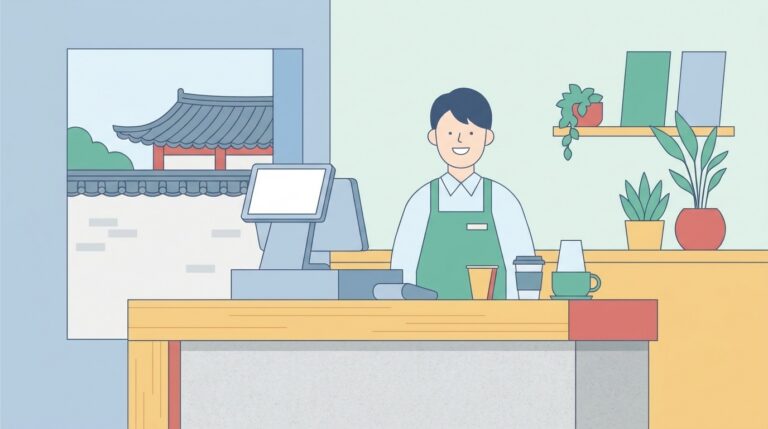
Phase 1: Empathy & K-Culture Opening
안녕하세요! 매일한글 에디터입니다. (Hello! I’m your Daily Hangul editor.)
Picture this: You are standing outside a trendy, warm-lit cafe in the hip streets of Yeonnam-dong or Seongsu-dong. The aromatic smell of freshly roasted espresso beans drifts through the door, indie music hums softly, and there’s a small handwritten sign taped to the glass: “주말 알바 구함 (Weekend Part-Time Staff Wanted).”
Your heart races! Working at a Korean cafe is practically the ultimate dream for international students and travelers alike—it’s where your favorite K-drama leads meet, where aesthetic latte art happens, and where your Korean fluency can skyrocket. But then reality hits: What if the cafe owner (사장님) thinks my Korean isn’t good enough? How do I convince them that I won’t freeze when thirty customers rush in during the lunch break?
Here is a local secret from my 10 years of mentoring foreign residents in Seoul: Korean cafe managers care about two magic things above all else—punctuality and POS system familiarity (포스기). In Korea’s fast-paced “Palli-Palli” (빨리빨리) culture, a boss doesn’t want to spend three weeks teaching someone how to punch in an iced Americano or apply a mobile discount coupon.
By mastering today’s key sentence—“이전에 커피숍에서 6개월 동안 일해 본 경험이 있어서 포스기(POS) 사용법을 알아요” (I have 6 months of previous experience working at a coffee shop, so I know how to use the POS system)—you instantly elevate yourself from a nervous rookie to a reliable, ready-to-work candidate. Let’s make sure you get hired with confidence!
Phase 2: Top 3 Core Expressions In-Depth Analysis
1. 이전에 커피숍에서 일해 본 경험이 있어요
- Pronunciation: Ijeone keopisyob-eseo ilhae bon gyeongheomi isseoyo. (Sound analogy: Think of “E-jeon-eh” like the English name Ian blending with dawn.)
- Meaning: “I have experience working at a coffee shop before.”
- K-Culture Moment: In slice-of-life dramas like Fight for My Way, characters constantly highlight their scrappy part-time jobs (알바 / alba) to prove their grit to managers.
- Editor’s Insight: The grammar pattern
-아/어 본 적(경험)이 있다is the gold standard for describing life experience at the A2 level. Saying “일했어요” (I worked) sounds dry, but saying “일해 본 경험이 있어요” (I have the experience of having worked) sounds professional, humble, and polite.- Situation Spectrum: Casual ⚠️ | Semi-formal ✅ | Formal ✅
- 🤔 Think About It: In English, we usually emphasize our job title (“I was a barista”). In Korean, people emphasize the time spent and the experiential process (“일해 본 경험”). Why do you think Korean workplace culture focuses so much on shared duration and accumulated time?
2. 포스기 사용법을 알아요 / 다룰 줄 알아요
- Pronunciation: Poseugi sayongbeobeul arayo / darul jul arayo. (Sound analogy: POS-eu-gi sounds like the tech acronym “POS” combined with a quick “gee!”)
- Meaning: “I know how to use the POS terminal / I know how to operate the POS.”
- K-Culture Moment: Seen in convenience store comedy webtoons and dramas: the terror of pressing the wrong button on the register and having a line of busy commuters staring at you!
- Editor’s Insight: In Korea, the cash register/touchscreen computer is almost universally called a 포스기 (POS-gi). Adding
-(으)ㄹ 줄 알아요conveys functional know-how (“I know the mechanics of how to do it”). It’s music to a cafe owner’s ears.- Situation Spectrum: Casual ⚠️ | Semi-formal ✅ | Formal ✅
- 🤔 Think About It: Notice how loanwords in Korean frequently attach native affixes (like POS + 기 [machine] = 포스기). Can you identify other tech words in your own language that adapt English acronyms this way?
3. 근무 시간 조율 가능해요
- Pronunciation: Geunmu sigan joyul ganeunghaeyo. (Sound analogy: Geun-mu sounds like a firm “gun-moo”, while jo-yul rolls smoothly like “Joe-yool”.)
- Meaning: “I am flexible with working hours / My schedule can be adjusted.”
- K-Culture Moment: In student-centered dramas, characters negotiate their college lecture schedules around cafe peak shifts.
- Editor’s Insight: 조율 (joyul) literally means “tuning an instrument” (like tuning a violin or piano). Using it in an interview shows you are ready to harmoniously blend your schedule with the cafe’s needs!
- Situation Spectrum: Casual 🚫 | Semi-formal ✅ | Formal ✅
- 🤔 Think About It: Flexibility is regarded as a sign of respect and teamwork in Korean collective society. How does scheduling flexibility carry different social values in your country?
Phase 3: Textbook Korean vs. Real-World Korean
Situation 1: Talking About Past Work Duration
- 📖 교과서 한국어 (Textbook Korean): 저는 6개월간 카페에서 근무한 경력이 존재합니다. (Jeoneun yuggaewolgan kape-eseo geunmuhan gyeongryeogi jonjaehamnida.)
- 🗣️ 진짜 한국어 (Real-World Korean): 저 이전에 카페 알바 6개월 해봤어요! (Jeo ijeone kape alba yuggaewol haebwasseoyo!)
- 💡 Why is it different? Textbook phrases often import stiff, written Sino-Korean vocabulary (“근무한 경력이 존재합니다”). In a real-life cafe interview, owners prefer approachable, energetic language. Saying “알바 해봤어요” sounds reliable yet friendly and warm.
Situation 2: Confirming You Can Handle Orders
- 📖 교과서 한국어 (Textbook Korean): 결제 단말기 조작법을 숙지하고 있습니다. (Gyeolje danmalgi jojakbeobeul sukjihago itseumnida.)
- 🗣️ 진짜 한국어 (Real-World Korean): 포스기 다룰 줄 알아서 바로 주문받을 수 있어요. (Poseugi darul jul araseo baro jumunbadeul su isseoyo.)
- 💡 Why is it different? Nobody says “결제 단말기” (payment terminal) behind the counter. Everyone calls it “포스기” (POS-gi). Showing that you know you can “바로 주문받다” (take orders right away) proves you require zero babysitting.
Phase 4: K-Culture Deep Dive & Non-Verbal Manners
4-1. Nunchi (눈치) & Body Language at the Interview
When interviewing for an alba (part-time job) in Korea, your non-verbal cues communicate 70% of your competence before you even finish your sentence:
1. The Two-Handed Handover: If you bring your printed resume (이력서), always hold it with both hands, thumb and index fingers resting on the top corners, bowing your head slightly (about 15 degrees) as you hand it across the table.
2. Engaged Eye Contact with Steady Nodding (끄덕임): While the manager (사장님) explains peak rush hours, nod attentively while making soft vocal acknowledgments like “네, 맞아요” (Yes, that’s right) or “네, 알겠습니다” (Yes, understood). Looking away or folding your arms conveys disinterest or resistance.
3. Post-Interview Table Cleanup: If the interviewer gives you a complimentary iced tea or water, do not just leave the empty cup on the table when you leave! Pick it up, bring it to the pick-up counter (반납대), and say: “감사히 잘 마셨습니다!” (Thank you, I enjoyed the drink!). This single action demonstrates instant cafe instincts.
4-2. Cultural Insight: The Holy Grail of “Gyeongnyeokjik” (경력직)
In Korea, cafes operate at blistering speeds—especially between 11:30 AM and 1:30 PM, the notorious “Post-Lunch Rush” when office workers stream out in hordes demanding 얼죽아 (Eol-juk-ah: Freezing to death, but still iced Americano!).
Because of this rush, training someone on basic cash handling, barcode scanning, mobile gifticon (기프티콘) redemption, and point accumulation (적립) during open hours is stressful for small business owners. When you casually drop that you already understand the POS menu tree and receipt printing, the manager’s immediate anxiety vanishes. You aren’t just an applicant; you are a problem-solver!
Phase 5: Real-World Roleplay Scenario
Setting: Monday afternoon at Cafe Haru, a boutique cafe in Hongdae. Manager Min (민 사장님) is sitting across from Liam at a quiet wooden table near the espresso machine.
- Turn 1 (Manager Min): 안녕하세요, 리암 씨 맞으시죠? 이력서 잘 봤어요. 한국에서 카페 알바는 처음이신가요?
(Annyeonghaseyo, Liam ssi majeosijyo? Iryeokseo jal bwasseoyo. Hangug-eseo kape albaneun cheoeum-isingayo?)
“Hello, you are Liam, right? I reviewed your resume. Is this your first time doing cafe part-time work in Korea?”
[🎭 따뜻하지만 꼼꼼하게 지원서를 살피며 안경을 고쳐 쓴다] -
Turn 2 (Liam): 네, 한국에서는 처음이지만, 이전에 커피숍에서 6개월 동안 일해 본 경험이 있어요!
(Ne, hangug-eseoneun cheoeum-ijiman, ijeone keopisyob-eseo yuggaewol dongan ilhae bon gyeongheomi isseoyo!)
“Yes, it’s my first time in Korea, but I have experience working at a coffee shop for six months before!”
[🎭 밝은 미소를 지으며 바른 자세로 사장님을 바라본다] -
Turn 3 (Manager Min): 아, 그래요? 6개월 정도 하셨으면 기본은 아시겠네요. 혹시 포스기는 다뤄보셨어요?
(A, geuraeyo? Yuggaewol jeongdo hasyeosseumyeon giboneun asigennéyo. Hoksi poseugineun darwobosyeosseoyo?)
“Oh, really? If you did it for about six months, you must know the basics. Have you operated a POS system by any chance?”
[🎭 약간 놀라며 호기심 어린 눈빛으로 묻는다] -
Turn 4 (Liam): 네! 음료 제조뿐만 아니라 포스기 사용법도 잘 알아요. 결제나 영수증 출력도 혼자 할 수 있어요.
(Ne! Eumryo jejoppunman anira poseugi sayongbeobdo jal arayo. Gyeoljena yeongsujeung chullyeokdo honja hal su isseoyo.)
“Yes! Along with making drinks, I know how to use the POS system well. I can handle card payments and receipt printing on my own.”
[🎭 두 손을 무릎 위에 단정히 모으고 자신감 있게 대답한다] -
Turn 5 (Manager Min): 오, 포스기 알면 진짜 큰 도움이 되죠. 그럼 근무 요일은 언제가 편하세요? 평일 오후 가능해요?
(O, poseugi almyeon jinjja keun doumi doejo. Geureom geunmu yoireun eonjega pyeonhaseyo? Pyeongil ohu ganeunghaeyo?)
“Oh, knowing the POS is a huge help. What working days do you prefer? Are you free weekday afternoons?”
[🎭 흡족한 표정으로 스케줄 수첩을 펼친다] -
Turn 6 (Liam): 화요일과 목요일은 수업이 일찍 끝나서 괜찮습니다. 다른 날도 근무 시간 조율 가능해요!
(Hwayoil-gwa mogyoireun sueobi iljjik kkeutnaseo gwaenchansseumnida. Dareun naldo geunmu sigan joyul ganeunghaeyo!)
“My classes finish early on Tuesdays and Thursdays, so those work great. I can also adjust my working hours for other days!”
[🎭 성실하고 유연한 태도로 고개를 끄덕인다] -
Turn 7 (Manager Min): 성격도 밝으시고 시간 조율도 잘 된다니 마음에 드네요. 손님들한테 한국어로 인사하는 건 어때요?
(Seonggyeokdo balkeusigo sigan joyuldo jal doendani maeume deuneyo. Sonnimdeulhante hangugeoro insahaneun geon eottaeyo?)
“I like that you’re cheerful and your schedule is flexible. How do you feel about greeting customers in Korean?”
[🎭 펜을 톡톡 두드리며 긍정적인 미소를 짓는다] -
Turn 8 (Liam): “어서 오세요! 주문 도와드리겠습니다!” 이렇게 언제든 밝게 인사할 준비 되어 있습니다!
(“Eoseo oseyo! Jumun dowadeurigesseumnida!” Ireohke eonjedeun balke insahal junbi doeeo isseumnida!)
“‘Welcome! May I take your order?’ I am ready to greet customers brightly like this anytime!”
[🎭 일어나서 씩씩하게 고개 숙여 인사하는 시늉을 보여준다]
🔀 Interactive Branching Moment
Manager Min asks: “주말에 갑자기 바빠지면 대타(shift cover) 가능할까요?” (If we suddenly get busy on weekends, can you cover a shift?)
- Option A: “죄송하지만 주말에는 절대 일 안 해요.” (Joesonghajiman jumareneun jeoldae il an haeyo. – “Sorry, but I never work on weekends.”)
- ❌ Result (Bad): Too blunt and rigid. The word ‘절대’ (never/absolutely) creates an uncomfortable wall. The manager might worry about teamwork.
- Option B: “미리 알려주시면 언제든 최대한 맞춰볼게요!” (Miri allyeojusimyeon eonjedeun choedaehan matchwobolgeyo! – “If you let me know in advance, I’ll do my best to adjust!”)
- 🌟 Result (Best): Perfect balance! It sets reasonable boundaries (미리 알려주시면) while showing wonderful teamwork and cooperative spirit (최대한 맞춰볼게요).
- Option C: “네! 주말이든 밤이든 무조건 다 부르세요!” (Ne! Jumal-ideun bam-ideun mujogeon da bureuseyo! – “Yes! Weekends or nights, unconditionally call me for everything!”)
- ⚠️ Result (Risk): Overpromising. If you fail to show up later because of exams, your reliability will plummet. Realistic flexibility is always better.
Phase 6: 10-Second Emotion Shadowing Drill
Follow the slash marks (/) for natural rhythm and pauses. Match the emotional cue inside the brackets!
[😊 자신감 넘치고 싹싹하게 / Confidently and pleasantly]
이전에 커피숍에서 / 6개월 동안 일해 본 경험이 있어서 / 포스기 사용법을 알아요!
(Ijeone keopisyob-eseo / yuggaewol dongan ilhae bon gyeongheomi isseoyo / poseugi sayongbeobeul arayo!)-
[🙋♀️ 공손하고 똑 부러지게 / Politely and clearly]
화요일, 목요일 가능하고요 / 다른 요일도 / 근무 시간 조율 가능해요.
(Hwayoil, mogyoil ganeunghagoyo / dareun yoildo / geunmu sigan joyul ganeunghaeyo.) -
[☕ 활기차고 경쾌하게 / Energetically and warmly]
어서 오세요! / 따뜻한 아메리카노 한 잔 / 주문 도와드리겠습니다!
(Eoseo oseyo! / Ttatteut-han amerikano han jan / jumun dowadeurigesseumnida!)
Phase 7: K-Culture Mini Dictionary
- 알바 (Alba)
- Short for 아르바이트 (derived from the German Arbeit). It refers to any hourly part-time job. In Korea, doing an alba is viewed as a foundational coming-of-age experience for young adults.
- 포스기 (Poseugi / POS Machine)
- The computerized touch screen used for orders, inventory, and payment. Knowing POS terminology (카드 결제 = card payment, 현금영수증 = cash receipt, 포인트 적립 = point accumulation) makes you instantly employable.
- 경력직 (Gyeongnyeokjik / Experienced Worker)
- An applicant who already has prior work experience. Small cafes adore hiring 경력직 because it saves dozens of hours of repetitive training.
- 대타 (Daeta / Substitute Shift Cover)
- Literally “pinch hitter” in baseball! In alba lingo, filling in for a sick or absent co-worker is called 대타 뛰다 (running as a sub). Being open to 대타 wins huge brownie points with colleagues and bosses.
Phase 8: Traveler & Resident Survival Kit
TOP 3 Survival Phrases
- 한글: 시급과 주휴수당은 어떻게 되나요?
- Romanization: Sigeub-gwa juhyusudang-eun eotteohke doenayo?
- Pro Tip: Inquire politely about the hourly wage (시급) and weekly holiday pay (주휴수당). Legal minimum wage in Korea is strictly protected, and asking respectfully shows you are informed.
- 한글: 음료 레시피는 제가 외워 올게요!
- Romanization: Eumryo resipineun jega oeweo olgeyo!
- Pro Tip: Say this at the end of the interview. Saying you’ll memorize the drink recipes in advance leaves an unforgettable impression of diligence.
- 한글: 보건증 발급받아 두었습니다.
- Romanization: Bogeonjeung balgeupbada dueotseumnida.
- Pro Tip: In Korea, every food and beverage worker must hold a valid Health Certificate (보건증). Getting it at a local public health center (보건소) prior to your interview proves you are 100% ready to work tomorrow.
Editor’s Practical Survival Note
Looking for cafe jobs in Korea? Skip random paper posters and download the two main job hunting applications directly: search for 알바몬 앱 다운로드 or 알바천국 공식 포털. Filter jobs by location (지역별) and look for postings marked “초보 가능” (Beginners welcome) or “동종 경력 우대” (Same-industry experience preferred) where your POS background will shine!
Phase 9: “One Step Deeper” (Reflective Question)
In many Western cafe settings, small talk, banter, and personal warmth define great customer service. However, in urban Korea, the highest form of service in a bustling cafe is often speed, precision, and frictionless convenience.
When you state that you know how to operate the POS machine (포스기 사용법을 알아요), you aren’t just boasting a technical skill; you are signaling your respect for the entire ecosystem of the cafe. You are saying, “I understand that your customers need to get their morning iced latte in under 90 seconds without system delays.” It reflects a deep cultural alignment with collective efficiency.
💬 Your Turn: In your home country, what is considered the #1 most attractive trait for a part-time cafe worker? Is it technical speed, friendly storytelling, latte art skill, or something else? Share your thoughts in the comments below!
Phase 10: FAQ & Avoiding Misunderstandings
Q: Can foreign visa holders legally work at cafes in Korea?
A: Yes, but you must verify your visa category! International students on D-2 or D-4 visas can work part-time if they obtain formal “Part-Time Work Permission” (시간제취업 허가) from Korean Immigration and their university. Working without this endorsement is illegal, so always notify your school coordinator before signing an alba contract.
Q: What if the POS software at the new cafe looks completely different from my old job?
A: Don’t panic! Almost all Korean cafe POS programs (such as OKPOS or PosBank) share identical layouts: categories on top (Coffee, Non-Coffee, Bakery), payment types on the bottom right (신용카드, 현금, 모바일쿠폰). Simply say: “기본적인 결제 흐름은 알고 있어서, 메뉴 위치만 익히면 바로 적응할 수 있습니다!” (I know the basic payment flow, so once I learn the menu locations, I can adapt right away!).
Q: Do I need to speak fluent Level 6 TOPIK Korean to get hired?
A: Not at all! Most owners look for clear listening skills, the ability to say standard cafe greetings politely, and reliability. Demonstrating A2/B1 practical sentences like today’s expressions with great pronunciation will often win you the job over someone with theoretical grammar skills.
🚨 Common Mistakes Board
- Mistake: Calling the register a “레지스터” (Rejiseuteo) or “캐셔” (Kaesyeo).
- Correct Action: Always say 포스기 (POS-gi). That is the universal term used by all owners and staff.
- Mistake: Using 반말 (casual talk) to sound friendly during the interview (e.g., saying “응, 포스기 알아!”).
- Correct Action: Stick firmly to 해요체 or 하십시오체 (e.g., “네, 포스기 다룰 줄 압니다 / 알아요”). Respect is non-negotiable.
- Mistake: Forgetting that “6 months” in Korean uses Sino-Korean numbers.
- Correct Action: Say 육 개월 (yug-gaewol), NOT 여섯 개월 (yeoseot-gaewol). Months with 개월 use 1, 2, 3, 4, 5, 6 (일, 이, 삼, 사, 오, 육).
Phase 11: Action Missions & Engagement
- 🥉 Bronze Mission (Solo Practice): Stand in front of your bathroom mirror and recite today’s key sentence 5 times out loud without looking at notes: “이전에 커피숍에서 6개월 동안 일해 본 경험이 있어서 포스기 사용법을 알아요!”
- 🥈 Silver Mission (Social Sharing): Record your voice on your phone reciting the Phase 6 Shadowing drill. Listen back to check if your pauses match the
/markers, and post your practice line in our community study group! - 🥇 Gold Mission (Real-World Test): Visit a local Korean-run cafe or convenience store. When paying, observe the cashier using the POS system. Silently identify the buttons: 신용카드 (credit card), 영수증 (receipt), 현금 (cash).
- 🎮 K-Culture Mission: Watch any episode of an alba-centered Korean drama (like Record of Youth or My Mister) and count how many times characters say 알바, 사장님, or stand beside a 포스기!
Phase 12: Interactive Quiz Challenge
Quiz 1. Situational Judgment
During a cafe interview, the owner asks: “혹시 주말에 오픈 타임(오전 8시) 근무 가능해요?” (Can you work the weekend opening shift at 8 AM?). Which response is the most natural and polite for an A2 learner?
1. 싫어요, 아침에는 잠을 자야 해요.
2. 네, 아침 시간도 괜찮고 근무 시간 조율 가능해요!
3. 몰라요, 사장님이 알아서 하세요.
4. 주말 오픈은 시급 두 배 주면 할게요.
👉 Click to reveal Answer & Explanation
- Correct Answer: 2번 (네, 아침 시간도 괜찮고 근무 시간 조율 가능해요!)
- Explanation: Option 2 expresses openness and adaptability in polite honorifics. Option 1 is too blunt and childish, Option 3 is disrespectful, and Option 4 sounds rude during an initial interview.
Quiz 2. Fill in the Blank
Complete the sentence to tell the owner that you know how to operate the POS machine:
“이전에 일해 봐서 (________) 사용법을 알아요.”
1. 세탁기 (Washing machine)
2. 청소기 (Vacuum cleaner)
3. 포스기 (POS system)
4. 자판기 (Vending machine)
👉 Click to reveal Answer & Explanation
- Correct Answer: 3번 (포스기)
- Explanation: 포스기 (POS-gi) is the cash register/POS machine. The other options mean washing machine (세탁기), vacuum (청소기), and vending machine (자판기).
Quiz 3. True / False Culture Check
Statement: When handing your resume (이력서) to a Korean cafe owner during an interview, it is customary to slide it across the table with one hand while keeping your other hand in your pocket.
* [ ] True
* [ ] False
👉 Click to reveal Answer & Explanation
- Correct Answer: False
- Explanation: In Korean etiquette, you should always hand important documents over with both hands (두 손으로) accompanied by a slight bow. Placing hands in your pockets during an interview is considered highly impolite!







