

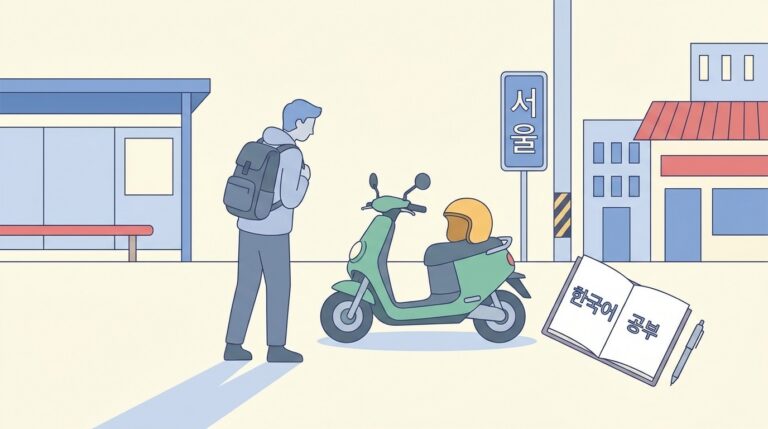
Riding an Electric Scooter in Korea: The Driver’s License Rule You Must Know
Phase 1: Empathy (Story Immersion Opening)
안녕하세요! 매일한글 에디터입니다. (Hello! This is your Daily Hangul editor.)
Picture this: You are strolling down the vibrant, tree-lined streets of Hongdae or enjoying the cool evening breeze along the Han River. You see colorful electric kickboards—Beam, Kickgoing, Swing—neatly lined up on the curb. In many Western cities, you can simply unlock a shared scooter with an app and a credit card, gliding effortlessly toward your favorite K-BBQ spot like the chic lead in a campus K-Drama.
You pull out your phone, download the rental app, scan the QR code, and suddenly—bam!—the screen displays a strict prompt: 운전면허증을 등록해 주세요 (Please register your driver’s license). You think, Wait, for a tiny two-wheeled scooter?!
Yes! Under Korean Road Traffic Law (도로교통법), electric scooters are classified as Personal Mobility (PM) devices. To legally ride one, you must hold at least a motorized bicycle license (원동기장치자전거면허) or a regular driver’s license. Riding without a license can lead to hefty fines, or worse, legal troubles during your dream vacation. Many of our intermediate learners have asked, “How do I talk about this politely with Korean friends, or understand police warnings without panicking?”
Today, we will break down the essential B1-level expressions, critical cultural etiquette (Nunchi on pedestrian paths), and real survival tips so you can navigate Korean streets confidently, safely, and legally.
Phase 2: Core 3 Expressions Deep Dive
Here are the top three expressions you will hear and use whenever electric scooters are mentioned in Korea.
1. 면허증 있어야 탈 수 있어요 (Myeonheojeung isseoya tal su isseoyo)
- Pronunciation: [Myeon-heo-jeung i-sseo-ya tal su i-sseo-yo] (Sounds like “myun-huh-jeung” with a crisp rising rhythm)
- Meaning: Literal: “You can ride only if you have a license.” / Real Nuance: “Heads up, you can’t legally ride this without a driver’s license!”
- K-Culture Moment: Often heard when foreign exchange students or young travelers try to unlock a shared scooter together, and a local friend urgently taps their shoulder to remind them.
- Editor’s Insight: The grammar pattern
-아/어야 [동사]할 수 있다expresses an absolute prerequisite (“only if A happens can B occur”). In Korea, PM laws tightened drastically after 2021, turning this phrase from friendly advice into a strict legal boundary.- Situation Spectrum: Casual (면허증 있어야 타지) ✅ / Semi-formal (면허증 있어야 탈 수 있어요) ✅ / Formal (면허증을 소지하셔야 이용 가능합니다) ✅
- 🤔 Think About It: In your country, are micro-mobility vehicles viewed as recreational toys or motor vehicles? Notice how the Korean term 원동기 (motor device) shifts the scooter into the same legal category as small motorbikes.
2. 헬멧 안 쓰면 범칙금 나와요 (Helmet an sseumyeon beomchikgeum nawayo)
- Pronunciation: [Hel-met an sseu-myeon beom-chik-geum na-wa-yo] (Sound analogy: “Hel-met” said quickly, followed by “an sseu-myeon” like blowing out a candle)
- Meaning: Literal: “If you do not wear a helmet, a fine comes out.” / Real Nuance: “Put on a helmet, or the police will ticket you 20,000 KRW right on the spot!”
- K-Culture Moment: Patrol police officers at major subway exits (like Gangnam or Hongdae) holding handheld ticketing devices, stopping students riding without protective gear.
- Editor’s Insight: In Korean, fines are idiomatically said to “come out” (나와요). The noun 범칙금 (traffic infraction fine) is distinguished from 과태료 (administrative penalty) because an officer directly hands it to the violator.
- Situation Spectrum: Casual (헬멧 안 쓰면 벌금 나와) ✅ / Semi-formal (헬멧 안 쓰면 범칙금 나와요) ✅ / Formal (안전모 미착용 시 범칙금이 부과됩니다) ✅
- 🤔 Think About It: Why does Korean culture emphasize collective safety enforcement through fines rather than simple disclaimers? Reflect on how Korean public policy prioritizes pedestrian-first protection in densely populated urban centers.
3. 인도에서 타시면 안 돼요 (Indo-eseo tasimyeon an dwaeyo)
- Pronunciation: [In-do-e-seo ta-si-myeon an dwae-yo] (Sound analogy: “In-do” sounds identical to the Korean name for India, but here it means “pedestrian sidewalk”)
- Meaning: Literal: “You must not ride on the sidewalk.” / Real Nuance: “Watch out! Scooters are prohibited on sidewalks; you have to stick to bike paths or the road shoulder.”
- K-Culture Moment: A pedestrian or elderly citizen calling out when a silent electric kickboard zips too close past a bus stop.
- Editor’s Insight:
-면 안 되다is the go-to grammar for B1 learners to express strong prohibitions politely. Using the honorific infix-시-(타시면) softens the tone while keeping the rule crystal clear.- Situation Spectrum: Casual (인도에서 타면 안 돼) ✅ / Semi-formal (인도에서 타시면 안 돼요) ✅ / Formal (보도 주행은 법적으로 금지되어 있습니다) ✅
- 🤔 Think About It: Compare the English word “sidewalk” with the Korean 인도 (人道 – literally “the path of humans”). The language itself explicitly defines the space as human territory where motorized wheels are unwelcome.
Phase 3: Textbook Korean vs. Real Korean
Let’s compare stiff classroom phrasing with how urban Koreans actually talk on the street.
Situation 1: Checking if someone has a license before scanning a scooter
- 📖 교과서 한국어 (Textbook Korean):
당신은 전동 킥보드 운전면허증을 보유하고 있습니까? (Dangsineun jeondong kikbodeu unjeonmyeonheojeungeul boyuhago isseumnikka? / Do you possess an electric kickboard driver’s license?) - 🗣️ 진짜 한국어 (Real Korean):
너 혹시 한국 면허증 있어? (Neo hoksi hanguk myeonheojeung isseo? / By the way, do you have a Korean license?) - 💡 왜 다를까? (Why is it different?):
Native speakers drop redundant subjects like ‘당신’ (which can sound confrontational in casual speech) and use the soft conversational buffer ‘혹시’ (by any chance) to confirm eligibility.
Situation 2: Stopping a friend from riding together on one scooter (Double Riding)
- 📖 교과서 한국어 (Textbook Korean):
동승자를 태우고 주행하는 것은 금지되어 있습니다. (Dongseungjareul taeugo juhaenghaneun geoseun geumjidoeeo isseumnida. / Riding with an accompanying passenger is prohibited.) - 🗣️ 진짜 한국어 (Real Korean):
둘이 같이 타면 진짜 위험해! 걸리면 바로 벌금이야. (Duri gati tamyeon jinjja wiheomhae! Geollimyeon baro beolgeumiya. / Riding two-up is super dangerous! If we get caught, it’s an instant fine.) - 💡 왜 다를까? (Why is it different?):
Young Koreans use the passive verb ‘걸리다’ (to get caught/busted by authorities) rather than formal legal terms like ‘단속되다’ (to be cracked down upon).
Phase 4: K-Culture Deep Dive & Non-verbal Manners
4-1. 눈치 (Nunchi) & Street Body Language
When navigating streets in Korea, quiet electric kickboards can easily surprise people. Koreans value spatial harmony:
* The Slight Head Nod & Apology: If you pass a pedestrian on a narrow shared bike lane, slightly bow your head and say “죄송합니다” (Joesonghamnida) or “지나갈게요” (Jinagalgeyo – Passing through). Don’t aggressively ring the bell multiple times—it is perceived as demanding and rude.
* Dismounting at Crosswalks: The law requires scooter riders to dismount and push their scooter across pedestrian crosswalks (횡단보도에서는 끌고 가기). Doing this exhibits impeccable Nunchi and earns instant respect from onlookers.
4-2. The Cultural Phenomenon: 킥라니 (Kick-rani)
In South Korea, news broadcasts and social media frequently use the satirical portmanteau 킥라니 (Kick-rani)—a blend of Kickboard and Gorani (고라니, the Korean water deer known for recklessly darting into roads at night).
Because electric kickboards are fast and quiet, riders who dart into oncoming traffic or weave through pedestrians earned this notorious nickname. Knowing this term helps you understand why locals and police take traffic enforcement so seriously: it’s not about spoiling your fun, it’s about curbing the “Kick-rani” hazard!
Phase 5: Real-Life Roleplay Scenario
Setting: Near Exit 3 of Seongsu Station. Your Korean friend Min-jun (민준) notices you staring eagerly at two parked shared scooters after dinner.
- Min-jun: 저거 타고 서울숲까지 갈래? 시원할 텐데! (Jeogeo tago Seoul-sup-kkaji gallae? Siwonhal tende! / Do you want to ride those to Seoul Forest? It would be so refreshing!)
- You: 오, 좋아요! 앱 깔아서 바로 탈까요? (O, joayo! Aep kkaraseo baro talkkayo? / Oh, sounds great! Should I download the app and ride right away?)
🎭 [Curiously taking out your smartphone] - Min-jun: 잠깐만! 너 한국 운전면허증 있어? (Jamkkanman! Neo hanguk unjeonmyeonheojeung isseo? / Wait a second! Do you have a Korean driver’s license?)
- You: 아니요, 없어요. 미국 면허증만 있어요. (Aniyo, eopseoyo. Miguk myeonheojeungman isseoyo. / No, I don’t. I only have my American license.)
- Min-jun: 아, 그러면 전동 킥보드는 못 타. 면허증 인증 필수거든! (A, geureomyeon jeondong kikbodeuneun mot ta. Myeonheojeung injeung pilsugeodeun! / Ah, then you can’t ride an electric kickboard. License verification is mandatory!)
🎭 [Gently holding your wrist to stop you from scanning] - You: 면허증 없이 타면 어떻게 돼요? (Myeonheojeung eopsi tamyeon eotteoke dwaeyo? / What happens if someone rides without a license?)
- Min-jun: 무면허 운전이라 범칙금 10만 원 나와. 헬멧도 없잖아! (Mumyeonheo unjeon-ira beomchikgeum simman-won nawa. Helmet-do eopjana! / It’s considered driving without a license, so you get fined 100,000 KRW. Plus, we don’t have helmets either!)
- You: 헐, 정말요? 큰일 날 뻔했네요. 그냥 걸어가요! (Heol, jeongmalyo? Keunil nal ppeonhaenneyo. Geunyang georeogayo! / Whoa, really? That was close. Let’s just walk!)
🎭 [Sighing with relief and putting the phone back in your pocket]
🔀 Interactive Branch Point: What would you do if Min-jun suggested: “둘이서 하나 같이 타자!” (Let’s just ride one scooter together)?
- Option A: “그래, 가까우니까 딱 5분만 타자!” (Sure, it’s close, let’s ride just for 5 minutes!)
- 🚫 Bad: Riding double is illegal, carries a 40,000 KRW fine, and drastically increases the risk of severe injury.
- Option B: “몰래 골목길로 가면 경찰 안 보이지 않을까?” (If we sneak through back alleys, won’t police not see us?)
- ⚠️ Risk: Delivery scooters and parked cars make narrow alleys the most dangerous spot for PM devices.
- Option C: “안 돼! 2인 탑승 불법이고 진짜 위험해. 차라리 따릉이 빌리자!” (No way! Double riding is illegal and really dangerous. Let’s rent Ttareungyi city bikes instead!)
- ✅ Best: Perfect cultural understanding and safety awareness! Normal bikes don’t require a driver’s license.
Phase 6: 10-Second Emotion Shadowing Drill
Practice these natural pacing patterns with the emotional roadmaps:
[🚨 단호하고 걱정스럽게 - Firm and caring]
“면허증 없으면 / 절대 타면 안 돼! / 10만 원 나와!”
(Myeonheojeung eopseumyeon / jeoldae tamyeon an dwae! / Simman-won nawa!)
“If you don’t have a license / you must never ride! / It’s a 100,000 won fine!”-
[😅 안도하며 가슴을 쓸어내리듯 - Relieved with a light sigh]
“와, 몰랐으면 / 경찰한테 걸릴 뻔했네요.”
(Wa, mollasseumyeon / gyeongchal-hante geollil ppeonhaenneyo.)
“Wow, if I hadn’t known / I almost got caught by the police.” -
[💡 밝고 대안을 제시하며 - Brightly offering an alternative]
“우리 킥보드 말고 / 따릉이 타고 한강 갈까요?”
(Uri kikbodeu malgo / Ttareungyi tago Han-gang galkkayo?)
“Instead of kickboards / shall we ride Ttareungyi bikes to the Han River?”
Phase 7: K-Culture Mini Dictionary
-
킥라니 (Kick-rani)
- Meaning: Reckless electric scooter rider (Kickboard + Gorani water deer).
- Usage: Used in conversation or comments when someone swerves dangerously: “방금 킥라니 봤어? 깜짝 놀랐네!” (Did you see that Kick-rani just now? I was so shocked!)
- 원동기장치자전거 (Wondonggi-jangchi-jajeongeo)
- Meaning: Motorized bicycle / Moped (Engine under 125cc or PM device under 25km/h).
- Usage: Legal term on official documents. Foreigners must hold at least this class of license to rent a scooter.
- 따릉이 (Ttareungyi)
- Meaning: Seoul’s official public rental bicycle system.
- Usage: The best legal alternative for tourists without a Korean license! Accessible to foreigners via the app without requiring a driver’s permit.
- 범칙금 (Beomchikgeum)
- Meaning: Traffic infraction fine paid to the National Police Agency.
- Usage: Paid when caught violating rules (e.g., riding on sidewalks: 30,000 KRW; no helmet: 20,000 KRW; no license: 100,000 KRW).
Phase 8: Survival Kit for Travelers
Top 3 Survival Phrases
- 면허증 인증해야 돼요? (Myeonheojeung injeunghaeya dwaeyo?)
- Pro Tip: Ask this when considering any micro-mobility app. (“Do I need to verify a driver’s license?”)
- 여기 주차하면 안 돼요. (Yeogi juchahamyeon an dwaeyo.)
- Pro Tip: Scooter parking is banned near subway entrances, tactile paving for the blind, and bus stops.
- 자전거 도로가 어디예요? (Jajeongeo doroga eodiyeyo?)
- Pro Tip: Use this to find legal lanes! Scooters cannot use sidewalks; they belong on bicycle paths or the right edge of roads.
Editor’s Travel Note
If you do not have an official Korean driver’s license or a recognized International Driving Permit (IDP) linked to a compatible service, do not risk it!
Instead, download the Seoul Public Bike Ttareungyi app for foreigners or use the public transport directions on the Naver Map navigation download page. Seoul’s subway and bus systems are among the world’s cleanest and fastest—you won’t even miss the scooter!
Phase 9: “한 발 더 깊이” (Going Deeper: Cultural Insight)
In Korean society, the sidewalk is not just a walkway; it is a shared sanctuary for families, children, and elderly citizens navigating hyper-dense urban neighborhoods. When personal mobility devices exploded in popularity, the public debate wasn’t about convenience—it centered on 배려 (Baeryeo – consideration for others) and mutual safety.
Koreans hold high expectations for collective civic responsibility. That is why the law treats an electric scooter not as an innocent toy, but as a motor vehicle requiring qualification and accountability. Following these rules shows that you respect the shared social contract of Korea’s streets.
💬 Your Turn: Does your home country require a driver’s license for e-scooters? How do people in your hometown balance pedestrian walkways and scooters? Share your thoughts in the comments below!
Phase 10: FAQ & Avoiding Misunderstandings
Q: Can I use an International Driving Permit (IDP) to rent an electric scooter in Korea?
A: Technically, the law allows IDP holders who are licensed for motorbikes/cars to ride PMs. However, most Korean rental apps (Kickgoing, Swing, etc.) require Korean mobile carrier identity verification (본인인증), which tourists cannot complete. Unless an app explicitly offers an IDP foreign passport verification lane, you will likely be blocked from renting.
Q: What if I ride an electric scooter under the influence of alcohol (음주운전)?
A: Never do this! Drunk riding of an e-scooter carries the exact same severe penalties as driving a car under Korean law: a 100,000 KRW fine, immediate license suspension or revocation, and potential criminal charges if an accident occurs.
Q: Can my friend and I ride together if we are under the weight limit?
A: Absolutely not. In Korea, carrying a passenger on a single-seat personal mobility device is punishable by a 40,000 KRW fine. Only one person per kickboard is permitted at all times.
🚨 흔한 실수 (Common Mistakes) Warning Board
- Mistake: Riding on the sidewalk because the road looks scary.
- Correct Action: Ride on designated bicycle paths (자전거 전용도로). If there is no bike path, ride on the far right lane of the car road. When in doubt, dismount and walk!
- Mistake: Leaving the helmet behind because “it’s just a short trip.”
- Correct Action: Always wear a certified safety helmet (안전모). Many rental operators provide helmets attached to the handlebars.
- Mistake: Parking the kickboard directly in front of subway entrances or tactile yellow paving.
- Correct Action: Park in designated PM parking zones (전동 킥보드 전용 주차구역) marked with white lines on the pavement.
Phase 11: Action Mission & Participation
Take your learning to the next level with this 3-tier challenge:
- 🥉 Bronze Mission (Solo Practice): Stand in front of a mirror and recite the sentence: “면허증 없으면 타면 안 돼요!” with a confident, urgent tone 5 times.
- 🥈 Silver Mission (Social Share): Check a photo or video of Seoul street traffic, spot one electric scooter, and write down whether the rider is properly wearing a helmet.
- 🥇 Gold Mission (Real-world Application): When talking with a friend about visiting Korea, explain the license and helmet rules using the Korean words 면허증 (Myeonheojeung) and 범칙금 (Beomchikgeum).
🎮 K-Culture Mission: Watch a modern Korean urban drama (such as Start-Up or Weightlifting Fairy Kim Bok-joo). Count how many bicycles or kickboards you see in campus scenes, and note how characters park them!
Phase 12: Interactive Quiz Challenge
Test your knowledge before hitting the streets of Seoul!
Q1. (Situational Judgment)
You are traveling in Busan and see an electric scooter. You hold an ordinary overseas driver’s license, but your rental app hasn’t verified your ID, and you don’t have a helmet. What should you do?
* A) Ride slowly only on the sidewalk.
* B) Skip the scooter, wear your sneakers, or hop on public transit.
* C) Ride quickly while keeping an eye out for police.
Q2. (Fill-in-the-Blank)
전동 킥보드를 타려면 반드시 운전_______이/가 있어야 해요. (To ride an electric scooter, you must have a driver’s _______.)
Q3. (True or False)
Under Korean law, two close friends can ride a single electric kickboard together as long as their total weight is under 100kg.
👉 Click here to reveal the answers and explanations!
- A1 Answer: B! Riding without an app-verified license and without a helmet puts you at risk of multiple police fines totaling over 120,000 KRW, plus sidewalk riding is prohibited.
- A2 Answer: 면허증 (Myeonheojeung). The complete phrase is 운전면허증 (Driver’s license).
- A3 Answer: False (X)! Riding two-up (동승자 탑승) is strictly illegal regardless of weight and incurs an immediate 40,000 KRW fine.







