

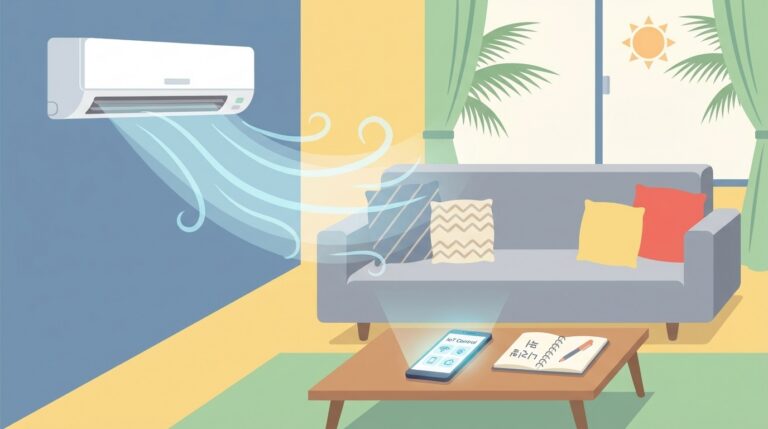
Beat the Korean Summer Heat from Your Phone: Master Smart Home Expressions Like a Seoulite
Phase 1: 공감 (Story-Driven Opening)
안녕하세요! 매일한글 에디터입니다.
Picture this: It is mid-July in Seoul. You step out of the blissfully chilled subway at Gangnam Station, and immediately, the humid, swamp-like summer air hits you like a wet wool blanket. Beads of sweat trickle down your neck, and your shirt is already sticking to your back. The thought of walking another ten minutes to your officetel apartment fills you with absolute dread—especially knowing that your room will feel like an unvented pizza oven the moment you unlock the door.
Suddenly, your Korean friend smiles, pulls out their smartphone, taps a button on the screen, and whispers, “집에 도착하기 10분 전에 미리 에어컨 켜 놨어 (I turned on the AC 10 minutes in advance).” When you finally arrive and open the front door, a crisp, arctic breeze greets you. You let out a long sigh of pure relief. That moment isn’t just technology; it is peak Korean convenience culture at its finest.
In South Korea’s fast-paced, high-tech urban life, smart home IoT apps like Samsung SmartThings and LG ThinQ aren’t futuristic novelties—they are daily survival essentials. Whether it is scheduling a robot cleaner before guests arrive or remote-controlling your air conditioner while walking from the bus stop, these gadgets genuinely transform your everyday routine. This guide breaks down the essential B1-level Korean phrases and cultural etiquette you need to talk about smart home routines like a true native. Trust me, learning these expressions will make your Korean conversations instantly sound more natural, savvy, and modern!
Phase 2: 핵심 표현 3선 심층 분석 (Top 3 Core Expressions)
1. 미리 켜 두다 (Miri kyeo duda)
- Pronunciation: [Miri kyeo-duda] (Sounds like “Mee-ree cure-doo-dah”, where ‘kyeo’ smoothly glides like the start of ‘cure’ without the r)
- Meaning: Literal: “To turn on in advance and keep it running.” / Real Nuance: Taking a proactive action beforehand so everything is pleasantly prepared when you arrive.
- K-Culture Moment: You will hear this constantly in Korean lifestyle vlogs (브이로그) and roommate sitcoms whenever someone is commuting home after work and wants their living room pre-cooled or floor heated.
- Editor’s Insight: The auxiliary verb combination -어/아 두다 means doing an action beforehand to maintain that state for future benefit. Adding 미리 (in advance) emphasizes your foresight!
- Situation Spectrum:
- Casual: ✅ (미리 켜 둬! / 미리 켜 놨어!)
- Semi-formal: ✅ (미리 켜 둬요 / 미리 켜 뒀어요)
- Formal: ✅ (미리 켜 둡니다)
- 🤔 Think About It: In English, we simply say “I turned it on ahead of time.” Korean uses a specific grammatical helper (-어 두다) to stress preserving the prepared state. How does this reflect Korea’s cultural value of foresight and preparation (사전 준비)?
2. 삶의 질이 수직 상승하다 (Salmui jiri sujilsangseunghada)
- Pronunciation: [Sal-mui ji-ri su-jik sang-seung-ha-da] (Imagine saying “sal-moo-ee jee-ree soo-jeek sahng-seung-ha-da”)
- Meaning: Literal: “One’s quality of life rises vertically.” / Real Nuance: “My life got 1000% better thanks to this item!”
- K-Culture Moment: Korean tech review channels and Twitter threads frequently use this phrase when raving about life-upgrading gadgets like robot vacuum cleaners (로봇청소기) and dishwashers (식기세척기).
- Editor’s Insight: The word 수직 (vertical) creates a dramatic visual metaphor. It means the improvement was not slow or gradual—it jumped straight to the sky.
- Situation Spectrum:
- Casual: ✅ (삶의 질 수직 상승했어!)
- Semi-formal: ✅ (삶의 질이 수직 상승해요!)
- Formal: ⚠️ (Used more in lifestyle presentations; in official boardrooms, say 삶의 질이 크게 향상되었습니다)
- 🤔 Think About It: Why do you think Korean internet slang loves hyperbolic directional words like ‘vertical rise’ (수직 상승) or ‘떡상’ (rocketing up) when describing personal comfort?
3. 밖에서 원격으로 제어하다 (Bakk-eseo won-gyeog-euro jeeohada)
- Pronunciation: [Bahk-keh-seo won-gyeo-geu-ro je-eo-ha-da] (Pronounce ‘bakk-eseo’ with a sharp, crisp double-k sound)
- Meaning: Literal: “To remotely control from the outside.” / Real Nuance: Operating your home appliances seamlessly from anywhere via mobile apps.
- K-Culture Moment: Tech-savvy young professionals living in smart officetels casually explain their home automation setup to visiting friends during housewarming parties (집들이).
- Editor’s Insight: In casual chat, you can shorten this to 밖에서 앱으로 켜다 (to turn on via app from outside). 원격 제어 (remote control) adds an intelligent, tech-forward touch.
- Situation Spectrum:
- Casual: ⚠️ (A bit formal for close friends; say “밖에서 앱으로 다 해!”)
- Semi-formal: ✅ (밖에서 원격으로 제어할 수 있어요)
- Formal: ✅ (외부에서 원격으로 제어합니다)
- 🤔 Think About It: Contrast how your home country handles home automation versus Korea’s unified smartphone brand ecosystems (like Samsung or LG). How does mobile dependency shape conversation?
Phase 3: 교과서 한국어 vs 진짜 한국어 (Textbook vs. Real-Life Korean)
Situation 1: Telling your roommate you will turn on the AC on your way home
- 📖 교과서 한국어: “저는 스마트폰 응용프로그램을 사용하여 에어컨을 가동하겠습니다.” (Jeoneun seumateupon eung-yong-peurogeuraem-eul sayonghayeo eeokeon-eul gadonghagesseumnida. – I will operate the air conditioner using a smartphone application.)
- 🗣️ 진짜 한국어: “집에 가면서 앱으로 에어컨 미리 켜 둘게!” (Jib-e gamyeonseo aeb-euro eeokeon miri kyeo dulge! – I’ll turn the AC on beforehand via the app on my way home!)
- 💡 왜 다를까? Real Koreans rarely use formal Sino-Korean nouns like “가동 (operation)” or “응용프로그램 (application)” in daily conversation. They prefer dynamic verbal endings like -어 둘게 and colloquial terms like 앱 (app).
Situation 2: Praising a newly bought robot vacuum cleaner
- 📖 교과서 한국어: “이 로봇청소기는 가사 노동을 줄여주어 매우 유용합니다.” (I robos-cheongso-gineun gasa nodong-eul juryeojueo maeu yuyonghamnida. – This robot vacuum is very useful because it reduces domestic labor.)
- 🗣️ 진짜 한국어: “로봇청소기 사고 삶의 질 완전 떡상했잖아!” (Robos-cheongso-gi sago salm-ui jil wanjeon tteoksang-haetjanha! – Buying this robot vacuum totally skyrocketed my quality of life!
- 💡 왜 다를까? Young Koreans express satisfaction with expressive slang like 완전 떡상 (massive jump/boom) rather than textbook adjectives like “유용하다 (useful)”.
Phase 4: K-Culture 딥다이브 & 비언어적 매너 (Deep Dive & Non-Verbal Nuance)
4-1. 눈치 (Nunchi) & Smart Home Etiquette
When using smart devices in shared Korean living spaces (with family or roommates), 눈치 (social intuition) is crucial. Running appliances remotely without alerting your housemate might startle them or waste electricity. Koreans often tap their phone screen, tilt it toward their companion with a satisfied half-smile, and casually announce: “미리 에어컨 켜 놨어~ (I turned on the AC already~).” It signals consideration, tech savviness, and care for everyone’s comfort.
Be mindful of 누진세 (progressive electric billing tiers) during July and August! Koreans love the cool air, but they always keep the temperature around 24–26°C to avoid exorbitant power bills.
4-2. Cultural Phenomenon: The “Three Household Deities” (삼신가전)
In contemporary Korea, three smart appliances are affectionately revered as 삼신가전 (Three Appliance Deities) or 3대 이모님 (The Three Aunties):
1. 로봇청소기 (Robot Vacuum)
2. 식기세척기 (Dishwasher)
3. 건조기 (Clothes Dryer)
Calling these machines 이모님 (Auntie) mirrors how Korean families treat reliable domestic helpers. Having these connected to your phone via IoT so they run while you work at your office is the ultimate status symbol of modern Korean adulthood!
Phase 5: 실전 롤플레이 시나리오 (Real-World Roleplay)
Setting: Walking together on an unbearable 33°C evening near Sinnonhyeon Station.
Characters: Min-jun (민준), your tech-savvy Korean friend, and You (Alex).
- 민준: 오늘 진짜 덥네요. 조금만 걸어도 땀이 줄줄 흘러요.
(Oneul jinjja deomneyo. Jogeumman georeodo ttami juljul heulleoyo.)
“It’s seriously boiling today. Sweat is just pouring down even after walking a few steps.”
🎭 [Wiping his forehead with the back of his hand, sighing heavily] -
Alex: 맞아요. 집에 들어가면 방이 사우나 같을까 봐 걱정돼요.
(Majayo. Jibe deureogamyeon bang-i sauna gateulkka bwa geokjeongdwaeyo.)
“I know right. I’m dreading stepping into my room because it’ll feel like a sauna.”
🎭 [Fan-waving his hand in front of his flushed face] -
민준: 걱정 마세요! 저 지금 스마트폰 앱으로 거실 에어컨 미리 켜 뒀어요.
(Geokjeong maseyo! Jeo jigeum seumateupon aeb-euro geosil eeokeon miri kyeo dwosseoyo.)
“Don’t worry! I just turned on the living room AC in advance through my smartphone app.”
🎭 [Casually tapping his screen and showing the LG ThinQ screen] -
Alex: 와, 진짜요? 밖에서도 원격으로 조작이 돼요?
(Wa, jinjyayo? Bakk-eseodo won-gyeog-euro jojagi dwaeyo?)
“Whoa, seriously? You can control it remotely even from outside?”
🎭 [Eyes widening in pleasant surprise] -
민준: 네! IoT 연결해 두니까 집에 도착하기 10분 전에 켜 둘 수 있어서 최고예요.
(Ne! IoT yeon-gyeol-hae dunikka jibe dochakhagi sip-bun jeone kyeo dul su isseoseo choegoyeyo.)
“Yeah! Ever since I hooked up IoT, being able to turn it on 10 minutes before getting home is the absolute best.”
🎭 [Beaming with pride as the app confirms connection] -
Alex: 대박… 로봇청소기도 그렇게 밖에서 돌려요?
(Daebak… Robos-cheongso-gido geureohke bakk-eseo dollyeoyo?)
“Amazing… Do you run your robot vacuum cleaner from outside like that too?”
🎭 [Looking intrigued, leaning in to inspect the phone] -
민준: 당연하죠! 퇴근할 때 미리 돌려놓으면 바닥이 뽀송뽀송해요. 삶의 질이 수직 상승해요.
(Dang-yeonhajyo! Toe-geunhal ttae miri dollyeonoh-eumyeon badagi bposong-bposonghaeyo. Salmui jiri sujiksangseunghae-yo.)
“Of course! If I run it beforehand when leaving work, the floor is totally fresh and clean. Quality of life skyrockets.”
🎭 [Nodding with sheer conviction] -
Alex: 저도 이번 주말에 스마트홈 기기 꼭 연동해 놔야겠어요!
(Jeodo ibeon jumare seumateu-hom gigi kkok yeondonghae nwayagesseoyo!)
“I definitely have to pair my smart home devices this weekend too!”
🎭 [Clenching fist with determination]
🔀 인터랙티브 분기점 (Interactive Branching Decision)
Min-jun smiles and asks, “우리 집 도착하면 시원할 텐데, Alex 씨는 집에 가서 뭐 할 거예요? (It’ll be cool when we arrive at my place, what are you going to do when you get home?)” How do you respond?
- Choice A: “저도 얼른 집에 가서 찬물로 샤워하고 앱 깔아볼래요! (I want to rush home, take a cold shower, and download the app!)”
- Feedback (Best): Natural, energetic, and directly validates Min-jun’s recommendation. Demonstrates great B1 fluency!
- Choice B: “에어컨은 전기세가 많이 나와서 저는 절대로 안 켜요. (AC costs too much electricity so I never turn it on under any circumstances.)”
- Feedback (Bad): Mood killer! While electric bills are a concern, flatly dismissing modern comforts dampens the friendly conversation.
- Choice C: “기계는 위험하니까 사람이 직접 스위치를 눌러야죠. (Machines are dangerous, so humans must press switches directly.)”
- Feedback (Risk): Sounds overly rigid and defensive, missing the fun casual tech vibe of modern Seoulites.
Phase 6: 10초 감정 섀도잉 드릴 (Emotional Shadowing Drill)
Practice reading these aloud with native-level rhythm. Pause momentarily at /.
[🥵 덥고 지쳐서 헐떡이며 / Exhausted and sweltering]- 날씨가 너무 더워서 / 숨이 턱턱 막혀요.
(Nalssiga neomu deowoseo / sum-i teok-teok makhyeoyo.)
“The weather is so hot / it literally takes my breath away.”
- 날씨가 너무 더워서 / 숨이 턱턱 막혀요.
[😎 뿌듯하고 든든하게 / Proud, calm, and reassuring]- 걱정하지 마세요! / 집에 도착하기 10분 전에 / 미리 켜 둘게요.
(Geokjeonghaji maseyo! / Jibe dochakhagi sip-bun jeone / miri kyeo dulgeyo.)
“Don’t worry! / Ten minutes before arriving home / I’ll turn it on in advance.”
- 걱정하지 마세요! / 집에 도착하기 10분 전에 / 미리 켜 둘게요.
[🤩 감탄하며 눈을 반짝이며 / Awestruck with sparkling eyes]- 진짜 스마트하네요! / 삶의 질이 / 수직 상승하는 기분이에요.
(Jinjja seumateuhaneyo! / Salmui jiri / sujik sangseunghaneun gibunieyo.)
“That’s so smart! / It really feels like / my quality of life is skyrocketing.”
- 진짜 스마트하네요! / 삶의 질이 / 수직 상승하는 기분이에요.
Phase 7: K-Culture 미니 사전 (Mini Dictionary)
- 자취생 필수템 (Jachwisaeng pilsu-tem)
- Meaning: Essential must-have items for solo dwellers / students living alone.
- Usage: Used widely on social media to recommend mini dishwashers, air fryers, or smart remote plugs.
- 삼신가전 (Samsingajeon)
- Meaning: The “Three Appliance Deities” (Robot cleaner, dishwasher, clothes dryer).
- Usage: Common in lifestyle chatter and newlywed home preparation discussions.
- 쾌적하다 (Kwoejeokhada)
- Meaning: Pleasantly cool, clean, and comfortable.
- Usage: The exact emotion felt when entering an air-conditioned room that has zero humidity.
- 누진세 (Nujinse)
- Meaning: Progressive utility tax rate.
- Usage: Crucial context for Korean summers; informs why residents monitor appliance runtimes via smartphone apps.
Phase 8: 여행자를 위한 생존 키트 (Traveler Survival Kit)
서바이벌 표현 TOP 3 (Survival Phrases)
- 에어컨 리모컨 어디 있어요? (Eeokeon rimokeon eodi isseoyo?)
- “Where is the air conditioner remote control?”
- Pro Tip: Great for Airbnbs or guesthouses if smart controls aren’t configured.
- 앱으로 미리 켜 둘 수 있나요? (Aeb-euro miri kyeo dul su innayo?)
- “Can I turn it on beforehand using an app?”
- Pro Tip: Useful when staying at tech-enabled boutique hotels or high-end glamping sites.
- 집안이 너무 쾌적해요! (Jiban-i neomu kwoejeokhaeyo!)
- “The house feels so wonderfully comfortable and fresh!”
- Pro Tip: The ultimate compliment to give your Korean host upon arriving at their apartment.
Editor’s Travel Note
When navigating Korean summer transit, always remember that public transit buses and subways feature heavily air-conditioned cabins, but private apartments quickly trap heat due to energy-efficient insulation. To ensure your trips are smooth, prepare your phone before leaving: download the 네이버 지도 앱 다운로드 to calculate exact arrival times down to the minute so you can activate your cooling devices at the precise 10-minute threshold!
Phase 9: “한 발 더 깊이” (Cultural Reflection)
Korean technology adoption is deeply intertwined with the cultural principle of 미리미리 (Miri-miri: doing things thoroughly in advance) and 빨리빨리 (Ppalli-ppalli: haste and efficiency). While ‘ppalli-ppalli’ is often criticized for impatience, in domestic spaces it evolves into a thoughtful quest to eliminate unnecessary physical friction. By connecting everyday appliances to IoT networks, Koreans create an automated shelter from extreme seasonal climates.
Controlling temperature before you step across the threshold reflects an aspiration to make home an immediate sanctuary rather than a place where one must wait for relief.
💬 Your Turn: How does smart home automation work in your hometown? Would your friends consider turning on an appliance from the outside “genius foresight” or “unnecessary effort”? Share your thoughts below!
Phase 10: FAQ & 오해 방지 (FAQ Schema)
Q: What is the grammatical difference between “미리 켜요” and “미리 켜 둬요”?
A: “미리 켜요” simply states the action of turning something on early. In contrast, “미리 켜 둬요” uses the auxiliary pattern -어 두다, which highlights that the appliance will remain in that activated, helpful state so that future comfort is guaranteed for you.
Q: Can I use “삶의 질 수직 상승” in a professional business meeting?
A: It is slightly too colloquial and internet-trendy for a formal corporate presentation. In business settings, replace it with “삶의 질이 대폭 향상되다” (Quality of life improved significantly) or “효율성이 극대화되다” (Efficiency is maximized).
Q: Is it okay to leave Korean air conditioners running all day instead of turning them on remotely?
A: In Korea, almost all residential electricity is calculated using 누진세 (progressive tax rates). Leaving an AC unit on constantly throughout the day while you work at the office can result in a shocking monthly bill. Turning it on remotely 10 to 15 minutes before arrival is the golden cost-saving standard!
🚨 흔한 실수 (Common Mistakes) 경고판
- Confusing ‘켜다’ (turn on) with ‘열다’ (open):
- ❌ 에어컨을 열어 두다 (Literally: to open the AC machine casing)
- ✅ 에어컨을 켜 두다 (Turn on the AC in advance)
- Misplacing ‘미리’:
- ❌ 켜 미리 뒀어요
- ✅ 미리 켜 뒀어요 (‘미리’ should be placed directly before the main verb)
- Overusing high-formal jargon in casual smart appliance chats:
- ❌ 제가 어플리케이션으로 냉방 장치를 작동시켰습니다.
- ✅ 제가 앱으로 에어컨 미리 켜 놨어요!
Phase 11: 액션 미션 & 참여 유도 (Action Missions)
- 🥉 Bronze Mission (Solo Shadowing): Record a 10-second voice note saying: “집에 도착하기 10분 전에 에어컨 미리 켜 뒀어요!” Focus on blending 켜 뒀어요 naturally.
- 🥈 Silver Mission (Social Share): Take a screenshot of your favorite lifestyle gadget (or your smart home app) and post it on your Instagram story with the caption: “이거 완전 삶의 질 수직 상승템!”
- 🥇 Gold Mission (Real-Life Chat): Next time you meet a Korean friend or your language exchange partner, ask them about their summer routine using: “더운 여름에 밖에서 에어컨 미리 켜 두세요?”
🎮 K-Culture Mission: Watch a recent Korean bachelor/bachelorette apartment tour (자취방 룸투어) on YouTube. Count how many times the creator mentions “스마트싱스 (SmartThings)”, “삶의 질 (Quality of life)”, or “미리 (in advance)”!
Phase 12: 인터랙티브 퀴즈 챌린지 (Interactive Quiz Challenge)
Quiz 1. Situation Judgment
You are sweating outside and commuting back to your apartment with your friend. You want to suggest turning on the living room AC right now so it’s cool upon arrival. Which sentence is most natural?
- 집에 도착하기 전에 에어컨을 열어 놓을까요?
- 집에 도착하기 10분 전에 앱으로 에어컨 미리 켜 둘까요?
- 밖에서 에어컨을 수직 상승할래요?
👉 정답 및 해설 보기 (Click to reveal answer)
정답: 2번
해설: Turning on electronic appliances requires 켜다, combined with -어 둘까요? to express doing something beforehand for future benefit. Option 1 incorrectly uses “열다” (to open), and Option 3 misuses the idiom “수직 상승”.
Quiz 2. Fill-in-the-Blank
Complete the sentence to mean: “I bought a robot vacuum cleaner, and my quality of life skyrocketed!”
로봇청소기 사고 삶의 질이 ______________ 했어요!
👉 정답 및 해설 보기 (Click to reveal answer)
정답: 수직 상승 (or 수직상승)
해설: 수직 상승 (vertical rise) paired with 하다 forms the popular Korean expression for experiencing a massive improvement in personal life quality.
Quiz 3. True / False Cultural Trivia
True or False: In Korea, the phrase “3대 이모님 (The Three Aunties)” refers to three elderly relatives who visit every weekend to clean your apartment.
👉 정답 및 해설 보기 (Click to reveal answer)
정답: False
해설: “3대 이모님” is humorous modern Korean slang referring to three labor-saving smart appliances: the robot cleaner (로봇청소기), dishwasher (식기세척기), and clothes dryer (건조기)!







