

Phase 1: Empathy & Story Opening
안녕하세요! 매일한글 에디터입니다. (Hello! This is your Daily Hangul editor.)
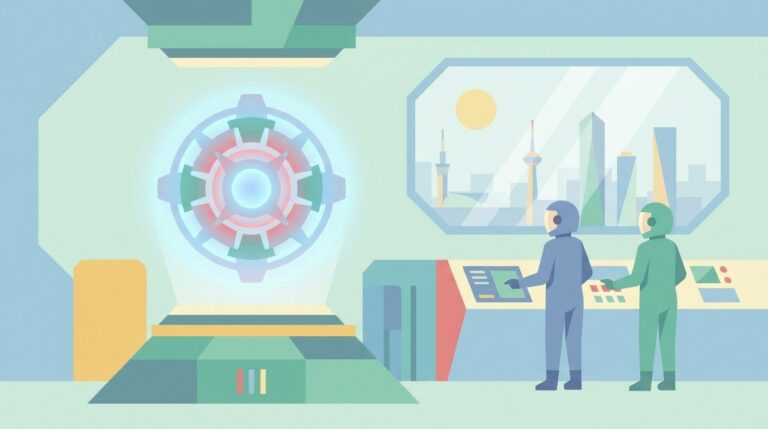
Imagine walking into the command center of the Korea Institute of Fusion Energy (KFE) in Daejeon—the home of KSTAR, affectionately dubbed Korea’s “Artificial Sun.” Across high-resolution monitors, complex plasma diagnostic simulations shimmer at an unfathomable 100 million degrees Celsius. You are sitting beside seasoned nuclear researchers, discussing the transition from magnetic confinement physics to full-scale commercial grid integration. The lead scientist takes off his glasses, rubs his temples, and sighs over a can of cold canned coffee: “결국 이론적 검증은 끝났습니다. 이제 중성자 조사를 버텨낼 블랭킷 신소재와 삼중수소 자급 증식이 상용화의 마지막 퍼즐이에요.” (In the end, theoretical verification is done. Now, developing neutron-resilient blanket materials and closed-loop tritium breeding is the final puzzle piece for commercialization.)
You completely comprehend the scientific crisis—the structural degradation caused by 14.1 MeV fusion neutrons and the fragile supply chain of tritium fuel. Yet, when you open your mouth to offer an engineering perspective in Korean, your words falter into rigid, dictionary-bound phrases like “그것은 참 어렵고 중요한 문제입니다” (That is a very difficult and important problem). Your intellectual depth evaporates into elementary textbook syntax.
At the C2 Mastery level, technical fluency is not merely about reciting periodic tables in Hangul; it is about articulating engineering bottlenecks with rhetorical elegance, professional gravity, and cultural rhythm. This lesson is built upon real consultations with foreign postdoctoral researchers and energy policy fellows working within Daedeok Innopolis. By mastering the linguistic framing of cutting-edge baseload engineering, you will hold your own in high-level symposia, research consortia, and executive strategy meetings without missing a single nuance.
Phase 2: Core 3 Expressions In-Depth
1. 마지막 퍼즐 (Majimak peojeul)
- Pronunciation: [Ma-ji-mak peo-jeul] (Think of ‘Mah-jee-mahk’ flowing effortlessly into ‘puzz-ul’)
- Meaning: Literally “the final puzzle piece.” Idiomatically, it signifies the definitive, missing linchpin required to complete a massive, long-term technological or systemic breakthrough.
- K-Culture Moment: Heard frequently in Korean investigative documentaries and techno-thrillers (reminiscent of the tension in The Silent Sea or Daedeok science news specials) when an elite research task force overcomes ninety-nine hurdles only to face the ultimate physical constraint.
- Editor’s Insight: While textbook learners lean on “최종 과제” (final task) or “마지막 문제” (last problem), “마지막 퍼즐” evokes an architectural totality. It conveys that every other systemic component is already locked in place, framing the current bottleneck not as a roadblock, but as the heroic final act of completion.
- Situation Spectrum: Casual: ⚠️ | Semi-formal: ✅ | Formal: ✅
- 🤔 Think About It: In English, we often say “the missing link” or “the holy grail.” How does viewing a monumental scientific breakthrough as a collaborative “puzzle” reflect the Korean cultural emphasis on systemic interdependence over isolated individual genius?
2. 자급 증식 (Jageup jeungsik)
- Pronunciation: [Ja-geup jeung-sik] (Pronounce ‘Jah-geup’ crisply, followed by a resonant ‘Jeung-sheek’)
- Meaning: Self-sufficient breeding / Closed-loop proliferation (specifically referring to producing as much or more fuel than consumed).
- K-Culture Moment: Used by government energy planners during Ministry of Science briefings when analyzing Korea’s resource dependency and advocating for energy sovereignty via domestic fuel-breeding cycles.
- Editor’s Insight: 자급 (self-reliance/self-supply) meets 증식 (breeding/propagation). In atomic discourse, foreign researchers frequently stumble by simply saying “스스로 연료를 만들다” (making fuel by itself). 자급 증식 instantly establishes your technical authority at C2, aligning your vocabulary with official atomic policy white papers.
- Situation Spectrum: Casual: 🚫 | Semi-formal: ✅ | Formal: ✅
- 🤔 Think About It: Given South Korea’s historical lack of fossil energy and complete reliance on international energy supply chains, why does the prefix 자급 (self-supply) carry such immense political and psychological weight in technological discussions?
3. 극한 환경을 견뎌내다 (Geuk-han hwan-gyeong-eul gyeon-dyeo-nae-da)
- Pronunciation: [Geuk-han hwan-gyeong-eul gyeon-dyeo-nae-da] (Crisp guttural ‘Geuk’, smoothly tethered to ‘gyeon-dyeo-nae-da’)
- Meaning: To withstand/endure hostile, extreme environments.
- K-Culture Moment: Prominently featured in scientific retrospectives celebrating Korean engineering milestones—from deep-sea LNG carriers to extreme plasma-facing tungsten diverters.
- Editor’s Insight: Notice the composite verb 견뎌내다 (견디다 [to endure] + 내다 [to achieve/carry through]). It does not denote passive suffering; it highlights an active triumph over crushing forces (such as thermal shock or intense displacement-per-atom neutron irradiation).
- Situation Spectrum: Casual: ⚠️ | Semi-formal: ✅ | Formal: ✅
- 🤔 Think About It: Contrast the English passive verb “to resist irradiation” with the Korean 견뎌내다, which treats the physical material almost animistically—as an entity fighting through hardship to emerge victorious on the other side.
Phase 3: Textbook Korean vs. Real Korean
Situation 1: Highlighting an unyielding engineering bottleneck in a strategy meeting
- 📖 교과서 한국어 (Textbook):
이 문제는 해결하기가 매우 어렵고 기술적인 장벽이 높습니다.
(I mun-je-neun hae-gyeol-ha-gi-ga mae-u eo-ryeop-go gi-sul-jeok-in jang-byeok-i nop-seumnida.)
“This problem is very difficult to solve and the technological barrier is high.” - 🗣️ 진짜 한국어 (Authentic C2):
이게 결국 상용화 로드맵의 최대 난제이자 넘어야 할 승부처입니다.
(I-ge gyeol-guk sang-yong-hwa ro-deu-maep-ui choe-dae nan-je-i-ja neom-eo-ya hal seung-bu-cheo-imnida.)
“Ultimately, this is the paramount bottleneck in our commercialization roadmap and the defining battleground we must overcome.” - 💡 왜 다를까? (Cultural & Linguistic Context):
Textbook Korean relies on dry evaluative adjectives (어렵다). Real Korean executives and chief researchers employ dynamic, strategic idioms (난제, 승부처) borrowed from board games and military strategy, framing engineering problems as heroic tipping points.
Situation 2: Expressing high confidence in the structural resilience of newly synthesized alloys
- 📖 교과서 한국어 (Textbook):
새로운 합금은 높은 열과 중성자를 잘 견딜 수 있을 것입니다.
(Sae-ro-un hap-geum-eun nop-eun yeol-gwa jung-seong-ja-reul jal gyeon-dil su iss-eul geos-imnida.)
“The new alloy will probably be able to withstand high heat and neutrons well.” - 🗣️ 진짜 한국어 (Authentic C2):
조사 손상과 열화 현상을 최소화해 내구성을 극한까지 담보해 냈습니다.
(Jo-sa son-sang-gwa yeol-hwa hyeon-sang-eul choe-so-hwa-hae nae-gu-seong-eul geuk-han-kka-ji dam-bo-hae naess-seumnida.)
“By mitigating displacement damage and thermal degradation, we have secured mechanical durability under critical extremes.” - 💡 왜 다를까? (Cultural & Linguistic Context):
C2 professional Korean minimizes weak epistemic modals (~ㄹ 수 있을 것이다) in favor of assertive, nominalized active verbs (담보해 냈다), which project deep accountability and scientific certainty.
Phase 4: K-Culture Deep Dive & Non-Verbal Manners
4-1. 눈치 (Nunchi) & Scientific Body Language in Korea
When debating technical feasibility in a Korean national laboratory or corporate R&D think-tank, high assertiveness must be balanced with sophisticated non-verbal deference. Direct frontal refutation (“당신 가설은 틀렸습니다” – “Your hypothesis is wrong”) destroys collective psychological safety.
* The Calibrated Nod (묵직한 끄덕임): When senior scientists present theoretical timelines, maintain upright posture and nod slowly with downcast eyes while taking notes. It signals: “I am absorbing your strategic horizon before contextualizing the physical constraints.”
* The Two-Handed Blueprint Gesture: When pointing to a schematic on a display or passing a technical binder, support your right elbow or forearm lightly with your left hand. In engineering spaces, this transforms a cold data presentation into a gesture of corporate respect and collaborative humility.
4-2. Cultural Code: The “Hwasik to Dawn” R&D Dynamic
South Korea’s miraculous rise from an impoverished nation to the builder of the APR-1400 nuclear reactor and world-record plasma durations at KSTAR stems from an extreme collective ethos known in Daedeok Innopolis as 연구실 뚝심 (laboratory grit). Major engineering breakthroughs are rarely celebrated in solitary cubicles. Instead, after weeks of failed vacuum vessel tests or ceramic coating cracks, teams head to local grilled pork belly (samgyeopsal) joints. Over sizzling meat and soju, hierarchical barriers soften, and engineers passionately scribble flux calculations on paper napkins. If you can bridge rigorous high-temperature physics with this warm, shared struggle, you become more than a foreign consultant—you become an intellectual comrade.
Phase 5: Real-World Roleplay Scenario
Setting: A technical strategy conference room inside the Korea Superconducting Tokamak Advanced Research (KSTAR) facility in Daejeon. You are sitting with Dr. Kang Min-seok (강민석 박사), a veteran principal investigator of plasma-facing materials.
- Dr. Kang: 전산 모사 데이터는 확보되었지만, 중성자 조사 후 격자 결함 생성을 막는 데 여전히 한계가 보입니다.
(Jeon-san mo-sa de-i-teo-neun hak-bo-doe-eoss-ji-man, jung-seong-ja jo-sa hu gyeok-ja gyeol-ham saeng-seong-eul mak-neun de yeo-jeon-hi han-gye-ga bo-imnida.)
“We have secured computational simulation data, yet there remain clear limits in preventing lattice defect formation post-neutron irradiation.”
🎭 (Takes off glasses, taps the tablet with a stylus, looking weary) -
You: 텅스텐 복합재의 연성 취성 전이 온도(DBTT)를 낮추는 작업이 예상보다 지연되는 모양이군요.
(Teong-seu-ten bok-hap-jae-ui yeon-seong chwi-seong jeon-i on-do-reul nat-chu-neun ja-geop-i ye-sang-bo-da ji-yeon-doe-neun mo-yang-i-gun-yo.)
“It seems reducing the ductile-to-brittle transition temperature of tungsten composites is facing more delays than anticipated.”
🎭 (Leaning forward slightly, keeping eye contact with analytical calm) -
Dr. Kang: 맞습니다. 이 내벽 소재가 14 MeV 중성자 플럭스를 견뎌내지 못하면 삼중수소 증식 블랭킷의 건전성도 무너집니다.
(Mat-seumnida. I nae-byeok so-jae-ga 14 MeV jung-seong-ja peul-leok-seu-reul gyeon-dyeo-nae-ji mot-ha-myeon sam-jung-su-so jeung-sik beul-laeng-kit-ui geon-jeon-seong-do mu-neo-jimnida.)
“Precisely. If this plasma-facing material cannot withstand the 14 MeV neutron flux, the integrity of the tritium breeding blanket collapses as well.”
🎭 (Frowning slightly, crossing arms) -
You: 삼중수소 자급 증식비(TBR) 1.05 달성이 상용 핵융합로의 경제성을 가르는 절대 조건이니까요.
(Sam-jung-su-so ja-geup jeung-sik-bi 1.05 dal-seong-i sang-yong haek-yung-hap-ro-ui gyeong-je-seong-eul ga-reun-eun jeol-dae jo-geon-i-ni-kka-yo.)
“Indeed, because achieving a tritium breeding ratio (TBR) of 1.05 is the absolute prerequisite determining commercial fusion’s viability.”
🎭 (Nodding thoughtfully while referencing page 4 of the technical brief) -
Dr. Kang: 그렇죠. 결국 이 신소재 내구성과 증식 기술이 핵융합 상용화의 마지막 퍼즐인 셈입니다.
(Geu-reo-chyo. Gyeol-guk i sin-so-jae nae-gu-seong-gwa jeung-sik gi-sul-i haek-yung-hap sang-yong-hwa-ui ma-ji-mak peo-jeul-in sem-imnida.)
“Exactly. Ultimately, this new material durability and breeding technology constitute the final puzzle piece of commercial nuclear fusion.”
🎭 (Sighing deeply, scanning your face to test your resolve) -
You: 해외 연구진과의 세라믹 증식재 공동 실증 실험 일정을 앞당기는 방안은 검토해 보셨습니까?
(Hae-oe yeon-gu-jin-gwa-ui se-ra-mik jeung-sik-jae gong-dong sil-jeung sil-heom il-jeong-eul ap-dang-gi-neun bang-an-eun geom-to-hae bo-syeoss-seumni-kka?)
“Have you considered moving up the timetable for the joint ceramic breeder qualification tests with our international partners?”
🎭 (Hands gently clasped on the table in an open posture) -
Dr. Kang: 리스크가 크지만, 무탄소 기저부하 기술 경쟁에서 뒤처지지 않으려면 피할 수 없는 선택일지도 모릅니다.
(Ri-seu-keu-ga keu-ji-man, mu-tan-so gi-jeo-bu-ha gi-sul gyeong-jaeng-e-seo dwi-cheo-ji-ji anh-eu-ryeo-myeon pi-hal su eopt-neun seon-taek-il-ji-do mo-reumnida.)
“The risk is substantial, but if we don’t want to fall behind in the zero-carbon baseload race, it might be an inevitable choice.”
🎭 (Gazing intently at the plasma chamber blueprint) -
You: 연구원분들의 뚝심이 결실을 맺을 수 있도록, 소재 물성 데이터베이스 통합 작업부터 신속히 밀어붙이시죠.
(Yeon-gu-won-bun-deul-ui dduk-sim-i gyeol-sil-eul maej-eul su iss-do-rok, so-jae mul-seong de-i-teo-be-i-seu tong-hap ja-geop-bu-teo sin-sok-hi mil-eo-but-i-si-jyo.)
“To ensure the team’s relentless grit bears fruit, let’s promptly push forward the consolidation of the material property database.”
🎭 (Offering a confident, collegial smile)
🔀 Interactive Decision Point
How do you conclude this strategic exchange to solidify leadership and rapport?
- Option A: “일단 이론상으로는 완벽하니까 납기일만 맞추면 어떻게든 되지 않겠습니까?” (Since it’s theoretically sound, won’t it just sort itself out if we meet the delivery deadline?)
- Option B: “공학적 난제가 산적해 있지만, 삼중수소 계통 분리 기술부터 차근차근 검증해 나가면 분명 돌파구가 열릴 겁니다.” (Engineering hurdles abound, but if we methodically validate the tritium fuel-cycle isolation systems first, a breakthrough will surely open up.)
- Option C: “소재 개발 실패 위험이 너무 커 보이는데, 차라리 프로젝트 규모를 축소하는 게 낫지 않겠습니까?” (The risk of material failure seems far too high; wouldn’t it be better to just downscale the project?)
Feedback:
* Option A (Risk): Highly dismissive of empirical engineering physics (어떻게든 되다 – “it’ll somehow work out”). In Korean high-tech circles, this sounds careless and irresponsible.
* Option B (Best): Demonstrates balanced strategic resilience (공학적 난제, 차근차근 검증, 돌파구). It validates the researcher’s anxiety while outlining disciplined action.
* Option C (Bad): Proposing an abrupt retreat (규모 축소) without deeper empirical justification invalidates months of team dedication, signaling a lack of professional 뚝심 (grit).
Phase 6: 10-Second Emotional Shadowing Drill
Practice reading these sentences aloud, pausing precisely at the slashes (/) and matching the exact emotional tone indicated in the brackets.
- [🧐 진지하고 결연하게 – Serious, Analytical, and Determined]
중성자 조사를 / 극한까지 견뎌낼 내벽재 개발이야말로 / 상용화의 마지막 퍼즐입니다.
(Jung-seong-ja jo-sa-reul / geuk-han-kka-ji gyeon-dyeo-nael nae-byeok-jae gae-bal-i-ya-mal-lo / sang-yong-hwa-ui ma-ji-mak peo-jeul-imnida.)
Developing plasma-facing materials that can withstand neutron irradiation to the limit / is indeed the final puzzle piece of commercialization. -
[⚡ 단호하고 카리스마 있게 – Decisive and Authoritative]
삼중수소 자급 증식 계통의 건전성을 / 이번 분기 내에 / 반드시 입증해 내야만 합니다.
(Sam-jung-su-so ja-geup jeung-sik gye-tong-ui geon-jeon-seong-eul / i-beon bun-gi nae-e / ban-deu-si ip-jeung-hae nae-ya-man hamnida.)
The integrity of the closed-loop tritium breeding cycle / within this quarter / must absolutely be verified without fail. -
[🤝 따뜻하고 신뢰감 넘치게 – Warm, Reassuring, and Collegial]
기술적 장벽이 높지만 / 현장 연구진의 뚝심이 있다면 / 충분히 극복할 수 있는 공학적 난제입니다.
(Gi-sul-jeok jang-byeok-i nop-ji-man / hyeon-jang yeon-gu-jin-ui dduk-sim-i iss-da-myeon / chung-bun-hi geuk-bok-hal su iss-neun gong-hak-jeok nan-je-imnida.)
Though technological barriers are steep / with the steadfast grit of our field researchers / this is an engineering hurdle we can thoroughly surmount.
Phase 7: K-Culture Mini Dictionary (4 Key Terms)
- 기저부하 (Gijeobuha) | Baseload Power
- Usage: Essential in energy policy. Denotes the minimum continuous electrical output required around the clock. When arguing for SMRs or fusion over intermittent renewables, Korean engineers describe them as “흔들림 없는 무탄소 기저부하” (an unwavering carbon-free baseload).
- 중성자 조사 (Jungseongja josa) | Neutron Irradiation
- Usage: Not to be confused with “investigation” (조사 / 調査), this 조사 (照射) means bombarding materials with high-energy subatomic radiation. Critical for discussing vessel embrittlement and material longevity.
- 증식 블랭킷 (Jeungsik beullaengkit) | Breeding Blanket
- Usage: The modular vessel lining engineered to absorb fusion neutrons, convert their kinetic energy into heat for turbines, and transmute lithium into tritium fuel. Often referred to colloquially by Korean researchers as “인공태양의 내벽이자 연료 공장” (the artificial sun’s inner wall and fuel factory).
- 뚝심 (Dduksim) | Unflinching Tenacity / Grit
- Usage: A culturally profound term describing stubborn, quiet, unwavering perseverance in the face of decade-long setbacks. Used frequently by executive directors praising laboratories that refuse to abandon difficult national R&D agendas.
Phase 8: Traveler’s Survival Kit (Daedeok R&D Hub Edition)
Top 3 Survival Expressions for Visiting Daejeon’s Science Cluster
- 한글: KFE 한국핵융합에너지연구원 정문으로 가주세요.
- Romanization: Kei-ef-i han-guk-haek-yung-hap-e-neo-ji-yeon-gu-won jeong-mun-eu-ro ga-ju-se-yo.
- Pro Tip: Taxis in Daejeon may confuse the long official title. State “카이스트 옆 KSTAR 연구원” (KSTAR institute next to KAIST) for immediate recognition.
- 한글: 기술 보안 구역이라 사전에 방문 등록을 마쳤습니다.
- Romanization: Gi-sul bo-an gu-yeok-i-ra sa-jeon-e bang-mun deung-rok-eul ma-chyeoss-seumnida.
- Pro Tip: National laboratories have strict level-1 security. Present your passport and registration code before stepping past the turnstile gate.
- 한글: 대덕연구단지 테크노밸리 방면 셔틀버스는 어디서 타나요?
- Romanization: Dae-deok-yeon-gu-dan-ji te-keu-no-bael-li bang-myeon syeo-teul-beo-seu-neun eo-di-seo ta-na-yo?
- Pro Tip: Commuter shuttles connect government complexes across Yuseong-gu. Asking for the specific campus shuttle saves expensive cross-valley cab fares.
Editor’s Travel Note
When heading down from Seoul for a technical symposium in Daejeon, reserve your KTX seat using the Korail train booking platform. Avoid generic map searches; instead, download the Naver Map navigation app which accurately tracks specialized regional science shuttles and internal gate designations inside Daedeok Innopolis. For hassle-free rides between laboratories, summon drivers via the Kakao T taxi booking app. Lastly, remember to stop by the legendary Sung Sim Dang bakery at Daejeon Station for a box of Twigim Soboro—bringing this iconic pastry to your host research team is an infallible cultural icebreaker!
Phase 9: “One Step Deeper” (Reflective Humanities Essay)
In Western scientific traditions, progress is frequently cataloged as a sequence of disruptive leaps led by individual visionaries. In Korea, monumental engineering feats—from mastering semiconductor lithography to confining ultra-hot fusion plasma—are viewed through the cultural prism of 은근과 끈기 (subtle resilience and perseverance) and 뚝심 (unshakable grit). When Korean atomic engineers speak of “마지막 퍼즐을 맞추다” (piecing together the final puzzle), there is an implicit understanding that this single puzzle piece was forged by the sweat of hundreds of unnamed junior researchers working through cold winter nights in Daejeon.
Language reflects societal values. By mastering nuanced expressions like 극한 환경을 견뎌내다 rather than sterile mechanical terms, you acknowledge the emotional and historical weight carried by Korean engineers who transformed a resource-barren peninsula into an advanced nuclear powerhouse. True C2 fluency is not about sounding like a machine; it is about honoring the human soul embedded within technical mastery.
💬 Your Turn: Have you ever worked on a long-term project that felt like searching for the 마지막 퍼즐? How does your native language describe the quiet endurance required to conquer seemingly impossible technical bottlenecks? Share your thoughts below!
Phase 10: FAQ & Common Pitfalls
Q: Can I use “마지막 퍼즐” in everyday business meetings, or is it strictly for science?
A: Absolutely! 마지막 퍼즐 is widely utilized across executive boardrooms, startup pitches, and corporate mergers. Whenever a single strategic hire, patent acquisition, or regulatory license completes a broader operational framework, declaring “이것이 우리 사업의 마지막 퍼즐입니다” (This is the final puzzle piece of our business) sounds visionary and sophisticated.
Q: What is the exact nuance between “견디다” and “버텨내다” when talking about material stress?
A: While both express endurance, 견디다 is more neutral and objective (e.g., 압력을 견디다 – to withstand pressure). In contrast, 버텨내다 carries a visceral, dramatic sense of holding the line against overwhelming odds through sheer tenacity. In high-level presentations, 견뎌내다 balances scientific objectivity with purposeful resolve.
Q: Is “원자력” (atomic energy) and “핵융합” (nuclear fusion) interchangeable in Korean?
A: No. While 원자력 historically encompasses both fission and fusion under the broader umbrella of atomic power, modern industry and media deliberately distinguish 원자력/원전 (conventional nuclear fission/plants) from 핵융합 (fusion energy). Conflating the two during technical policy debates can lead to misconceptions regarding radioactive waste profiles.
🚨 Common Mistakes (흔한 실수) Warning Board
- Mistake: Using 최후의 문제 (the ultimate problem) to mean the final hurdle.
- Correction: Use 마지막 퍼즐 (the final puzzle piece) or 최종 난제 (the final complex hurdle). 최후 carries an ominous, apocalyptic tone (like “doomsday”).
- Mistake: Saying 삼중수소를 스스로 만들다 in technical papers.
- Correction: Use the formal compound term 삼중수소 자급 증식 (closed-loop tritium breeding). Academic Korean favors Sino-Korean compounds over descriptive colloquial verbs.
- Mistake: Pronouncing 신소재 (new materials) as [신-소-제].
- Correction: Ensure crisp pronunciation of 신소재 [Sin-so-jae]. Mispronouncing technical dipthongs undermines an otherwise sophisticated C2 technical delivery.
Phase 11: Action Missions & Cultural Quest
- 🥉 Bronze Mission (Solo Shadowing): Record your voice reading the Phase 6 Shadowing Drill sentences 3 times. Focus on shifting your vocal register from analytical rigor to warm collegiality at the slash points.
- 🥈 Silver Mission (Interactive Writing): Draft a 3-sentence technical summary of an engineering challenge in your own field using the expressions 마지막 퍼즐, 자급 증식, and 난제. Post it in the comments below for personal feedback!
- 🥇 Gold Mission (Real-World Deployment): In your next professional encounter with Korean colleagues or in an online forum, replace “어려운 문제예요” with “우리가 함께 넘어야 할 결정적인 승부처입니다”. Note how their eyes light up at your elevated phrasing!
- 🎮 K-Culture Mission: Search YouTube for recent Korean science documentaries about KSTAR (keyword: KSTAR 인공태양 1억도). Count how many times the narrators and researchers use the words 극한, 난제, or 뚝심. You will be amazed at how prominent these cultural keystones are!
Phase 12: Interactive Quiz Challenge
Test your mastery of C2-level energy terminology and cultural nuance!
- Contextual Judgment: You are presenting before the Ministry of Science and ICT. Which sentence sounds most authoritative when addressing materials limitations?
- A) 소재가 잘 안 버텨줘서 시험이 조금 망했습니다.
- B) 14 MeV 중성자 조사를 견뎌낼 신소재 확보가 상용화 로드맵의 승부처입니다.
- C) 소재가 견디는 힘이 부족해서 문제가 아주 큽니다.
- Fill-in-the-Blank: Complete the following technical statement:
핵융합 상용로의 연료 공급 안정성을 담보하기 위해서는 삼중수소 ( ) 기술의 확립이 필수적입니다.- (Hint: 4 Hangul syllables meaning “self-sufficient closed-loop breeding”)
- True or False Cultural Quiz:
- In Korean scientific culture, using the word 뚝심 (dduksim) during an executive engineering review is considered unprofessional because it refers to emotional grit rather than hard empirical data. (True / False)
👉 Click to reveal answers and detailed explanations!
- Answer: B
- Explanation: Option B uses precise technical terminology (중성자 조사, 신소재 확보, 승부처) appropriate for ministerial briefings. Option A is overly colloquial and defeatist (망했습니다), while Option C uses elementary, imprecise wording (문제가 아주 큽니다).
- Answer: 자급 증식 (Jageup jeungsik)
- Explanation: 삼중수소 자급 증식 (closed-loop tritium self-breeding) is the definitive technical term describing the breeding of fusion fuel within the blanket.
- Answer: False
- Explanation: Quite the opposite! Even at the highest echelons of national laboratories and ministerial reviews, 뚝심 is deeply revered. It encapsulates the admirable tenacity of researchers confronting decades-long physical and engineering barriers.
- Explanation: Quite the opposite! Even at the highest echelons of national laboratories and ministerial reviews, 뚝심 is deeply revered. It encapsulates the admirable tenacity of researchers confronting decades-long physical and engineering barriers.







