

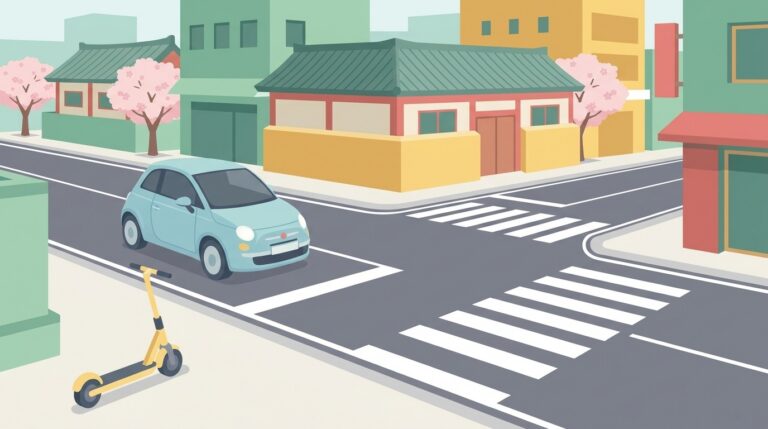
Crossing Streets in Korea Like a Local: Right-Turn Stops and Scooter Etiquette
Phase 1: Empathy (Story-driven Hook)
안녕하세요! This is your Daily Hangul editor and local culture navigator! Imagine this scene: You’re standing at an intersection in bustling Hongdae or quiet Seongsu-dong, sipping an iced Americano. The pedestrian light turns green, but you spot a car slowly edging into the crosswalk to make a right turn. At the same exact moment, an electric scooter (전동 킥보드) whizzes past behind you on the sidewalk. You freeze in your tracks, wondering: Wait, do I walk? Will the car stop? Am I in the scooter’s lane?
If you’ve visited Korea recently or watched street vlogs, you might have felt this exact moment of hesitation. For decades, Korea had an infamous ppalli-ppalli (hurry, hurry) driving reputation. But over the last couple of years, an immense cultural and legal shift has taken over Korean roads. Today, drivers are legally required to make a full, complete stop (일단 멈춤) at crosswalks when making right turns if a pedestrian is crossing or even stepping toward the curb. Meanwhile, cities are cracking down on electric scooter safety, encouraging mutual consideration. Learning how to navigate these interactions doesn’t just keep you safe—it lets you communicate effortlessly with drivers, riders, and locals using natural, polite Korean. Let’s explore how to read the street like a true Seoulite!
Phase 2: 3 Key Expressions Deep Dive
1. 일단 멈추다 (Ildan meomchuda)
- Pronunciation: [Ildan meomchuda] (Sounds like eel-dahn mum-choo-dah)
- Meaning: Literal: “To stop for now / to pause first” | Nuance: Bringing everything to a full pause before taking the next step or re-evaluating the situation.
- K-Culture Moment: You will hear this constantly on traffic safety campaigns featuring celebrities like Yoo Jae-suk, reminding drivers at red lights: “우회전할 때 일단 멈춤!” (Full stop when turning right!).
- Editor’s Insight: 일단 (ildan) means “first” or “for the moment.” Paired with 멈추다, it implies an intentional, non-negotiable pause. You can use it in daily life too, like: “일단 생각 좀 해볼게요” (Let me pause and think about it first).
- Situation Spectrum: Casual: ✅ | Semi-formal: ✅ | Formal: ✅
- 🤔 Think About It: Does your native language have a word that distinguishes a “rolling stop” from a “conscious full stop”? Why do you think Korean specifically emphasizes 일단 (first of all) in pedestrian rules?
2. 먼저 지나가세요 (Meonjeo jinagaseyo)
- Pronunciation: [Meonjeo jinagaseyo] (Sounds like mun-juh jee-nah-gah-say-yo)
- Meaning: Literal: “Please pass through first” | Nuance: A warm, courteous way to yield the right-of-way to a pedestrian, driver, or scooter rider.
- K-Culture Moment: Often seen in wholesome K-Drama romance scenes when two pedestrians or a scooter rider and a pedestrian meet at a narrow alleyway intersection in Bukchon Hanok Village.
- Editor’s Insight: This sentence pairs the adverb 먼저 (first / ahead) with the polite imperative -세요. If someone slows down or hesitates to let you pass, you can say this with a soft smile and an open-hand gesture.
- Situation Spectrum: Casual: ⚠️ (Use 먼저 가 with close friends) | Semi-formal: ✅ | Formal: ✅
- 🤔 Think About It: In many Western countries, people just wave or say “After you!” How does adding the respectful honorific suffix -세요 change the feeling of street courtesy?
3. 보행자 우선이에요 (Bohaengja useon-ieyo)
- Pronunciation: [Bohaengja useon-ieyo] (Sounds like boh-hang-jah oo-sun-ee-ay-yo)
- Meaning: Literal: “Pedestrians come first / It is pedestrian priority.”
- K-Culture Moment: Seen on bright yellow traffic banners near school zones (어린이 보호구역) or in public service ads starring popular K-Pop idols advocating for scooter helmet laws.
- Editor’s Insight: 보행자 means “pedestrian” (walking person) and 우선 means “priority.” Whether you are talking about zebra crossings or explaining scooter rules on pedestrian pathways, this phrase defines modern Korean traffic mindset.
- Situation Spectrum: Casual: ⚠️ (Too formal for friends; say 사람 먼저야) | Semi-formal: ✅ | Formal: ✅
- 🤔 Think About It: How does phrasing priority as “pedestrians first” rather than “cars must yield” subtly shift who holds respect in a shared urban space?
Phase 3: Textbook Korean vs. Real Korean
Situation 1: Telling an electric scooter rider to slow down on the sidewalk
- 📖 Textbook Korean: 속도를 줄여 주십시오. (Sokdoreul julyeo jusipsio.) — Please reduce your speed.
- 🗣️ Real Korean: 조금만 천천히 가 주세요! (Jogeumman cheoncheonhi ga juseyo!) — Please go just a little slower!
- 💡 Why different? The textbook phrase sounds like an automated municipal loudspeaker. Real Koreans use 조금만 (just a little) to soften requests and prevent the other person from feeling defensive.
Situation 2: Acknowledging a car that stopped to let you cross
- 📖 Textbook Korean: 길을 양보해 주셔서 대단히 감사합니다. (Gireul yangbohae jusyeoseo daedanhi gamsahamnida.) — Thank you very much for yielding the road.
- 🗣️ Real Korean: 감사합니다! (Gamsahamnida!) + a brief nod (꾸벅)
- 💡 Why different? You have only 2 seconds while crossing the crosswalk! Long sentences delay traffic. A warm verbal 감사합니다 combined with a 15-degree head bow is the gold standard of Korean street communication.
Phase 4: K-Culture Deep Dive & Non-Verbal Etiquette
4-1. Nunchi (눈치) & Gestures: The Crosswalk Bow & Hand Wave
When you cross a street in Korea and a car turns right, the driver will usually bring the car to a dead halt behind the stop line. In Korean culture, making brief eye contact and offering a subtle hand raise (palm facing outward at chest height) accompanied by a 꾸벅 (kku-beok, a short nod) represents peak Nunchi. It signals: “I see you, thank you for waiting, and I will cross promptly so you can continue your day.” Avoid staring down at your smartphone while stepping off the curb, especially with electric scooters around.
4-2. Cultural Code Analysis: The Evolution of Seoul’s Mobility Culture
If you watch 2000s K-Dramas, you might remember wild car chases and frantic honking at yellow lights. But recent road safety legislation (particularly the 2022 revised Road Traffic Act) transformed Korea’s streetscape. Today, drivers failing to come to an absolute stop when turning right face hefty fines and demerit points. Similarly, shared electric scooters (shared PMs like Beam or Kickgoing) now require an official driver’s license, helmets, and strictly prohibit sidewalk tandem riding (two people on one scooter). Pedestrian safety has officially become a major social value in contemporary Korean civic life.
Phase 5: Real-Life Roleplay Scenario
Setting: A tree-lined intersection near Seoul Forest in Seongsu-dong. You are about to cross the street to meet a friend at a trendy bakery. A silver sedan begins to turn right, and a young local named Minjun is waiting nearby with an electric scooter.
- Turn 1 (Minjun): 조심하세요! 저 차 우회전하려고 해요. (Josimhaseyo! Jeo cha uhoejeonhallyeogo haeyo. / Be careful! That car is trying to turn right.)
🎭 Points gently toward the approaching sedan. - Turn 2 (You): 아, 횡단보도 앞인데 안 멈추나요? (A, hoengdanbodo ap-inde an meomchunayo? / Oh, isn’t it going to stop in front of the crosswalk?)
🎭 Steps back onto the sidewalk curb. - Turn 3 (Minjun): 요즘은 법이 바뀌어서 다 멈춰요. 잠깐만 기다려 봐요. (Yojeumeun beobi bakkwieoseo da meomchwoyo. Jamkkanman gidaryeo bwayo. / These days the law changed, so everyone stops. Let’s wait just a moment.)
🎭 Steps off his scooter kickstand. - Turn 4 (Driver):
🎭 Brings the car to a complete stop before the white line, smiles, and gestures with a light hand motion. - Turn 5 (You): 진짜 멈췄네요! 보행자 우선이 맞네요. (Jinjja meomchweotneyo! Bohaengja useon-i matneyo. / It really stopped! Pedestrians truly come first.)
🎭 Relieved smile. - Turn 6 (Minjun): 맞아요, 운전자가 먼저 가라고 손짓하네요. 건너가요! (Majayo, unjeonjaga meonjeo garago sonjit-hanaeyo. Geonneogayo! / Right, the driver is gesturing for us to go first. Let’s cross!)
🎭 Waves back to the driver. - Turn 7 (You): 네! 운전자분께 인사하고 가야겠어요. 감사합니다! (Ne! Unjeonjabunkke insahago gayagesseoyo. Gamsahamnida! / Yes! I should greet the driver. Thank you!)
🎭 Does a polite 15-degree nod toward the driver while walking briskly. - Turn 8 (Minjun): 킥보드도 인도에서는 항상 조심해야 해요. 안전하게 건너세요! (Kikbodeudo indoe-seoneun hangsang josimhaeya haeyo. Anjeonhage geonneoseyo! / Scooters must always be careful on walkways too. Cross safely!)
🎭 Gives a warm thumbs-up.
🔀 Interactive Choice Point
You see an electric scooter speeding quickly down the sidewalk toward you while you are waiting at the corner. What do you say?
- Option A: “야! 멈춰!” (Ya! Meomchwo!)
- Feedback (Bad): Too rude and aggressive! “야” is informal and confrontational, which can trigger an unnecessary street argument.
- Option B: “조금만 비켜 주세요, 위험해요!” (Jogeumman bikyeo juseyo, wiheomhaeyo!)
- Feedback (Best): Clear, polite, and effective. It immediately lets the rider know there is a safety issue without escalating conflict.
- Option C: “그냥 지나가세요, 괜찮아요.” (Geunyang jinagaseyo, gwaenchanayo!)
- Feedback (Risk): Dangerous! By telling an erratic scooter rider to “just pass through,” you might cause an accident for yourself or other pedestrians.
Phase 6: 10-Second Emotion Shadowing Drill
Practice reading these out loud with rhythm and genuine emotion!
[👀 Alert and cautious]
우회전할 때는 / 횡단보도 앞에서 / 일단 멈춰야 해요.
(Uhoejeonhal ttaeneun / hoengdanbodo ap-eseo / ildan meomchwoya haeyo.)
When turning right, / in front of the crosswalk, / you must come to a full stop first.-
[😊 Grateful and courteous]
멈춰 주셔서 감사합니다, / 먼저 지나갈게요!
(Meomchwo jusyeoseo gamsahamnida, / meonjeo jinagalgeyo!)
Thank you for stopping for me, / I will go ahead and cross first! -
[🛡️ Confident and firm]
인도에서는 / 보행자가 / 항상 우선이에요.
(Indoe-seoneun / bohaengjaga / hangsang useon-ieyo.)
On pedestrian sidewalks, / pedestrians / are always the top priority.
Phase 7: K-Culture Mini Dictionary
- 우회전 일시정지 (Uhoejeon ilsi-jeongji) | Right-turn temporary full stop | The official legal term for stopping completely at red lights and pedestrian zones before making a right turn.
- 공유 킥보드 (Gong-yu kikbodeu) | Shared electric scooter | App-based rental scooters seen in Korean metropolitan cities (e.g., Swing, Beam, Kickgoing).
- 보행자 전용 도로 (Bohaengja jeon-yong doro) | Pedestrian-only walkway | Paved paths or alleys where motor vehicles and personal mobility scooters are strictly forbidden from entering.
- 배려 운전 (Baeryeo unjeon) | Considerate driving | The Korean concept of driving empathetically, yielding to pedestrians, elderly walkers, and public transit.
Phase 8: Traveler’s Survival Kit
Survival Phrases TOP 3
- 먼저 건너갈게요! (Meonjeo geonneogalgeyo!) — I will cross first! (Pro Tip: Say this while giving a gentle hand wave to a driver waiting for you).
- 킥보드 조심하세요! (Kikbodeu josimhaseyo!) — Watch out for the scooter! (Pro Tip: Use this to warn a travel buddy if you hear a scooter ringing its bell behind you).
- 헬멧 착용해야 돼요? (Helmet chak-yonghaeya dwaeyo?) — Do I need to wear a helmet? (Pro Tip: In Korea, the answer is always yes—riding without a helmet incurs a 20,000 KRW fine).
Editor’s Travel Note
- Pedestrian Navigation: Google Maps does not provide walking routes in Korea! Always download and use the Naver Map pedestrian navigation app download or KakaoMap to find safe crosswalks and avoid stairs if you are hauling luggage.
- Scooter Rentals: If you plan to ride electric scooters, foreign tourists must possess an International Driving Permit (IDP) or Korean driver’s license. Always park in designated motorcycle/bicycle zones, never in the middle of tactual paving for the visually impaired.
Phase 9: “One Step Deeper” (Reflective Prompt)
Korea’s shift toward absolute pedestrian priority is more than just a traffic law update; it reflects a broader transformation in how Korean society views communal space. For decades during rapid industrial development, speed and vehicular efficiency dominated city planning. Now, conscious pauses, mutual nods, and pedestrian safety represent a collective commitment to protecting every individual’s daily commute. When a car stops at an empty-looking crosswalk to make sure nobody is approaching, it demonstrates the quiet, everyday respect Koreans extend to strangers.
💬 Your Turn: How does traffic culture operate in your home country? Do drivers actively yield before making right turns, or is it common for pedestrians to wait? Share your experiences in the comments below!
Phase 10: FAQ & Common Mistakes
Q: Can electric scooters ride on the sidewalk in Korea?
A: No. Legally, electric kickboards are classified as personal mobility devices (PM) and must use bicycle paths or the far-right lane of roads. Riding on pedestrian sidewalks can result in fines unless a specific sign permits it.
Q: Do cars always stop when the pedestrian light is green during a right turn?
A: Yes! Drivers must come to a complete stop if any pedestrian is crossing or waiting to cross. Even if no pedestrian is in sight, drivers must stop at red lights before turning right.
Q: Is it considered rude to jog across the crosswalk when a driver yields?
A: Not at all! In fact, many Koreans do a light, brisk trot (종종걸음) accompanied by a polite nod to show consideration for the driver’s time.
🚨 Common Mistakes (흔한 실수) Warning Board
- Mistake 1: Assuming a turning car won’t stop.
- Correct Action: Watch the car’s wheels. If they stop, make eye contact, nod, and cross confidently.
- Mistake 2: Double-riding on one shared electric scooter with a friend.
- Correct Action: Never ride together (2인 탑승 금지). It is illegal in Korea and carries a 40,000 KRW fine.
- Mistake 3: Saying “You go first” inappropriately to cars with 너 먼저 가.
- Correct Action: Always use polite speech like 먼저 지나가세요 or simply nod and cross if the driver gestures to you.
Phase 11: Action Missions
- 🥉 Bronze Mission: Stand before a mirror and practice saying: 멈춰 주셔서 감사합니다! (Meomchwo jusyeoseo gamsahamnida!) with a friendly 15-degree bow.
- 🥈 Silver Mission: Write a comment or post an Instagram Story about Korean street etiquette using the hashtag
#DailyHanguland include the term 보행자 우선 (Bohaengja useon). - 🥇 Gold Mission: Next time you are in Korea or at a crosswalk, make eye contact with a yielding driver, offer a quick nod, and say 감사합니다 as you step across.
- 🎮 K-Culture Mission: Watch an episode of a modern Seoul-based drama (like Crash Course in Romance or Welcome to Samdal-ri) and spot whether cars stop at small corner intersections!
Phase 12: Interactive Quiz Challenge
1. Situational Judgment: You are crossing the street, and a driver has completely stopped their car to let you pass. What is the most natural thing to say and do?
* A) Stare at your phone and walk slowly.
* B) Say “감사합니다!” with a polite bow and cross briskly.
* C) Yell “일단 멈추세요!”
2. Fill-in-the-Blank:
우회전할 때 횡단보도 앞에서 _______ 멈춰야 합니다.
(When turning right, you must _______ stop before the crosswalk.)
* Hint: It means “first of all / for the moment.”
3. True or False:
In Korea, it is legal for two adults to ride one electric kickboard together without helmets on the sidewalk.
👉 Click to view Answers and Explanations
- Answer: B. A brisk walk with 감사합니다 and a nod reflects perfect Korean street courtesy (배려).
- Answer: 일단 (Ildan). The full sentence is: 우회전할 때 횡단보도 앞에서 일단 멈춰야 합니다.
- Answer: False. Tandem riding, riding without helmets, and sidewalk riding are all strictly prohibited and subject to police fines in Korea!







