

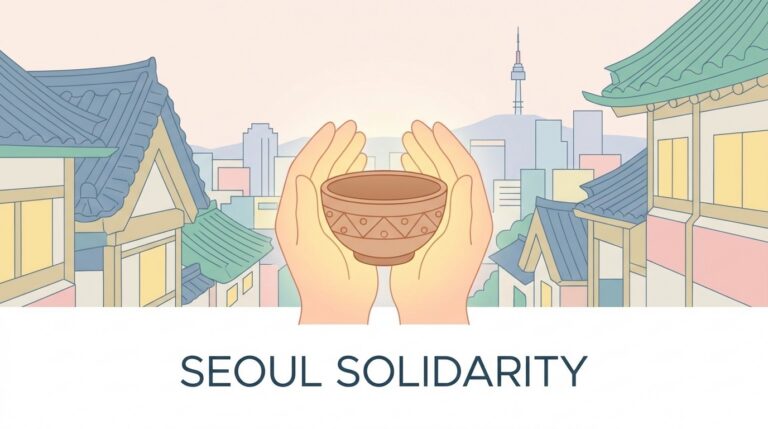
Why Koreans Still Cry for Strangers: The Modern Evolution of Jeong
Phase 1: Empathy (Immersive Storytelling Opening)
안녕하세요! 매일한글 에디터입니다. (Annyeonghaseyo! It is your Daily Hangul editor.)
Picture a quiet Friday night in Mapo-gu, Seoul. You are sitting inside a compact one-room studio (oneroom), surrounded by the hum of an air purifier, the glow of your smartphone, and an empty delivery container of tteokbokki. South Korea today has one of the world’s highest rates of single-person households (il-in gagu). On the surface, daily life feels distinctly hyper-individualistic. People navigate the subway with noise-canceling headphones, eyes locked onto screens, scrupulously avoiding eye contact to respect personal space. You might easily assume that the historic Korean virtues of collective warmth—what we call Jeong (정)—have faded into museum exhibits.
Then, an alert shriek pierces the subway cars: an emergency alert (jaenan munja) about flash floods in an older, semi-basement residential district across town. Watch what happens next. The very commuters who looked emotionally indifferent thirty seconds ago begin refreshing news feeds with genuine furrowed brows. Within hours, anonymous netizens mobilize community funds, volunteers organize shifts on social media, and local convenience stores send emergency lunchboxes to stranded seniors. When tragedy strikes, the modern walls of hyper-independence dissolve instantly.
Many of our advanced C1 learners tell me: “I know the textbook definition of Jeong as mutual affection, but why does a modern, high-tech society react to a stranger’s misfortune as if their own family member were hurting?” This guide exists to deconstruct that exact paradox. Understanding how Jeong (warm attachment) and its emotional sibling Han (unresolved collective sorrow) transform into civic solidarity will elevate your Korean from technically proficient to culturally profound. Let’s delve into the beating heart of modern Korea.
Phase 2: 3 Core Expressions for Deep Understanding
Here are three advanced C1-level expressions that capture the pulse of modern Korean solidarity.
1. 남의 일 같지 않다 (Nam-ui il gatji anta)
- Pronunciation: [Nam-ui il gat-ji an-ta] (Pronounce nam-ui like nah-mee, and il like the English word eel—smooth and flowing).
- Meaning: Literal: “It does not feel like someone else’s affair.” / Nuance: “I feel their pain so deeply that it hits close to home; I cannot look away.”
- K-Culture Moment: Seen frequently in documentaries and JTBC or SBS evening news interviews when ordinary citizens rush to donate blood or deliver briquettes (yeontan) after an unexpected winter freeze.
- Editor’s Insight: In Western individualism, empathy often respects boundary lines (“I feel for you, but that is your journey”). In contrast, Nam-ui il gatji anta collapses the boundary between self and other. It stems directly from Korea’s relational selfhood—acknowledging that we share the same societal vulnerability.
- Situation Spectrum: Casual (✅ – with friends) | Semi-formal (✅ – community meetings) | Formal (✅ – news, formal essays)
- 🤔 Think About It: Does your native language distinguish between “feeling pity for an outsider” versus “feeling an outsider’s grief as an extension of your own family”?
2. 마음을 보태다 (Maeum-eul botaeda)
- Pronunciation: [Mae-um-eul bo-tae-da] (Mae-um rhymes with plumb, botaeda feels like bo-teh-da).
- Meaning: Literal: “To add one’s heart/mind.” / Nuance: “To contribute sincere emotional and tangible support, however humble, to a collective cause.”
- K-Culture Moment: K-pop fandoms routinely state this when organizing charitable donations under an artist’s birthday banner, sending relief supplies to flooded areas rather than sending luxury gifts to the idol.
- Editor’s Insight: Notice the verb botaeda (to add, augment). Koreans often feel sheepish about donating material wealth alone because pure transactional help feels cold. By framing assistance as “adding a piece of my heart,” the act becomes relational rather than charitable condescension.
- Situation Spectrum: Casual (⚠️ – sounds slightly poetic, but usable) | Semi-formal (✅) | Formal (✅)
- 🤔 Think About It: Why does Korean prioritize the offering of the “heart” (maeum) over the specific quantity of money or labor being offered?
3. 십시일반 (Sipsi-ilban)
- Pronunciation: [Sip-si-il-ban] (Sino-Korean idiom: 十匙一飯. Crisp, rhythmic syllables: ship-she-eel-bahn).
- Meaning: Literal: “Ten spoons make one whole bowl of rice.” / Nuance: “Small contributions from many people unite to accomplish a monumental relief effort.”
- K-Culture Moment: In historical and contemporary K-dramas (e.g., Reply 1988 or disaster films like Exit), neighbors pool together loose change or emergency rations during neighborhood shortages.
- Editor’s Insight: This idiom is the bedrock of modern Korean crowd-donations and civil society. From the 1997 Gold-Collecting Campaign (Geummoa-gi Undong) during the IMF crisis to today’s micro-donations via Kakao Bank, Sipsi-ilban proves that Korean resilience relies on distributed small gestures.
- Situation Spectrum: Casual (✅) | Semi-formal (✅) | Formal (✅)
- 🤔 Think About It: How does your home society organize mutual aid during moments when institutional safety nets fall short?
Phase 3: Textbook Korean vs. Real Native Korean
To sound like a nuanced C1 speaker, you need to transition from stiff handbook formulations to visceral, lived expressions.
Situation 1: Expressing Deep Grief for a National or Community Tragedy
- 📖 교과서 한국어 (Textbook):
삼가 고인의 명복을 빌며 유가족에게 깊은 위로의 말씀을 전합니다. (Samga goin-ui myeongbogeul bilmyeo yugajog-ege gipeun wiro-ui malsseum-eul jeonhamnida.)
“I pray for the deceased’s soul and offer deep words of consolation to the bereaved family.” - 🗣️ 진짜 한국어 (Real Native Nuance):
소식 듣고 온종일 가슴이 먹먹하고 아려서 일이 손에 안 잡히더라고요. (Sosik deutgo onjong-il gaseumi meongmeokhago aryeoso iri sone an japideoragoyo.)
“Ever since hearing the news, my chest has felt so heavy and aching all day that I couldn’t get any work done.” - 💡 왜 다를까? (Cultural Insight):
While the textbook version is indispensable for formal eulogies or funeral banners, living conversations value somatic expressions of empathy. Words like meongmeokhada (chest feeling choked/suffocated by sorrow) and arida (a stinging emotional ache) communicate genuine bodily resonance.
Situation 2: Explaining Why You Joined an Anonymous Charity Drive or Volunteer Shift
- 📖 교과서 한국어 (Textbook):
재해를 입은 수재민들을 돕기 위해 자발적으로 기부금을 전달했습니다. (Jaehae-reul ibeun sujaemindeureul dopgi wihae jabaljeogeuro gibugeumeul jeondalhaessumnida.)
“I voluntarily delivered a monetary donation to assist disaster victims.” - 🗣️ 진짜 한국어 (Real Native Nuance):
다들 고생하시는데 가만히 있을 수가 없어서 소액이나마 십시일반으로 보탰어요. (Dadeul gosaenghasineunde gamanhi isseul suga eopseoseo so-aeginama sipsi-ilbaneuro botaesseoyo.)
*”Seeing everyone suffer so much, I simply couldn’t sit by doing nothing, so I pitched in whatever little I could.” - 💡 왜 다를까? (Cultural Insight):
Koreans rarely boast about benevolence. Self-effacing adverbs such as so-aeginama (“even if it is just a tiny sum”) reflect Gyeomson (humility), signaling that your motivation is pure communal solidarity rather than personal moral righteousness.
Phase 4: K-Culture Deep-Dive & Non-Verbal Manners
4-1. 눈치 (Nunchi) & Somatic Gestures in Times of Collective Mourning
When discussing public grief or community hardship in Korea, non-verbal cues carry enormous weight:
* The Taboo of Pity (Bulsanghada): Refrain from loudly remarking “Jeongmal bulsanghaeyo!” (They are so pitiful!). Direct pity implies hierarchy—it elevates the speaker above the suffering subject. Instead, adopt a subdued voice tone, lower your gaze slightly, and use verbs of shared sadness: “Gaseumi neomu apeuneyo” (My heart aches).
* Subtle Physical Resonance: When meeting community organizers or neighbors delivering supplies, Koreans often clasp both hands together over their chest or hand over items with both hands while gently bowing their heads. This posture indicates total emotional presence without invading personal boundaries.
4-2. Cultural Code Analysis: The Alchemy of Han (恨) into Jeong (情)
Historians often describe Koreans as possessing Han—an accumulated, collective sorrow born of historical invasions, war, rapid modernization, and unresolved social injustices. But Han is never purely passive despair. In Korean sociology, Han transforms through Hanpuri (the cathartic untying of sorrow) into fierce, proactive Jeong.
Consider the historical precedent of the 2007 Taean Oil Spill. When an oil tanker devastated the west coast, experts predicted an environmental wasteland for decades. Yet 1.2 million citizens traveled across the peninsula with old towels, rags, and buckets, down on their knees cleaning rocks one by one in freezing winds. In contemporary eras, this identical cultural DNA flashes on social platforms: when delivery drivers get hurt in blizzards, consumers order hot canned coffees to be handed directly to them via delivery notes. Even amid hyper-urban solitude, solidarity is an active Korean reflex.
Phase 5: Real-Life Roleplay Scenario
Setting: You have signed up at a temporary volunteer staging ground in a local community welfare center in northern Seoul following catastrophic summer flash floods. You are working alongside Min-jun, a lifelong neighborhood resident and veteran community organizer.
[Characters: You (C1 Volunteer) & Min-jun (Community Coordinator)]
[Atmosphere: Cardboard boxes of bottled water and dry socks everywhere. Gentle rain tapping on the window; volunteers working quietly.]
Turn 1: Min-jun
* 🎭 행동 지문: 이마의 땀을 수건으로 닦으며 당신에게 비타민 음료를 건넨다.
* 한글: 비도 쏟아지는데 이렇게 아침 일찍부터 먼 길을 와 주셨네요. 정말 고마워요.
* Romanization: Bido ssodajineunde ireoke achim iljjikbuteo meon gireul wa jusyeonneyo. Jeongmal gomawoyo.
* English: It’s pouring rain, yet you came all this way so early in the morning. Thank you so very much.
Turn 2: You
* 🎭 행동 지문: 음료를 두 손으로 받으며 고개를 끄덕인다.
* 한글: 별말씀을요. 뉴스 보는데 정말 남의 일 같지 않아서 가만히 있을 수가 없더라고요.
* Romanization: Byeolmalsseumeullyo. Nyuseu boneunde jeongmal nam-ui il gatji anaseo gamanhi isseul suga eopdeoragoyo.
* English: Don’t mention it. Watching the news, it felt so close to home that I simply couldn’t sit idle.
Turn 3: Min-jun
* 🎭 행동 지문: 물품 상자들을 정리하며 씁쓸하게 옅은 미소를 짓는다.
* 한글: 맞아요. 반지하에 사시는 어르신들이 살림살이를 다 잃으셔서 참 가슴이 미어집니다.
* Romanization: Majayo. Banjihae sasineun eoreosindeuri sallimsarireul da ireusyeoseo cham gaseumi mieojimnida.
* English: Indeed. My heart tears apart knowing the elderly neighbors living in semi-basements lost all their household belongings.
Turn 4: You
* 🎭 행동 지문: 상자 테이프를 능숙하게 뜯으며 진지한 눈빛으로 말한다.
* 한글: 소액이나마 작은 마음이라도 보태고 싶어서 달려왔습니다. 제가 지금 뭘 먼저 도우면 될까요?
* Romanization: So-aeginama jageun maeum-irado botaego sipeoseo dallyeowasseumnida. Jega jigeum mwol meonjeo doumyeon doelkkayo?
* English: I rushed over because I wanted to contribute even a small token of my heart. What task should I help with first?
Turn 5: Min-jun
* 🎭 행동 지문: 창고 안쪽의 구호물품 꾸러미를 가리킨다.
* 한글: SNS 보고 전국에서 십시일반으로 보내준 생필품 키트가 산더미예요. 이걸 세대별로 분류해 주시면 됩니다.
* Romanization: SNS bogo jeonguk-eseo sipsi-ilbaneuro bonaejun saengpilpum kiteuga sandeomiyeyo. Igeol sedae-byeollo bullyuhae jusimyeon doemnida.
* English: Thanks to social media, relief supply kits sent from across the country via collective aid are piled high like a mountain. You can help sort these by household.
Turn 6: You
* 🎭 행동 지문: 쌓여있는 물품 박스들의 손글씨 응원 메모들을 유심히 들여다본다.
* 한글: 상자마다 ‘힘내세요’라고 적힌 포스트잇이 가득하네요. 혼자가 아니라는 걸 다들 느끼셨으면 좋겠어요.
* Romanization: Sangjamada ‘himnaeseyo’rago jeokhin poseuteu-isi gadeukhaneyo. Honjaga aniraneun geol dadeul neukkisyeosseumyeon jokesseoyo.
* English: Every single box is covered in sticky notes saying “Stay strong.” I truly hope our neighbors feel they aren’t alone.
Turn 7: Min-jun
* 🎭 행동 지문: 감동받은 표정으로 어깨를 가볍게 두드려준다.
* 한글: 그럼요, 이런 온정이 모여서 결국 큰 아픔도 이겨내는 법이니까요. 오늘 정말 큰 힘이 됩니다.
* Romanization: Geureomyo, ireon onjeongi moyeoseo gyeolguk keun apeumdo igyeonaeneun beobinikkayo. Oneul jeongmal keun himi doemnida.
* English: Absolutely. When this brand of warm affection gathers, it always overcomes even profound sorrow. You are a massive strength to us today.
Turn 8: You
* 🎭 행동 지문: 밝고 결연한 표정으로 장갑을 낀다.
* 한글: 저야말로 우리 동네의 소중한 연대에 함께할 수 있어서 감사할 따름입니다. 자, 힘내서 시작하시죠!
* Romanization: Jeoyamallo uri dongne-ui sojunghan yeondae-e hamkkehal su isseoseo gamsahal ttareumimnida. Ja, himnaeseo sijakhasijyo!
* English: I am the one who is grateful to be part of our neighborhood’s precious solidarity. Come on, let’s put our energy in and begin!
🔀 Interactive Branch Point: How do you respond to an overwhelmed victim?
At noon, an elderly resident walks in shivering, overwhelmed by grief and refusing food. What do you do?
- Option A: Walk up, give her a pat on the back, and say cheerfully: “할머니, 힘내세요! 다 지나갈 일이에요! 기운 차리셔야죠!” (Grandmother, cheer up! Everything passes! You must get your energy back!)
- Option B: Silently bring a cup of warm barley tea and a clean dry towel, kneel to eye level, and say: “어르신, 많이 놀라셨죠. 날이 차가운데 목이라도 먼저 축이셔요. 곁에 있을게요.” (Ma’am, you must have been terribly frightened. It’s cold outside, so please moisten your throat first. I’ll stay right beside you.)
- Option C: Explain social administrative paperwork: “어르신, 여기서 이러시면 안 되고 동사무소에 가서 피해 사실 확인서를 접수하셔야 보상받아요.” (Ma’am, you shouldn’t be doing this here; you must go to the community center to submit a disaster damage certificate to receive compensation.)
Feedback Evaluation:
* Option A (Risk): Forced optimism (Toxic Positivity) invalidates deep trauma. To an elderly Korean who lost their lifelong memories, being told “da jinagal irieyo” sounds dismissive and emotionally tone-deaf.
* Option B (Best): Flawless C1 Execution. You honor dignity, address immediate somatic shock without invasive chatter, and maintain non-demanding presence (gyeote isseulgeyo).
* Option C (Bad): Bureaucratic and devoid of Jeong. While practical, offering procedural logistics before acknowledging acute emotional devastation shatters relational empathy.
Phase 6: 10-Second Emotional Shadowing Drill
Read each line out loud. Pay keen attention to the slash markers (/), which indicate micro-pauses for natural, native cadence.
[🥺 비통함과 공감 / Heartfelt Sorrow]
뉴스 보는데 / 남의 일 같지 않아서 / 온종일 가슴이 먹먹했어요.
(Nyuseu boneunde / nam-ui il gatji anaseo / onjong-il gaseumi meongmeokhaesseoyo.)
“Watching the news / it felt so close to home / that my chest felt suffocated with sorrow all day.”-
[🤝 겸손과 굳은 연대 / Humble Solidarity]
큰돈은 못 되지만 / 십시일반으로 / 조금이나마 마음을 보태고 싶었습니다.
(Keundoneun mot doeji-man / sipsi-ilbaneuro / jogeuminama maeum-eul botaego sipeosseumnida.)
“It isn’t a fortune / but through our collective spoonfuls / I wanted to add a small piece of my heart.” -
[🔥 다정한 결의 / Warm Determination]
각자도생하는 시대라지만 / 이런 재난 앞에서는 / 우리 서로 손잡아야죠.
(Gakjado-saenghaneun sidaerajiman / ireon jaenan ap-eseoneun / uri seoro sonjab-ayajyo.)
“They say this is an era where everyone survives on their own / yet before such calamity / we must hold hands together.”
Phase 7: K-Culture Mini-Dictionary
| Term (한글 + Romanization) | Nuanced English Definition | Real-World Cultural / Societal Application |
|---|---|---|
| 1. 각자도생 (Gakjado-saeng) | “Every person searches for their own survival” | A cynical modern buzzword describing hyper-competitive, solitary life where institutional safety feels absent. Often used as a societal critique. |
| 2. 연대 (Yeondae) | “Civic solidarity and mutual alliance” | Used frequently by social movements, labor unions, and neighborhood collectives when uniting across generational or political divides. |
| 3. 온정 (Onjeong) | “Warm, compassionate affection” | Refers to humane kindness delivered during cold circumstances, such as offering free meals to underfed children or heating pads to workers. |
| 4. 한풀이 (Hanpuri) | “The cathartic unknotting of accumulated grief” | Historically expressed through shamanic rituals or traditional folk music (Pansori); today, it describes artistic or civic movements that transform trauma into healing. |
Phase 8: Traveler’s Compassionate Survival Kit
When you live in or travel through South Korea, you might witness emergencies, severe weather, or moments of public mourning. Here is your practical survival guide.
Top 3 Crisis & Consolation Phrases
- 도움이 필요하시면 언제든 말씀해 주세요. (Doumi piryohasimyeon eonjedeun malsseumhae juseyo.)
- Meaning: “Please let me know anytime if you need help.”
- Pro Tip: Keep your posture relaxed and voice gentle. Perfect when noticing someone struggling with heavy cargo, mobility, or disorientation.
- 다치신 데는 없으세요? 괜찮으세요? (Dachisin deneun eopseuseyo? Gwaenchaneuseyo?)
- Meaning: “Are you unhurt anywhere? Are you okay?”
- Pro Tip: Notice the honorific marker -sin. Asking about bodily harm first (dachisin de) demonstrates immediate care.
- 조금이나마 보탬이 되었으면 좋겠습니다. (Jogeuminama botaemi doe-eosseumyeon jokesseumnida.)
- Meaning: “I hope this serves as even a modest contribution.”
- Pro Tip: The essential phrase when handing over donations, snacks, or volunteer assistance.
Editor’s Travel Note: Staying Connected & Safe
- Install the official disaster response application Emergency Ready App (국민재난안전포털) to receive instant translated alerts regarding localized weather, transport suspensions, and shelter locations.
- During extreme typhoons or localized disruptions, rely on Naver Map subway and bus updates rather than generic foreign mapping services, as local transportation routes update their emergency detour routes within minutes.
Phase 9: “One Step Deeper” (Sociolinguistic Essay)
In traditional agricultural Korea, Jeong was cultivated within the physical confines of the Dure (cooperative farming collective) and Pumasi (labor-exchange network). You loved and assisted your neighbor because you plowed the same paddies and ground the same grain. Modern urbanization, however, shattered those rural boundaries. Millions moved into high-rise apartments, enclosed in high-speed digital silos where one might not know the name of the person living in room 402.
Yet the myth that Jeong is extinct misinterprets how cultural archetypes survive. Jeong has not died; it has undergone digital sublimation. When injustice strikes—whether an underpaid gig-worker’s tragic passing or a neighborhood submerged by torrential rain—Koreans do not retreat into cold neutrality. The collective grief (Han) awakens the dormant software of kinship (Jeong). Even if we live alone, eat alone (honbap), and drink alone (honsul), our relational instinct compels us to act as if our neighbor’s wound were our own.
💬 Your Turn: Have you ever experienced an unexpected moment of communal warmth or solidarity while in Korea or engaging with Korean communities abroad? Share your story in the comments below!
Phase 10: FAQ & Common Pitfalls
Q: Is Jeong always positive, or can it have a dark side?
A: In modern Korea, Jeong is recognized as a double-edged sword. While it fuels extraordinary altruism during crises, excessive Jeong can lead to blurry personal boundaries, nepotism (yeongo-juui), or an inability to say “no” to toxic requests because doing so is seen as “lacking affection” (jeong-i eopda). Modern youth value Geon-ganghan Jeong—warmth paired with mutual respect for personal agency.
Q: Can foreigners truly participate in Jeong, or is it exclusively an in-group Korean trait?
A: Absolutely! Jeong is an acquired, relational emotion, not a genetic trait. When a foreigner shows sincere somatic care, uses humble speech, and rolls up their sleeves during a community crisis, Koreans are profoundly moved. In fact, elder Koreans often remark with astonishment: “Hanguk saram da dwaenne!” (“You’ve become completely Korean!”).
Q: What is the emotional difference between Seulpeum (sadness) and Han (sorrow)?
A: Seulpeum is an immediate, situational emotion (e.g., crying over a sad film). Han is a chronic, existential knot of grief, historical trauma, and thwarted justice that lingers in a group’s collective memory. While sadness exhausts you, Han possesses potential kinetic energy that transforms into action.
🚨 Common Mistakes Alert (흔한 실수 TOP 3)
- Calling suffering people “불쌍해요” (Bulsanghaeyo):
- Mistake: “저 사람들 진짜 불쌍해요.” (Those people are so pitiable.)
- Correct Action: Say “정말 안타깝네요” (Jeongmal antakkapneyo – It is so tragic and heartbreaking) or “마음이 너무 아파요” (Maeumi neomu apayo). Protect their dignity.
- Confusing “기부” (Transactional Charity) with “마음을 보태다” (Solidarity):
- Mistake: Bragging, “내가 돈 많이 기부했어!” (I donated lots of money!)
- Correct Action: Say “작은 정성이라도 보태고 싶었어” (Jageun jeongseong-irado botaego sipeosseo – I wanted to add even a humble sincere gesture).
- Assuming silence means cold indifference:
- Mistake: Misinterpreting a quiet subway car during a national crisis as unfeeling.
- Correct Action: Recognize that in Korean public decorum, quiet solemnity is the highest expression of shared respect.
Phase 11: Action Missions
- 🥉 Bronze Mission (Solo Practice): Stand in front of your mirror and practice the phrase: “소식 듣고 정말 남의 일 같지 않았어요. 조금이나마 마음을 보태고 싶습니다.” Work on keeping your facial muscles solemn, lowering your vocal pitch by a half-step.
- 🥈 Silver Mission (Social Media Engagement): Find an official social media post about a community or animal rescue in Korea, and leave a genuine comment expressing solidarity: “작은 힘이나마 십시일반으로 보탭니다. 모두 힘내세요!”
- 🥇 Gold Mission (Real-Life Mastery): The next time you experience an inconvenience in Korea caused by a public emergency or weather disruption, do not complain. Instead, smile warmly at the subway attendant, delivery driver, or clerk and say: “날씨가 궂은데 고생이 정말 많으십니다. 힘내세요!”
- 🎮 K-Culture Mission: Watch Episode 13 of Reply 1988 or the movie Tae Guk Gi / Exit. Identify the moments where characters use somatic mutual aid rather than verbal contracts to rescue one another.
Phase 12: Interactive Quiz Challenge
Test your mastery of Korean collective empathy! Try answering without looking at the spoilers.
1. Contextual Judgment
You hear that a fellow graduate student’s family home in the countryside was damaged by a landslide. Which text message demonstrates the highest level of C1 cultural fluency and empathetic tact?
* (A) “집이 무너졌다니 너무 불쌍해요! 힘내세요!”
* (B) “소식 듣고 너무 놀랐어요. 정말 남의 일 같지 않아서 마음이 아프네요. 제가 도울 수 있는 게 있다면 언제든 편하게 말해줘요.”
* (C) “인생은 각자도생이니까 너무 슬퍼하지 말고 멘탈 잡으세요.”
👉 Click to reveal Answer & Explanation
Correct Answer: (B)
Explanation: Option (B) avoids downward-looking pity (bulsanghaeyo), explicitly connects with the relational idiom nam-ui il gatji anaseo, and provides a safe, non-invasive offer of support. Option (C) misapplies gakjado-saeng cruelly, and (A) sounds childishly dismissive.
2. Fill in the Blank
Complete the historical idiom representing collective mutual support:
아무리 힘든 일이라도 열 사람이 ( )으로 힘을 모으면 거뜬히 해낼 수 있습니다.
👉 Click to reveal Answer & Explanation
Correct Answer: 십시일반 (Sipsi-ilban)
Explanation: The idiom Sipsi-ilban (ten spoons create one bowl of food) perfectly matches the collective concept of gathering small fractions of effort to resolve a crisis.
3. True or False Cultural Concept
Statement: In modern Korean society, single-person households (il-in gagu) and high digital connectivity have eradicated the foundational emotional impulse of Jeong, turning Korea into a purely individualistic culture identical to Western metropolitan models. (True / False)
👉 Click to reveal Answer & Explanation
Correct Answer: False
Explanation: While everyday public behavior has grown more respectful of personal space and privacy, Jeong and Han remain latent cultural blueprints. They reactivate instantly in moments of public disaster, civic injustice, or national grief through digital mutual aid and rapid volunteerism.






