

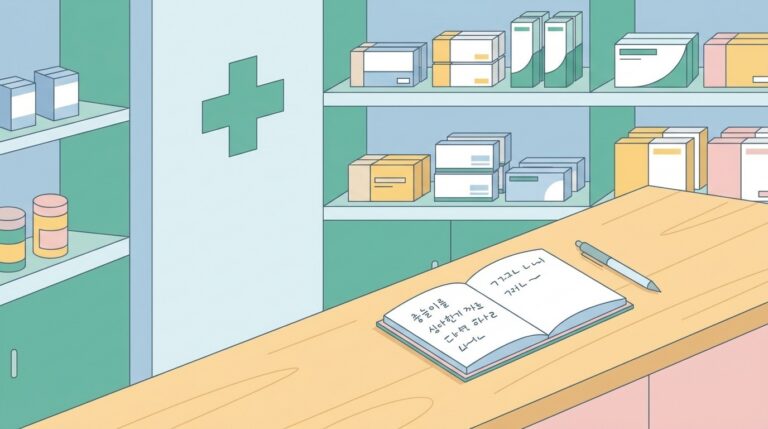
Surviving a Korean Pharmacy: How to Take Your Medicine Without Any Panic
Phase 1: Empathy (Your Seoul Pharmacy Story)
안녕하세요! (Annyeonghaseyo!) It’s your Daily Hangul editor and local Seoul navigator here. Picture this: You’ve been having the best trip of your life in Seoul. You walked 20,000 steps through Bukchon Hanok Village, indulged in piping-hot spicy tteokbokki along the Han River, and suddenly… your throat feels like sandpaper, and your head is pounding. Just like a dramatic scene straight out of a K-drama where the protagonist gets caught in an unexpected rainstorm, you find yourself standing outside a door marked with a glowing red or green cross and the single syllable: 약 (Yak).
You timidly open the door. A friendly pharmacist in a crisp white coat looks up. You manage to point to your head and cough, but then the pharmacist hands you a small paper packet and speaks in a rapid stream of syllables: “Haru-e se beon, sik-hu samsip-bun-e han al-ssik deuseyo!” Your brain freezes. Did they say three pills at once? Before meals? After meals?
Take a deep breath! You are not alone. As a tutor who has coached hundreds of beginners through their first Korean travel hurdles, I know that health emergencies can feel intimidating. Mastering just a few core pharmacy expressions won’t just save you from an accidental overdose of daytime cold medicine—it will give you the superpower to travel with rock-solid confidence. Let’s conquer the Korean pharmacy together!
Phase 2: Core Expressions Deep Dive
1. 하루에 세 번 (Haru-e se beon)
- Pronunciation: [Ha-ru-e se beon] (Sounds like “Ha” like laugh, “roo” like kangaroo, “eh”, “seh”, and “burn” without the ‘r’)
- Meaning: “Three times a day.” (Literal: In a day, three times)
- K-Culture Moment: You will hear this in almost every medical drama like Hospital Playlist whenever a doctor hands a patient their discharge notes.
- Editor’s Insight: 하루 (Haru) means “one day.” 세 (Se) is the native Korean number for three, and 번 (Beon) is the counter for occurrences. Notice how Korean stacks time units from largest to smallest: [One day] + [Three times].
- Situation Spectrum: Casual: ✅ | Semi-formal: ✅ | Formal: ✅ (This is a neutral time-frequency phrase used in all situations)
- 🤔 Think About It: In English, we say “three times a day” (count first, time frame second). Why do you think Korean establishes the time container (하루에) before counting the actions inside it?
2. 한 알씩 드세요 (Han al-ssik deuseyo)
- Pronunciation: [Han al-ssik deu-seh-yo] (“Han” rhymes with “run”, “al” rhymes with “ball”, “ssik” sounds like a snappy “seek”, “deu-seh-yo” like “duh-say-yo”)
- Meaning: “Please take one pill at a time.” (Literal: One pill each, please consume)
- K-Culture Moment: The polite honorific ending -드세요 (deuseyo) is the polite form of 먹다 (meokda – to eat). In Korean culture, taking medicine is treated as “eating/consuming” medicine!
- Editor’s Insight: 알 (Al) is the counter for pills, eggs, and round drops. The magic suffix -씩 (-ssik) means “each” or “at a time.” If the pharmacist says 두 알씩 (Du al-ssik), they mean “two pills each time.”
- Situation Spectrum: Casual: ⚠️ (Use only with close friends as 한 알씩 먹어) | Semi-formal: ✅ | Formal: ✅
- 🤔 Think About It: In English, we “take” medicine, but in Korean, you “eat” (먹다) or “honorably consume” (드시다) medicine. What does this reveal about how medicine was historically seen as food/herbal nourishment in Korea?
3. 밥 먹고 드세요 (Bap meokgo deuseyo)
- Pronunciation: [Bap meok-go deu-seh-yo] (“Bap” sounds like “bop”, “meok-go” sounds like “muck-go”)
- Meaning: “Please take this after eating a meal.” (Literal: Eat rice/meal, and then consume)
- K-Culture Moment: In K-dramas, family members often ask each other 밥 먹었어? (Did you eat?) as a token of love. Pharmacists will almost always advise you to take medicine on a full stomach to protect your stomach lining.
- Editor’s Insight: While textbook language uses 식후 (Sik-hu / after meal), in everyday spoken Korean, pharmacists will warmly say 밥 먹고 드세요 (Bap meokgo deuseyo) so you don’t forget to protect your belly!
- Situation Spectrum: Casual: ⚠️ | Semi-formal: ✅ | Formal: ✅
- 🤔 Think About It: Why is 밥 (Bap – cooked rice) synonymous with all meals in Korean daily culture?
Phase 3: Textbook Korean vs. Real-World Korean
Situation 1: Asking for Headache Medicine
- 📖 교과서 한국어 (Textbook): 두통약을 복용하고 싶습니다. (Dutongyag-eul bogyonghago sipsumnida.) – “I wish to ingest headache medication.”
- 🗣️ 진짜 한국어 (Real-World): 두통약 하나 주세요. (Dutongyak hana juseyo.) – “Please give me one headache medicine.”
- 💡 Why is it different? Nobody uses the formal clinical verb 복용하다 (to ingest medicine) across a retail pharmacy counter. Simply naming the symptom + medicine (약, yak) followed by 하나 주세요 (Please give me one) sounds natural, polite, and immediate.
Situation 2: Asking How Often to Take It
- 📖 교과서 한국어 (Textbook): 이 약의 복용법을 알려주십시오. (I yag-ui bogyongbeob-eul allyeojusipsio.) – “Please instruct me on the method of consumption for this drug.”
- 🗣️ 진짜 한국어 (Real-World): 이거 하루에 몇 번 먹어요? (Igeo haru-e myeot beon meogeoyo?) – “How many times a day do I take this?”
- 💡 Why is it different? Real-life Korean prefers simple demonstratives like 이거 (Igeo – this) paired with standard polite question forms like 먹어요? (Do I eat/take it?).
Phase 4: K-Culture Deep Dive & Non-Verbal Etiquette
4-1. Nunchi (눈치) & Body Language at the Pharmacy
- The Two-Handed Hand-off: When the pharmacist hands you your medicine box or prescription bag (약봉투, yak-bongtu), always receive it using both hands (or with your right hand supported at the wrist/forearm by your left hand). This small gesture signals respect and care.
- The Agreement Nod: While the pharmacist circles dosing instructions on your packet with a pen, maintain eye contact and nod gently saying 네 (Ne – yes). This indicates you have understood each step.
4-2. The Culture Code: The Magic Paper Pouch (약봉투)
If you ever receive prescription medicine in Korea, you will be amazed by the packaging. Instead of big amber plastic bottles with childproof caps, Korean pharmacies dispense customized, individual translucent paper packets (포, po), often sealed together in a tearable strip.
Printed right on the outer paper bag is a personalized calendar grid showing 아침 (Morning / Breakfast), 점심 (Lunch), and 저녁 (Dinner), alongside 식후 30분 (30 minutes after meals). Pharmacists will routinely take a ballpoint pen and circle the exact meal slots for you. It’s a hallmark of Korea’s hyper-efficient, patient-centered healthcare delivery!
Phase 5: Real-World Roleplay Scenario
- Setting: A warm, tidy neighborhood pharmacy near Hongik University Station.
- Characters:
- Alex: A traveler with a scratchy throat and runny nose.
- Pharmacist Park: A smiling pharmacist wearing wire-rimmed glasses.
- Alex: 안녕하세요! 감기약 좀 주세요. (Annyeonghaseyo! Gamgiyak jom juseyo.)
🎭 Alex touches his throat gently, speaking with a polite, raspy voice.
(Hello! Could I please get some cold medicine?) -
Pharmacist Park: 목이 아프세요, 콧물이 나세요? (Mogi apeuseyo, konmuri naseyo?)
🎭 The pharmacist tilts his head with concern and points to his throat and nose.
(Does your throat hurt, or do you have a runny nose?) -
Alex: 둘 다요. 머리도 조금 아파요. (Dul dayo. Meorido jogeum apayo.)
🎭 Alex gestures holding two fingers up and rubs his temple.
(Both. My head hurts a little too.) -
Pharmacist Park: 네, 이 종합 감기약 드시면 돼요. (Ne, i jonghap gamgiyak deusimyeon dwaeyo.)
🎭 Pharmacist Park reaches to the shelf and brings out a green box.
(Understood, you can take this multi-symptom cold medicine.) -
Alex: 이거 하루에 몇 번 먹어요? (Igeo haru-e myeot beon meogeoyo?)
🎭 Alex points to the box with an inquisitive look.
(How many times a day do I take this?) -
Pharmacist Park: 하루에 세 번, 한 알씩 드세요. (Haru-e se beon, han al-ssik deuseyo.)
🎭 The pharmacist holds up three fingers, then points to a single capsule picture on the box.
(Take one pill at a time, three times a day.) -
Alex: 밥 먹기 전에 먹어요? (Bap meokgi jeone meogeoyo?)
🎭 Alex asks carefully to confirm meal timing.
(Do I take it before eating?) -
Pharmacist Park: 아니요, 꼭 밥 먹고 드세요! 졸릴 수 있어요. (Aniyo, kkok bap meokgo deuseyo! Jollil su isseoyo.)
🎭 Pharmacist Park waves his hand gently and rests his cheek on his hands indicating sleepiness.
(No, please make sure to take it after meals! It may cause drowsiness.)
🔀 Interactive Choice Point
You are about to pay for your cold medicine, but your stomach is already grumbling, and you need water to take a pill immediately. What do you do?
- Option A: Say: 물 좀 주실 수 있어요? (Mul jom jusil su isseoyo? – Could you give me some water?)
- 👉 Feedback [BEST]: Perfect! Almost all Korean pharmacies have a filtered cold/hot water dispenser with conical paper cups (봉투컵) near the entrance. Pharmacists will happily point it out so you can take your medicine on the spot.
- Option B: Say: 지금 다 먹어요! (Jigeum da meogeoyo! – I eat all now!)
- 👉 Feedback [BAD]: Whoops! This sounds like you are going to swallow the entire box of 10 pills right now. The pharmacist will look alarmed.
- Option C: Wave your hands, grab a random drink from the convenience store next door, and drink it with sweet milk tea.
- 👉 Feedback [RISK]: Taking medication with dairy, caffeine, or acidic juice can hinder absorption or upset your stomach. Stick to plain water!
Phase 6: 10-Second Emotion Shadowing Drill
Follow the rhythm slashes / for natural pauses, and match the emotional cues in brackets:
[🥺 아프고 지친 목소리로 - Tired & aching]
저기요… / 감기약 / 하나 주세요.
(Jeogiyo… / gamgiyak / hana juseyo.)-
[🤔 궁금하고 진지하게 - Inquiring & attentive]
이거 / 하루에 / 몇 번 먹어요?
(Igeo / haru-e / myeot beon meogeoyo?) -
[💊 안도하며 또박또박 - Relieved & clear]
아, / 하루에 세 번 / 한 알씩요! / 감사합니다.
(A, / haru-e se beon / han al-ssik-yo! / Gamsahamnida.)
Phase 7: K-Culture Mini Dictionary
- 약국 (Yakguk): Pharmacy / Drugstore. Marked with a red or green “약” sign. Unlike Western mega-pharmacies, Korean neighborhood pharmacies focus primarily on medications and wellness supplements.
- 식후 (Sik-hu): “After meals.” The character 식 (Sik) stands for food/meal, and 후 (Hu) means after. Most common instruction: 식후 30분 (30 minutes after eating).
- 감기약 (Gamgiyak): Cold medicine. You can specify 목감기약 (Mok-gamgiyak – sore throat cold), 코감기약 (Ko-gamgiyak – runny nose/congestion), or 종합감기약 (Jonghap-gamgiyak – multi-symptom cold).
- 진통제 / 두통약 (Jintongje / Dutongyak): Pain reliever / Headache medicine. Acetaminophen (Tylenol) is widely available over the counter under the phonetic name 타이레놀 (Tairenol).
Phase 8: Traveler’s Survival Kit
Survival Expressions TOP 3
- 소화제 주세요 (Sohwaje juseyo)
Pronunciation: [So-hwa-je ju-se-yo]
Pro Tip: Ate too much Korean barbecue or spicy fried chicken? Ask for this! Korean digestion remedies (like drinkable Gas Whal Myung Su) work wonders. - 졸려요? (Jollyeoyo?)
Pronunciation: [Jol-lyeo-yo?]
Pro Tip: Ask this if you want to know if cold medicine will make you drowsy during a sightseeing day. - 대일밴드 있어요? (Daeil-baendeu isseoyo?)
Pronunciation: [Dae-il-baen-deu it-seo-yo?]
Pro Tip: Got blisters from walking in Myeongdong? 대일밴드 (Daeil-band) is the iconic Korean brand name for adhesive bandages (Band-Aids).
Editor’s Travel Note
- Late-Night Emergency: If local pharmacies are closed, head to convenience stores like GS25, CU, or 7-Eleven. They stock basic over-the-counter essentials (안전상비의약품) like basic pain relievers, fever reducers, cold tablets, and digestion tonics.
- Navigation Guide: Search for nearby pharmacies using the Naver Map navigation app. Simply type “약국” into the search bar.
- Medical Hotline: If you experience severe symptoms, call the Emergency Medical Information Center 1339 for immediate English medical translation assistance.
Phase 9: “One Step Deeper” (Cultural Reflection)
In many Western cultures, medicine is treated with strict scientific detachment—a chemical dose to alleviate a clinical ailment. In Korea, however, recovery is deeply intertwined with 밥정 (Bap-jeong)—the communal affection rooted in shared meals. The phrase “밥이 보약이다” (A good meal is the best medicine) reflects the belief that your body heals when it is nourished. That’s why Korean pharmacists don’t just hand you pills; they check whether you have eaten, warn you about an empty stomach, and remind you to rest warm. It is healthcare wrapped in Korean 정 (Jeong – empathetic affection).
💬 Your Turn: In your home country, what do people traditionally eat or drink when they catch a nasty cold? Chicken soup? Hot tea with lemon? Share your go-to home remedy in the comments below!
Phase 10: FAQ & Avoiding Misunderstandings
Q: Can I buy common painkillers like Ibuprofen or Tylenol without a prescription in Korea?
A: Yes! Most mild pain relievers, cold medicines, antacids, and muscle patches (파스, paseu) are sold directly over the counter at any neighborhood pharmacy without needing a doctor’s prescription.
Q: Why did the pharmacist ask me “졸려도 괜찮아요?” (Is it okay if it makes you sleepy?)
A: Many effective Korean cold medicines contain antihistamines that induce severe drowsiness. If you are planning an active day of walking or driving, reply: “안 졸린 걸로 주세요” (An jollin geollo juseyo – Please give me non-drowsy medicine).
Q: What does “식전” (Sik-jeon) mean on a medicine pouch?
A: 식전 (Sik-jeon) means “before meals.” While most medicines are taken 식후 (after meals), stomach protectors or specific antibiotics might be marked 식전 30분 (30 minutes before meals).
🚨 Common Mistakes Alert
- Mistake: Pronouncing 약 (medicine) like the English exclamation “Yuck!”
- Correct Action: Keep your mouth open roundly and say “Yak” (rhyming with “Bach” or the start of “Yacht”).
- Mistake: Demanding a large bottle of 100 tablets.
- Correct Action: Korean over-the-counter pain pills are almost always sold in blister strips of 10 capsules per box. If you need more, ask for 두 통 주세요 (Du tong juseyo – Two boxes, please).
- Mistake: Throwing away the printed paper prescription bag.
- Correct Action: Keep it! Korean pharmacy bags contain the exact drug names, warnings, and itemized billing, which your travel insurance will require for reimbursement.
Phase 11: Action Missions & Community
- 🥉 Bronze Mission (Solo): Stand in front of your bathroom mirror and practice saying: 하루에 세 번, 한 알씩! (Haru-e se beon, han al-ssik!) three times smoothly.
- 🥈 Silver Mission (Social): Next time you watch a K-drama where a character gives medicine or tea to someone, write down how many times you hear the word 약 (Yak) or 밥 (Bap) and share it on Instagram tagging
@DailyHangul! - 🥇 Gold Mission (Real Life): Walk into a Korean pharmacy (or an online Korean mart) and confidently ask for bandages or throat lozenges: “목캔디 주세요” (Mok-kaendi juseyo) or “밴드 주세요” (Baendeu juseyo).
- 🎮 K-Culture Mission: Watch Episode 1 of any medical K-drama (like Hospital Playlist or Dr. Romantic) and spot the scene where a healthcare provider gives instructions to a patient!
Phase 12: Interactive Quiz Challenge
Test your new skills! Read the questions below, then click the toggle to reveal the explanations.
1. Situational Judgment:
The pharmacist hands you a box of cold medicine and says: “식후에 두 알씩 드세요.” How should you take this medicine?
(A) Take two pills before breakfast only.
(B) Take two pills each time, after meals.
(C) Take one pill twice a day with water.
2. Fill-in-the-Blank:
“Could you please give me one headache medicine?”
→ 두통약 _______ 주세요. (Hint: Korean native number for ‘one’)
3. True or False:
In Korea, basic pain relievers like Tylenol can only be purchased in hospitals and pharmacies, never in convenience stores. (True / False)
👉 Click to reveal answers & explanations!
-
Answer: (B)
Explanation: 식후 (Sik-hu) means after meals, and 두 알씩 (Du al-ssik) means two pills each time! -
Answer: 하나 (Hana)
Sentence: 두통약 하나 주세요. (Dutongyak hana juseyo.) -
Answer: False
Explanation: Basic over-the-counter remedies (안전상비의약품) such as Tylenol, fever medicine, and digestives are readily available 24/7 at most Korean convenience stores!







