

Don’t Panic at the Korean Clinic! How to Explain a Dry Cough and Phlegm Like a Local
Phase 1: Empathy (Story-Immersed Opening)
안녕하세요! 매일한글 에디터입니다. (Hello! This is your Daily Hangul editor.)
Picture this: You are having the trip of your life in Seoul. You enjoyed spicy tteokbokki along the Han River yesterday, but this morning, you woke up with a throat that feels like sandpaper. Walking into the crisp autumn breeze, you let out a sharp, hacking cough. It is annoying, persistent, and now there is even a little phlegm caught in your chest. You spot a local clinic sign: 내과 (Naegwa – Internal Medicine). You muster up the courage to walk through the sliding glass doors, but your mind freezes. What if you just point at your throat and say “아파요 (Apado – It hurts)”? The doctor might mistake a chest cold for a simple sore throat! Describing specific physical symptoms in another language feels intimidating. But with just three simple sentence patterns, you can explain your cough accurately and get the right prescription within five minutes. Let’s master these survival phrases together!
Phase 2: Deep Dive into 3 Core Expressions
1. 마른기침이 계속 나와요 (Mareun-gichimi gyesok nawado)
- Pronunciation: [Mareun-gichimi gyesok nawado] (Sound clue: Think of ‘mareun’ like ‘maroon’ said quickly, and ‘gichim’ like ‘gee-chim’)
- Meaning: Literal: “Dry cough keeps coming out.” / Nuance: “I have this continuous, hacking dry cough that won’t go away.”
- K-Culture Moment: You often hear this in office K-Dramas when an overworked character tries to hide their cold during an important board meeting by muffling a hack into their sleeve.
- Editor’s Insight: In Korean, symptoms often “come out” (나오다 – naoda) or “occur” (나다 – nada) rather than being something you “have” (가지다 – gajida). Recognizing this perspective shift makes your Korean sound instantly natural.
- Situation Spectrum:
- Casual (to friends): 마른기침이 계속 나와 (Mareun-gichimi gyesok nawa) ✅
- Semi-formal (to doctor/pharmacist): 마른기침이 계속 나와요 (Mareun-gichimi gyesok nawado) ✅
- Formal (announcements/official): 마른기침이 지속적으로 발생합니다 (Mareun-gichimi jisokjeogeuro balsaenghamnida) ⚠️
- 🤔 Think About It: Why do you think Korean treats symptoms as separate things that “emerge” (나오다) from the body rather than possessions (“I have a cough”)?
2. 가래가 조금 섞여 나와요 (Garaega jogeum seokkyeo nawado)
- Pronunciation: [Garaega jogeum seokkyeo nawado] (Sound clue: ‘Garae’ sounds like ‘ga-reh’, ‘seokkyeo’ sounds like ‘sock-yeo’)
- Meaning: Literal: “Phlegm comes out slightly mixed.” / Nuance: “There is a little bit of phlegm mixed in when I cough.”
- K-Culture Moment: In family dramas, an affectionate Korean grandmother will instantly brew ginger tea (생강차 – saenggangcha) the second she hears this exact sentence.
- Editor’s Insight: The word ‘섞이다’ (seokkida) means ‘to be mixed’. Using ‘섞여 나와요’ indicates that your cough is predominantly dry, but occasionally produces mucus. This helps the doctor choose between a cough suppressant and an expectorant!
- Situation Spectrum:
- Casual: 가래가 좀 섞여 나와 (Garaega jom seokkyeo nawa) ✅
- Semi-formal: 가래가 조금 섞여 나와요 (Garaega jogeum seokkyeo nawado) ✅
- Formal: 객담이 소량 동반됩니다 (Gaekdami soryang dongbandoemnida) ⚠️
- 🤔 Think About It: English speakers usually say “I’m coughing up phlegm.” Notice how Korean frames it as phlegm being “mixed in with the cough”?
3. 목이 간질간질해요 (Mogi ganjil-ganjilhaeyo)
- Pronunciation: [Mogi ganjil-ganjilhaeyo] (Sound clue: ‘ganjil-ganjil’ bounces gently off your tongue like a tickle)
- Meaning: Literal: “My throat is tickle-tickle.” / Nuance: “My throat feels itchy and ticklish, making me want to cough.”
- K-Culture Moment: Classic variety show scene where an idol drinks icy water or eats spicy food and grabs their throat with a cute expression saying this phrase.
- Editor’s Insight: Korean is extraordinarily rich in mimetic words (의태어 – uitaeeo). ‘간질간질’ (ganjil-ganjil) captures the exact physical sensation of a feather tickling the back of your throat.
- Situation Spectrum:
- Casual: 목이 간질간질해 (Mogi ganjil-ganjilhae) ✅
- Semi-formal: 목이 간질간질해요 (Mogi ganjil-ganjilhaeyo) ✅
- Formal: 인후통 및 소양감이 있습니다 (Inhutong mit soyanggami itseumnida) 🚫
- 🤔 Think About It: How many mimetic words does your native language use to describe physical discomfort compared to Korean?
Phase 3: Textbook Korean vs. Real Korean
Situation 1: Explaining an irritated, dry throat
- 📖 교과서 한국어: 제 인후에 통증이 있습니다. (Je inhue tongjeungi itseumnida. – “I have pain in my larynx.”)
- 🗣️ 진짜 한국어: 목이 칼칼하고 간질간질해요. (Mogi kalkal-hago ganjil-ganjilhaeyo. – “My throat feels scratchy and ticklish.”)
- 💡 왜 다를까? Real Koreans describe how their throat feels using sensory words like 칼칼하다 (scratchy/dry) rather than medical anatomical terms like 인후 (larynx).
Situation 2: Saying your cough won’t stop
- 📖 교과서 한국어: 기침을 멈출 수 없습니다. (Gichimeul meomchul su eopseumnida. – “I am unable to cease coughing.”)
- 🗣️ 진짜 한국어: 기침이 잘 안 멈춰요. (Gichimi jal an meomchwoyo. – “The cough just won’t stop easily.”)
- 💡 왜 다를까? Instead of robotic modal verbs like ‘~할 수 없다’ (cannot), native speakers express helplessness against illness using the adverb ‘잘 안’ (not easily/barely).
Phase 4: K-Culture Deep Dive & Non-Verbal Manners
4-1. 눈치 (Nunchi) & Clinic Etiquette
- The Elbow Shield: Never cough into your bare palms in a Korean clinic waiting room. Always cough directly into your upper inner sleeve or a tissue.
- Two-Handed Delivery: When handing over your passport, Alien Registration Card (ARC), or credit card at reception, use both hands or support your right wrist with your left hand. It demonstrates instant respect.
- The Seated Bow: When you sit in the doctor’s consultation chair, a slight nod of the head (15 degrees) while saying “안녕하세요 (Annyeonghaseyo)” sets a polite, cooperative tone.
4-2. Cultural Code: The Fast-Paced ‘Ppalli-Ppalli’ Clinic Experience
In Korea, local neighborhood clinics (동네 의원 – dongne uiwon) are remarkably fast. You rarely wait more than 15 minutes, and doctor consultations usually last around 2 to 3 minutes! Korean doctors expect you to state your main symptoms immediately. Being concise and using accurate symptom phrases like “마른기침” (dry cough) and “가래” (phlegm) ensures the doctor grasps your condition in seconds.
Phase 5: Real-Life Roleplay Scenario
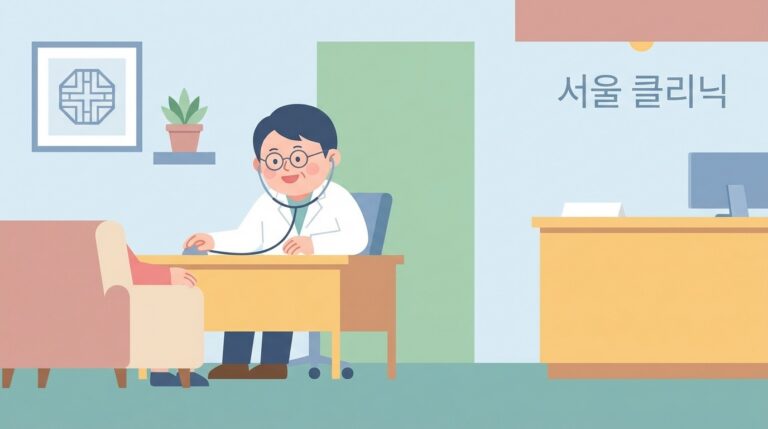
Setting: Dr. Park’s Internal Medicine Clinic (박내과의원) near Sinchon Station. Sunlight streams into a clean, compact examination room with a stethoscope on the desk.
Characters:
* Dr. Park (의사): Kind, swift, and attentive middle-aged doctor wearing round glasses.
* Alex (학습자): An international student dealing with a nagging cough after a weekend trip to Busan.
- 의사 (Dr. Park): 어디가 불편해서 오셨어요? (Eodiga bulpyeonhaeseo osyeosseoyo?)
🎭 안경을 고쳐 쓰며 차트를 봅니다.– What brings you in today? - Alex: 며칠 전부터 감기 기운이 있었는데요. (Myeochil jeonbuteo gamgi giuni isseonneundeyo.)
🎭 목을 살짝 만지며– I have had cold symptoms for a few days. - 의사 (Dr. Park): 열도 나시나요? 기침은 어때요? (Yeoldo nasinayo? Gichimeun eottaeyo?)
🎭 체온계를 집어 듭니다.– Do you have a fever too? How is your cough? - Alex: 열은 없는데, 마른기침이 계속 나와요. (Yeoreun eomneunde, mareun-gichimi gyesok nawado.)
🎭 마스크 너머로 작게 기침합니다.– No fever, but I keep having a dry cough. - 의사 (Dr. Park): 가래도 같이 나오나요? (Garaedo gachi naonayo?)
🎭 청진기를 준비하며 묻습니다.– Is there phlegm coming up as well? - Alex: 가래가 조금 섞여 나와요. 목도 간질간질해요. (Garaega jogeum seokkyeo nawado. Mokdo ganjil-ganjilhaeyo.)
🎭 답답한 표정으로 가슴을 가리킵니다.– A little phlegm is mixed in. My throat is ticklish, too. - 의사 (Dr. Park): 자, 숨 크게 들이쉬세요. 목이 많이 부었네요. (Ja, sum keuge deurisi-seyo. Mogi mani bueonneyeo.)
🎭 청진기로 가슴 소리를 듣습니다.– Okay, take a deep breath in. Your throat is quite swollen. - Alex: 심한 감기인가요? (Simhan gamgi-ingayo?)
🎭 걱정스러운 눈빛으로 물어봅니다.– Is it a severe cold?
🔀 Interactive Choice Point
The doctor finishes the checkup and says, “약 3일 치 처방해 드릴게요. (I will prescribe 3 days of medicine.)” How do you ask if this medicine will make you sleepy?
- Option A: “이 약 먹으면 졸려요?” (I yak meogeumyeon jollyeoyo?)
- Option B: “약 먹고 잠을 잡니까?” (Yak meokgo jameul jamnikka?)
- Option C: “약이 저를 재웁니까?” (Yagi jeoreul jaeumnikka?)
Feedback:
* Option A is the BEST Choice! “이 약 먹으면 졸려요?” is natural, polite A2 Korean. The doctor will easily tell you if a non-drowsy formula is available.
* Option B is Awkward. It sounds like an interrogation: “Do I sleep after eating medicine?”
* Option C is a Literal Translation Risk! Direct translation of “Does the medicine put me to sleep?” sounds dramatic and unnatural in Korean.
Phase 6: 10-Second Emotion Shadowing Drill
Practice these lines with rhythm pauses (/) and emotional tone!
[😷 지치고 답답하게 - Tired and frustrated]
마른기침이 / 계속 나오고 / 목이 간질간질해요.
(Mareun-gichimi / gyesok naogo / mogi ganjil-ganjilhaeyo.)-
[🩺 차분하고 정확하게 - Calm and precise]
가래가 / 조금 / 섞여 나와요.
(Garaega / jogeum / seokkyeo nawado.) -
[🥺 조심스럽고 공손하게 - Polite and curious]
혹시 / 이 약 먹으면 / 많이 졸린가요?
(Hoksi / i yak meogeumyeon / mani jollingayo?)
Phase 7: K-Culture Mini Dictionary
- 내과 (Naegwa) | Internal Medicine Clinic | The default clinic in Korea for colds, stomach aches, and fatigue.
- 처방전 (Cheobangjeon) | Medical Prescription | The paper document the clinic prints for you to take to any nearby pharmacy.
- 식후 30분 (Sikhu samsipbun) | 30 minutes after meals | The golden dosage rule in Korea designed to protect your stomach lining from medicine irritation.
- 약국 (Yakguk) | Pharmacy | Always located right next door or on the first floor of any building housing a clinic.
Phase 8: Traveler’s Survival Kit
Top 3 Survival Phrases
- 가까운 내과가 어디예요? (Gakkaun naegwaga eodiyeyo?)
- Meaning: Where is the nearest internal medicine clinic?
- Pro Tip: Ask convenience store clerks or hotel concierges when searching offline.
- 기침약 주세요. (Gichim-yak juseyo.)
- Meaning: Please give me cough medicine.
- Pro Tip: Use this at a pharmacy if the clinic is closed.
- 목에 뿌리는 스프레이 있어요? (Moge ppurineun seupeurei isseoyo?)
- Meaning: Do you have a spray for the throat?
- Pro Tip: Great for quick relief against dry scratchy sensations.
Editor’s Travel Note
- Essential Navigation: Use the Naver Map app download to find open clinics by searching
내과(Naegwa). Google Maps is inaccurate for real-time Korean medical hours. - Emergency Translation: Call the Korea Travel Hotline at
1330for free three-way phone interpretation with your doctor. - Payment: Most clinics accept international credit cards. Keep receipts (영수증 – yeongsujeung) and medical fee details (진료비 세부내역서 – jinryobi sebunaeyeokseo) for travel insurance claims.
Phase 9: Step Deeper (Reflection)
In Korea, visiting a clinic is an act of communal consideration as much as personal recovery. In dense urban spaces like Seoul, sniffling or coughing openly on public transit without seeking treatment or wearing a mask can cause collective discomfort. Korean medical communication reflects this mutual care: it values descriptive sensory words that help doctors treat symptoms before they spread. Showing that you understand your body’s signals helps your doctor take care of you faster.
💬 Your Turn: Have you ever experienced a sudden cold while traveling abroad? How did you explain your symptoms without knowing the local language? Share your story in the comments below!
Phase 10: FAQ & Common Mistakes
Q: Do I need an appointment before visiting an internal medicine clinic (내과) in Korea?
A: No! Most local neighborhood clinics operate primarily on walk-ins. You simply check in at the front desk with your passport or ARC and wait your turn.
Q: Can I buy cold medicine with codeine over the counter at a pharmacy?
A: No. Strong cough suppressants require a prescription (처방전) from a doctor at a clinic. Over-the-counter options at pharmacies are milder.
Q: What should I say if I also have chills and body aches?
A: You can say: “몸살 기운이 있고 으슬으슬 추워요 (Momsal giuni itgo euseul-euseul chuwoyo – I have body aches and feel chilly).”
🚨 Common Mistakes Warning Board
- Mistake: Telling the doctor “가슴이 아파요 (Gaseumi apado)” when you just have a dry cough.
- Problem: This means “I have chest pain” and might lead the doctor to suspect cardiac trouble!
- Correct Action: Say “기침할 때 가슴이 답답해요 (Gichimhal ttae gaseumi dapdaphaeyo – My chest feels tight/stuffy when I cough).”
- Mistake: Waiting outside the pharmacy for your name to be called.
- Problem: Pharmacies call prescription numbers or names at the counter; you need to hand in your paper prescription first.
- Correct Action: Walk in, hand the paper 처방전 directly to the pharmacist, and sit down.
- Mistake: Using honorifics on yourself when describing symptoms (e.g., “제가 기침을 하십니다”).
- Problem: ‘-시-‘ is only for elevating other people.
- Correct Action: Keep it simple: “기침이 나와요 (Gichimi nawado).”
Phase 11: Action Mission
- 🥉 Bronze Mission: Stand in front of a mirror and say “마른기침이 계속 나와요 (Mareun-gichimi gyesok nawado)” three times using natural hand gestures.
- 🥈 Silver Mission: Save the three core expressions in your phone’s memo app so you can point to them instantly in case of an emergency.
- 🥇 Gold Mission: Next time you visit a Korean pharmacy or clinic, greet the staff with “안녕하세요” and describe your throat condition using “목이 간질간질해요”!
- 🎮 K-Culture Mission: Watch an episode of a medical drama like Hospital Playlist and listen for when patients describe their symptoms using the word ‘나오다’ (naoda)!
Phase 12: Interactive Quiz Challenge
1. Situational Judgment: You have had a dry cough for 3 days and your throat feels ticklish. Which phrase is best to say to the doctor?
A) 목에 피가 납니다. (Moge piga namnida.)
B) 마른기침이 계속 나오고 목이 간질간질해요. (Mareun-gichimi gyesok naogo mogi ganjil-ganjilhaeyo.)
C) 감기가 절대로 안 끝납니다. (Gamgiga jeoldaero an kkeunnamnida.)
2. Fill in the Blank:
가래가 조금 ______ 나와요. (A little phlegm is mixed in.)
[ 섞여 / 던져 / 닫혀 ]
3. True or False:
In Korea, you must always make a hospital reservation several days in advance for basic cold treatment at a neighborhood 내과 (Naegwa).
👉 Click to Reveal Answers & Explanations!
- Answer: B | B accurately and naturally communicates both the dry cough and the ticklish throat. (A means your throat is bleeding; C sounds overly dramatic!)
- Answer: 섞여 (seokkyeo) | ‘섞여 나와요’ comes from 섞이다 (to be mixed).
- Answer: False | Neighborhood clinics (내과) operate mostly on walk-in visits for standard cold and flu symptoms!







