

Phase 1: Empathy & Story Opening
안녕하세요! (Hello!) It’s your Daily Hangul editor.
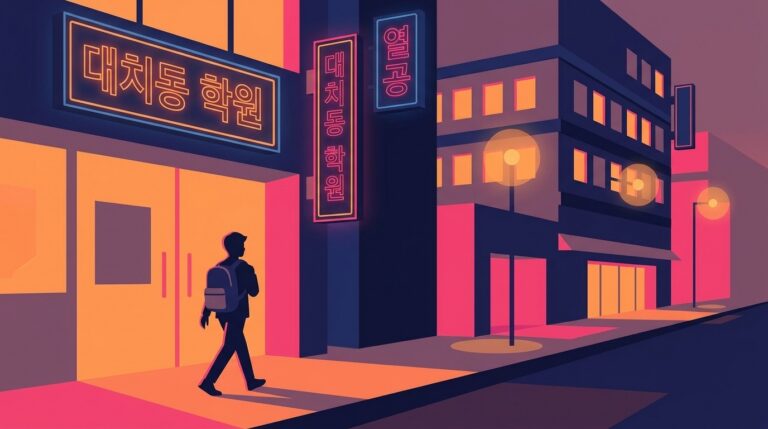
Imagine walking down the bustling streets of Daechi-dong, Gangnam, at 10:00 PM on a Tuesday. The neon signs glow, but this is not nightlife for clubbers. Instead, hundreds of bright yellow shuttle buses line the avenues, hazard lights blinking, while exhausted parents wait in double-parked sedans. Suddenly, the automatic doors of massive academy buildings slide open, and a flood of children—some as young as ten years old, carrying backpacks nearly as big as their torsos—spills onto the sidewalk clutching math workbooks and science binders.
This is the reality of Korea’s 사교육 열풍 (private education fever). Korea’s relentless educational zeal famously transformed a war-torn nation into a global tech powerhouse within two generations. However, this miracle cast a heavy shadow: hyper-competitive “kindergarten exams” (7세 고시), elementary school prep classes targeting medical school admissions (초등 의대반), and children caught in a relentless cycle of after-school academies.
When chatting with Korean friends in their 20s, 30s, or 40s, this topic comes up constantly—whether they are recalling their own childhood burnout or debating whether they want to raise children in Korea. As an intermediate (B2) learner, being able to talk about these socio-cultural debates moves you far beyond textbook pleasantries like “취미가 뭐예요? (What is your hobby?)”. Based on real feedback from our community members, this guide gives you the nuanced vocabulary, authentic cultural insights, and natural conversational cadence needed to discuss Korea’s education craze with empathy and fluency.
Phase 2: Core 3 Expressions
1. 사교육 열풍 (Sagyo-yuk yeol-pung)
- Pronunciation: [Sa-gyo-yuk yeol-pung] (Sound analogy: Imagine “sah-gyo-yook” followed by “yull-poong”, sounding like a sudden gust of wind)
- Meaning:
- Literal: Private education heat-wind (gale).
- Real Nuance: An uncontrollable, feverish craze or frenzy around private tutoring and cram schools.
- K-Culture Moment: In the hit satire drama SKY Castle, parents hire multimillion-dollar private coordinators to manipulate high school records, perfectly embodying 사교육 열풍.
- Editor’s Insight: The word “열풍” (fever/craze) implies a collective social phenomenon that sweeps up everyone, whether they want to participate or not. You will see this in news headlines about “초등 의대반 열풍” (the craze for elementary medical school prep classes).
- Situation Spectrum: Casual: ⚠️ | Semi-formal: ✅ | Formal: ✅
- 🤔 Think About It: In your culture, do people view private tutoring as an individual choice or a collective social pressure?
2. 학원 뺑뺑이 돌다 (Hagwon bbaeng-bbaeng-i dolda)
- Pronunciation: [Hag-won bbaeng-bbaeng-i dol-da] (Sound analogy: “Hag-won” + “bbaeng-bbaeng” sounds like spinning dizzyingly in a circle, like a merry-go-round)
- Meaning:
- Literal: To spin around in circles through academies.
- Real Nuance: To be dragged through a back-to-back, exhausting daily circuit of cram schools (English, Math, Essay writing, Taekwondo, Piano) with zero downtime.
- K-Culture Moment: In Crash Course in Romance, students rush between Banpo and Daechi cram schools with triangle kimbap in their hands, literally 학원 뺑뺑이를 돌다.
- Editor’s Insight: “뺑뺑이” conveys dizziness, repetition, and lack of agency. When Korean adults say, “어릴 때 학원 뺑뺑이만 돌았어요 (When I was young, I just spun around academies all day)”, they are expressing nostalgia tinged with bitter fatigue.
- Situation Spectrum: Casual: ✅ | Semi-formal: ✅ | Formal: 🚫
- 🤔 Think About It: Does your native language have an idiom for running endlessly between extracurricular commitments?
3. 등골 브레이커 (Deung-gol beu-re-i-keo)
- Pronunciation: [Deung-gol beu-re-i-keo] (Sound analogy: “Deung-gol” [backbone] combined with Konglish “breaker”)
- Meaning:
- Literal: Backbone breaker.
- Real Nuance: An expense so exorbitant that it breaks parents’ backs (financially and physically), especially expensive tuition fees or luxury school items demanded by peer pressure.
- K-Culture Moment: Popularized when teenagers demanded million-won North Face jackets in the 2010s, this term is now widely used by parents discussing private academy fees: “학원비가 진짜 등골 브레이커예요 (Hagwon fees are real backbone-breakers).”
- Editor’s Insight: Koreans value filial piety and parental sacrifice deeply. Using this slang conveys both self-deprecating humor and honest acknowledgment of financial strain.
- Situation Spectrum: Casual: ✅ | Semi-formal: ⚠️ | Formal: 🚫
- 🤔 Think About It: How does your language express the financial toll that children’s education or fashion trends put on parents?
Phase 3: Textbook Korean vs. Real Korean
Situation 1: Describing a child’s packed schedule
- 📖 교과서 한국어: 아이가 방과 후에 여러 학원에 다니고 있어요. (A-i-ga bang-gwa hu-e yeo-reo hag-won-e da-ni-go iss-eo-yo.) — The child attends several academies after school.
- 🗣️ 진짜 한국어: 우리 조카는 초등학생인데 벌써 학원 뺑뺑이 돌리고 있어요. (U-ri jo-ka-neun cho-deung-hak-saeng-in-de beol-sseo hag-won bbaeng-bbaeng-i dol-li-go iss-eo-yo.) — My nephew is just an elementary schooler, but they’re already running him through the hagwon marathon.
- 💡 왜 다를까? Textbook Korean sounds like an official survey response. Native speakers use “뺑뺑이 돌리다” (to put someone through the mill/circuit) to capture the breathless, assembly-line reality of Korean children’s daily schedules.
Situation 2: Commenting on aggressive parenting styles
- 📖 교과서 한국어: 부모님들의 교육에 대한 관심이 매우 높습니다. (Bu-mo-nim-deul-ui gyo-yuk-e dae-han gwan-sim-i mae-u nop-seum-ni-da.) — Parents’ interest in education is very high.
- 🗣️ 진짜 한국어: 강남 부모들 치맛바람이 장난 아니에요. (Gang-nam bu-mo-deul chi-mat-ba-ram-i jang-nan a-ni-e-yo.) — The pushy helicopter parenting in Gangnam is no joke.
- 💡 왜 다를까? “치맛바람” (skirt wind) is a vivid cultural idiom describing mothers bustling around schools and hagwons, aggressively lobbying for their children’s success. Saying “장난 아니에요” gives your reaction an authentic, expressive kick.
Phase 4: K-Culture Deep Dive & Non-Verbal Manners
4-1. 눈치 (Nunchi) & Tone: The Art of Discussing Education
In Korea, talking about children’s academic performance or hagwon expenses requires delicate social radar (눈치):
* Never brag directly about test placements: If your friend’s child is in an “초등 의대반” (elementary med-school prep track), they rarely boast directly. Instead, they will sigh, look slightly overwhelmed, and say, “아이 따라가느라 저까지 피 말려요 (It’s draining the life out of me just trying to keep up with the kid).”
* Acknowledge the burden with a sigh and nod: When a Korean acquaintance complains about hagwon costs or entrance exams, do not say, “Why don’t you just stop sending them?” That ignores the deep social pressure. Instead, nod slowly with downcast eyes, let out a soft sigh, and say, “진짜 고민 많으시겠어요 (You must have so many worries).”
4-2. The “10 PM Curfew” & The Darker Side of Hagwon Culture
Did you know that Seoul has a government-mandated curfew for hagwons? By law, hagwons in Seoul must shut their doors by 10:00 PM to protect students’ sleep. Yet, drive past Gangnam at 9:58 PM, and you will see students sprinting into 24-hour study cafes (스터디 카페) to continue studying until 2:00 AM.
This relentless cycle inspired hit K-Dramas like SKY Castle, Green Mothers’ Club, and The Penthouse. What foreign viewers often mistake for surreal melodrama is closer to investigative documentary for families living in Daechi-dong and Mok-dong. While public education normalization (공교육 정상화) is on every presidential administration’s agenda, the fear of falling behind in Korea’s winner-take-all college entrance exam (수능, Suneung) keeps the hagwon lights on.
Phase 5: Real-Life Roleplay Scenario
Setting: A quiet cafe near Daechi Station, Seoul. You are having coffee with your Korean friend, Minho (31), whose 10-year-old niece recently joined an “elementary medical school prep class”.
- Turn 1 (Minho):
🎭 Looking at his phone, shaking his head with a heavy sigh
우리 조카가 이번에 초등 의대반에 들어갔대. 걔 이제 겨우 열 살인데.
(U-ri jo-ka-ga i-beon-e cho-deung ui-dae-ban-e deul-eo-gat-dae. Gye i-je gyeo-u yeol sal-in-de.)
My niece got into an elementary medical school prep track. She’s only ten years old. -
Turn 2 (You):
🎭 Leaning forward with genuine curiosity and empathy
열 살인데 벌써 의대 준비를 해요? 사교육 열풍이 진짜 대단하네요.
(Yeol sal-in-de beol-sseo ui-dae jun-bi-reul hae-yo? Sa-gyo-yuk yeol-pung-i jin-jja dae-dan-ha-ne-yo.)
She’s ten and already preparing for medical school? The private education fever is truly intense. -
Turn 3 (Minho):
🎭 Tapping fingers on the coffee cup, looking frustrated
응, 학교 끝나면 매일 밤 10시까지 학원 뺑뺑이 돌아. 주말에도 학원 가고.
(Eung, hak-gyo kkeut-na-myeon mae-il bam yeol-si-kka-ji hag-won bbaeng-bbaeng-i do-ra. Ju-mal-e-do hag-won ga-go.)
Yeah, once school finishes, she runs the hagwon circuit until 10 PM every day. Even on weekends. -
Turn 4 (You):
🎭 Frowning in sympathy, tilting head slightly
아이가 너무 스트레스받지 않을까요? 친구들과 놀 시간도 없겠어요.
(A-i-ga neo-mu seu-teu-re-seu-bad-ji anh-eul-kka-yo? Chin-gu-deul-gwa nol si-gan-do eop-get-seo-yo.)
Wouldn’t she be under too much stress? She probably doesn’t even have time to play with friends. -
Turn 5 (Minho):
🎭 Glancing around to check if anyone is listening
누나도 마음 아파해. 근데 대치동에선 남들 다 하니까 안 시키면 불안하대.
(Nu-na-do ma-eum a-pa-hae. Geun-de Dae-chi-dong-e-seon nam-deul da ha-ni-kka an si-ki-myeon bul-an-ha-dae.)
My sister feels bad too. But here in Daechi-dong, everyone does it, so she gets anxious if she doesn’t join in. -
Turn 6 (You):
🎭 Nodding understandingly
학원비도 만만치 않을 텐데, 부모님들 등골 브레이커네요.
(Hag-won-bi-do man-man-chi anh-eul ten-de, bu-mo-nim-deul deung-gol beu-re-i-keo-ne-yo.)
Academy fees can’t be cheap either—it must be a total backbone breaker for parents. -
Turn 7 (Minho):
🎭 Chuckling wryly, rubbing his forehead
맞아. 매달 수백만 원씩 깨진대. 공교육만으로는 입시를 감당하기 힘들대나 봐.
(Maj-a. Mae-dal su-baek-man won-ssik kkae-jin-dae. Gong-gyo-yuk-man-eu-ro-neun ip-si-reul gam-dang-ha-gi him-deul-dae-na bwa.)
Exactly. Millions of won disappear every month. They say public schooling alone can’t handle college entrance exams. -
Turn 8 (You):
🎭 Speaking gently with a reflective tone
한국의 높은 교육 수준 뒤에 이런 그림자가 있는 줄 몰랐어요. 조카가 지치지 않았으면 좋겠네요.
(Han-guk-ui nop-eun gyo-yuk su-jun dwi-e i-reon geu-rim-ja-ga iss-neun jul mol-rat-seo-yo. Jo-ka-ga ji-chi-ji anh-at-seu-myeon joh-get-ne-yo.)
I didn’t realize such a shadow lay behind Korea’s high education standards. I hope your niece doesn’t burn out.
🔀 Interactive Decision Point
How would you respond to Minho at Turn 6 if you wanted to deepen the conversation?
- Option A (Best): “학원비도 만만치 않을 텐데, 부모님들 등골 브레이커네요. 부모님이나 아이나 다 안쓰러워요.” (Acknowledges both financial and emotional pressure with cultural empathy.)
- Feedback: Perfect! You used idiomatic vocabulary (등골 브레이커) while showing heartfelt empathy for both sides.
- Option B (Bad): “그냥 학원 그만두고 미국으로 유학 보내면 안 돼요?” (Just tell them to quit and study in America.)
- Feedback: Too blunt and unrealistic. It ignores economic and family constraints, sounding dismissive of their daily struggle.
- Option C (Risk): “한국 부모들은 너무 극성맞은 것 같아요.” (Korean parents seem way too overzealous.)
- Feedback: Risky! “극성맞다” has a negative judgment tone. Even if Koreans criticize this system themselves, hearing an outsider label them this way can cause defensiveness.
Phase 6: 10-Second Emotion Shadowing Drill
Practice these natural intonations by pausing at the / marks:
[😮 씁쓸하고 답답하게 / Bittersweet and dismayed]
초등학생 때부터 / 밤늦게까지 학원 뺑뺑이라니 / 진짜 너무 팍팍하네요.
(Cho-deung-hak-saeng ttae-bu-teo / bam-neuj-ge-kka-ji hag-won bbaeng-bbaeng-i-ra-ni / jin-jja neo-mu pak-pak-ha-ne-yo.)
Running the hagwon circuit late into the night starting from elementary school… life is truly so harsh.-
[🤔 진지하고 공감하며 / Serious and deeply empathetic]
남들 다 하니까 / 불안해서 따라갈 수밖에 없는 / 그 심정도 이해돼요.
(Nam-deul da ha-ni-kka / bul-an-hae-seo tta-ra-gal su-bak-e eop-neun / geu sim-jeong-do i-hae-dwae-yo.)
Because everyone else does it, you feel anxious not doing it—I totally understand that feeling. -
[🔥 결의에 찬 어조로 / Firm and resolute]
공교육이 정상화되어야 / 아이들도 / 비로소 숨을 쉴 수 있을 거예요.
(Gong-gyo-yuk-i jeong-sang-hwa-dweo-ya / a-i-deul-do / bi-ro-so sum-eul swil su iss-eul geo-ye-yo.)
Only when public education is normalized will our children finally be able to breathe.
Phase 7: K-Culture Mini Dictionary
- 일타강사 (Il-ta-gang-sa) | Star Hagwon Instructor / Top-ranking Lecturer
- Short for “1등 스타 강사” (Number one star lecturer). These elite tutors earn millions of dollars annually, have celebrity agents, and fill stadium-sized auditoriums. They are the rock stars of Korean test prep.
- 대치동 (Dae-chi-dong) | The Mecca of Korean Private Education
- A Gangnam neighborhood renowned for having thousands of hagwons clustered along a single boulevard. In Korean culture, moving to Daechi-dong is the ultimate symbol of high-investment educational parenting.
- 7세 고시 (Chil-se go-si) | The 7-Year-Old Civil Service Exam
- A satirical term for the rigorous entrance tests given to 6- and 7-year-olds to enter elite “English Kindergartens” (영유). It mirrors the stress of the historic civil service exams (고시).
- 킬러 문항 (Kil-leo mun-hang) | Killer Questions / High-discrimination Exam Questions
- Hyper-complex college entrance exam questions requiring multiple university-level calculation steps designed specifically to filter out top 1% scores. These questions drive desperate families straight into private hagwons.
Phase 8: Survival Kit for Travelers
TOP 3 Survival Phrases for Navigating Academic Neighborhoods
- 여기가 대치동 학원가인가요? (Yeo-gi-ga Dae-chi-dong hag-won-ga-in-ga-yo?)
- Is this the Daechi-dong academy district?
- Pro Tip: Useful if you are exploring Seoul and suddenly notice heavy traffic and dozens of study centers around Daechi Station (Line 3).
- 주변에 조용한 스터디 카페가 있어요? (Ju-byeon-e jo-yong-han seu-teo-di ka-pe-ga iss-eo-yo?)
- Is there a quiet study cafe nearby?
- Pro Tip: Study cafes in Korea are state-of-the-art with individual booths, white noise machines, and fast Wi-Fi. Perfect for remote work or study.
- 밤 10시 넘으면 택시 잡기 힘들어요? (Bam yeol-si neom-eu-myeon taek-si jab-gi him-deul-eo-yo?)
- Is it hard to hail a taxi past 10 PM?
- Pro Tip: In areas like Gangnam and Daechi-dong, roads get jammed with parent pickups and dismissed students right at 10:00 PM. Book your taxi beforehand!
Editor’s Travel Note: Academy Districts & Transit Tips
If you want to witness this sociological phenomenon firsthand, visit Daechi Station (Exit 2 or 3) around 9:45 PM. To navigate the streets smoothly, ensure you have the Naver Map app installation guide bookmarked on your phone, as foreign maps lack real-time bus locations. Most study cafes in the area operate unmanned kiosks that accept international credit cards, making them accessible even if you do not have a local phone number.
Phase 9: One Step Deeper (Reflection Question)
In traditional Korea, Confucian civil service exams (과거 시험) were the sole vehicle for upward social mobility regardless of aristocratic status. This ancient reverence for scholastic achievement merged with modern capitalism, creating a deep-seated belief that exam results define your entire destiny. While this relentless drive pulled Korea out of post-war poverty with unprecedented speed, today’s generation is questioning whether the heavy sacrifice of childhood happiness is worth the price.
💬 Your Turn: Does your home country prioritize public schooling, or does private tutoring play a major role in university admissions? How do people in your culture balance academic ambition with mental well-being? Share your thoughts below in Korean or English!
Phase 10: FAQ & Avoiding Misunderstandings
Q: Why don’t Korean parents just rely on public schools?
A: Korean public schools follow an egalitarian curriculum that does not cater to extreme high-level college entrance exam questions (킬러 문항). Parents worry that relying solely on regular school lessons will leave their kids disadvantaged against peers who have already previewed 3 years of curriculum in private academies.
Q: Is hagwon only for wealthy Gangnam families?
A: Not at all. While Gangnam has the highest expenditure, private tutoring is ubiquitous across all income levels in Korea. Middle-class and working-class families regularly sacrifice leisure, retirement savings, and dining out to fund their children’s academy fees.
Q: Can an adult learner use the word “학원” for language study?
A: Yes! Any private educational institute is a “학원” (Hagwon). If you attend a Korean language institute or cooking school in Seoul, you are also attending a hagwon: “저 요즘 한국어 학원 다녀요 (I attend a Korean language hagwon these days).”
🚨 Common Mistakes Alert
- Mistake: Saying “아이들이 학원에 가고 싶어 해요 (Children want to go to hagwons)” in general discussions.
- Correction: Most children go due to peer and parental pressure. Say: “남들 다 가니까 어쩔 수 없이 가요 (They have no choice but to go because everyone else does).”
- Mistake: Confusing “공교육” (Public education) with “사교육” (Private education).
- Correction: Remember: 공 (Gong = Public/Fair) vs. 사 (Sa = Private/Individual).
- Mistake: Using “등골 브레이커” in formal academic essays or business emails.
- Correction: Use formal phrases like “가계 경제에 과도한 부담 (excessive burden on household finances)” instead.
Phase 11: Action Mission & Engagement
- 🥉 Bronze Mission (Solo Practice): Practice the Phase 6 Shadowing Drill out loud 3 times. Focus on releasing a deep sigh before saying “학원 뺑뺑이라니…”.
- 🥈 Silver Mission (Social Connection): Write a one-sentence comment on your social media or language exchange app using the term 사교육 열풍 or 등골 브레이커.
- 🥇 Gold Mission (Real Interaction): Ask a Korean conversation partner: “요즘 한국에서 ‘초등 의대반’ 열풍이 분다던데, 어떻게 생각하세요? (I heard there’s a craze for elementary med-school prep in Korea these days—what do you think about it?)”
🎮 K-Culture Mission: Watch Episode 1 of SKY Castle or Crash Course in Romance this week and listen specifically for how characters discuss “대치동” and “학원비”. Note down one emotional expression you recognize!
Phase 12: Interactive Quiz Challenge
1. Situational Judgment
Your Korean coworker sighs and says: “이번 달은 둘째 학원비 때문에 남는 돈이 없네요.” (This month, we have no money left because of our second child’s academy fees.) What is the most culturally empathetic B2-level response?
a) “그냥 학원을 다 끊어버리세요!” (Just cut off all academies!)
b) “아이고, 학원비가 진짜 등골 브레이커네요. 고생 많으세요.” (Oh dear, academy fees are real backbone-breakers. You must be going through a lot.)
c) “한국 사람들은 돈이 많아서 괜찮잖아요.” (Koreans have a lot of money, so it’s fine, right?)
2. Fill in the Blank
밤늦게까지 여러 학원을 쉴 새 없이 돌아다니는 힘든 일정을 한국어로 ‘학원 ________ 돌다’라고 부릅니다.
(Running tirelessly between academies late into the night is called ‘Hagwon ________ dolda’.)
3. True / False Cultural Fact
In Seoul, all private hagwons can stay open until 2:00 AM as long as parents sign a written consent form. (True / False)
👉 Click to reveal answers and explanations!
- Answer: b) Option b uses authentic slang (등골 브레이커) while validating their emotional and economic burden. Option a is dismissive and naive, while option c is insensitive.
- Answer: 뺑뺑이 (bbaeng-bbaeng-i). The full phrase is “학원 뺑뺑이 돌다”.
- Answer: False. By Seoul municipal ordinance, hagwons must close at 10:00 PM regardless of parental consent. Students often move to unregulated 24-hour study cafes afterward!







