

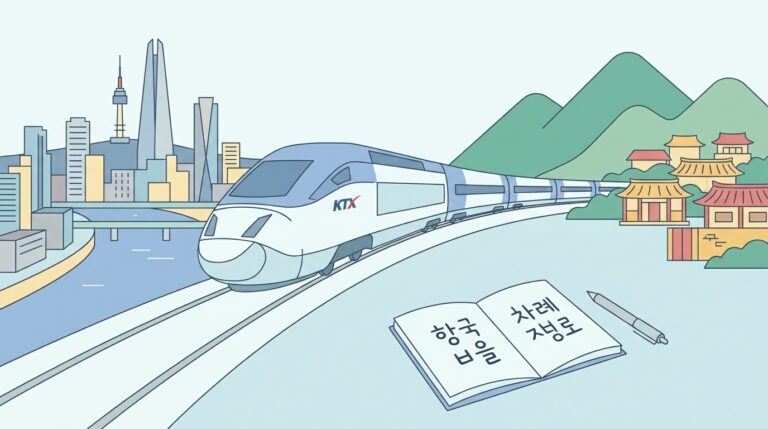
Phase 1: 공감 (Story Immersion Opening)
안녕하세요! 매일한글 에디터입니다.
Have you ever watched the acclaimed drama My Liberation Notes (나의 해방일지) and felt a deep ache in your heart watching the three siblings spend three exhausting hours every single day just commuting from their fictional rural town of Sanpo to Seoul? Or perhaps you tuned into Welcome to Samdal-ri (웰컴투 삼달리) and witnessed the agonizing burnout young people face when they feel that surviving in Seoul is their only path to success.
In contemporary South Korea, more than 50% of the entire national population lives packed inside the Seoul Capital Area (수도권), which accounts for just under 12% of the country’s land area. Meanwhile, hundreds of charming small towns and provincial cities across Gangwon, Jeolla, and Gyeongsang provinces face the existential threat of “regional extinction” (지역 소멸).
When foreign learners reach the advanced C1 level, they frequently hit a wall: you want to join serious university seminars, debate social issues with your Korean colleagues over dinner, or understand insightful documentary features on KBS, but textbook vocabulary like “대도시” (big city) and “시골” (countryside) falls flat. You want to articulate concepts like fair opportunities regardless of postal code, decentralization, and quality of life with the exact gravitas and nuance of a thoughtful native speaker.
This guide draws directly from real feedback from our advanced learners and international policy fellows who struggled to talk about urban concentration without sounding either overly academic or unintentionally condescending toward provincial residents. Let’s master the language of national balanced growth so you can articulate what truly makes a nation sustainable!
Phase 2: 핵심 표현 3선 심층 분석 (Core Expressions Deep Dive)
1. 서울 공화국 (Seoul gong-hwa-guk)
- Pronunciation: [Seoul gong-hwa-guk] (Sounds like Soh-ool gong-hwa-gook with a crisp, open ‘g’)
- Meaning: Literal: “The Republic of Seoul” | Real Nuance: A biting, satirical critique pointing out that South Korea functions almost like an independent city-state where capital, elite universities, infrastructure, and political power are monopolized by Seoul.
- K-Culture Moment: Commonly heard during late-night political talk shows like Ssulzun (썰전) or in investigative podcasts whenever housing prices in Gangnam surge while provincial train stations shut down.
- Editor’s Insight: Use this term when you want to highlight the structural inequality between the capital and the rest of the nation. It reflects critical self-awareness among Koreans regarding hyper-centralization.
- Situation Spectrum: Casual (✅ with close friends debating news) / Semi-formal (✅ podcast, op-ed, panel) / Formal (⚠️ slightly provocative in official governmental reports; use ‘수도권 과밀화’ instead)
- 🤔 Think About It: Does your home country concentrate political, cultural, and financial power into a single mega-capital, or is authority geographically dispersed? How does your native language satirize this divide?
2. 지방 소멸 (Ji-bang so-myeol)
- Pronunciation: [Ji-bang so-myeol] (Sounds like Jee-bahng soh-myuhl, ending with a soft lateral ‘l’ sound)
- Meaning: Literal: “Provincial Extinction” | Real Nuance: The severe demographic crisis where provincial counties and small cities lose youth to Seoul, leading to closing schools, vanishing maternity wards, and eventual community erasure.
- K-Culture Moment: Frequently referenced in variety programs like You Quiz on the Block (유 퀴즈 온 더 블럭) when visiting rural elementary schools that hold an entrance ceremony for just one solitary student.
- Editor’s Insight: “지방” (provinces/regions) in this phrase is a neutral administrative term, but paired with “소멸” (extinction), it carries intense civic urgency. Saying “지방 소멸 위기” (the crisis of regional extinction) instantly elevates your Korean to high-level policy fluency.
- Situation Spectrum: Casual (⚠️ slightly heavy for small talk) / Semi-formal (✅ book clubs, discussion circles) / Formal (✅ academic papers, business presentations)
- 🤔 Think About It: Why does the Korean language use such a dramatic word as “소멸” (extinction) rather than simply “인구 감소” (population decline)? What does this reveal about South Korea’s demographic urgency?
3. 정주 여건을 개선하다 (Jeong-ju yeo-geon-eul gae-seon-ha-da)
- Pronunciation: [Jeong-ju yeo-geo-neul gae-seon-ha-da] (Sounds like Juhng-joo yuh-guh-neul geh-sun-ha-da)
- Meaning: Literal: “To improve settlement conditions” | Real Nuance: Developing high-quality living environments—hospitals, cultural venues, public transit, and schools—so that people actually want to reside permanently in an area rather than just visit on vacation.
- K-Culture Moment: Used by local community leaders, regional architects, and urban planners featured in documentaries like Docu Prime (EBS 다큐프라임) advocating for sustainable regional ecosystems.
- Editor’s Insight: Beginners say “살기 좋게 만들다” (make it good to live), which is cute but colloquial. In policy or social critique, “정주 여건을 개선하다” demonstrates a sophisticated command of institutional C1 vocabulary.
- Situation Spectrum: Casual (🚫 sounds like a civil servant reading a brief) / Semi-formal (✅ serious dinner debate) / Formal (✅ board meetings, policy proposals)
- 🤔 Think About It: What constitutes true “정주 여건” for you: world-class healthcare, accessible public parks, or high-speed fiber internet?
Phase 3: 교과서 한국어 vs 진짜 한국어 (Textbook vs. Real Korean)
Situation 1: Describing an abandoned, quiet rural hometown
- 📖 교과서 한국어 (Textbook Korean):
“이 마을은 사람이 적어서 매우 조용합니다.”
(I maeureun sarami jeogeoseo maeu joyonghamnida. / This village is very quiet because there are few people.) - 🗣️ 진짜 한국어 (Real Natural C1 Korean):
“젊은 층이 빠져나가면서 동네가 거의 텅텅 비어가고 있어요.”
(Jeolmeun cheungi ppajyeonagamyeonseo dongnega geoui teongteong bieogago isseoyo. / As the younger generation has left, the neighborhood has virtually hollowed out.) - 💡 왜 다를까? (Why the difference?):
Textbook Korean uses dry, clinical adjectives like “조용하다” (quiet). Native speakers express the socio-economic reality using the evocative mimetic word “텅텅 비다” (completely empty/hollowed out) and the continuous verb form “-어 가고 있다” to show gradual structural decay.
Situation 2: Critiquing hyper-centralization in a debate
- 📖 교과서 한국어 (Textbook Korean):
“한국의 모든 자원은 서울에 모여 있습니다.”
(Hangugui modeun jawoneun Seoure moyeo isseumnida. / All resources of Korea are gathered in Seoul.) - 🗣️ 진짜 한국어 (Real Natural C1 Korean):
“수도권 쏠림 현상이 너무 심해서 국가적 비효율을 낳고 있어요.”
(Sudokwon ssolim hyeonsangi neomu simhaeseo gukgajeok bihyeoyureul nako isseoyo. / The polarization toward the capital region is so acute that it produces nationwide inefficiency.) - 💡 왜 다를까? (Why the difference?):
At the C1 level, natural phrasing avoids simplistic verbs like “모이다” (gather). Koreans favor dynamic socio-economic compounds such as “쏠림 현상” (skewing/polarization phenomenon) and actionable analytical terms like “국가적 비효율” (nationwide inefficiency).
Phase 4: K-Culture 딥다이브 & 비언어적 매너 (Deep Dive & Non-Verbal Nuance)
4-1. 눈치 (Nunchi) & Mindful Gestures
When discussing regions outside the capital area, linguistic nunchi is paramount. A historic faux pas committed by some city dwellers is treating any region outside Seoul as “시골” (the rustic sticks) or assuming people living in provincial cities like Daejeon, Gwangju, or Busan have simpler aspirations.
* Tone & Vocabulary Watch: Never label major regional cities as “시골”. Use “지역” (regions), “지방 거점 도시” (regional hub cities), or their specific names.
* Body Language: In panel discussions or group dinners, when a Korean speaker laments that their hometown is shrinking, slightly incline your head forward, drop the volume of your voice by 10%, and offer a gentle reflective nod (고개를 끄덕이다). Avoid grinning or calling small towns “so quaint and cute” (너무 아기자기해요)—to the locals fighting for their municipal hospital, depopulation is an existential challenge, not a rustic postcard aesthetic.
4-2. Cultural Code Analysis: Welcome to Samdal-ri vs. My Liberation Notes
In contemporary K-Drama, the narrative of the city is undergoing a seismic shift. For decades, the dominant trope was “상경” (migrating up to Seoul to achieve fame and fortune). But modern dramas reflect a counter-revolution. In Welcome to Samdal-ri, returning to Jeju is not a surrender; it is a rediscovery of community and mental well-being. Conversely, My Liberation Notes reveals the silent alienation of commuting from the provincial margins to the glitter of Seoul’s Gangnam and Yeouido.
Koreans no longer universally believe that living in Seoul guarantees happiness. The buzzword “워라밸” (Work-Life Balance) has collided with exorbitant housing prices, creating a growing hunger for decentralized living—provided that fair medical care, jobs, and social respect follow.
Phase 5: 실전 롤플레이 시나리오 (Real-Life Roleplay Scenario)
Setting: A cozy cafe in Gangneung overlooking the East Sea. You are speaking with Min-woo, a 34-year-old local startup founder who left a top tech company in Pangyo to launch a sustainable creative hub on the coast.
- Turn 1 (Min-woo):
“서울 살 때는 맨날 지옥철에 시달리면서 야근만 했는데, 강릉 오니까 비로소 숨통이 트여요.”
(Seoul sal ttaeneun maennal jiokcheore sidallimyeonseo yageunman haenneunde, Gangneung onikka biroso sumtongi teuyeoyo. / When I lived in Seoul, I suffered on the hellish subway and worked late every day, but coming to Gangneung has finally allowed me to breathe.)
🎭 따뜻한 커피 잔을 어루만지며 바다를 바라본다. -
Turn 2 (You):
“정말 부러워요. 하지만 지방에서 새로운 사업을 시작하시는 게 결코 쉽지는 않았을 텐데요?”
(Jeongmal bureowoyo. Hajiman jibangeseo saeroun saeobeul sijakhasineun ge gyeolko swipjineun anasseul tendeyo? / I truly envy you. But starting a new business in the provinces couldn’t have been easy at all, right?)
🎭 진지하게 경청하며 공감 섞인 미소를 짓는다. -
Turn 3 (Min-woo):
“솔직히 말하면 인프라가 턱없이 부족해요. 병원이나 문화생활은 차치하고라도, 함께 일할 청년 인재를 구하기가 하늘의 별 따기거든요.”
(Soljiki malhamyeon impeuraga teokeopsi bujokhaeyo. Byeongwonina munhwasaenghwareun chachihagorado, hamkke ilhal cheongnyeon injaereul guhagiga haneurui byeol ttagigeodeunyo. / Frankly, the infrastructure is woefully lacking. Setting aside hospitals and cultural life, recruiting talented young people to work here is like plucking a star from the sky.)
🎭 씁쓸한 표정으로 찻잔을 내려놓는다. -
Turn 4 (You):
“결국 정주 여건과 일자리가 맞물려 돌아가야 지역 소멸의 악순환을 끊을 수 있겠군요.”
(Gyeolguk jeongju yeogeongwa iljariga matmullyeo doragaya jibang somyeorui aksunhwaneul kkeuneul su ikketgunyo. / Ultimately, living conditions and job opportunities must turn in tandem to break the vicious cycle of regional extinction.)
🎭 고개를 깊이 끄덕이며 메모장에 요점을 적는다. -
Turn 5 (Min-woo):
“맞아요! 수도권 일극 체제가 지속되는 한, 지방 청년들은 계속 서울로 내몰릴 수밖에 없어요.”
(Majayo! Sudokwon ilgeuk chejega jisokdoeneun han, jibang cheongnyeondeureun gyesok Seoullo naemollil subakke eopseoyo. / Exactly! As long as the unipolar Seoul system persists, young people outside Seoul have no choice but to be pushed toward the capital.)
🎭 두 손으로 탁자를 가볍게 두드리며 열변을 토한다. -
Turn 6 (You):
“어디에 살든 품격 있는 삶을 누릴 권리가 보장되어야 국가의 지속 가능한 미래도 가능하겠죠.”
(Eodie saldeun pumgyeok inneun salmeul nuril gwolliga bojangdoeeoya gukgawi jisok ganeunghan miraedo ganeunghagetjyo. / Only when the right to enjoy a dignified life anywhere one lives is guaranteed can a sustainable future for the nation become possible.)
🎭 확신에 찬 눈빛으로 미소를 교환한다. -
Turn 7 (Min-woo):
“정확한 지적이세요. 그래서 저희 같은 로컬 크리에이터들이 현장에서 새로운 대안을 만들어보려고 발버둥 치는 중입니다.”
(Jeonghwakhan jijeogiseyo. Geuraeseo jeohui gateun rokeol keurieiteodeuri hyeonjangeseo saeroun daeaneul mandeureoboryeogo balbeodung chineun jung-imnida. / You hit the nail right on the head. That is why local creators like us are struggling on the ground to forge a viable alternative.)
🎭 자부심 넘치는 표정으로 창밖의 동해 바다를 가리킨다. -
Turn 8 (You):
“민우 님의 시도가 지역 균형 발전의 훌륭한 마중물이 되기를 진심으로 응원하겠습니다.”
(Min-woo nimui sidoga jiyeok gyunhyeong baljeonui hollyunghan majungmuri doegireul jinsimeuro eungwonhagesseumnida. / I genuinely cheer for your endeavor to become wonderful priming water for balanced regional growth.)
🎭 두 손으로 따뜻하게 감사의 목례를 건넨다.
🔀 인터랙티브 분기점 (Interactive Decision Point)
Min-woo asks: “어떻게 하면 서울에 몰려 있는 대기업이나 대학들을 지방으로 분산시킬 수 있을까요?” (How can we disperse major corporations and universities concentrated in Seoul to the regions?)
- Option A: “그냥 서울 아파트 가격을 더 올리면 사람들이 알아서 지방으로 내려가지 않을까요?”
Evaluation: Bad ❌ — Counter-productive. Hyper-inflating housing prices hurts working families without building provincial foundations. Shows a lack of policy understanding. - Option B: “단순히 시설을 이전하는 걸 넘어서, 파격적인 세제 혜택과 정주 여건 개선이 패키지로 맞물려야 실질적인 유인이 생길 것 같아요.”
Evaluation: Best ✅ — Flawless C1 articulation! Mentions systemic incentives (tax perks + settlement improvement) using sophisticated terminology (“실질적인 유인”). Min-woo will immediately respect your intellect. - Option C: “지방에 사는 사람들에게 그냥 매달 현금을 직접 지원해 주는 게 제일 빠를 텐데요.”
Evaluation: Risk ⚠️ — While direct cash grants are tested in some pilot policies, bringing this up abruptly risks sounding populist and ignores long-term industrial infrastructure.
Phase 6: 10초 감정 섀도잉 드릴 (Emotion Shadowing Drill)
Practice reading these sentences aloud, pausing at / and embedding the designated emotion:
[🤔 진지하고 단호하게 / Serious & Firm]
“수도권 일극 체제를 방치하면 / 결국 국가 전체가 / 활력을 잃고 맙니다.”
(Sudokwon ilgeuk chejereul bangchihamyeon / gyeolguk gukga jeonchega / hwallyeogeul ilko mamnida.)
(If we neglect the metropolitan unipolar system, / the entire nation will ultimately / lose its dynamic vitality.)-
[🥺 안타깝고 공감하며 / Empathetic & Sorrowful]
“태어나고 자란 고향을 떠나야만 / 꿈을 펼칠 수 있는 현실이 / 참 가슴 아파요.”
(Tae-eonago jaran gohyangeul tteonayaman / kkumeul pyeolchil su inneun hyeonsiri / cham gaseum apayo.)
(The reality where young people must leave their birthplace / simply to unfold their dreams / is truly heartbreaking.) -
[💡 희망을 담아 확신 있게 / Hopeful & Resolute]
“어디에 살든 / 공정한 기회가 보장될 때 / 비로소 진정한 선진국으로 / 도약할 수 있어요.”
(Eodie saldeun / gongjeonghan gihoega bojangdoel ttae / biroso jinjeonghan seonjingugeuro / doyakhal su isseoyo.)
(When fair opportunities are secured anywhere one lives, / only then can we leap forward / into a genuinely advanced society.)
Phase 7: K-Culture 미니 사전 (Mini Dictionary)
-
귀농·귀촌 (Gwi-nong · Gwi-chon)
Literal: Returning to farming · Returning to the countryside.
Usage: “귀농” means actively switching careers to agriculture; “귀촌” refers to moving out of metropolitan areas for quiet lifestyle reasons without necessarily farming. Widely seen in trendy TV series like Little Forest (리틀 포레스트). -
로컬 크리에이터 (Local Creator)
Literal: Regional/Local Creator.
Usage: High-frequency buzzword in contemporary South Korea. Describes creative entrepreneurs revitalizing regional food heritage, traditional liquor, architecture, and art in provincial towns instead of staying in Seoul. -
마중물 (Ma-jung-mul)
Literal: Priming water (the water poured into a dry pump to draw out groundwater).
Usage: Metaphorical C1 gem used in editorials to describe initial public investments or seed projects that trigger broader national revival: “이 프로젝트가 지역 활성화의 마중물이 되길 바랍니다.” -
삶의 질 (Sam-ui jil)
Literal: Quality of life.
Usage: The foundational phrase in balanced growth debates. Emphasizes that modern citizens value clean air, reasonable housing costs, and leisure time over raw financial metrics.
Phase 8: 여행자를 위한 생존 키트 (Traveler’s Survival Kit)
Provincial Travel Survival Phrases TOP 3
-
“이 지역 특산물로 만든 대표 메뉴가 뭐예요?”
(I jiyeok teuksanmullo mandeun daepyo menyuga mwoyeyo?)
Pro Tip: Locals outside Seoul take immense pride in regional specialties (e.g., Gangneung tofu, Jeonju bibimbap, Tongyeong oysters). Asking this question immediately wins radiant smiles from restaurant owners. -
“시내로 나가는 버스는 배차 간격이 어떻게 되나요?”
(Sinaero naganeun beoseuneun baecha ganggyeogi eotteoke doenayo?)
Pro Tip: In provincial counties, buses may run only once every 90 minutes. Always confirm “배차 간격” (dispatch interval) before heading out into the countryside. -
“이 근처에 가볼 만한 숨은 명소를 추천해 주실 수 있나요?”
(I geuncheoe gabol manhan sumeun myeongsoreul chucheonhae jusil su innayo?)
Pro Tip: Use “숨은 명소” (hidden gems) instead of touristic tourist traps; provincial taxi drivers love revealing secret scenic hilltops!
Editor’s Travel Note
- Essential Mobility Apps: When traveling beyond the capital, subway systems do not exist outside major metropolitan nodes. Make sure to complete your KORAIL Talk train booking app download well in advance to reserve KTX-Eum and SRT tickets. Furthermore, always utilize Naver Map intercity navigation and transit route planner rather than international mapping software, as local bus dispatch timetables in rural counties sync exclusively with domestic maps.
- Local Currency Advantage: Download the “지역사랑상품권” (Regional Love Gift Certificate) apps for specific provinces to receive 5-10% cashback discounts when dining at local restaurants.
Phase 9: “한 발 더 깊이” (Thought Essay)
In classical Korean philosophy, the bond with one’s hometown (고향) represented the spiritual anchor of human dignity. Yet the swift miracle of the Han River compressed three centuries of industrialization into half a century, pulling millions of families into high-rise Seoul apartments. Today, when half of all municipal regions face depopulation extinction warnings, the debate over regional development is no longer about asphalt roads or new industrial complexes—it is about psychological justice. When a society forces its youth to abandon their roots merely to survive, both the overcrowded capital and the lonely province suffer profound spiritual depletion.
💬 Your Turn: Does your native country suffer from hyper-concentration in a single capital city, or are opportunities equitably dispersed across regional hubs? Leave your thoughts in the comments below using the expression: “제가 사는 나라에서는 ~”!
Phase 10: FAQ & 오해 방지 (FAQ Schema)
Q: Is using the word “시골” (Sigol) considered offensive to Koreans?
A: It is not inherently an offensive slur, but context matters immensely. If you call an established regional metropolis like Daejeon or Daegu “시골”, it sounds uneducated and dismissive. In intellectual discourse, always substitute “시골” with “지방” (provinces/regions) or “농어촌 지역” (farming and fishing areas).
Q: Why do Korean youth insist on living in Seoul despite brutal housing costs?
A: Beyond simple lifestyle vanity, the Korean corporate ladder remains heavily concentrated in Seoul. The top headquarters, specialized medical clinics, prestigious cultural exhibits, and diverse career networks are overwhelmingly clustered in the capital, making relocation feel like a high-stakes gamble for ambitious youth.
Q: What is the official government terminology for balanced regional growth?
A: The standard administrative and constitutional term is “국가 균형 발전” (National Balanced Development). Pair this with “자치 분권” (Local Autonomous Decentralization) to discuss local regional governments gaining legislative and budgetary independence.
🚨 흔한 실수 (Common Mistakes) 경고판
- Calling all areas outside Seoul “시골”:
Wrong: 부산은 참 예쁜 시골이네요.
Correct Action: 부산은 매력적인 해양 거점 도시네요. (Busan is a charming maritime hub city.) - Confusing ‘지방 소멸’ with simple ‘인구 감소’:
Insight: “인구 감소” is demographic decline. “지방 소멸” highlights the complete disappearance of local government infrastructure and municipal extinction. - Using overly casual speech when discussing regional economic hardship:
Insight: Do not treat provincial economic struggle as entertainment or gossip. Frame it with respectful terms like “지역 활성화 과제” (regional revitalisation tasks).
Phase 11: 액션 미션 & 참여 유도 (Action Missions)
- 🥉 Bronze Mission (Solo Practice): Read the 3 sentences in the Phase 6 Shadowing Drill aloud three times. Focus on holding a serious, empathetic tone during the pause marks
/. - 🥈 Silver Mission (Social Engagement): Write a short comment below summarizing your thoughts using the term 서울 공화국 or 정주 여건.
- 🥇 Gold Mission (Real-World Application): The next time you chat with an advanced Korean friend or language exchange partner, ask this debate starter: “한국의 수도권 집중 현상을 해결하려면 정주 여건 개선이 먼저일까요, 아니면 일자리 분산이 먼저일까요?”
- 🎮 K-Culture Mission: Watch an episode of My Liberation Notes (나의 해방일지) and notice the color palette shift between the congested streets of Seoul and the quiet open fields of Sanpo.
Phase 12: 인터랙티브 퀴즈 챌린지 (Interactive Quiz)
1. Situational Judgment:
You are participating in a graduate seminar on urban planning. Which sentence expresses the most nuanced, respectful solution for regional revitalization?
* A) “지방 사람들에게 서울 아파트를 무료로 나눠줘야 합니다.”
* B) “단순한 재정 지원을 넘어 청년들이 머물 수 있는 양질의 일자리와 정주 여건을 동시에 구축해야 합니다.”
* C) “시골은 어차피 사라질 운명이니 대도시에만 투자하는 게 합리적입니다.”
2. Fill-in-the-Blank:
“수도권에만 모든 자원이 집중되는 ( ) 체제를 극복해야 지속 가능한 미래를 기대할 수 있다.”
3. True or False:
“The term ‘로컬 크리에이터’ (Local Creator) in South Korea generally refers to social media influencers taking selfies at famous Seoul landmarks.” (True / False)
🔍 정답 및 해설 펼치기 (Click to reveal answers & explanations)
1. 정답: B
해설: Sentence B uses advanced C1 concepts (“양질의 일자리”, “정주 여건 구축”) to address structural solutions rather than simplistic transfers or defeatist views.
2. 정답: 일극 (Il-geuk)
해설: “수도권 일극 체제” (Unipolar system concentrated in the capital region) is the precise macro-sociological phrase describing hyper-concentration.
3. 정답: False
해설: “로컬 크리에이터” specifically refers to innovative entrepreneurs and artisans cultivating unique regional culture, business models, and local products outside the capital metropolitan area.






