

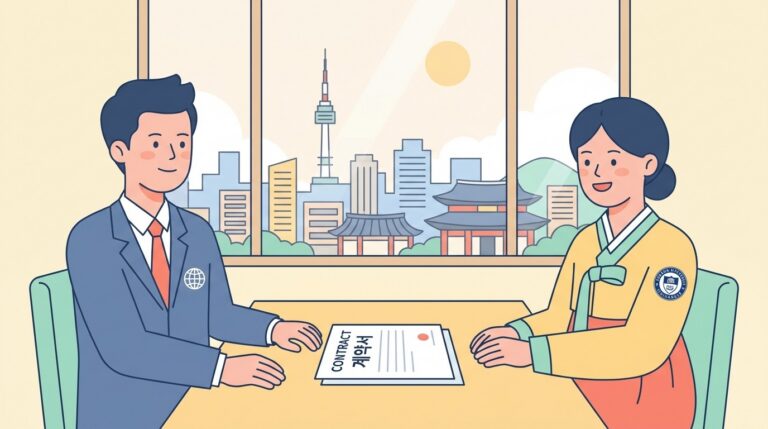
Mastering Joint Patent & Licensing Negotiations with Korean Universities
Phase 1: Empathy (Real-World Opening)
안녕하세요! 매일한글 에디터입니다. (Hello! I’m the Daily Hangul editor.)
Picture this: You are seated in a sunlit conference room overlooking the campus of a prestigious university in Seoul. Across the polished oak table sit the Director and legal counsel from the 산학협력단 (Sanhak-hyeopryeok-dan — University Industry-Academia Cooperation Foundation). Steam gently curls up from paper cups of roasted corn silk tea. The mood is courteous and polite, but the stakes couldn’t be higher. You’ve co-developed a breakthrough patent, and now comes the moment of truth: dividing the patent shares (지분율, jibunyul) and securing your company’s exclusive licensing rights (전용실시권, jeonyong-silsigwon).
If you’ve watched K-dramas like Start-Up or Search: WWW, you know that Korean corporate negotiations are an art form. Push too aggressively using transactional Western rhetoric, and you appear dismissive of the university’s academic prestige. Stay too passive, and your company risks losing exclusive rights to competitors. Many foreign business leaders tell us: “I know how to speak professional Korean, but in IP negotiations, I sound either bluntly demanding or vaguely unsure.”
This guide draws directly from real-world corporate licensing cases in South Korea. By mastering the C1-level diplomatic phrasing below, you will protect your company’s commercial interests while honoring the collaborative spirit (상생, sangsaeng) that Korean partners value most.
Phase 2: Core Expressions Deep Dive
1. 공동 특허 지분율을 합리적으로 조율하고자 합니다
- Pronunciation: Gongdong teokheo jibunyuleul hamnijeogeuro joyulhagoja hamnida. (Sound hint: Hamnijeogeuro is pronounced like “hum-knee-juh-geu-ro” due to nasalization, not “hap-ri”).
- Meaning: “We would like to reasonably adjust the joint patent ownership ratio.”
- K-Culture Moment: Reminiscent of Han Ji-pyeong in Start-Up, recalibrating shareholder equity during high-stakes investor dispute meetings.
- Editor’s Insight: The word 조율 (joyul) literally means tuning a musical instrument. By choosing 조율 over 협상 (hyeopsang, negotiation/bargaining), you position the meeting not as a financial clash, but as a fine-tuning of harmonious teamwork.
- Situation Spectrum: Casual 🚫 | Semi-formal ⚠️ | Formal ✅
- 🤔 Think About It: Why does Korean corporate culture prefer musical tuning metaphors (조율) over aggressive transaction verbs like “split” or “leverage”?
2. 사업화 촉진을 위해 전용실시권 부여 조건을 전제하고 싶습니다
- Pronunciation: Sae-eop-hwa chok-jin-eul wi-hae jeon-yong-sil-si-gwon bu-yeo jo-geon-eul jeon-je-ha-go sip-seum-ni-da.
- Meaning: “To accelerate commercialization, we would like to premise granting an exclusive license.”
- K-Culture Moment: The calculated corporate deal-making seen in legal thrillers like Vincenzo or Law School.
- Editor’s Insight: 전제하다 (jeonjehago, to premise/make a precondition) is a firm diplomatic lever. By anchoring your request in 사업화 촉진 (accelerating commercialization), you frame exclusive rights not as corporate greed, but as an essential engine to bring university research to life.
- Situation Spectrum: Casual 🚫 | Semi-formal ⚠️ | Formal ✅
🤔 Think About It: How does tying exclusive ownership to public benefit (commercializing research) alter the negotiation dynamics in heavily regulated East Asian economies?
3. 상호 윈윈할 수 있는 절충안을 모색해 보시죠
- Pronunciation: Sang-ho win-win-hal su inneun jeol-chung-an-eul mo-saek-hae bo-si-jyo. (Pronounce mo-saek with an open “o”).
- Meaning: “Let us explore a middle-ground compromise where both sides can win.”
- K-Culture Moment: The strategic board reconciliations typical of Queen of Tears or Misaeng.
- Editor’s Insight: In English, “compromise” occasionally carries a negative connotation of settling for less. In professional Korean, 절충안 (jeolchungan) implies seasoned maturity and intellectual flexibility. Combining it with 모색하다 (mosaekhada, to thoughtfully explore) shows tremendous respect.
- Situation Spectrum: Casual 🚫 | Semi-formal ✅ | Formal ✅
- 🤔 Think About It: How does Confucian business etiquette view collaborative compromise versus individual legal victory?
Phase 3: Textbook Korean vs. Real Korean
Situation 1: Suggesting a 60:40 patent ownership split
- 📖 교과서 한국어 (Textbook): 우리는 특허를 60대 40으로 나눠야 합니다. (Uri-neun teokheo-reul yuk-sip dae sa-sip-euro nanwoya hamnida. — “We must divide the patent 60 to 40.”)
- 🗣️ 진짜 한국어 (Real-World C1): 당사의 후속 상용화 투자 기여분을 감안하여, 지분율을 6대 4 수준으로 정리하면 어떨까 합니다. (Dangsa-ui husok sangyonghwa tuja giyeobuneul gamanhayeo, jibunyuleul yuk dae sa sujuneuro jeongrihamyeon eotteolkka hamnida. — “Taking into account our subsequent commercialization investment contributions, how would you feel about settling the equity ratio at around 6 to 4?”)
- 💡 왜 다를까? (Why the difference?): Saying 나눠야 합니다 (“must divide”) sounds combative. Elite corporate practitioners cite specific rationale (기여분, contribution) and use soft consultative sentence endings (~어떨까 합니다, “how about”).
Situation 2: Emphasizing the need for an exclusive commercial license
- 📖 교과서 한국어 (Textbook): 우리 회사만 독점적으로 이 기술을 써야 합니다. (Uri hoesaman dokjeomjeogeuro i gisuleul sseoya hamnida. — “Only our company must use this technology exclusively.”)
- 🗣️ 진짜 한국어 (Real-World C1): 대규모 양산 설비 투자의 리스크를 상쇄하기 위해, 일정 기간 전용실시권 설정이 선행되어야 합니다. (Daegyumo yangsan seolbi tuja-ui riseukeureul sangswaehagi wihae, iljeong gigan jeonyongsilsigwon seoljeongi seonhaengdoeeoya hamnida. — “To offset the risks of large-scale mass-production facility investment, establishing an exclusive license for a defined period must take precedence.”)
- 💡 왜 다를까? (Why the difference?): Using 독점 (monopoly/exclusive) triggers regulatory alarms with university boards. Using statutory terms like 전용실시권 (exclusive exploitation license) framed around risk mitigation (리스크 상쇄) sounds objective, lawful, and reasonable.
Phase 4: K-Culture Deep Dive & Non-verbal Etiquette
4-1. 눈치 (Nunchi) & Non-Verbal Strategy
In university tech negotiations, you are dealing with academics and civil administrators bound by strict statutory audits (감사, gamsa).
* Two-Handed Material Delivery: When handing over term sheets or draft MOUs, always support your right forearm with your left hand or hold documents with both hands.
* The Head Tilt of Consideration: When the university director makes an objection, avoid immediate counter-arguments. Pause for 2–3 seconds, gently nod with an audible “아, 교수님 말씀도 일리가 있습니다” (“Ah, Professor, your point is well taken”), before gently reframing your position. This validates their prestige (체면, chemyeon).
4-2. Cultural Code: The Sanhak Ecosystem
Under Korea’s Technology Transfer Promotion Act, university administrators face severe legal scrutiny if they surrender state-funded intellectual property below appraised market value. When negotiating with 산학협력단, never frame the deal as “helping the university cash out.” Instead, celebrate their academic breakthrough and highlight how your commercialization will produce academic royalties (경상기술료, running royalties) that fund subsequent doctoral research.
Phase 5: Real-World Roleplay Scenario
Setting: Executive Boardroom, Seoul National Research Foundation Building.
Characters:
* Alex Kim: Head of Strategy at a global med-tech startup.
* Director Park: Senior Licensing Director at the University Industry-Academia Cooperation Foundation.
Turn 1
Director Park: 이번 바이오센서 공동 연구 결과물이 기대 이상입니다만, 특허 지분 배분에서 산학단의 기본 가이드라인인 5대 5를 벗어나긴 어렵습니다.
(Ibeon baiosenseo gongdong yeon-gu gyeolgwamuri gidae isang-imnida-man, teokheo jibun baebun-eseo sanhakdan-ui gibon gaideurain-in o dae o-reul beoseonagin eoryeopseumnida.)
“The results of our joint biosensor research exceeded expectations, but departing from our foundation’s 50:50 default patent split guideline is difficult.”
🎭 Adjusts gold-rimmed glasses and taps the draft agreement with a pen.
Turn 2
Alex Kim: 교수님과 연구팀의 원천기술 개발 노고에는 깊이 공감하고 있습니다.
(Gyosunimgwa yeon-gutim-ui woncheongisul gaebal nogo-eneun gipi gonggamhago isseumnida.)
“We deeply appreciate the immense hard work of the professor and research team in developing the core original technology.”
🎭 Nods respectfully with palms flat on the table, maintaining open posture.
Turn 3
Alex Kim: 다만 임상 시험 및 인허가 과정에 소요되는 당사의 후속 투자 비용을 고려할 때, 지분율을 6대 4로 조율하는 것이 현실적입니다.
(Daman imsang siheom mit in-heoga gwajeong-e soyodoeneun dangsa-ui husok tuja biyong-eul goryeohal ttae, jibunyuleul yuk dae sa-ro joyulhaneun geosi hyeonsiljeogimnida.)
“However, considering our company’s subsequent investment costs required for clinical trials and regulatory licensing, adjusting the equity to 6:4 is realistic.”
🎭 Slides the financial forecast slide forward gently with both hands.
Turn 4
Director Park: 음, 6대 4라… 감사원 감사 규정상 국유 R&D 자산의 지분 축소는 상당한 소명 자료를 요합니다.
(Eum, yuk dae sa-ra… Gamsawon gamsa gyujeongsang gugyu R&D jasan-ui jibun chukso-neun sangdanghan somyeong jaryo-reul yohamnida.)
“Um, 6 to 4… Due to state audit regulations, reducing ownership of national R&D assets requires substantial justifying documentation.”
🎭 Leans back thoughtfully, arms loosely folded, nodding slowly.
Turn 5
Alex Kim: 충분히 이해합니다. 그렇다면 기술료 체계에서 산학단의 실익을 보전해 드리는 절충안은 어떠실지요?
(Chungbuni ihaehamnida. Geureotamyeon gisulryo chegye-eseo sanhakdan-ui sirigeul bojeonhae deurineun jeolchungan-eun eotteosiljiyo?)
“We fully understand. In that case, what would you think of a compromise that preserves the foundation’s net returns through the royalty structure?”
🎭 Softens facial expression into a warm, constructive smile.
Turn 6
Director Park: 실익 보전 방안이라면, 구체적으로 어떤 구상을 가지고 계십니까?
(Sirik bojeon bang-an-iramyeon, guchejeog-euro eotteon gusang-eul gajigo gyesimnikka?)
“If it preserves our tangible returns, what specific scheme do you envision?”
🎭 Leans forward with renewed interest.
Turn 7
Alex Kim: 지분율은 6대 4로 정하되, 초기 3년간 전용실시권을 부여해 주시면 경상기술료 요율을 1.5% 상향 조정하겠습니다.
(Jibunyureun yuk dae sa-ro jeonghade, chogi samnyeongan jeonyongsilsigwoneul buyeohae jusimyeon gyeongsang-gisulryo yoyureul il-jeom-o peosenteu sanghyang jojeonghagetseumnida.)
“While fixing the share at 6:4, if you grant us an exclusive license for the initial 3 years, we will raise the running royalty rate by 1.5%.”
🎭 Delivers the counter-offer with calm clarity and unwavering eye contact.
Turn 8
Director Park: 좋습니다. 상용화 리스크를 줄이면서 대학 발전 기금도 확보할 수 있는 합리적인 제안이군요. 긍정적으로 검토하겠습니다.
(Jotseumnida. Sangyonghwa riseukeureul jurimyeonseo daehak baljeon gigeumdo hwakbohal su inneun hamnijeogin je-an-igunyo. Geungjeongjeog-euro geomto-hagetseumnida.)
“Sounds good. That is a rational proposal that minimizes commercialization risk while securing university development funds. We will review it favorably.”
🎭 Unclasps hands and offers a firm, approving nod.
🔀 Interactive Scenario Branch Point
If Director Park still hesitates about granting exclusive licensing (전용실시권), how should you respond?
- Option A: “규정만 따지시면 저희는 상용화 프로젝트 전체를 철회할 수밖에 없습니다.” (If you only care about regulations, we will have to withdraw the entire project.)
- Option B: “해외 진출 시 글로벌 제약사와의 라이선스 계약을 위해서는 일정 기간 전용실시권 보장이 필수적입니다. 대신 최소 보증 기술료(Minimum Royalty) 조항을 신설하시죠.” (To secure sublicensing deals with global pharmaceutical partners, exclusive licensing is indispensable. Instead, let us institute a Minimum Royalty clause.)
- Option C: “그럼 전용실시권 대신 통상실시권으로 가되, 지분율을 8대 2로 주십시오.” (Then give us a non-exclusive license, but make the patent split 80:20 in our favor.)
💡 Branch Feedback
- Option A (Bad): Threatening project termination destroys relationship equity (신뢰) instantly and insults the university’s academic council.
- Option B (Best): Pure strategic diplomacy. It articulates global business requirements while presenting the university board with bulletproof risk insurance (최소 보증 기술료).
- Option C (Risk): Demanding an 80:20 split directly violates national university IP threshold boundaries and invites formal regulatory rejection.
Phase 6: 10-Second Emotion Shadowing Drill
Read aloud along the slash markers (/) for authentic business cadence!
[👔 진중하고 설득력 있게 / Serious & Persuasive]
“당사의 후속 투자 기여분을 감안하여 / 지분율을 6대 4 수준으로 / 조율하고자 합니다.”
(Dangsa-ui husok tuja giyeobuneul gamanhayeo / jibunyuleul yuk dae sa sujuneuro / joyulhagoja hamnida.)-
[🤝 정중하지만 확고하게 / Polite yet Resolute]
“초기 시장 진입 리스크를 고려할 때 / 최소 3년간의 전용실시권 설정이 / 선행되어야 합니다.”
(Chogi sijang jin-ip riseukeureul goryeohal ttae / choeso samnyeongan-ui jeonyongsilsigwon seoljeongi / seonhaengdoeeoya hamnida.) -
[💡 밝고 건설적인 톤으로 / Bright & Constructive]
“경상기술료 요율 조정을 통해 / 양측이 상호 윈윈할 수 있는 절충안을 / 찾아보시죠.”
(Gyeongsang-gisulryo yoyul jojeongeul tonghae / yangcheugi sangho win-win-hal su inneun jeolchungan-eul / chajabosijyo.)
Phase 7: K-Culture Mini Dictionary
-
산학협력단 (Sanhak-hyeopryeok-dan) | University Industry-Academia Cooperation Foundation
The independent legal entity within Korean universities managing research grants, industry collaborations, IP, and patents. -
전용실시권 (Jeon-yong-sil-si-gwon) | Exclusive License / Exclusive Right to Practice
A statutory right granting a single entity exclusive commercial exploitation of patented technology, excluding all third parties and even the licensor. -
통상실시권 (Tong-sang-sil-si-gwon) | Non-Exclusive License
A non-exclusive right where the university can grant practice rights to multiple companies simultaneously. -
경상기술료 (Gyeong-sang-gi-sul-ryo) | Running Royalties
Periodic royalty payments calculated as a percentage of commercial sales, distinct from 선급기술료 (upfront milestone fees).
Phase 8: Business Traveler’s Survival Kit
Top 3 Business Meeting Phrases
-
계약서 초안을 면밀히 검토한 후 회신드리겠습니다. (Geyakseo cho-aneul myeonmilhi geomtohan hu hoesindeurigetseumnida.)
“We will review the draft agreement meticulously and revert shortly.”
Pro Tip: Use this to buy time during tough negotiation pushes. -
연구진의 지식재산권을 존중하며 상생 모델을 구축하고자 합니다. (Yeon-gujin-ui jisik-jaesangwoneul jonjunghamyeo sangsaeng modereul guchukhagoja hamnida.)
“We respect the researchers’ IP and wish to build a co-prosperity model.” -
기술 이전 전담 변리사와 협의 후 다시 연락드리겠습니다. (Gisul ijeon jeondam byeonrisawa hyeobi hu dasi yeonrakdeurigetseumnida.)
“We will consult our dedicated patent attorney and reconnect with you.”
Editor’s Travel Note
When heading to R&D cluster hubs in Pangyo or Hongneung Bio Valley, avoid standard foreign rideshare apps. Instead, make sure you complete your Naver Map app download in advance for precise building-to-building navigation and campus transit stops. Also, business casual in Korean corporate R&D leans conservative: dark navy or charcoal suits, pristine dress shirts, and formal business card cases are mandatory.
Phase 9: Stepping Deeper (한 발 더 깊이)
In Western business jurisprudence, negotiations are often analyzed through the lens of game theory and rights optimization. In South Korea, however, industrial growth historically operated through the concept of 상생 (Sangsaeng — Co-prosperity). Universities are viewed not simply as vendors selling patents, but as sacred cradles of national knowledge. When you negotiate joint patent shares and exclusive terms, positioning your company as an engine that transforms academic ingenuity into national economic prestige will win far more concessions than legal pressure ever could.
💬 Your Turn: Have you ever negotiated an intellectual property or business agreement in your own culture? How do your local contract customs contrast with the Korean concept of 조율 (harmonious tuning)? Share your thoughts in the comments below!
Phase 10: FAQ & Common Mistakes
Q: Can a university researcher waive their patent shares directly during our meeting?
A: No. Under the Korean Invention Promotion Act, employee inventions (직무발명) developed with university infrastructure belong automatically to the Sanhak Foundation (산학협력단). Individual professors cannot legally sign away patent title on their own.
Q: What is the typical duration for an exclusive license (전용실시권) with Korean universities?
A: Typically 3 to 7 years. Because public universities must prevent technology shelving, exclusive rights usually come with performance milestones or transition clauses into non-exclusive licenses (통상실시권) if minimum commercial milestones are missed.
Q: Does signing an MOU (양해각서) legally secure our patent shares?
A: In Korea, standard MOUs are generally non-binding intent statements. You must execute a formal 공동연구 및 기술실시 계약서 (Joint R&D and Technology Exploitation Agreement) to legally enforce equity and licensing exclusivity.
🚨 Common Mistakes Warning Board
- ❌ Mistake 1: Demanding 100% unilateral patent assignment for university-developed R&D.
Correct Action: Korean state-funded institutions rarely permit complete assignment. Propose joint co-ownership (공동 특허) paired with exclusive licensing (전용실시권). - ❌ Mistake 2: Using informal Korean endings like ~하자 or ~해요 in negotiations.
Correct Action: Always employ high-formality deferential speech (하십시오체 like ~하고자 합니다, ~하시지요). - ❌ Mistake 3: Treating the IACF administrative manager as a mere clerk.
Correct Action: These officers hold significant statutory authority regarding state audit compliance. Treat them with executive respect (팀장님, 부단장님).
Phase 11: Action Mission & Engagement
- 🥉 Bronze Mission (Solo Mastery): Practice recording Phrase 1 and Phrase 2 from Phase 6 three times on your smartphone voice memo app, hitting the emotion marks.
- 🥈 Silver Mission (Community Share): Write down a hypothetical compromise sentence proposing a 70:30 patent split using 기여분을 감안하여 and post it in the comments below.
- 🥇 Gold Mission (Real-World Application): In your next corporate email with a Korean partner, swap out 협상 for 조율 and observe how warmly the tone shifts.
🎮 K-Culture Mission: Watch Episode 4 of the drama Start-Up or Episode 1 of Misaeng. Listen closely for how project proposals and resource negotiations are phrased between teams.
Phase 12: Interactive Quiz Challenge
1. Situational Judgment Quiz
The university team is worried about government audit scrutiny regarding public IP assets. Which phrase is the most appropriate and persuasive?
* A) 감사원 규정은 저희가 알 바 아닙니다. (We don’t care about audit rules.)
* B) 감사 규정상 우려하시는 지점을 해소할 수 있도록, 소명 데이터와 단계별 보상 조항을 계약서에 명시하시죠. (To address your audit concerns, let us incorporate explanatory data and staged compensation clauses in the contract.)
* C) 그냥 5대 5로 하고 나중에 몰래 계약서를 다시 씁시다. (Let’s sign 5:5 and rewrite it secretly later.)
2. Fill-in-the-Blank Quiz
초기 시장 진입 리스크를 고려하여, 5년간 타사의 진입을 제한하는 ( ) 부여를 전제하고자 합니다.
(Hint: The statutory term for exclusive exploitation license).
3. True or False Culture Quiz
In Korean corporate terminology, the word 조율 (tuning) implies weakness and should be avoided in serious executive legal agreements. (T/F)
👉 Click to reveal answers and explanations!
-
Answer: B
Explanation: Acknowledging their audit constraints and offering concrete contractual guardrails (소명 데이터) demonstrates professional competence and builds partnership trust. -
Answer: 전용실시권 (Jeon-yong-sil-si-gwon)
Explanation: This legal right guarantees an exclusive commercial monopoly over the patented technology for a designated period. -
Answer: False
Explanation: 조율 is the gold standard of high-level diplomatic coordination in Korean business, projecting sophistication and collaborative leadership.






