

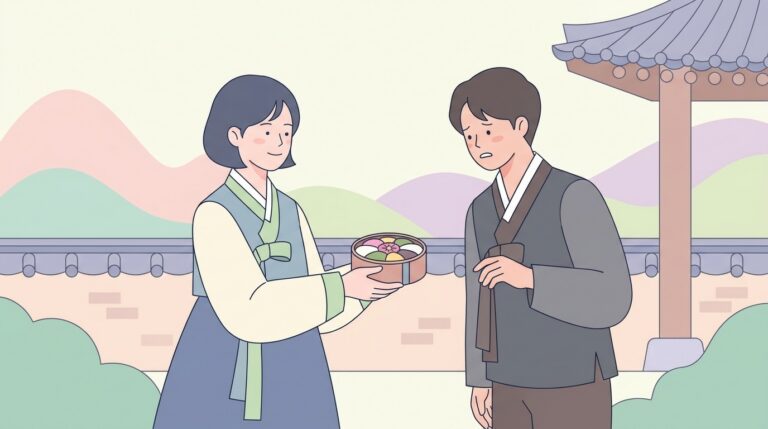
Why Koreans Feed Their Worst Enemies: The Genius of ‘Miun Nom Tteok’
Phase 1: 공감 (Empathetic Opening)
안녕하세요! 매일한글 에디터입니다. (Hello! I’m your Daily Hangul editor.)
Picture this quintessential K-drama workplace scene: You are seated in a glass-walled conference room in Yeouido. Across the mahogany table sits Manager Kang—the passive-aggressive colleague who consistently nitpicks your proposals, subtly takes credit for your team’s labor, and smiles while delivering backhanded compliments. Your pulse quickens. Every Western communication instinct screams at you to confront him directly, set strict boundaries, or cut him off with cold, professional indifference.
Suddenly, your respected Department Head leans in and murmurs an ancient piece of advice: “미운 놈 떡 하나 더 준다.” (Miun nom tteok hana deo junda — “Give an extra rice cake to the one you dislike.”) Instead of freezing Manager Kang out, your boss hands him a warm cup of premium traditional tea and compliments his sharp attention to detail.
At first glance, this sounds absurd. Why reward malice with kindness? Isn’t that toxic positivity, or worse, enabling toxic behavior? As advanced C2 learners of Korean, you are ready to peel back the literal surface of idiomatic language and uncover Korea’s profound, historical philosophy of social survival. This proverb is not naive submission. It is an elite psychological chess move—a masterclass in cheosesul (처세술, the art of social navigation) designed to neutralize hostility, preserve communal equilibrium, and disarm your adversary before conflict ever erupts. Based on feedback from international executives working in Seoul, mastering this paradoxical mindset is the exact threshold separating someone who merely speaks Korean from someone who truly understands the Korean psyche.
Phase 2: 핵심 표현 3선 심층 분석 (In-Depth Analysis of 3 Core Expressions)
1. 미운 놈 떡 하나 더 준다
- Pronunciation: [Mi-un nom tteok ha-na deo jun-da] (Pronunciation tip: Glide the ‘tteok’ with a sharp, tense double-t, rhyming loosely with the English ‘puck’ but punchier.)
- Meaning: Literal: “Give an extra rice cake to the rascal you hate.” / Real Nuance: “Neutralize hostility and assert moral superiority by showering your opponent with unexpected magnanimity.”
- K-Culture Moment: Seen in family melodramas when a mother-in-law gives the juiciest cut of beef to a son-in-law she secretly distrusts, disarming his defensiveness and keeping family peace intact.
- Editor’s Insight: The word nom (놈) is an informal, slightly derogatory term for a fellow or guy, showing unfiltered internal distaste. Yet the external action—giving tteok (historically a celebratory luxury grain delicacy)—is lavishly generous. It represents a deliberate contrast between internal judgment and external statesmanship.
- Situation Spectrum: Casual: ⚠️ | Semi-formal: ✅ | Formal: ✅ (Used as a philosophical quote in professional commentary)
- 🤔 Think About It: Does your native culture emphasize swift, decisive confrontation (e.g., “calling someone out”), or does it have an equivalent concept to “killing with kindness” as a strategic art form?
2. 웃는 낯에 침 못 뱉는다
- Pronunciation: [Un-neun na-che chim mot baen-neun-da] (Phonetic flow: “Oon-neun na-che chim mo-baen-neun-da”, where ‘chim’ sounds like ‘chime’ without the ‘e’.)
- Meaning: Literal: “One cannot spit on a smiling face.” / Real Nuance: “It is almost psychologically impossible for an adversary to escalate open aggression against someone who remains flawlessly gracious and smiling.”
- K-Culture Moment: In corporate thrillers, an ambitious deputy director smiles cordially while bowing to an arrogant auditor, leaving the auditor with zero social justification to attack him.
- Editor’s Insight: This proverb highlights the heavy social sanctions in Korean culture against anyone who attacks another person unprovoked. By maintaining a radiant, polite exterior (unneun nat), you force your antagonist to conform to civility or risk looking like a public brute.
- Situation Spectrum: Casual: ✅ | Semi-formal: ✅ | Formal: ✅
- 🤔 Think About It: How does maintaining an unyielding smile alter interpersonal power dynamics compared to physical or verbal aggression?
3. 속을 삭이다
- Pronunciation: [So-geul sa-gi-da] (Pronunciation tip: ‘Sak-i-da’ softens into ‘sa-gi-da’, mirroring the sensation of a sigh escaping your lips.)
- Meaning: Literal: “To ferment or digest one’s insides.” / Real Nuance: “To internalize, metabolize, and dissolve intense resentment or humiliation without letting it explode outward.”
- K-Culture Moment: An artisan or seasoned politician sitting in solitude with eyes closed, taking a deep breath after being publicly insulted, transforming emotional toxicity into patient focus.
- Editor’s Insight: Rooted in Korea’s culinary history of fermentation (sak-im), this expression treats bitter emotions like aged kimchi or vinegar. You do not suppress anger destructively (hwatbyeong); you slowly digest it until its sting matures into seasoned wisdom.
- Situation Spectrum: Casual: ✅ | Semi-formal: ✅ | Formal: ✅
- 🤔 Think About It: How does “fermenting” anger differ from the Western concept of emotional suppression?
Phase 3: 교과서 한국어 vs 진짜 한국어 (Textbook vs. Real-World Korean)
Situation 1: Deciding how to handle a colleague who constantly undermines your project.
- 📖 교과서 한국어:
- 저 팀원은 마음에 안 들지만 공적으로는 친절하게 대해야 합니다.
(Jeo timwoneun maeume an deuljiman gongjeogeoroneun chinjeolhage daehaeya hamnida.)
“I dislike that teammate, but I must treat them kindly in a professional capacity.”
- 저 팀원은 마음에 안 들지만 공적으로는 친절하게 대해야 합니다.
- 🗣️ 진짜 한국어:
- 얄밉긴 해도 미운 놈 떡 하나 더 주는 셈 치고, 이번 프로젝트 자료 먼저 챙겨줍시다.
(Yalmipgin haedo miun nom tteok hana deo juneun sem chigo, ibeon peurojekteu jaryo meonjeo chaenggyeojupsida.)
“They get on my nerves, but let’s consider it giving an extra rice cake to someone we dislike—let’s send them the project briefing first.”
- 얄밉긴 해도 미운 놈 떡 하나 더 주는 셈 치고, 이번 프로젝트 자료 먼저 챙겨줍시다.
- 💡 왜 다를까? Textbook Korean sounds like an ethical manual. Native C2 speakers rely on the idiomatic shorthand “~셈 치고” (considering it as…) combined with proverbs to convey pragmatic tactical concessions without sounding self-righteous.
Situation 2: Maintaining composure during an aggressive stakeholder negotiation.
- 📖 교과서 한국어:
- 기분이 몹시 상했지만 상대방에게 화를 내지 않고 참았습니다.
(Gibuni mopsi sanghaetjiman sangdaebangege hwareul naeji anko chamasseumnida.)
“I was very offended, but I endured without showing anger to the counterparty.”
- 기분이 몹시 상했지만 상대방에게 화를 내지 않고 참았습니다.
- 🗣️ 진짜 한국어:
- 속이 부글부글 끓었는데, 웃는 낯에 침 못 뱉는다고 끝까지 미소로 응대했죠.
(Sogi bugeulbugeul kkeuleonneunde, unneun nache chim mot baetneundago kkeutkkaji misoro eungdaehaetjyo.)
“My blood was boiling, but knowing no one can spit on a smiling face, I handled them with a smile right until the end.”
- 속이 부글부글 끓었는데, 웃는 낯에 침 못 뱉는다고 끝까지 미소로 응대했죠.
- 💡 왜 다를까? Advanced native Korean expresses internal bodily reactions (sogi bugeulbugeul) contrasted against disciplined social presentation (unneun nache chim mot baetneunda), creating a vivid narrative arc.
Phase 4: K-Culture 딥다이브 & 비언어적 매너 (Deep Dive & Non-Verbal Manners)
4-1. 눈치 (Nunchi) & The Strategic Poker Face
When practicing the philosophy of Miun nom tteok hana deo junda, your physical delivery is everything. If you offer a favor or concession with clenched jaws or an exaggerated, sarcastic grin, the gesture backfires as passive aggression.
* The Eyes: Maintain a relaxed, steady gaze. Do not narrow your eyes or look down prematurely, which conveys resentment or guilt. Keep your brow smooth.
* The Hands: When handing over an asset—whether it is a literal box of pastries during a team visit or an important presentation deck—always use two hands (yangson), lightly supporting your right forearm with your left hand. This physical show of deep respect elevates your stature.
* Voice Tone: Drop your pitch by half an octave. Speak in measured, calm tones. When dealing with difficult peers, calmness (yeoyoo, 여유) communicates unshakeable internal dominance.
4-2. Cultural Codes: The Agrarian Roots of Rice Cake Diplomacy
Why a tteok (rice cake)? In historical, agrarian Joseon, rice cakes required tremendous communal labor, scarce glutinous rice, and hours of steaming. Offering rice cake was an unmistakable marker of honor and hospitality. In tight-knit agricultural villages, ostracizing a troublesome neighbor risked lifelong feuds and damaged collaborative work like harvesting (pumasi). By gifting an extra rice cake to an antagonist, you achieved three things:
1. You publicly established your moral high ground (daeinbae, 대인배—a person of noble spirit).
2. You triggered the universal psychological obligation of reciprocity (jeong, 정).
3. You deprived them of any legitimate pretext to sabotage you.
In modern K-dramas (such as Misaeng or Agency), this manifests when top executives invite their internal adversaries to secluded Hanjeongsik (traditional multicourse) dinners instead of launching immediate smear campaigns.
Phase 5: 실전 롤플레이 시나리오 (Real-Life Roleplay Scenario)
Setting: A sleek startup incubator office in Teheran-ro, Gangnam. It is 9:30 PM.
Characters:
* You: Senior Product Lead.
* Team Leader Min (민 팀장): An insecure, hyper-critical department head who has been privately belittling your product launch to senior management.
민 팀장: 이번 기획안, 시장 분석이 너무 이상주의적이지 않아요? 현장 감각이 좀 부족한 것 같은데.
(Ibeon gihoegan, sijang bunseogi neomu isangjuuijeogiji anayo? Hyeonjang gamgagi jom bujokhan geot gateunde.)
🎭 [Crossing his arms, looking down at your proposal with a skeptical smirk]
“Doesn’t this proposal seem overly idealistic? It feels rather detached from reality on the ground.”
You: 민 팀장님께서 영업 현장을 오래 이끄셨으니 그렇게 보실 수도 있겠네요.
(Min timjangnimkkeseo yeongeop hyeonjangeul orae ikkeusyeosseumyeon geureoke bosil sudo itgenneyo.)
🎭 [Nodding with a calm, receptive expression, taking down notes]
“Given your extensive leadership on the sales front, Team Leader Min, I can understand why you might see it that way.”
민 팀장: 뭐… 기본기는 나쁘지 않은데, 내 부서 쪽 리소스를 쓰기엔 아직 위험 부담이 크단 뜻입니다.
(Mwo… gibongineun nappeuji aneunde, nae buseo jjok risoseureul sseugien ajik危险 budami keudan tteusimnida.)
🎭 [Tapping his fingers against the table, expecting defensive pushback]
“Well… your fundamentals aren’t bad, but committing my department’s resources still poses too great a risk.”
You: 맞습니다. 그래서 팀장님의 날카로운 피드백이 가장 필요했습니다.
(Matseumnida. Geuraeseo timjangnimui nalkkaroun pideubaegi gajang piryohaesseumnida.)
🎭 [Pulling out an artisanal pour-over coffee you brought specifically for him]
“You are entirely right. That is precisely why your sharp feedback was what I needed most.”
민 팀장: 어? 이건 뭐예요?
(Eo? Igeon mwoyeyo?)
🎭 [Startled, lowering his arms and looking at the warm tumbler]
“Huh? What is this?”
You: 야근하실 때 드시라고 팀장님 좋아하시는 원두로 내려왔습니다. 미운 놈 떡 하나 더 준다고 생각하시고 받아주세요.
(Yageunhasil ttae deusirago timjangnim joahasinun wonduro naeryeowasseumnida. Miun nom tteok hana deo jundago saenggakhasi-go badajuseyo.)
🎭 [Offering the tumbler with both hands, chuckling with warm, disarming humor]
“I brewed this with the single-origin beans you like, to help with your late-night work. Just think of it as ‘giving an extra rice cake to someone you find annoying,’ and please accept it.”
민 팀장: 하하! 참, 사람 무안하게 만드네. 알겠어요. 리소스 조정안, 내일 오전까지 다시 봐줄게요.
(Haha! Cham, saram muanhage mandeune. Algesseoyo. Risoseu jojeongan, naeil ojeonkkaji dasi bwajulgeyo.)
🎭 [Blushing slightly, laughing awkwardly as the tension evaporates]
“Haha! Wow, you really know how to make a man feel sheepish. Alright. Send over the resource adjustments—I’ll review them by tomorrow morning.”
You: 세심하게 검토해 주셔서 진심으로 든든합니다.
(Sesimhage geomtohae jusyeoseo jinsimeuro deundeunhamnida.)
🎭 [Bowing with genuine poise]
“Having you review it in detail makes me feel truly supported.”
🔀 인터랙티브 분기점 (Interactive Decision Point)
Imagine Min Team Leader scoffed at your proposal again right after turn 3. What is your move?
- Option A: “팀장님은 대안도 없으시면서 비판만 하시네요.” (You only criticize without offering alternatives.)
- ❌ Result (Bad): Escalates into an open power struggle. He blocks your departmental budget permanently.
- Option B: Acknowledge his tactical concern, bring him into the advisory circle, and gift him a small token of gratitude.
- 🏆 Result (Best): Classic Miun Nom Tteok execution. You disarm his ego, leaving him socially obligated to assist your project.
- Option C: Say nothing, nod silently, and send an email to the HR grievance committee the next morning.
- ⚠️ Result (Risk): Lacks nunchi. You avoid immediate tension but earn a reputation as someone incapable of navigating delicate corporate politics.
Phase 6: 10초 감정 섀도잉 드릴 (10-Second Emotion Shadowing Drill)
Practice these high-level sentences out loud. Match the emotional signposts and follow the rhythm slashes / for natural pauses.
[😌 여유롭고 능청스럽게 - Relaxed, playful, and strategically composed]
미운 놈 / 떡 하나 더 준다잖아요. / 먼저 웃으면서 챙겨주세요.
(Miun nom / tteok hana deo jundajanayo. / Meonjeo useumyeonseo chaenggyeojuseyo.)
“They say to give an extra rice cake to the rascal you dislike. Take care of him with a smile first.”-
[🧘 내면의 분노를 삼키며 단호하게 - Swallowing inner frustration with stoic dignity]
속은 부글부글 끓지만, / 웃는 낯에 침 못 뱉는 법이니까 / 한 번 더 품어 봅시다.
(Sogeun bugeulbugeul kkeuljiman, / unneun nache chim mot baetneun beobini-kka / han beon deo pumeo bopsida.)
“My blood is boiling inside, but since no one can spit on a smiling face, let’s embrace him one more time.” -
[🤝 상대의 무장해제를 이끌어내는 부드러움 - Soft, disarming warmth]
섭섭하셨던 점은 털어버리시고, / 이 떡 드시면서 / 다시 이야기하시죠.
(Seopseophasyeotdeon jeomeun teoreobeorisigo, / i tteok deusi-myeonseo / dasi iyagihasijyo.)
“Let’s shake off past grievances; enjoy this rice cake, and let’s speak again.”
Phase 7: K-Culture 미니 사전 (Mini Dictionary)
-
처세술 (Cheosesul) [Cheo-se-sul]
Translation: The art of social maneuvering / worldly wisdom.
Usage: Refers to navigating complicated workplace politics and interpersonal rivalries with sophisticated tact rather than brute force. -
속내 (Songnae) [Song-nae]
Translation: One’s hidden thoughts or true intentions.
Usage: Contrasted with geotchi-re (superficial pleasantries). A master of Korean diplomacy knows how to keep their songnae impenetrable while keeping external interactions cordial. -
대인배 (Dae-in-bae) [Dae-in-bae]
Translation: A magnanimous person; someone with broad shoulders and a noble heart.
Usage: The opposite of so-in-bae (a petty person). Used to praise someone who forgives petty attacks and offers unexpected generosity. -
감정 소모 (Gamjeong somo) [Gam-jeong so-mo]
Translation: Emotional drain / unnecessary psychological expenditure.
Usage: Often cited as the reason to practice this proverb: engaging in bitter arguments causes pointless gamjeong somo. Gifting a figurative “rice cake” settles the issue with zero wasted energy.
Phase 8: 여행자를 위한 생존 키트 (Traveler’s Survival Kit)
Survival Expressions TOP 3
- 제가 한턱 낼게요! (Jega hanteok naelgeyo!)
Meaning: “It’s on me! / I’ll treat you!”
Pro Tip: Use this to effortlessly melt awkward friction with local colleagues or service staff. - 신경 써 주셔서 감사합니다. (Singyeong sseo jusyeoseo gamsahamnida.)
Meaning: “Thank you for your thoughtful attention.”
Pro Tip: Perfect when someone has been difficult or nitpicky; this forces them to live up to the compliment. - 좋게 좋게 생각해요. (Joke joke saenggakaeyo.)
Meaning: “Let’s look at this constructively / peacefully.”
Pro Tip: The ultimate phrase to de-escalate brewing tensions in a group.
Editor’s Travel Note: Disarming Tension in Local Markets
When shopping in bustling traditional spots like Seoul’s Gwangjang Market or Busan’s Jagalchi Market, you might occasionally encounter an elderly vendor who seems stern or impatient with tourist questions. Don’t take it personally! Instead of walking away or looking visibly annoyed, try the Miun Nom Tteok mindset: smile warmly and say, “이모님, 인상이 너무 좋으셔서 홀린 듯 들어왔어요!” (“Auntie, your warm smile drew me right in!”). Watch their demeanor instantly transform as they slip extra free snacks (service, 서비스) into your bag.
Navigation Tip: Before setting out, install the Naver Map Application to seamlessly navigate local alleys, check bus arrival timings, and explore hidden culinary gems off the beaten tourist path.
Phase 9: “한 발 더 깊이” (One Step Deeper)
Traditional Korean houses (hanok) were built without high stone barriers between neighbors; sounds, smells, and arguments seeped through paper doors. In this hyper-proximate reality, burning bridges was not a personal indulgence—it was a community catastrophe. ‘Giving an extra rice cake’ is a philosophical recognition that your adversary cannot be eradicated; they must be integrated. It is the wisdom of an ancient society that understood an essential paradox: total victory in an argument is the quickest path to total isolation. Generosity is not a surrender; it is the ultimate armor of the resilient.
💬 Your Turn: Have you ever used radical kindness or strategic generosity to neutralize an uncomfortable rival at school or work? Share your experience in the comments below!
Phase 10: FAQ & 오해 방지 (FAQ & Common Mistakes)
Q: Does this proverb mean I should tolerate workplace bullying or abuse?
A: Absolutely not. In contemporary Korean society, severe toxicity, harassment, or abuse is classified as gapjil (갑질) and is subject to strict legal and corporate penalties. This proverb is a strategic framework for managing mundane rivalries, competing department heads, or difficult acquaintances—not illegal mistreatment.
Q: Can I use this proverb directly to someone’s face?
A: Be careful! Because it contains the derogatory noun nom (놈), jokingly saying “미운 놈 떡 하나 더 준다잖아요” to an elder or superior can sound offensive unless you share exceptional mutual rapport. Use it when speaking with peers, quoting it in self-deprecating humor, or reflecting on your own life philosophy.
Q: Is the ‘rice cake’ always literal?
A: Rarely! In modern times, the “rice cake” can be a sincere compliment, an introduction to a valuable contact, covering the bill for afternoon coffee, or assigning someone credit in a presentation.
🚨 Common Mistakes Warning Board
| Mistake | Why it Fails | Correct Action |
|---|---|---|
| Calling a client or boss nom (놈) | Nom is an informal, semi-insulting label. Using it near an elder will cause grave offense. | Use formal idiom: 호의를 베풀다 (ho-uireul bepulda, to extend goodwill). |
| Delivering the gesture with visible sarcasm | Rolling your eyes while offering a gift triggers humiliation, accelerating the conflict. | Maintain authentic yeoyoo (calm, gracious composure). |
| Assuming ‘giving a rice cake’ means being weak | Yielding your boundaries entirely invites further exploitation. | Give strategic warmth, but keep your professional boundaries firm. |
Phase 11: 액션 미션 & 참여 유도 (Action Missions)
- 🥉 Bronze Mission (Solo Shadowing): Record yourself saying Phase 6’s first shadowing sentence 3 times, mastering the transition from miun nom to chaenggyeojuseyo.
- 🥈 Silver Mission (Community Sharing): Leave a comment below using the structure: “얄밉긴 하지만, 미운 놈 떡 하나 더 주는 셈 치고…” applied to a funny daily scenario (e.g., sharing French fries with an annoying younger sibling).
- 🥇 Gold Mission (Real-world Execution): Identify someone in your professional or academic circle who has been frosty toward you. Tomorrow, bring them a coffee or write an appreciative note on their recent work. Notice how the social energy shifts.
🎮 K-Culture Mission: Watch Episode 1 or 2 of the legendary corporate K-drama Misaeng (Incomplete Life). Spot the subtle moments where seasoned managers buy drinks or tenderize relationships with difficult peers rather than engaging in shouting matches.
Phase 12: 인터랙티브 퀴즈 챌린지 (Interactive Quiz)
1. Situation Judgement
A project partner from another team consistently questions your schedule in public Slack channels. Which response best illustrates the proverb 미운 놈 떡 하나 더 준다?
* A) Mute them and refuse to answer their messages.
* B) Reply publicly: “You have great points; let’s feature your department’s priorities in the header of our next update.”
* C) Report their tone to executive leadership immediately.
👉 Click to Reveal Answer & Analysis
Correct Answer: B
By publicly giving them status and credit (the modern “rice cake”), you disarm their criticism, make them invested in your schedule’s success, and display unmistakable maturity to everyone in the channel.
2. Fill in the Blank
한국에서는 대인관계에서 갈등이 생겼을 때, 오히려 상대에게 호의를 베풀어 마음을 돌리는 지혜를 가리켜 “( ) 놈 ( ) 하나 더 준다”라고 합니다.
👉 Click to Reveal Answer & Analysis
Correct Answer: 미운 / 떡
Full sentence: “미운 놈 떡 하나 더 준다” (Give an extra rice cake to the rascal you dislike).
3. True / False Cultural Insight
True or False: Practicing this proverb requires you to genuinely love and respect your enemy from the bottom of your heart.
👉 Click to Reveal Answer & Analysis
Correct Answer: False!
The genius of the proverb lies in the gritty reality of the word 놈. You do not have to eradicate your private dislike. It is an art of behavioral statesmanship: feeling irritation inwardly while choosing an elegant, pragmatic action outwardly to protect your peace.







