

Phase 1: Empathy (Story-Driven Opening)
안녕하세요! 매일한글 에디터입니다. (Annyeonghaseyo! I am your Daily Hangul editor.)
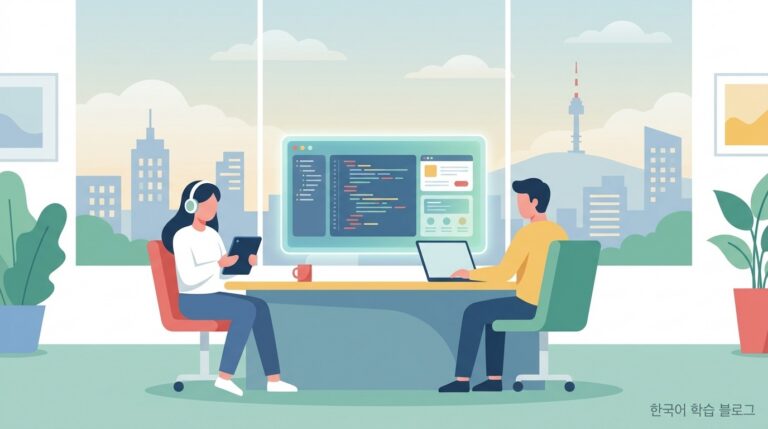
Picture this: You are sitting in an ultra-sleek open-plan office in Pangyo Techno Valley—the Silicon Valley of South Korea. You just poured yourself an iced Americano (아이스 아메리카노), the engine fuel of Korean tech workers. You spent three days perfecting a responsive button component in Figma. You hand it off to Min-jun, your lead frontend engineer, hoping for smooth sailing. An hour later, a Slack ping flashes: “디자이너님, 이거 마진 값이랑 폰트 토큰이 기존 컴포넌트랑 안 맞는 것 같은데요?” (Designer-nim, it seems the margin values and font tokens don’t match the existing components?) Your heart sinks. You try to explain in textbook Korean, but technical terms get tangled with honorifics, and what should have been a quick 5-minute sync turns into an awkward hour of miscommunication.
Every foreign designer and developer working in or collaborating with Korean teams runs into this exact wall. In fast-paced Korean IT environments where ppalli-ppalli (fast, agile execution) meets high design polish, bridging the gap between Figma and code requires more than just English tech buzzwords. Mastering standardized design system terminology and diplomatic handoff expressions protects product UX and eliminates exhausting friction between teammates. This guide draws from real-life handoff debriefs and corporate Korean language coaching to help you communicate like a trusted Pangyo tech insider.
Phase 2: Core Expressions Deep Dive
1. 소통 비용을 줄이다 (Sotong bi-yong-eul jurida)
- Pronunciation: [Sotong bi-yong-eul jurida] (So-tong bee-yong-eul joo-ree-da, sounds like “so-tone” + “bee-yong”)
- Meaning: Literal: “To reduce communication expense” / Actual Nuance: “To slash communication friction or back-and-forth overhead.”
- K-Culture Moment: In the tech startup drama Start-Up, mentors constantly emphasize building streamlined processes so founders stop wasting precious sprint cycles arguing over specs.
- Editor’s Insight: In Korean tech workplaces, time spent in unnecessary meetings or clarifying vague specs is viewed as a literal “cost” (비용). Framing your design system rules as a tool that reduces communication cost positions you as a strategic thinker rather than just an artist.
- Situation Spectrum: Casual: ⚠️ | Semi-formal: ✅ | Formal: ✅
- 🤔 Think About It: Does your native workplace culture treat miscommunication as an interpersonal issue or as a quantifiable operational expense, as Korean tech does?
2. 손발이 맞다 (Sonbari matda)
- Pronunciation: [Sonbari matda] (Son-bahr-ee maht-dah, rhyming with “lawn car-ee”)
- Meaning: Literal: “Our hands and feet match” / Actual Nuance: “To be completely in sync; to have seamless chemistry and teamwork.”
- K-Culture Moment: Often heard on variety shows like Running Man when partners clear a tandem mission effortlessly, or in corporate retrospectives when sprint releases deploy without bugs.
- Editor’s Insight: While Western teams often say “we’re on the same page,” Koreans emphasize physical harmony—hands and feet moving as one unit. Saying this to a developer after a clean handoff builds instant rapport.
- Situation Spectrum: Casual: ✅ | Semi-formal: ✅ | Formal: ⚠️
- 🤔 Think About It: Why do you think Korean idioms frequently use coordinated body parts (손/발, 눈치) to signify professional alignment?
3. 일관성을 유지하다 (Ilgwanseong-eul yujihada)
- Pronunciation: [Ilgwanseong-eul yujihada] (Eel-gwan-sung-eul yoo-jee-hah-da)
- Meaning: Literal: “To maintain consistency” / Actual Nuance: “To preserve design cohesion and brand integrity across user journeys.”
- K-Culture Moment: Used by strict K-Pop creative directors reviewing trainee album artwork, demanding that visual identity stays intact across physical merch, teaser videos, and mobile apps.
- Editor’s Insight: The noun 일관성 (consistency) paired with 유지하다 (to maintain/keep) is the holy grail argument when resisting ad-hoc visual tweaks from upper management.
- Situation Spectrum: Casual: ⚠️ | Semi-formal: ✅ | Formal: ✅
- 🤔 Think About It: In your native language, is “consistency” viewed as strict compliance or as user trust? In Korean tech, it represents reliability toward the user.
Phase 3: Textbook Korean vs. Real Korean
Situation 1: Explaining component reusability
- 📖 교과서 한국어 (Textbook): “이 디자인 요소를 여러 화면에서 다시 사용할 수 있도록 만드십시오.” (I dijain yosoreul yeoreo hwamyeon-eseo dasi sayonghal su itdorok mandeusipsio. / Make this design element reusable across multiple screens.)
- 🗣️ 진짜 한국어 (Real-World Tech): “이 컴포넌트는 다른 뷰에서도 재활용할 수 있게 공통 모듈로 빼둘게요.” (I keomponeonteuneun dareun byueseodo jaehwalyonghal su itge gongtong modyullo ppaedulgeyo. / Let’s decouple this component as a shared module so we can reuse it across views.)
- 💡 왜 다를까? (Why the difference?): Real Korean tech teams weave Konglish dev terms (컴포넌트, 뷰, 모듈) with the colloquial phrasal verb 빼두다 (to set aside / isolate into a separate module), which sounds proactive and natural.
Situation 2: Proposing a quick design-dev sync before handoff
- 📖 교과서 한국어 (Textbook): “우리가 만나서 디자인 규격에 대해 대화할 시간이 있습니까?” (Uriga mannaseo dijain gyugyeoge daehae daehwahal sigani itseumnikka? / Do we have time to meet and converse about design standards?)
- 🗣️ 진짜 한국어 (Real-World Tech): “핸드오프 전에 누락된 인터랙션 없는지 10분만 가볍게 싱크 맞춰볼 수 있을까요?” (Haendeo-opeu jeone nurakdoen inteoraeksyeon eomneunji sip-bunman gabyeopge singkeu matchwobol su isseulkkayo? / Could we do a quick 10-minute sync before handoff to make sure no interaction states were missed?)
- 💡 왜 다를까? (Why the difference?): Asking to “talk about standards” sounds heavy and intimidating. Using 가볍게 싱크 맞추다 (lightly sync up) lowers the stakes while precisely addressing missed micro-interactions.
Phase 4: K-Culture Deep Dive & Non-Verbal Manners
4-1. 눈치 (Nunchi) & Digital Etiquette in Korean Tech Handoffs
In Korean corporate environments, handoffs are not just files uploaded to a shared cloud drive; they are social handshakes. When presenting your Figma spec or reviewing a pull request:
* The Softening Particle (쿠션어): Avoid blunt assertions like “이거 틀렸어요” (This is wrong). Instead, use cushion language like “제가 확인했을 때는 ~로 보이는데, 확인 한번 부탁드려도 될까요?” (Based on what I checked, it appears to be ~, would you mind checking once?).
* Slack/Jira Punctuation: Ending a message with just a period can feel cold or displeased to Korean colleagues. Tech workers frequently soften their sentences with “~요!”, gentle tildes “~”, or the polite affirmative “넵!” (much friendlier than the rigid “네”).
* Screen-Sharing Posture: When navigating Figma during a sync, never rapidly scroll or snap zoom without announcing: “화면 조금 움직일게요!” (Moving the screen slightly!). This demonstrates mindful respect for your peer’s visual focus.
4-2. Cultural Code Analysis: The Pangyo “Coffee Chat” (커피챗)
Just like in K-Dramas like Search: WWW or Start-Up, informal alignment happens over iced lattes outside the meeting room. When developers and designers face fundamental friction over component edge cases, you rarely resolve it by trading combative comments on Figma frames. A team member will say, “커피 한잔하면서 얘기할까요?” (Shall we grab a coffee and talk?). In Korean business culture, stepping away to a cafe de-escalates professional disagreement into collaborative problem-solving.
Phase 5: Real-World Roleplay Scenario
Setting: A standing meeting table inside a collaborative workspace at Seongsu-dong. Min-jun, a meticulous Frontend Lead, is reviewing your newly standardized design tokens before a major design system migration.
- 민준 (Min-jun):
🎭 (Figma 화면을 진지하게 스크롤하며 안경을 올린다)“디자이너님, 이번에 새로 정리해 주신 버튼 컴포넌트 라이브러리 봤는데요. 상태별(Hover, Active, Disabled) 프로퍼티가 이전 버전이랑 조금 달라진 것 같아요.” (Dijaineonim, ibeone saero jeongrihae jusin beoteun keomponeonteu raibeureori bwanneundeyo. Sangtaebyeol peuropeotiga ijeon beojeon-irang jogeum dallajin geot gatayo. / Designer-nim, I looked at the new button component library you organized. The state properties like Hover, Active, and Disabled seem slightly different from the previous version.) - You:
🎭 (태블릿을 켜서 디자인 토큰 문서를 보여주며)“아, 네! 제품 전반의 일관된 사용자 경험을 지키기 위해서 글로벌 토큰으로 표준화했어요.” (A, ne! Jepum jeonban-ui ilgwandoen sayongja gyeongheom-eul jikigi wihaeseo geullobeol tokeuneuro pyojunhwahaesseoyo. / Ah, yes! To safeguard a consistent user experience across the product, I standardized them into global tokens.) - 민준 (Min-jun):
🎭 (턱을 괴고 코드를 머릿속으로 떠올리며)“표준화 취지는 너무 좋은데요. 당장 이번 스프린트에 하위 호환성을 깨트리지 않고 반영하려면 개발 리소스가 꽤 들겠어요.” (Pyojunhwa chwijineun neomu joeundeyo. Dangjang ibeon seupeurinteue hawi howanseong-eul kkaeteuriji anko banyeongharyeomyeon gaebal risoseuga kkwae deulgesseoyo. / I love the intent behind standardization, but supporting backward compatibility without breaking things this sprint will require quite a bit of dev resources.) - You:
🎭 (미소를 띠며 공감하는 톤으로)“맞아요, 마이그레이션 품이 많이 들 수밖에 없죠. 그래서 컴포넌트 단위를 잘게 쪼개서 점진적으로 배포할 수 있게 준비해 봤어요.” (Majayo, maigeureisyeon pumi mani deul subakke eopjyo. Geuraeseo keomponeonteu danwireul jalge jjogaeseo jeomjinjeogeuro baepohal su itge junbihae bwasseoyo. / Exactly, migration inevitably takes effort. That’s why I broke down component units into smaller atomic pieces so we can deploy incrementally.) - 민준 (Min-jun):
🎭 (눈이 살짝 커지며 반가운 표정으로)“오, 그렇게 나눠 두셨어요? 그러면 소통 비용도 훨씬 줄고 기존 코드 베이스에 붙이기도 수월하겠네요.” (O, geureoke nanwo dusyeosseoyo? Geureomyeon sotong biyongdo hwolssin julgo gijon kodeu beiseue buchigido suweolhaganneyo. / Oh, you separated them like that? That will drastically slash communication friction and make attaching to the legacy codebase much easier.) - You:
🎭 (고개를 끄덕이며 밝은 어조로)“네! 개발팀과 손발을 맞춰가면서 작업해야 불필요한 재작업이 없으니까요.” (Ne! Gaebaltimgwa sonbareul matchwogamyeonseo jageophaeya bulpiryohan jaejageobi eopseunikkayo. / Yes! Only when we work in lockstep with the dev team can we avoid unnecessary rework.) - 민준 (Min-jun):
🎭 (노트북을 덮으며 미소 짓는다)“좋습니다! 그럼 이번 주에 디자인 토큰 네이밍 룰만 짧게 맞춰보고 바로 컴포넌트 개발 들어갈게요.” (Jotsseumnida! Geureom ibeon jue dijain tokeun neiming rulman jjalge matchwobogo baro keomponeonteu gaebal deureogalgeyo. / Great! Let’s align on token naming rules briefly this week and jump straight into component development.) - You:
🎭 (감사의 목례를 하며)“감사합니다, 민준 님! 정리된 문서 슬랙으로 바로 쏴드릴게요!” (Gamsahamnida, Min-jun nim! Jeongridoen munseo seullaeg-euro baro sswadeurilgeyo! / Thank you, Min-jun nim! I will shoot the documented spec over on Slack right away!)
🔀 Interactive Choice Point
At turn 4, Min-jun worries about development overhead. How do you respond?
- Option A: “디자인 시스템 가이드라인이니까 개발팀에서 일정 맞춰서 다 구현해 주셔야 해요.” (It is our design system guideline, so the development team must implement it all according to schedule.)
- Feedback (Bad): High friction! Imposing design specs unilaterally alienates developers and creates departmental silos.
- Option B: “맞아요, 마이그레이션 품이 많이 들 수밖에 없죠. 그래서 컴포넌트 단위를 잘게 쪼개서 점진적으로 배포할 수 있게 준비해 봤어요.” (Exactly, migration takes effort. That’s why I prepared smaller atomic components for incremental deployment.)
- Feedback (Best): Empathetic, acknowledges technical constraints, and presents an actionable engineering-friendly compromise.
- Option C: “힘드시면 그냥 이전 디자인 그대로 두고 이번 작업은 건너뛸까요?” (If it’s difficult, should we just keep the old design and skip this work?)
- Feedback (Risk): Avoidance! Yielding completely abandons your design system vision and perpetuates technical and UX debt.
Phase 6: 10-Second Emotion Shadowing Drill
Practice these natural cadences. Slashes (/) indicate breath pauses.
[🤝 확신에 차서 / Confident & Collaborative]
“잘 만든 디자인 시스템은 / 제품의 일관성을 지켜 줄 뿐만 아니라 / 소통 비용을 획기적으로 줄여 줘요.”
(Jal mandeun dijain siseutemeun / jepum-ui ilgwanseong-eul jikyeo jul ppunman anira / sotong bi-yong-eul hoekgijeogeuro juryeo jwoyo.)
(A well-made design system / not only preserves product consistency / but dramatically slashes communication costs.)-
[💡 싹싹하고 배려심 넘치게 / Thoughtful & Proactive]
“핸드오프 전에 / 개발팀 의견 먼저 듣고 / 네이밍 룰 싱크 맞춰보고 싶어요.”
(Haendeo-opeu jeone / gaebaltim uigyeon meonjeo deutgo / neiming rul singkeu matchwobogo sipeoyo.)
(Before handoff / I’d love to hear the dev team’s input first / and sync up our naming rules.) -
[🙌 진심으로 든든해하며 / Grateful & Encouraging]
“덕분에 개발팀이랑 / 손발이 착착 맞아서 / 이번 스프린트 일정 맞출 수 있었어요!”
(Deokbune gaebaltimirang / sonbari chakchak majaseo / ibeon seupeurinteu iljeong matchul su isseosseoyo!)
(Thanks to you / our teamwork was in perfect rhythm / so we hit our sprint deadline!)
Phase 7: K-Culture Mini Dictionary
- 싱크를 맞추다 (Singkeureul matchuda)
- Translation: To sync up / align expectations.
- Context: A quintessential tech idiom combining English “sync” and Korean “맞추다” (to adjust/fit). Used constantly on Slack for impromptu check-ins.
- 핸드오프 (Haendeo-opeu)
- Translation: Designer-to-developer spec handoff.
- Context: Borrowed from English, but treated as a milestone noun in Seoul startups: “핸드오프 미팅” (handoff meeting) or “핸드오프 완료” (handoff complete).
- 품이 들다 (Pumi deulda)
- Translation: To require laborious manual effort / sweat equity.
- Context: Rooted in traditional Korean collective labor exchange (품앗이). Tech leads use it to describe tasks requiring heavy repetitive engineering.
- 삽질 (Sap-jil)
- Translation: Literal: Shoveling dirt / Actual: Wasted effort barking up the wrong tree.
- Context: Highly common startup slang: “토큰 정의 안 하고 개발했다가 이틀 동안 삽질했네요” (We didn’t define tokens and ended up wasting two days on futile rework).
Phase 8: Expat Tech Professional’s Survival Kit
Top 3 Workplace Survival Lines
- “피그마 링크 전달드렸어요! 코멘트 편하게 남겨 주세요.”
(Pigeuma ringkeu jeondaldeuryeosseoyo! Komenteu pyeonhage namgyeo juseyo.)
Pro Tip: Saying “편하게 남겨 주세요” (feel free to leave comments comfortably) opens a welcoming, non-defensive channel for engineers. - “컴포넌트 상태값(State) 누락된 것 있는지 확인 부탁드립니다.”
(Keomponeonteu sangtaegat nurakdoen geot inneunji hwagin butakdeurimnida.)
Pro Tip: Pinpoints micro-states (hover, disabled, error) before coding starts, preventing sprint bottlenecks. - “스프린트 회고 때 디자인 부채(Design Debt) 안건으로 올려볼게요.”
(Seupeurinteu hoego ttae dijain buchae angeoneuro ollyeobolgeyo.)
Pro Tip: Demonstrates B2 maturity by formalizing design debt during retrospectives rather than grumbling informally.
Editor’s Seoul Tech Life Note
If you work or interview in Korea’s digital scene, install the 원티드(Wanted) 채용 플랫폼 to explore local tech stacks and read design system case studies published by Korean unicorn teams like Toss and Woowa Brothers. When meeting remote teammates in Pangyo or Gangnam, use 카카오맵 지도 앱 rather than foreign map engines to locate complex techno-valley campus towers and basement cafeteria sync lounges.
Phase 9: “One Step Deeper” (Reflective Humanities Essay)
In Western software design, documentation often functions as an explicit contract: “Here is the spec; execute it according to ticket scope.” However, Korean work culture is built upon the foundational concept of 우리 (Uri – We/Our). When a Korean engineer looks at a design system, they are not merely looking at UI assets; they are gauging whether the designer acknowledges shared team responsibility. By articulating how component standardization saves your teammate’s engineering bandwidth (소통 비용을 줄이다), you transform an abstract design guideline into an act of communal solidarity. Design systems in Korea succeed not by corporate mandate, but when teams feel that mutual empathy has entered the code.
💬 Your Turn: In your experience, do engineering and design teams in your country collaborate as contractual partners or as an interconnected “우리”? Share your story in the comments below!
Phase 10: FAQ & Avoiding Misunderstandings
Q: Can I use “손발이 맞다” with my team manager or C-level executive?
A: It is best used peer-to-peer or by a senior addressing a team. If speaking upward to an executive, rephrase more deferentially: “개발팀과 긴밀하게 협업하여 진행하고 있습니다” (We are collaborating closely with the engineering team).
Q: What is the polite way to reject a developer’s request to break component standardization?
A: Use the validation-first formula: “어떤 말씀이신지 충분히 이해했습니다. 다만 제품 전반의 일관성과 유지보수 비용을 고려했을 때, 기존 토큰 규칙을 준수하는 것이 장기적으로 유리할 것 같습니다.” (I completely understand your point. However, considering product consistency and long-term maintenance costs, abiding by established token rules seems more advantageous).
Q: Why do Korean developers call designers “디자이너님” instead of using first names?
A: Unless your company enforces an English nickname policy (like Kakao or Coupang), the suffix -님 (nim) is the indispensable gold standard for professional respect across functional boundaries.
🚨 Common Mistakes Alert
- Mistake: Saying “이거 제 디자인이니까 손대지 마세요” (This is my design, don’t touch it).
- Correct Action: Reframe ownership around users: “사용자 경험의 일관성을 위해 컴포넌트 규격을 유지해 주시면 좋겠습니다.” (To preserve user consistency, it would be great if we maintain component standards.)
- Mistake: Overusing cold honorifics like “~하십시오” on Slack.
- Correct Action: Adopt modern tech semi-formal tone: “~해 주시면 감사하겠습니다!” or “~확인 부탁드려요!”
- Mistake: Translating technical terms literally into Hanja-based Korean when Konglish is standard.
- Correct Action: Use natural industry terms (컴포넌트, 토큰, 핸드오프, 상태값) instead of archaic dictionary translations.
Phase 11: Action Missions
- 🥉 Bronze Mission (Solo Practice): Read the Phase 6 Emotion Shadowing Drill aloud 3 times, focusing on natural pauses at the slashes (
/). - 🥈 Silver Mission (Social Engagement): Write a Slack message in Korean asking to sync with a teammate using 가볍게 싱크 맞추다, and share your draft sentence in our comments.
- 🥇 Gold Mission (Real-World Execution): In your next Figma file or design documentation, write your component release notes using the phrases 일관성 유지 and 소통 비용 절감.
- 🎮 K-Culture Mission: Watch an episode of the K-Drama Start-Up (스타트업) or Search: WWW (검색어를 입력하세요 WWW) and listen for how tech colleagues address each other using ~님 during design and sprint debates.
Phase 12: Interactive Quiz Challenge
Test your real-world tech Korean instincts!
Question 1 (Context Evaluation)
You want to explain to your engineering lead that standardizing components will eliminate back-and-forth arguments during development. Which phrase works best?
* A) 우리 싸우지 말아요 (Let’s not fight)
* B) 소통 비용을 획기적으로 줄여 줘요 (It drastically reduces communication friction)
* C) 개발팀이 편하게 일해야 해요 (Dev team needs to work comfortably)
Question 2 (Fill in the Blank)
“컴포넌트 라이브러리를 정리하면 제품의 일관된 사용자 경험을 [ ] 수 있습니다.”
* A) 지켜 줄 (protect / safeguard)
* B) 숨겨 둘 (hide / conceal)
* C) 잊어버릴 (forget)
Question 3 (True or False Cultural Quiz)
In modern Korean tech startups, calling a developer “개발자” directly without attaching their name and -님 (e.g., just saying “Hey 개발자”) is considered polite and casual.
* True / False
👉 정답 및 해설 보기 (Click to see Answer & Explanation)
- Question 1 Answer: B. 소통 비용을 줄이다 is the exact professional phrase Korean tech companies use to denote reducing process friction and miscommunication overhead.
- Question 2 Answer: A. 지켜 줄 (from 지키다, to guard/protect). Standardized systems protect and uphold the consistent user experience.
- Question 3 Answer: False! Addressing someone by their raw job title without -님 or their name is considered very rude. Always say 민준 님 or 개발자님!







