

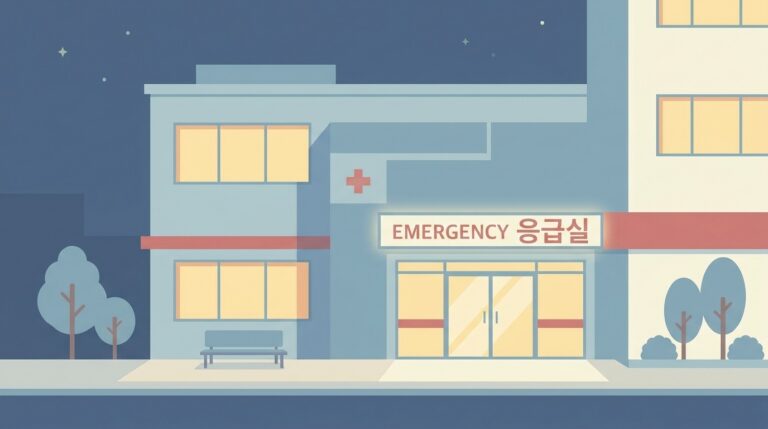
Navigating a Korean Night ER: What to Say When Symptoms Worsen
Phase 1: 공감 (Story-Immersive Opening)
안녕하세요! 매일한글 에디터입니다.
Imagine this: It is 2:00 AM in Seoul. You were discharged from an emergency room just three hours ago with a blister pack of cold medicine, feeling confident that the worst had passed. But as you lie in your Airbnb bed, your forehead begins burning, your teeth chatter uncontrollably, and you feel a wave of dizziness whenever you stand up.
If you have ever watched the medical K-drama Hospital Playlist (슬기로운 의사생활), you know how fast-paced Korean emergency centers operate. Doctors speak rapidly, triage monitors beep without stopping, and patients move through tests with military efficiency. In moments like these, panic can freeze your English, let alone your beginner-level Korean. When the night-duty nurse handed you your paperwork earlier, they probably gave you a vital instruction: “증상이 다시 심해지거나 고열이 나면 바로 병원으로 다시 오세요” (If your symptoms get worse again or you develop a high fever, come right back to the hospital).
Misunderstanding discharge warnings is one of the most common complaints among expats and travelers. This guide is crafted directly from clinical interpretation cases and foreign patient feedback. By mastering just a few structured survival phrases at the A2 level, you can clearly convey your emergency, request government-supported phone interpretation, and safely navigate Korea’s world-class night healthcare system without breaking into a cold sweat.
Phase 2: 핵심 표현 3선 심층 분석 (3 Essential Expressions)
1. 증상이 다시 심해지면 바로 오세요. (Jeungsangi dasi simhaejimyeon baro oseyeo.)
- Pronunciation: [Jung-sang-ee dah-shee shim-hae-jee-myeon bah-roh oh-seh-yoh] (Think: “Jung-sang” sounds like a rhythmic gong ring, “baro” rhymes with “tah-roe”).
- Meaning: Literal: “If symptoms worsen again, come immediately.” / Nuance: Standard, protective medical instruction urging you not to wait until daytime if your condition deteriorates.
- K-Culture Moment: The classic post-discharge scene in medical dramas where a caring ER resident hands discharge papers to a stubborn protagonist while emphasizing that recovery is not always linear.
- Editor’s Insight: The connective ending -(으)면 means “if/when”, while 심해지다 combines 심하다 (severe) with -아/어지다 (to become). When paired with 바로 (right away / immediately), it signals urgency: do not hesitate to revisit.
- Situation Spectrum: Casual 🚫 | Semi-formal ✅ | Formal ✅
- 🤔 Think About It: In your home country, do ER doctors tell you to call an ambulance first, or do they advise you to walk right back in? Korea’s medical accessibility often favors direct walk-in return visits.
2. 열이 계속 안 떨어져요. (Yeori gyesok an tteoreojyeoyo.)
- Pronunciation: [Yeo-ree gyeh-sohk ahn tteo-ruh-jyeo-yoh] (Pronounce “tteo” like a snappy, double-t ‘t-toe’ sound, like in ‘teriyaki’ with intense breath control).
- Meaning: Literal: “Fever continuously does not fall.” / Nuance: “The fever just won’t break despite taking medication.”
- K-Culture Moment: A parent or partner pacing in an ER reception lobby, showing the digital thermometer screen to the triage nurse with anxious eyes.
- Editor’s Insight: 떨어지다 literally means to drop. Koreans rarely say “I have high fever” during follow-up visits; instead, they describe whether the fever has fallen (열이 떨어지다) or climbed (열이 오르다). Using 안 떨어져요 immediately justifies an emergency re-evaluation.
- Situation Spectrum: Casual ⚠️ | Semi-formal ✅ | Formal ✅
- 🤔 Think About It: Why does Korean describe fever as an active entity that “rises” or “falls” rather than just a state you “have”?
3. 의료 통역을 요청할 수 있나요? (Uiryo tong-yeogeul yocheonghal su innayo?)
- Pronunciation: [We-ryoh tong-yuh-geul yoh-chung-hahl soo een-nah-yoh?] (Think: “We-ryo” as “we-rio”, and “tong-yeok” rhyming with “song-book”).
- Meaning: Literal: “Can I request medical interpretation?” / Nuance: A polite, professional inquiry to connect with the 1339 medical hotline or on-call translator.
- K-Culture Moment: An international traveler showing a translation app at the desk of an emergency center, while the triage staff swiftly dials the Korea Tourism Organization or 1339 helpline on speakerphone.
- Editor’s Insight: -(으)ㄹ 수 있나요? is the gold standard A2 structure for asking “Can I / Is it possible to…”. Memorizing this stem allows you to ask for anything politely in Korea without sounding demanding.
- Situation Spectrum: Casual 🚫 | Semi-formal ✅ | Formal ✅
- 🤔 Think About It: Many tourists assume ER staff speak fluent English. While Korean doctors read English medical literature with ease, spoken triage during high-stress night shifts is far smoother with three-way phone interpretation.
Phase 3: 교과서 한국어 vs 진짜 한국어 (Textbook vs. Real-Life)
Situation 1: Telling the triage staff your condition got worse
- 📖 교과서 한국어 (Textbook Korean): 저의 질병 상태가 악화되었습니다. (Jeoui jilbyeong sangtaega akhwadoeeossseumnida. / My disease condition has worsened.)
- 🗣️ 진짜 한국어 (Real-Life Korean): 약을 먹었는데 더 아파요. (Yageul meogeonneunde deo apayo. / I took the medicine, but it hurts more.)
- 💡 왜 다를까? (Why the difference?): Real-world emergency speech relies on simple, direct action-cause structures (-는데, but/and). Formal Sino-Korean nouns like “악화” (deterioration) feel robotic when you are sitting in pain.
Situation 2: Asking for emergency English support
- 📖 교과서 한국어 (Textbook Korean): 영어 통역 서비스를 제공해 주실 수 있으십니까? (Yeongeo tong-yeok seobiseureul jegonghae jusil su isseusimnikka? / Could you provide an English interpretation service?)
- 🗣️ 진짜 한국어 (Real-Life Korean): 영어 통역 전화 연결해 주세요. (Yeongeo tong-yeok jeonhwa yeongyeolhae juseyo. / Please connect me to an English interpreter by phone.)
- 💡 왜 다를까? (Why the difference?): Korean night emergency rooms rely on instant third-party telephone interpretation (such as 1339). Asking directly to connect (연결해 주세요) gets immediate action.
Phase 4: K-Culture 딥다이브 & 비언어적 매너 (Culture & Etiquette)
4-1. 눈치 (Nunchi) & Gestures in the Emergency Room
When you re-enter a Korean ER at night, keep your non-verbal cues precise. Avoid shouting or dramatic pacing, which staff may interpret as emotional agitation rather than clinical escalation.
* The Two-Handed Paper Handover: Hand your previous prescription (처방전) or hospital discharge card (퇴원 영수증) using both hands. This immediately tells the desk that you are a return patient, bypassing preliminary registration bureaucracy.
* Body Pointing with Respect: Instead of pointing with a single index finger to where it hurts, lightly place an open palm on the affected area (e.g., abdomen, temple) while bowing your head slightly (목례) to the triage nurse.
4-2. Cultural Code: The KTAS Triage System & 24/7 Pharmacies
Korean emergency departments run on the KTAS (Korean Triage and Acuity Scale) from Level 1 (Resuscitation) to Level 5 (Non-urgent).
1. ER Surcharges (응급관리료): If you visit an emergency room with a mild fever (Level 4 or 5), your National Health Insurance co-pay or tourist out-of-pocket fee will include an administrative emergency surcharge. However, when a fever spikes over 38.5°C (101.3°F) accompanied by chills or abdominal pain, you qualify for acute care.
2. Convenience Store Basics vs. ER: Koreans often try 안전상비의약품 (basic over-the-counter medicine like Tylenol or cold medicine) from a convenience store (CU, GS25, 7-Eleven) first. If a doctor told you “증상이 심해지면 바로 오세요”, it means your initial assessment placed you at risk of rapid escalation—so do not substitute convenience store pills for a hospital checkup.
Phase 5: 실전 롤플레이 시나리오 (Real-Life Roleplay)
Setting: Seoul National University Hospital Emergency Medical Center (응급의료센터), 2:30 AM.
Characters: Nurse Kim (efficient, sharp-eyed triage nurse) & Alex (A2 Korean learner visiting Korea).
- Turn 1 (Alex): 저기요, 아까 낮에 진료받았는데요. (Jeogiyo, akka naje jinryobadanneundeyo.)
- 🎭 Holds out the hospital discharge envelope with both hands, looking tired.
- “Excuse me, I was treated here earlier today…”
- Turn 2 (Nurse Kim): 네, 환자분 등록번호 보여주세요. 어디가 불편하세요? (Ne, hwanjabun deungnokbeonho boyeojuseyo. Eodiga bulpyeonhaseyo?)
- 🎭 Scans the barcode on the paperwork and looks directly at Alex.
- “Yes, please show me your patient ID number. What is bothering you?”
- Turn 3 (Alex): 약을 먹었는데 열이 계속 안 떨어져요. 39도예요. (Yageul meogeonneunde yeori gyesok an tteoreojyeoyo. Samsipgudoyeyo.)
- 🎭 Shows the smartphone screen with a photo of the thermometer showing 39.1°C.
- “I took the medicine, but the fever won’t go down. It’s 39 degrees.”
- Turn 4 (Nurse Kim): 오한이나 구토 증상도 있으신가요? (Ohan-ina guto jeungsangdo isseusingayo?)
- 🎭 Grabs a digital ear thermometer to verify the temperature immediately.
- “Do you also have chills or vomiting symptoms?”
- Turn 5 (Alex): 네, 너무 춥고 어지러워요. 혹시 의료 통역 전화 연결해 주실 수 있나요? (Ne, neomu chupgo eojireowoyo. Hoksi uiryo tong-yeok jeonhwa yeongyeolhae jusil su innayo?)
- 🎭 Shivers slightly while speaking slowly and clearly.
- “Yes, I feel very cold and dizzy. By any chance, could you connect a medical interpretation call?”
- Turn 6 (Nurse Kim): 네, 1339 통역 스피커폰으로 바로 연결해 드릴게요. 잠시만요. (Ne, 1339 tong-yeok seupikeoponeuro baro yeongyeolhae deurilgeyo. Jamsimanyo.)
- 🎭 Dials 1339 on the reception telephone and turns on the speakerphone.
- “Yes, I will connect 1339 interpretation on speakerphone right away. One moment.”
- Turn 7 (Alex): 감사합니다. 의사 선생님이 심해지면 다시 오라고 하셨어요. (Gamsahamnida. Uisa seonsaengnimi simhaejimyeon dasi orago hasyeosseoyo.)
- 🎭 Bows head lightly in gratitude.
- “Thank you. The doctor told me to come back if it got worse.”
- Turn 8 (Nurse Kim): 잘 오셨어요. 2번 베드로 가서 누워 계세요. (Jal osyeosseoyo. Ibeon bedeuro gaseo nuwo gyeseyo.)
- 🎭 Hands back Alex’s card and points toward the acute monitoring bay.
- “You did the right thing coming in. Please go lie down in Bed 2.”
🔀 인터랙티브 분기점 (Interactive Decision Point)
Imagine Nurse Kim asks you: “한국어로 진료 보실 수 있겠어요?” (Can you proceed with treatment in Korean?)
- Choice A: “네, 조금요! 하지만 복잡한 말은 어려워요.” (Ne, jogeumyo! Hajiman bokjaphan mareun eoryeowoyo. / Yes, a little! But complex words are difficult.)
- 👉 Feedback: [BEST] Honest, concise, and realistic. It reassures the medical team while still prompting them to summon language support or speak in plain sentences.
- Choice B: “괜찮아요! 저 한국어 잘해요!” (Gwaenchanayo! Jeo hangugeo jalhaeyo! / I’m fine! I speak Korean well!)
- 👉 Feedback: [RISK] Pride can be dangerous in medical emergencies. If the doctor uses specialized Sino-Korean terms for complications or drug allergies, you might miss crucial warnings.
- Choice C: Silently nodding without saying anything.
- 👉 Feedback: [BAD] In Korea, nodding can be interpreted as “I understand completely.” Always speak up if your comprehension is unclear.
Phase 6: 10초 감정 섀도잉 드릴 (Shadowing Drill)
Practice these lines with pause slashes (/) and emotional cues:
[😰 Anxious & Urgent]
약 먹었는데도 / 열이 안 떨어져요! / 도와주세요.
(Yak meogeonneundedo / yeori an tteoreojyeoyo! / Dowajuseyo.)
(Even after taking medicine / the fever won’t drop! / Please help me.)-
[🤝 Polite & Seeking Help]
외국인 환자인데요, / 1339 의료 통역 / 부탁드립니다.
(Oegugin hwanjaindeyo, / il-sam-sam-gu uiryo tong-yeok / butakdeurimnida.)
(I am a foreign patient, / 1339 medical interpretation / I kindly request.) -
[🤒 Exhausted but Clear]
증상이 심해지면 / 바로 오라고 / 하셨어요.
(Jeungsangi simhaejimyeon / baro orago / hasyeosseoyo.)
(If symptoms worsen / to come right back / the doctor said.)
Phase 7: K-Culture 미니 사전 (Core Vocabulary)
- 응급실 (Eung-geup-sil) | Emergency Room (ER)
- Usage: Used in conversation or taxi rides. Large hospitals use 권역응급의료센터 (Regional Emergency Medical Center) for major trauma, while local clinics use 야간진료 (Night Clinic).
- 해열제 (Hae-yeol-je) | Antipyretic / Fever Reducer
- Usage: Essential at pharmacies. If your fever remains high, doctors will ask: “해열제 언제 드셨어요?” (When did you last take a fever reducer?).
- 처방전 (Cheo-bang-jeon) | Medical Prescription
- Usage: Always take this paper with you when revisiting an ER. It contains your drug registration numbers, preventing toxic drug interactions.
- 의료 통역 (Ui-ryo Tong-yeok) | Medical Interpretation
- Usage: Unlike general tourist translation, this refers specifically to certified interpretation for diagnoses, dosage, and medical consent forms.
Phase 8: 여행자를 위한 생존 키트 (Survival Kit for Travelers)
TOP 3 Survival Phrases for Night Emergencies
- 여기 제일 가까운 응급실로 가주세요. (Yeogi jeil gakkaun eunggeupsillo gajuseyo.)
- Meaning: “Please take me to the nearest emergency room.”
- Pro Tip: Say this directly to a taxi driver or show the written address.
- 주사 맞은 자리가 너무 아파요. (Jusa majeun jariga neomu apayo.)
- Meaning: “The injection site hurts terribly.”
- Pro Tip: Useful if you received an IV drip or shot earlier and notice swelling.
- 영어 가능한 의사 선생님 계신가요? (Yeongeo ganeunghan uisa seonsaengnim gyesingayo?)
- Meaning: “Is there an English-speaking doctor available?”
- Pro Tip: University hospitals in Seoul frequently have residents who can manage basic English consultations.
Editor’s Travel Note: Night Medical Checklist
- Emergency Medical Information Helpline (1339): You can dial
1339directly without an area code on any phone in Korea for 24/7 medical interpretation, hospital locating, and ambulance dispatch. You can explore full foreign language assistance details via the official 1339 Emergency Medical Information Call Center guide. - Emergency Ready App: Download the Ministry of the Interior’s safety app via the Emergency Ready App on Google Play Store to find nearby open nighttime clinics and hospitals in English.
- Payment & Identification: Korean hospitals require your physical Passport and an international credit card (Visa/Mastercard). Keep your passport photo page saved on your phone as a backup.
Phase 9: “한 발 더 깊이” (Cultural Reflection)
In many Western healthcare systems, patients are instructed to avoid visiting the emergency room unless there is a life-or-death crisis; non-emergency calls are redirected to family physicians or telephone triage nurses. In contrast, Korea operates on a culture of ultra-fast clinical responsiveness and preventive protection. When a Korean physician tells you, “증상이 다시 심해지면 바로 오세요”, they reflect an institutional philosophy that preventing rapid deterioration through prompt re-admission is far better than enduring unnecessary suffering at home. It is an expression of social care embedded in healthcare efficiency.
💬 Your Turn: Have you ever experienced an emergency room visit outside your home country? What was the most challenging part of describing your symptoms in another language? Share your story in the comments below!
Phase 10: FAQ & 오해 방지 (FAQ Schema)
Q: Can I call an ambulance in Korea for free, or will I be billed like in the US?
A: Calling 119 for an emergency ambulance operated by the Korean Fire Agency is completely free for everyone, including foreign travelers. However, 119 should only be dialed for genuine, urgent situations. For non-urgent transportation or hospital transfers, private ambulances charge regulated out-of-pocket fees.
Q: If my fever reaches 38.5°C at 3 AM, should I go to an ER or wait for morning clinics?
A: If you were already evaluated earlier and the doctor explicitly told you “증상이 다시 심해지거나 고열이 나면 바로 오세요”, you should return immediately. A sudden spike despite fever medication can indicate an active secondary bacterial infection requiring intravenous antibiotics.
Q: Do foreign insurance cards (like travel insurance) work directly at the billing desk?
A: Most Korean emergency rooms require you to pay the bill upfront via credit card or cash upon discharge. They will provide an English Itemized Receipt (진료비 세부내역서) and Diagnosis Statement (진료확인서/진단서), which you submit to your travel insurer for reimbursement later.
🚨 Common Mistakes Warning Board
- Mistake: Throwing away your initial prescription slip or medication packaging.
- Correct Action: Always bring the physical medicine envelopes back to the ER. Korean medicine packs print exact drug names, dosages, and schedules directly on the individual paper pouches.
- Mistake: Using translation apps for entire complex paragraphs.
- Correct Action: Break your symptoms into short, sequential sentences: “Took pill at 12” -> “Fever rose at 2” -> “Vomited once”. This prevents translation algorithm hallucinations.
- Mistake: Assuming all ERs have equal capabilities.
- Correct Action: Not all neighborhood hospitals handle night pediatric or orthopedic cases. Call 1339 first to check which nearest facility has the right specialist on duty.
Phase 11: 액션 미션 & 참여 유도 (Action Missions)
- 🥉 Bronze Mission (Solo Practice): Stand in front of your mirror and practice saying: “열이 안 떨어져요. 통역 연결해 주세요.” three times without pausing.
- 🥈 Silver Mission (Social Share): Save the number
1339in your phone’s address book under the name “Korea Medical Hotline” and take a screenshot to share with your fellow travel companions or study group. - 🥇 Gold Mission (Real-Life Readiness): Draft a medical memo on your phone notes app right now with your blood type, chronic allergies, and current medications translated into simple Korean using the structures learned today.
- 🎮 K-Culture Mission: Watch an episode of a medical K-drama (like Hospital Playlist or Dr. Romantic). Pay close attention to the triage desk scene and listen for the words 열 (fever), 증상 (symptoms), or 응급실 (ER).
Phase 12: 인터랙티브 퀴즈 챌린지 (Interactive Quiz)
Q1. Situational Judgment:
You were discharged from the ER at midnight. At 4:00 AM, your thermometer reads 39.2°C, and your chest hurts when breathing. What is the most appropriate action?
* (A) Wait until 9:00 AM for regular outpatient clinics to open.
* (B) Take double the dosage of leftover cold medicine.
* (C) Go immediately to the ER and say: “증상이 심해져서 다시 왔어요.”
Q2. Fill-in-the-Blank:
Fill in the missing connective particle meaning “if/when”:
증상이 다시 심해지____ 바로 병원으로 오세요. (Hint: vowel ending uses -면, consonant ending uses -으면)
Q3. True or False:
Calling the 119 emergency ambulance service in South Korea costs hundreds of dollars for foreign tourists. (True / False)
👉 Click to view Answers & Explanations
- Q1 Answer: (C)
- Explanation: High fever accompanied by new severe symptoms (like chest pain) requires immediate clinical reassessment. Never arbitrarily double your medication dosage.
- Q2 Answer: -면 (심해지면)
- Explanation: The verb stem of 심해지다 is 심해지-, which ends in a vowel. Therefore, you attach -면 to form 심해지면 (if it worsens).
- Q3 Answer: False
- Explanation: 119 emergency ambulance transport operated by public fire departments in Korea is 100% free of charge for all residents and visitors.
- Explanation: 119 emergency ambulance transport operated by public fire departments in Korea is 100% free of charge for all residents and visitors.







