

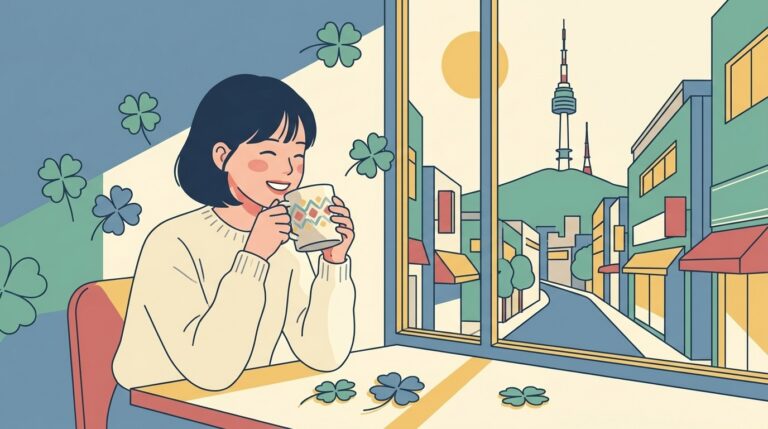
Master Wonyoung Thinking: How to Turn Any Bad Day into Lucky Vicky Vibes in Korean
Phase 1: Empathy & Storytelling
안녕하세요! 매일한글 에디터입니다. (Hello! This is your Daily Hangul editor.)
Picture this: You have walked twenty minutes through the bustling alleys of Seongsu-dong under the summer sun to visit that famous bakery everyone on Instagram is raving about. You step into the queue, stomach rumbling, waiting for the signature salt bread. Just as you reach the counter, the baker hangs up the dreaded sign: 매진 (Sold Out). Your heart sinks. You feel that familiar wave of frustration rising up your chest.
In the past, you might have sighed, grumbled, and let a ruined pastry ruin your entire afternoon. But if you have been following Korean pop culture lately, you know there is a viral superpower sweeping the nation: 원영적 사고 (Wonyoung Thinking). When IVE’s Jang Wonyoung waited in line for bread and watched the person right ahead of her purchase the last loaf, she beamed at the camera and said: “Now I get to wait for a piping-hot, freshly baked batch straight out of the oven! Aren’t I totally Lucky Vicky?”
That mental reframing took Korea by storm. As an editor who has coached hundreds of international learners moving to Seoul, I often see students freeze or get stressed when minor mishaps occur—a missed subway, a rainy forecast, or a sold-out menu item. Learning how Koreans use slang like 오히려 좋아 (Even better!) and 완전 럭키비키잖아! (Totally Lucky Vicky!) does not just build your vocabulary; it gives you the cultural armor to navigate everyday life with infectious charm and unbreakable mental peace.
Phase 2: 3 Key Expressions Deep Dive
1. 완전 럭키비키잖아! (Wanjeon reokibiki-jana!)
- Pronunciation: Wahn-jeon reok-ki-bee-kee-jah-nah! (Sounds like “One-zone lucky-Vicky-zha-nah”)
- Meaning:
- Literal: “Isn’t it completely Lucky Vicky?”
- Real Nuance: “What seemed like bad luck is actually the universe doing me a huge favor!”
- K-Culture Moment: Coined by IVE member Jang Wonyoung (whose English name is Vicky). It went viral across X (Twitter), YouTube shorts, and corporate Slack channels as the gold standard of hyper-optimism.
- Editor’s Insight: The ending -잖아 (-jana) seeks confirmation from the listener (“you know, right?”). It invites the other person into your joyful delusion, making it impossible for anyone around you to stay grumpy.
- Situation Spectrum: Casual ✅ | Semi-formal ⚠️ | Formal 🚫
- 🤔 Think About It: In English, we say “Every cloud has a silver lining,” which sounds poetic and philosophical. Why do you think young Koreans prefer turning optimism into an energetic, idol-inspired catchphrase?
2. 오히려 좋아 (Ohiryeo joa)
- Pronunciation: Oh-hee-ryeo jo-ah (Sounds like “Oh-hee-ryeo joe-ah”)
- Meaning:
- Literal: “Rather, it’s good.”
- Real Nuance: “Actually, this unexpected twist turns out to be even better!”
- K-Culture Moment: Originating from Korean gaming streamers when a strategy went sideways, this catchphrase quickly migrated into mainstream slang. From variety shows to university group chats, whenever plans fail, someone shouts this out.
- Editor’s Insight: This phrase is the ultimate social diffuser. If your friend accidentally drops ice cream or takes the wrong bus stop, saying 오히려 좋아 instantly relieves their guilt and reframes the mistake as a fun detour.
- Situation Spectrum: Casual ✅ | Semi-formal ✅ | Formal 🚫
- 🤔 Think About It: Does speaking positivity out loud genuinely change how you perceive a stressful situation, or does it feel unnatural in your native tongue?
3. 긍정 회로 돌리기 (Geungjeong hoero dolligi)
- Pronunciation: Geung-jeong hwe-ro dol-li-gi (Sounds like “Geung-jung hway-ro dol-lee-ghee”)
- Meaning:
- Literal: “Running the positive circuit.”
- Real Nuance: “Activating maximum positive delusions to safeguard my mental health.”
- K-Culture Moment: Often heard in workplace K-dramas and office life memes. When facing a looming deadline or impossible workload, workers tell each other: “긍정 회로 풀가동하자! (Let’s run our positive circuit at full capacity!)”
- Editor’s Insight: Borrowed from electrical circuits, this expression acknowledges reality: life can short-circuit you, so you must consciously flip the switch to positive thoughts to avoid burning out.
- Situation Spectrum: Casual ✅ | Semi-formal ✅ | Formal ⚠️
- 🤔 Think About It: Many cultures view mental victory (정신 승리) with skepticism, viewing it as denial. In high-pressure Korean society, why might this be viewed as a healthy coping skill instead?
Phase 3: Textbook Korean vs. Real Korean
Situation 1: It starts pouring rain while you are outside without an umbrella.
- 📖 교과서 한국어 (Textbook Korean):
비가 오지만 긍정적으로 생각합시다.
(Bi-ga ojiman geungjeongjeog-euro saeng-gakhapsida. / It is raining, but let us think positively.) - 🗣️ 진짜 한국어 (Real Korean):
비 오니까 날씨도 시원하고 오히려 좋아!
(Bi onikka nalssido siwonhago ohiryeo joa! / Since it’s raining, it feels cool—actually even better!) - 💡 왜 다를까? (Why is it different?): Textbook Korean sounds like a formal public service announcement. Native speakers connect the physical silver lining (cool air) directly with the lively slang 오히려 좋아 to spark immediate laughter.
Situation 2: The restaurant you wanted to try has a 60-minute waitlist.
- 📖 교과서 한국어 (Textbook Korean):
대기 시간이 너무 기니까 다음에 오겠습니다.
(Daegi sigani neomu ginikka daeume ogessseumnida. / The wait time is too long, so I will come next time.) - 🗣️ 진짜 한국어 (Real Korean):
동네 구경할 시간 생겼네, 완전 럭키비키잖아!
(Dongne gugyeonghal sigan saenggyeonne, wanjeon reokibiki-jana! / Now we have time to explore the neighborhood, totally Lucky Vicky!) - 💡 왜 다를까? (Why is it different?): Modern Koreans turn passive patience into an adventure. Instead of giving up, framing the wait as an opportunity to wander creates a lighthearted, enjoyable dynamic.
Phase 4: K-Culture Deep Dive & Non-verbal Manners
4-1. 눈치 (Nunchi) & Body Language
When applying 원영적 사고, delivery is everything:
1. The Bright Smile & High Pitch: Do not deliver 완전 럭키비키잖아! in a flat, monotone voice. If you sound bored, it comes off as bitter sarcasm! Raise your pitch slightly and maintain genuine eye contact.
2. The Dual Thumb-Up or Finger Heart: Pair 오히려 좋아 with a quick double thumbs-up or small shrug. It signals to your companions: “I’m relaxed, so you don’t need to stress on my account.”
3. Read the Room (Nunchi): If someone has experienced a serious accident, financial loss, or family trouble, do not use Lucky Vicky slang. This mindset is reserved for daily inconveniences, minor delays, and small blunders.
4-2. The Cultural Engine: Resilience in a Fast-Paced Society
Korea is internationally celebrated for its lightning-fast speed (빨리빨리 culture), but high efficiency often brings high collective stress. Whether studying for university entrance exams or meeting strict work deadlines, feeling overwhelmed is a common experience.
Historically, Korean culture maintained an ethos of 한 (Han)—deep sorrow and enduring grit. Over the last decade, young Koreans have transformed this into 흥 (Heung)—vibrant, communal joy and self-deprecating optimism. “Wonyoung Thinking” is not naive ignorance; it is an active cultural rebellion against negativity, allowing people to protect their mental space while staying joyful.
Phase 5: Real-Life Roleplay Scenario
- Setting: A stylish rooftop cafe in Ikseon-dong on a Saturday afternoon. Sudden rain begins splashing your table, and you drop your dessert fork on the floor.
- Characters:
- 민준 (Min-jun): Your thoughtful Korean friend who gets stressed easily when outings go off schedule.
- You: A positive explorer armed with your new slang.
Dialogue:
1. 민준: 아, 갑자기 비 오네! 테라스 자리 겨우 잡았는데 어떡하지?
(A, gapjagi bi one! Teraseu jari gyeou jabanneunde eotteokhaji?)
[English: Oh, it’s suddenly raining! We barely managed to snag this terrace seat, what do we do?]
🎭 Hair slightly damp, frantically looking around with wide eyes.
- You: 실내로 들어가면 되지! 비 오는 거 보면서 커피 마시면 더 분위기 있잖아.
(Silnaero deureogamyeon doeji! Bi oneun geo bomyeonseo keopi masimyeon deo bunwigi itjana.)
[English: We can just move indoors! Drinking coffee while watching the rain fall has even more atmosphere.]
🎭 Smiling warmly and grabbing your iced latte. -
민준: 그런가? 근데 너 방금 포크 바닥에 떨어뜨렸잖아. 다시 받아와야 해.
(Geureonga? Geunde neo banggeum pokeu badage tteoreotteuryeotjana. Dasi badawayo hae.)
[English: Really? But you just dropped your fork on the floor. We have to go ask for another one.]
🎭 Frowning with a guilty, apologetic expression. -
You: 새 포크로 먹으면 더 깨끗하지! 완전 럭키비키잖아!
(Sae pokeuro meogeumyeon deo kkaekkeuthaji! Wanjeon reokibiki-jana!)
[English: Eating with a brand-new fork will be even cleaner! Isn’t that totally Lucky Vicky!]
🎭 Giving a cute two-finger peace sign with sparkling eyes. -
민준: 푸하하! 진짜 너의 긍정 회로는 못 말린다.
(Puhaha! Jinjja neoui geungjeong hoeroneun mot mallinda.)
[English: Hahaha! Nobody can stop your positive circuit.]
🎭 Bursting into laughter, shoulders visibly relaxing. -
You: 어차피 벌어진 일인데 기분 나빠하면 나만 손해야!
(Eochapi beoreojin irinde gibun nappahamyeon naman sonhaeya!)
[English: What happened already happened; feeling bad about it only hurts me!]
🎭 Shrugging casually with an infectious grin. -
민준: 맞아. 실내 자리 창가 쪽 하나 비었다! 오히려 좋아!
(Maja. Silnae jari changga jjok hana bieotda! Ohiryeo joa!)
[English: You’re right. A window seat just opened up inside! Actually even better!]
🎭 Pointing cheerfully toward the cozy indoor corner. -
You: 거봐, 내 말이 맞지? 얼른 들어가자!
(Geobwa, nae mari matji? Eolleun deureogaja!)
[English: See, didn’t I tell you? Let’s hurry inside!]
🎭 Walking inside with happy, bounce-filled steps.
🔀 Interactive Decision Point
When Min-jun’s favorite bakery is closed for inventory, how should you respond?
* Choice A: “문 닫았네. 오늘 운 진짜 안 좋다. 그냥 집에 가자.”
(Mun dadanne. Oneul un jinjja an jota. Geunyang jibe gaja. / It’s closed. We have horrible luck today. Let’s just go home.)
* Outcome (Bad): Kills the mood instantly. Min-jun feels guilty for recommending the spot.
* Choice B: “근처에 다른 맛집 찾을 기회네! 오히려 좋아, 럭키비키잖아!”
(Geuncheoe dareun matjip chajeul gihoene! Ohiryeo joa, reokibiki-jana! / An opportunity to find another good spot nearby! Actually even better, totally Lucky Vicky!)
* Outcome (Best): Pure charismatic brilliance! You lift his spirits and make the day memorable.
* Choice C: “사장님한테 전화해서 왜 안 여냐고 물어볼까?”
(Sajangnimhante jeonhwahaeseo wae an yeonyago mureobolkka? / Should we call the owner and ask why they aren’t open?)
* Outcome (Risk): Creates awkward social tension and makes you seem confrontational.
Phase 6: 10-Second Emotion Shadowing Drill
Practice matching the natural melody of native speakers. The slashes (/) mark brief rhythmic breathing pauses!
[😊 Bright & Uplifting]
오히려 / 잘됐어! / 다른 카페 가보자!
(Ohiryeo / jaldwaesseo! / Dareun kape gaboda!)
It’s actually / a good thing! / Let’s go try another cafe!-
[✨ Playful & Bubbly]
줄이 길다고? / 수다 떨 시간 생겼네 / 완전 럭키비키잖아!
(Juri gildago? / Suda tteol sigan saenggyeonne / Wanjeon reokibiki-jana!)
The line is long? / More time to gossip together / Totally Lucky Vicky! -
[💪 Determined & Encouraging]
이미 일어난 일이야 / 긍정 회로 / 풀가동하자!
(Imi ireonan iriya / Geungjeong hoero / Pul-gadong-haja!)
It already happened / Let’s run our positive circuit / At full power!
Phase 7: K-Culture Mini Dictionary
- 정신 승리 (Jeongsin Seungri)
- Meaning: Mental victory.
- Context: Convincing yourself that you won an emotional battle even if you lost on paper. Used half-jokingly among friends.
- 긍정 회로 (Geungjeong Hoero)
- Meaning: Positivity circuit.
- Context: The mental switch you flick on to imagine best-case outcomes when reality throws a curveball.
- 갓생 (Gatsaeng)
- Meaning: “God-life” (God + Saeng/Life).
- Context: Living a diligent, productive, and exemplary daily life filled with workouts, study, and positive habits.
- 폼 미쳤다 (Pom Michyeotda)
- Meaning: One’s form/skill is insane.
- Context: Complimenting someone whose style, wit, or performance is at an all-time peak.
Phase 8: Traveler’s Survival Kit
TOP 3 Survival Phrases for Travelers
- 오히려 좋아요! (Ohiryeo joayo!)
- Pronunciation: Oh-hee-ryeo jo-ah-yo!
- Pro Tip: The polite -요 (-yo) ending lets you use this safely with Airbnb hosts, taxi drivers, and tour guides when plans shift.
- 괜찮아요, 그럴 수도 있죠. (Gwaenchanayo, geureol sudo itjyo.)
- Pronunciation: Gwaen-chahn-ah-yo, geu-reol su-do eet-jyo.
- Pro Tip: Means “It’s okay, that can happen!” A magical phrase that proves you have gracious manners when someone makes an honest mistake.
- 이것도 다 추억이죠! (Igeotdo da chueog-ijyo!)
- Pronunciation: Ee-geot-do dah choo-eog-ee-jyo!
- Pro Tip: Means “This will all be a great memory!” Say this when you get lost in an unfamiliar neighborhood.
Editor’s Travel Note
When traveling in South Korea, unexpected detours happen. If you miss your express train on the subway, don’t panic! Open your favorite navigation service via the Naver Map app transit guide to quickly re-route your journey. Korean subway stations are mini-cities filled with delicious convenience food, socks, and flower shops. Remind yourself: missing a train simply means a 10-minute snack mission!
Phase 9: One Step Deeper
Language is a reflection of collective survival. In many Western cultures, positivity is frequently treated as an individual, introspective virtue (“Look on the bright side”). In Korean society, however, emotions are deeply shared (정, Jeong). When someone experiences a stumble, their personal distress creates reciprocal concern in everyone around them.
By saying 완전 럭키비키잖아 or 오히려 좋아, you are not just soothing yourself—you are performing an act of care for your peers. You are releasing them from guilt, maintaining the social harmony, and converting shared disappointment into shared laughter. It is relational resilience at its finest.
💬 Your Turn: Have you ever experienced a travel disaster or minor mishap that turned out to be an unexpected highlight? How would you describe that moment using “Wonyoung Thinking”? Share your story in the comments below!
Phase 10: FAQ & Common Mistakes
Q: Can I use “완전 럭키비키잖아!” with my Korean boss or university professor?
A: 절대 안 돼요 (Definitely not)! This is very casual slang (반말). If you use it with a supervisor, it will sound disrespectful. In professional environments, stick to polite alternatives such as: “오히려 더 좋은 배움의 기회가 된 것 같습니다 (This seems to have become an even better learning opportunity).”
Q: What is the real difference between “정신 승리” and “원영적 사고”?
A: 정신 승리 (Mental Victory) carries a self-mocking tint—it implies you actually lost, but you are rationalizing it to save face. 원영적 사고 (Wonyoung Thinking) is pure, genuine conviction that the outcome will bring authentic delight. One is defensive; the other is proactive joy.
Q: What if I say “오히려 좋아” and people think I’m making fun of them?
A: It is all about facial expression. If your eyebrows are furrowed or you roll your eyes, it sounds like biting sarcasm. Keep your face relaxed, smile warmly, and offer a concrete silver lining immediately afterward.
🚨 Common Mistakes Warning Board
- Mistake 1: Dropping honorifics. Saying “럭키비키잖아” to taxi drivers or store clerks.
- Correct Action: Keep it polite: “오히려 더 좋네요! (Ohiryeo deo jonne-yo!)”
- Mistake 2: Using the phrase during genuinely somber events.
- Correct Action: If someone lost their wallet, express genuine comfort (“어떡해요… 속상하시겠어요”) before searching for silver linings.
- Mistake 3: Saying “오히려” alone without an adjective.
- Correct Action: “오히려” is an adverb meaning “rather.” Pair it with a predicate like 오히려 좋아 or 오히려 편해.
Phase 11: Action Mission & Engagement
- 🥉 Bronze Level (Solo Practice): Stand in front of your mirror. Think of one minor inconvenience you faced today (e.g., waking up 5 minutes late). Aloud, say: “오히려 좋아! [Reason why it is good]!”
- 🥈 Silver Level (Social Share): Post a photo of your everyday moment on Instagram Stories or Threads. Caption it: “완전 럭키비키잖아! 🍀” and tag someone who needs a dose of good energy.
- 🥇 Gold Level (Real-Life Application): Next time you grab a drink with a Korean friend or your language exchange partner, intentionally use 오히려 좋아 when an order is delayed or a seat is taken.
- 🎮 K-Culture Mission: Watch an episode of a Korean variety show or an IVE vlog on YouTube. Try to spot when the captions show the four-leaf clover emoji 🍀 alongside the word 럭키비키!
Phase 12: Interactive Quiz Challenge
Test your situational mastery below! Pick your answers, then tap the spoiler block to reveal the explanations.
1. Situational Judgment
You ordered an iced Americano at a Seoul cafe, but the barista accidentally handed you a hot latte because of a printer slip. You are not allergic to dairy. What is the most natural “Wonyoung Thinking” response to cheer up the flustered barista?
* (A) “이거 아닌데요. 다시 만들어 주세요.” (This isn’t it. Remake it.)
* (B) “날씨도 쌀쌀한데 오히려 좋아요! 맛있게 마실게요!” (The weather is chilly anyway, so it’s actually even better! I’ll enjoy it!)
* (C) “완전 럭키비키잖아! 너 이름이 뭐야?” (Totally Lucky Vicky! What’s your name?)
2. Fill-in-the-Blank
Complete the sentence to mean: “Since the subway was delayed, we got to talk more. Isn’t that totally Lucky Vicky!”
지하철이 늦게 와서 이야기 더 많이 했네. 완전 [__________]잖아!
3. Cultural True or False
- Statement: “오히려 좋아” can only be used when playing video games and should never be spoken in casual cafes or restaurants.
- (True / False)
👉 Click here to reveal the answers and explanations!
- Answer: (B)
- Explanation: Option (B) demonstrates peak empathy and manners! It reassures the barista politely while using 오히려 좋아요. Option (A) is cold, and Option (C) inappropriately drops honorifics.
- Answer: 럭키비키 (reokibiki)
- Explanation: Combining 완전 with 럭키비키잖아 completes Korea’s favorite positivity phrase.
- Answer: False
- Explanation: While it originated in streaming communities, 오히려 좋아 is now an everyday staple used across all social settings among friends and peers.
- Explanation: While it originated in streaming communities, 오히려 좋아 is now an everyday staple used across all social settings among friends and peers.







