

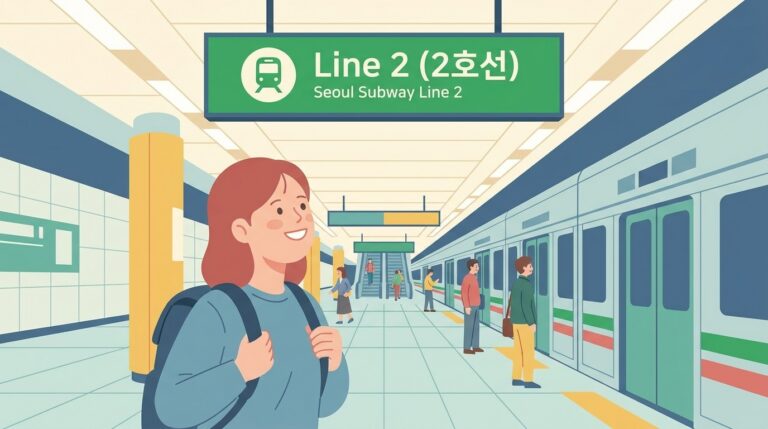
Which Way to Line 2? The Ultimate Seoul Subway Transfer Guide
안녕하세요! 매일한글 에디터입니다. Have you ever stepped into Sindorim Station during evening rush hour? It feels like stepping straight into an intense scene from a fast-paced K-drama! Commuters glide past you with laser focus, electronic chimes echo through the corridors, and vibrant directional arrows point everywhere at once. You just landed in Seoul, ready to soak in the youth vibes of Hongdae or marvel at Gangnam, but suddenly your phone GPS spins in circles underground. You stare at the labyrinth of tunnels, desperately looking for the iconic green circle of Subway Line 2. A student of mine once spent 40 minutes wandering around Dongdaemun History & Culture Park Station simply because she did not know the right words to ask a passing local for directions. Learning this simple sentence will save you time, sore feet, and travel anxiety!
Phase 2: Core Expressions
1. 2호선 타려면 어디로 가요? (2-hoseon taryeomyeon eodiro gayo?)
- Pronunciation: ee-ho-seon ta-ryeo-myeon eo-di-ro ga-yo? (Think of “ee” like the letter ‘E’, and “hoseon” like ‘hose’ + ‘sun’.)
- Meaning: “Where do I go if I want to take Line 2?” (Literal: Line 2 / in order to ride / where to / go?)
- K-Culture Moment: Picture an exhausted main character running through the station to catch the last train after working late in a slice-of-life K-drama like Misaeng.
- Editor’s Insight: The suffix ~(으)려면 (~ryeomyeon) means “if you intend to”. Combining it with “어디로 가요?” (Where do I go?) forms the polite golden formula for asking directions anywhere in Korea.
- Situation Spectrum:
- Casual (Friends): 🚫 2호선 어디로 가? (Too blunt with strangers)
- Semi-formal (Polite everyday): ✅ 2호선 타려면 어디로 가요?
- Formal (Public announcements): ⚠️ 2호선 탑승구는 어디입니까?
- 🤔 Think About It: In English, we usually ask “Where is Line 2?” but in Korean, asking “Where do I go to ride it?” emphasizes personal action and destination path. How does focusing on the action change how you picture your route?
2. 여기서 갈아타요? (Yeogiseo garatayo?)
- Pronunciation: yeo-gi-seo ga-ra-ta-yo? (Sounds like “yo-key-saw ga-ra-ta-yo”)
- Meaning: “Do I transfer here?”
- K-Culture Moment: Used by travel vloggers when navigating Seoul’s massive transfer hubs like Express Bus Terminal or Wangsimni.
- Editor’s Insight: “갈아타다” (garatada) is a compound verb made from “갈다” (to change) and “타다” (to ride). Add “여기서” (here) with a rising tone at the end to turn it into an instant question.
- Situation Spectrum:
- Casual: 🚫 여기서 갈아타?
- Semi-formal: ✅ 여기서 갈아타요?
- Formal: ✅ 여기서 환승합니까?
- 🤔 Think About It: Koreans value efficient movement in busy transit hubs. A quick three-word question helps you verify your route without stopping the crowd.
3. 몇 번 출구예요? (Myeot beon chul-guye-yo?)
- Pronunciation: myeot-beon chool-goo-ye-yo? (Rhymes with “mutt bun tool goo yea yo”)
- Meaning: “Which exit is it?”
- K-Culture Moment: Meeting your friend at “Hongdae Station Exit 9″—the most famous meetup landmark in youth culture!
- Editor’s Insight: Seoul stations can have more than 14 exits spanning several city blocks. Knowing your exit number prevents walking an extra kilometer on street level.
- Situation Spectrum:
- Casual: 🚫 몇 번 출구야?
- Semi-formal: ✅ 몇 번 출구예요?
- Formal: ✅ 몇 번 출구입니까?
- 🤔 Think About It: In many Western subway systems, stations are marked by street names (e.g., “8th Avenue Exit”). Why do you think Korea adopted clear, sequential numbers instead?
Phase 3: Textbook Korean vs. Real Korean
Situation 1: Asking which direction to walk towards Line 2
- 📖 교과서 한국어 (Textbook): 2호선 탑승 위치는 어디에 있습니까? (Where is the boarding location for Line 2 located?)
- 🗣️ 진짜 한국어 (Real Life): 저기요, 2호선 어디예요? (Excuse me, where is Line 2?)
- 💡 왜 다를까?: Native speakers in busy transit stations prefer ultra-short, direct phrases over formal dictionary syntax so listeners can respond in one second.
Situation 2: Asking if this platform goes to Hongdae
- 📖 교과서 한국어 (Textbook): 이 전철은 홍대입구역 방면으로 운행합니까? (Does this electric train operate toward Hongik University Station?)
- 🗣️ 진짜 한국어 (Real Life): 이거 홍대 가요? (Does this go to Hongdae?)
- 💡 왜 다를까?: When doors are about to close, quick communication is king. Replacing technical transit terms with “이거 [Place] 가요?” is natural and crystal clear.
Phase 4: K-Culture Deep Dive & Non-Verbal Manners
4-1. 눈치 (Nunchi) & Gestures on the Subway
- The Quick Excuse: Always initiate with a light nod and “저기요…” (jeogiyo, excuse me). Avoid grabbing someone’s shoulder or sleeve; personal space is treasured in transit corridors.
- Open Palm Pointing: When a station attendant or fellow commuter points the way, they will often gesture with an open palm rather than a single index finger. Follow their palm direction!
- Escalator Etiquette: Stand on the right side if you are resting; keep the left side clear for people rushing to catch the train. Displaying good nunchi means staying attuned to the flow of walking commuters around you.
4-2. Cultural Code: The Magic of Circle Line 2 (초록색 2호선)
In Seoul, Line 2 is not just a subway line—it is the pulse of the entire capital. Represented by its distinct green circle icon, Line 2 is a loop line that connects Seoul’s most iconic university districts (Hongik Univ., Ewha, Sinchon) with commercial powerhouses (Gangnam, Samseong/COEX) and trendy spots (Seongsu). If you master Line 2, you have unlocked 80% of Seoul’s top attractions!
Phase 5: Real-Life Roleplay Scenario
Setting: You just stepped off Line 1 at Sindorim Station. The corridors are bustling, and you need to find the green Line 2 platform to reach Hongdae.
NPC: Helpful commuter Min-su holding an iced Americano.
- You: 저기요, 실례합니다! (Jeogiyo, sillyehamnida!)
🎭 Bow slightly with a polite smile
(Excuse me, pardon me!) - Min-su: 네? 무슨 일이세요? (Ne? Museun iriseyo?)
🎭 Pauses with a welcoming head tilt
(Yes? What is the matter?) - You: 2호선 타려면 어디로 가요? (2-hoseon taryeomyeon eodiro gayo?)
🎭 Pointing gently down the hallway
(Which way do I go to take Line 2?) - Min-su: 아, 2호선이요? 저쪽 초록색 표지판 따라가세요. (A, 2-hoseon-iyo? Jeojjok choroksaek pyojipan ttaragaseyo.)
🎭 Points forward with an open hand
(Ah, Line 2? Follow that green sign over there.) - You: 여기서 바로 갈아타요? (Yeogiseo baro garatayo?)
🎭 Double-checking with curious eyes
(Do I transfer right here?) - Min-su: 계단 내려가시면 바로 나와요! (Gyedan naeryeogasimyeon baro nawayo!)
🎭 Smiles encouragingly
(Go down those stairs and it appears right away!) - You: 정말 감사합니다! 좋은 하루 보내세요! (Jeongmal gamsahamnida! Joeun haru bonaeseyo!)
🎭 Bowing 15 degrees politely
(Thank you so much! Have a wonderful day!) - Min-su: 네, 조심해서 가세요! (Ne, josimhaeseo gaseyo!)
🎭 Waves lightly
(Sure, take care!)
🔀 Interactive Choice Point
You reach the stairs, but you see two different directions for Line 2: “City Hall / Sinchon direction” vs “Gangnam / Sadang direction”. You want to go to Hongdae. What do you do?
- Option A: Shout “Hongdae!” loudly to anyone walking down the stairs.
- Feedback (Bad): 🚨 Too startling in a quiet Korean transit environment. Locals might feel uncomfortable.
- Option B: Ask a commuter near the stairs: “저기요, 이거 홍대 가요?” (Jeogiyo, igeo Hongdae gayo?)
- Feedback (Best): 🌟 Perfect! Polite, natural A1 Korean that gets an instant “네” (yes) or “아니요, 반대쪽이에요” (no, opposite side).
- Option C: Hop on any incoming train and hope it circles around eventually.
- Feedback (Risk): ⚠️ While Line 2 is a circle, taking the wrong direction could turn a 15-minute ride into a 70-minute accidental tour of Seoul!
Phase 6: 10-Second Emotion Shadowing Drill
Read each phrase out loud, respecting the pause slashes (/) and channeling the given emotion:
[🙋 Polite and seeking help]
저기요… / 2호선 타려면 / 어디로 가요?
(Jeogiyo… / 2-hoseon taryeomyeon / eodiro gayo?)-
[🤔 Curious and attentive]
여기서 / 계단으로 / 내려가요?
(Yeogiseo / gyedaneuro / naeryeogayo?) -
[😊 Relieved and super grateful]
아, 감사합니다! / 좋은 하루 보내세요!
(A, gamsahamnida! / Joeun haru bonaeseyo!)
Phase 7: K-Culture Mini Dictionary
- 환승 (Hwanseung) | Transfer (Transit)
- Everyday usage: Used when changing between subway lines or switching from subway to bus. Look for the colorful transfer emblem with overlapping circles!
- 호선 (Hoseon) | Line Number
- Everyday usage: Attached directly to numbers (e.g., 1호선 = Line 1, 2호선 = Line 2). Always pronounced using Sino-Korean numbers: 일(1), 이(2), 삼(3).
- 출구 (Chulgu) | Station Exit
- Everyday usage: Crucial for rendezvous. Koreans almost always set plans using exit numbers: “강남역 11번 출구 앞” (In front of Gangnam Station Exit 11).
- 개찰구 (Gaechalgu) | Ticket Turnstile / Fare Gates
- Everyday usage: The barrier where you tap your transit card. If you tap the wrong gate, station staff can open the side emergency gate for you.
Phase 8: Survival Kit for Travelers
Survival Expressions TOP 3
- 교통카드 충전해 주세요. (Gyotong-kadeu chungjeon-hae juseyo.)
- Meaning: Please recharge my transit card.
- Pro Tip: Convenience stores inside stations will top up your card with cash in seconds!
- 반대쪽으로 탔어요. (Bandae-jjogeuro tasseoyo.)
- Meaning: I took the train in the opposite direction.
- Pro Tip: If you tap out and re-enter the correct platform at the same station within 15 minutes, you won’t be charged an extra fare on Seoul subways.
- 화장실이 개찰구 안에 있어요? (Hwajangsiri gaechalgu ane isseoyo?)
- Meaning: Is the restroom inside the ticket gates?
- Pro Tip: Seoul subway stations have clean restrooms, but some are outside the fare gates while others are inside on the platform.
Editor’s Travel Note
- Essential Navigation: Google Maps often struggles with real-time subway routing and walking navigation in Korea. For the best transit guidance, check the 네이버 지도 앱 다운로드 (Naver Map app) to view real-time train arrivals and exact carriage transfer doors!
- Transit Cards: Grab a T-Money card or the unlimited Climate Card (기후동행카드) at any convenience store for unlimited rides on Seoul transit during your trip.
Phase 9: One Step Deeper
Seoul’s transit system is consistently ranked among the world’s most clean and orderly networks, largely rooted in Korea’s deep sense of communal consideration (baeryeo, 배려). Notice the bright pink priority seats designated for pregnant passengers—locals leave them empty even during peak rush hour. The intuitive color-coded lines and bilingual announcements reflect a society engineered around smooth collective movement. Next time you travel beneath Seoul, you are not just commuting; you are participating in a quiet communal harmony.
💬 Your Turn: Which subway station in Seoul do you dream of visiting first? Hongdae, Gangnam, or Myeongdong? Tell us in the comments below!
Phase 10: FAQ & Avoiding Misunderstandings
Q: Why do people say “이호선” (I-hoseon) instead of “두호선” (Du-hoseon)?
A: Subway line numbers always use Sino-Korean numerals (일, 이, 삼, 사…). Line 1 is 일호선 (Il-hoseon), Line 2 is 이호선 (I-hoseon), and Line 3 is 삼호선 (Sam-hoseon). Native Korean numbers (하나, 둘, 셋) are never used for transit lines!
Q: What should I do if I get stuck at the turnstile gate with an error beep?
A: Do not panic or crawl under! Look for the “Help” button (도움벨) located on the side emergency gate. Press it, and station staff will instantly unlock the gate for you.
Q: Is talking allowed on the subway train?
A: Quiet conversation with your travel buddy is totally fine, but loud phone calls or playing videos without earphones are considered impolite (sil-lye).
🚨 흔한 실수 (Common Mistakes)
- Calling Line 2 “Two-Hoseon”: Saying English numbers or “두호선” confuses locals. Always say 이호선 (I-hoseon).
- Tapping transit cards too quickly: Wait for the reader to chime “삑” (Pik!) before walking through the turnstile.
- Standing on the left side of escalators: Always stand on the right to leave the left lane open for walking commuters.
Phase 11: Action Missions
- 🥉 Bronze Mission (Solo): Practice saying “2호선 타려면 어디로 가요?” out loud 5 times in front of the mirror, matching the friendly melody of Phase 6.
- 🥈 Silver Mission (Social): Snap a photo of any transit map or screenshot your transit app and caption it with: “오늘 배운 한국어: 2호선 타려면 어디로 가요?”
- 🥇 Gold Mission (Real Life): When you visit Korea, ask a friendly station staff member for an exit or line direction using 100% Korean!
- 🎮 K-Culture Mission: Watch a vlog or drama set in Seoul and spot the iconic green Line 2 signage in station scenes!
Phase 12: Interactive Quiz Challenge
Quiz 1: Situation Judgment
You want to go to Line 2, but you are not sure if you are in the right corridor. What is the most polite, natural way to ask a passerby?
* A) 저기요, 2호선 타려면 어디로 가요?
* B) 야! 2호선 어디야?
* C) 2호선 탑승을 갈망합니다.
👉 Click to view Answer & Explanation
Correct Answer: A
* Explanation: Option A is the natural, courteous A1 level phrase. Option B uses rude non-honorific speech (banmal) with strangers. Option C uses an awkward literary word meaning “I yearn to board Line 2”!
Quiz 2: Fill in the Blank
Complete the question: “Do I transfer here?”
여기서 ______? (Hint: Combination of to change + to ride)
👉 Click to view Answer & Explanation
Correct Answer: 갈아타요 (garatayo)
* Full sentence: 여기서 갈아타요? (Yeogiseo garatayo?)
Quiz 3: True or False Cultural Quiz
On Seoul subway escalators, standing on the right side and keeping the left side open for walking passengers is the customary commuter etiquette.
👉 Click to view Answer & Explanation
Correct Answer: True (O)
* Explanation: Keeping the left side free allows rushed commuters to catch their connecting transfers without delay!
Safe travels on the Seoul subway, and see you in the next lesson! 화이팅! (Hwaiting!)”,







