

The Art of Doing Nothing: Unlocking Korean ‘Meong’ to Cure Burnout
Phase 1: Empathy (A Story-Driven Opening)
안녕하세요! 매일한글 에디터입니다. (Hello! It’s your Daily Hangul editor.)
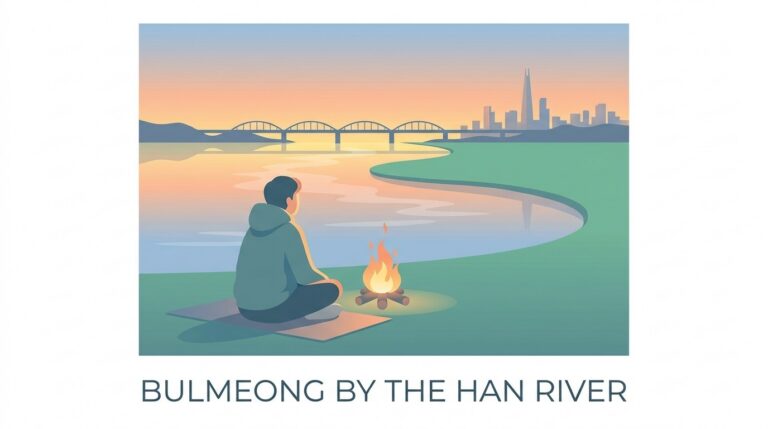
Picture this scene from a popular K-drama: After working 70 hours a week under an impossible manager in Gangnam, the protagonist doesn’t head to a buzzing lounge or hit the gym. Instead, they drive out to a quiet campsite in Gapyeong, pitch a solitary tent, strike a match, and sit in utter silence for four straight hours, their gaze locked onto the dancing orange embers. No phone, no notifications, no inner monologue planning tomorrow’s sprint. In Korea, we call this ritual 불멍 (Bulmeong)—zoning out into the flames.
In our hyper-accelerated “Ppalli-Ppalli” (hurry-hurry) culture, philosopher Byung-Chul Han famously diagnosed Korea as the quintessential “Fatigue Society” (피로사회), where individuals become both the master and slave in an endless loop of self-exploitation. But contemporary Koreans have engineered a brilliant linguistic and cultural antidote: giving space to the brain’s Default Mode Network through “멍때리기” (meong-ttaerigi – zoning out). If you have ever felt guilty for sitting still or felt mentally fried after hours of structured studying, this lesson is your ultimate emotional passport. Today, we delve into the sophisticated C1 vocabulary and socio-cultural nuances that modern Koreans use to reclaim their peace, step away from burnout, and embrace intentional stillness.
Phase 2: Core Expressions Deep Dive
1. 불멍하다 / 물멍하다 (Bulmeonghada / Mulmeonghada)
- Pronunciation: [Bul-meong-ha-da / Mul-meong-ha-da] (Think of “Bull” without the hard L + “mung” like the bean, combined with “ha-da”)
- Meaning:
- Literal: Fire-daze-doing / Water-daze-doing.
- Nuance: Engaging in therapeutic, unstructured visual meditation by passively watching flickering flames or undulating water currents.
- K-Culture Moment: Seen frequently on variety shows like Three Meals a Day or I Live Alone, where celebrities sit beside a firepit with a cup of drip coffee, sigh deeply, and let all facial expressions melt away into peaceful blankness.
- Editor’s Insight: The morpheme 멍 (meong) stems from 멍하니 (meonghani, vacant-mindedly). Attaching it to specific elements—불 (fire), 물 (water), 숲 (forest/trees = sup-meong), or even 바람 (wind = baram-meong)—transforms passive daydreaming into an intentional act of mental self-care.
- Situation Spectrum:
- Casual (Friends): ✅ “우리 오늘 캠핑 가서 불멍이나 실컷 하자.” (Let’s go camping today and just zone out into the fire.)
- Semi-formal (Coworkers): ✅ “주말에 호숫가에서 물멍하면서 머리를 좀 비우고 왔어요.” (I emptied my head this weekend by zoning out watching the lake.)
- Formal (Boardroom/Executive Presentation): ⚠️ (Use descriptive phrasing like ‘뇌의 휴식을 위한 무념무상의 시간’ instead of slang-rooted words.)
- 🤔 Think About It: In English, “spacing out” or “zoning out” often carries a slight stigma of laziness or inattention. Why did Korean society invent compound nouns celebrating the exact element you are zoning out into?
2. 뇌에 여백을 주다 (Noee yeobaegeul juda)
- Pronunciation: [Noe-e yeo-bae-geul ju-da] (Pronounce ‘noe’ like ‘nu’ in French ‘nuit’ + ‘yeo-baek’ like ‘yuh-beck’ with a crisp final ‘k’)
- Meaning:
- Literal: To give blank space/margins to the brain.
- Nuance: Intentionally withholding mental inputs to allow the mind to process, declutter, and reset.
- K-Culture Moment: In intellectual talk shows like Alssulsinjap (The Dictionary of Useless Knowledge), writers and neuroscientists use this elegant phrase to explain why walking along the Han River sparks creative breakthroughs.
- Editor’s Insight: 여백 (yeobaek) is traditionally an artistic term from East Asian ink wash painting (sumukhwa), referring to deliberate empty canvas that gives life to painted subjects. Using this word for mental health elevates resting from “wasted time” to “vital artistic composition.”
- Situation Spectrum:
- Casual: ✅ “머리가 터질 것 같아서 뇌에 여백 좀 주려고 산책 나왔어.” (My head felt like exploding, so I came out for a walk to give my brain some breathing room.)
- Semi-formal: ✅ “창의적인 아이디어를 내려면 뇌에도 여백을 주는 시간이 필수적입니다.” (Giving margin to the brain is essential to generating creative ideas.)
- Formal: ✅ Suitable across all formal and academic contexts.
- 🤔 Think About It: Does your native language view “rest” as the absence of work (passive), or as a deliberate architectural space within work (active margin)?
3. 마음을 추스르다 (Maeumeul chuseureuda)
- Pronunciation: [Ma-eu-meul chu-seu-reu-da] (Flow smoothly: ‘Ma-eum’ like ‘mah-um’ + ‘chu’ like ‘chew’ + ‘seu-reu-da’)
- Meaning:
- Literal: To gather up, tuck in, and tidy disheveled feelings.
- Nuance: To pull oneself together after severe emotional turbulence, burnout, or grief.
- K-Culture Moment: In melancholic healing dramas like My Liberation Notes or Lost, characters speak this line softly when deciding to stop running away from their exhaustion and face themselves calmly.
- Editor’s Insight: The verb 추스르다 originally describes gathering up the sagging hem of an oversized garment or tidying up scattered bundles. When applied to 마음 (mind/heart), it conveys an intimate, tender self-compassion—gathering the scattered fragments of your burned-out spirit.
- Situation Spectrum:
- Casual: ✅ “번아웃이 심했는데 이제 마음 좀 추스르고 있어.” (I had severe burnout, but I’m slowly composing myself now.)
- Semi-formal: ✅ “잠시 휴직하면서 마음을 추스를 시간이 필요합니다.” (I need some time on leave to collect my emotional equilibrium.)
- Formal: ✅ Deeply empathetic and respected in written essays or speeches.
- 🤔 Think About It: Contrast “pulling yourself together” (which implies discipline and tension) with “마음을 추스르다” (which implies gentle tucking and comforting). What difference does this make to someone healing from burnout?
Phase 3: Textbook Korean vs. Real-World Korean
Situation 1: Explaining what you are doing during a break
- 📖 교과서 한국어 (Textbook): 저는 지금 아무 일도 하지 않고 쉬고 있습니다. (Jeo-neun ji-geum a-mu il-do ha-ji an-ko swi-go it-seumnida. / “I am currently doing nothing and taking a rest.”)
- 🗣️ 진짜 한국어 (Real-World): 아무 생각 없이 멍때리면서 뇌 좀 환기하고 있어요. (A-mu saeng-gak eop-si meong-ttae-ri-myeon-seo noe jom hwan-gi-ha-go iss-eo-yo. / “I’m just zoning out with an empty head, airing out my brain.”)
- 💡 Why the difference? Textbook Korean treats resting as a formal state of inactivity. Native speakers specify the emotional mechanism: “뇌를 환기하다” (airing out/ventilating the brain) paired with the vernacular “멍때리다” captures sensory relief.
Situation 2: Expressing the urge to alleviate mental overload
- 📖 교과서 한국어 (Textbook): 직장 업무 때문에 스트레스를 심하게 받아서 해소해야 합니다. (Jik-jang eom-mu ttae-mun-e seu-teu-re-seu-reul sim-ha-ge bad-a-seo hae-so-hae-ya hamnida. / “I am heavily stressed due to workplace tasks and need to relieve it.”)
- 🗣️ 진짜 한국어 (Real-World): 완전히 번아웃 와서 과부하 걸렸어요. 며칠 폰 끄고 잠적하고 싶네요. (Wan-jeon-hi beon-a-ut wa-seo gwa-bu-ha geol-lyeoss-eo-yo. Myeo-chil pon kkeu-go jam-jeok-ha-go sim-ne-yo. / “Total burnout hit me and my system is overloaded. I feel like turning off my phone and going off the grid for a few days.”)
- 💡 Why the difference? C1 speakers master high-register technical metaphors like 과부하 (electrical overload) combined with conversational slang like 잠적하다 (vanishing/going incognito), painting an evocative picture of fatigue.
Phase 4: K-Culture Deep Dive & Non-Verbal Manners
4-1. 눈치 (Nunchi) & Non-Verbal Demeanor during ‘Meong’
When you join Korean friends at a glamping site, a riverside terrace, or an ocean-view cafe in Gangneung, recognizing the “unspoken boundary of silence” is supreme Nunchi.
- Eye Contact Dissolution (시선 풀기): When someone slips into Bulmeong or Mulmeong, their eyes un-focus. Do not ask, “화났어?” (Are you angry?) or “무슨 생각해?” (What are you thinking?). Doing so violently pulls them out of their Default Mode Network reset.
- The Shared Parallel Silence: Sit side-by-side rather than face-to-face. Keep physical gestures subtle; cradle a hot mug with both hands, look toward the horizon, and let sighs happen naturally without reacting with alarm.
4-2. Cultural Code: The Paradox of “Space-Out Competitions” (멍때리기 대회)
In 2014, Korean visual artist Woopsyang inaugurated the world’s first 한강 멍때리기 대회 (Han River Space-Out Competition). Contestants sit on yoga mats under the blazing sun for 90 minutes without checking smart devices, talking, sleeping, or laughing. Heart rates are measured every 15 minutes, and the steadiest pulse wins a trophy shaped like Rodin’s The Thinker.
What started as a quirky art project became a nationwide socio-cultural movement. In a society where high-speed Wi-Fi, instant food deliveries, and hyper-competitive credential building (spec) demand relentless cognitive engagement, sitting immobile in public became the ultimate counter-cultural protest against toxic productivity.
Phase 5: Real-Life Roleplay Scenario
Setting: A quiet riverside campsite along the Bukhan River in Gapyeong at 10 PM. The firewood crackles softly.
Characters:
* Min-seo (민서): Your Korean colleague, an exhausted tech project manager recovering from a grueling software launch.
* You: A thoughtful friend who notices her emotional overload.
Min-seo: 불꽃 보고 있으니까… 진짜 아무 생각도 안 드네요. 머릿속이 새하얘져요.
(Bul-kkot bo-go iss-eu-ni-kka… jin-jja a-mu saeng-gak-do an deu-ne-yo. Meo-rit-sok-i sae-ha-yae-jyeo-yo.)
🎭 Stares blankly into the burning logs, shoulders dropping by three inches.
“Looking at the fire… my mind truly goes completely blank. Everything in my head is turning clear white.”
You: 그동안 쉼 없이 달렸잖아요. 지금은 그냥 뇌에 여백을 좀 줘요.
(Geu-dong-an swim eop-si dal-lyeot-ja-nayo. Ji-geum-eun geu-nyang noe-e yeo-bae-geul jom jwo-yo.)
🎭 Speaking in a muted, comforting cadence, handing her a warm cup of barley tea.
“You’ve been running nonstop all this time. Right now, just allow some blank margins for your brain.”
Min-seo: 늘 뭔가를 생산적으로 해야 한다는 강박 때문에 이렇게 가만히 있는 게 처음엔 죄책감 들더라고요.
(Neul mwon-ga-reul saeng-san-jeok-eu-ro hae-ya han-da-neun gang-bak ttae-mun-e i-reoh-ge ga-man-hi it-neun ge cheo-eum-en joe-chaek-gam deul-deo-ra-go-yo.)
🎭 Faint self-deprecating smile, stirring the tea gently with a spoon.
“Because of the obsession that I must always do something productive, just sitting still like this felt like a guilt trip at first.”
You: 한국 사회가 워낙 치열하니까요. 그래도 비워내야 다시 채울 수 있는 법이에요.
(Han-guk sa-hoe-ga wo-nak chi-yeol-ha-ni-kkayo. Geu-rae-do bi-wo-nae-ya da-si chae-ul su it-neun beob-i-e-yo.)
🎭 Nodding slowly, mirroring her calm tempo.
“Korean society is undeniably fierce. Still, only by emptying out can you refill your reserves.”
Min-seo: 맞아요. 매일 마감에 쫓기다 보니 제 감정이 탈진된 줄도 몰랐어요.
(Maj-a-yo. Mae-il ma-gam-e jjot-gi-da bo-ni je gam-jeong-i tal-jin-doen jul-do mol-lass-eo-yo.)
🎭 Taking a quiet, lingering sip of tea, releasing a long-held breath.
“Exactly. Being chased by daily deadlines, I didn’t even notice my emotions had burnt out to exhaustion.”
You: 오늘 밤엔 일 이야기는 일절 접어두고, 우리 딱 불멍에만 집중해요.
(O-neul bam-en il i-ya-gi-neun il-jeol jeob-eo-du-go, u-ri ttak bul-meong-e-man jip-jung-hae-yo.)
🎭 Tossing another cedar log onto the hearth, warming palms toward the glow.
“Tonight, let’s fold up work talk entirely and focus strictly on our fire-daze.”
Min-seo: 고마워요. 덕분에 엉킨 생각들이 서서히 풀리는 기분이에요.
(Go-ma-wo-yo. Deok-bun-e eong-kin saeng-gak-deul-i seo-seo-hi pul-li-neun gi-bun-i-e-yo.)
🎭 Her eyes soften as she turns her gaze back to the crackling red embers.
“Thank you. Thanks to this, I feel like my tangled thoughts are gradually unraveling.”
You: 다행이네요. 타닥타닥 소리 들으면서 천천히 마음을 추스르자고요.
(Da-haeng-i-ne-yo. Ta-dak-ta-dak so-ri deul-eu-myeon-seo cheon-cheon-hi ma-eum-eul chu-seu-reu-ja-go-yo.)
🎭 Smiling warmly before turning back to silence together.
“I’m glad. Listening to the crackle and pop, let’s take our sweet time gathering our peace.”
🔀 Interactive Decision Point
Min-seo falls completely silent for five minutes, watching the smoke rise. Her eyes look heavy and thoughtful. What is your next move?
- Option A: Break the silence cheerfully: “민서 씨, 심심한데 넷플릭스나 틀까요?” (Min-seo, are you bored? Shall we turn on Netflix?)
- Feedback (Bad): 🚫 You just interrupted her brain’s Default Mode Network reset! She was entering a state of creative de-cluttering; introducing digital stimuli will drag her back to cognitive fatigue.
- Option B: Ask her deep probing questions about her project: “아까 말한 프로젝트 상무님 피드백은 어땠어요?” (How was that executive feedback on your project earlier?)
- Feedback (Risk): ⚠️ Highly counter-productive. Bringing work back to the campfire re-triggers the sympathetic nervous system and invalidates the whole purpose of Bulmeong.
- Option C: Stay silent, gently add another log to the fire, and hand her a toasted marshmallow without speaking.
- Feedback (Best): ✅ Master-level Nunchi. This silent, non-intrusive companionship honors her need for mental emptiness while showing profound solidarity.
Phase 6: 10-Second Emotional Shadowing Drill
Read these sentences out loud. Follow the emotional cues and pause strictly at every slash (/) to master the authentic native cadence.
[😮💨 Deeply exhausted, surrendering all mental tension]- 아무 생각도 안 하고 / 멍하니 있으니까 / 이제야 좀 살 것 같아요.
- (A-mu saeng-gak-do an ha-go / meong-ha-ni iss-eu-ni-kka / i-je-ya jom sal geot gat-a-yo.)
- “Not thinking about anything / and just spacing out / I finally feel like I can breathe again.”
[🌿 Calm, philosophically reflective, grounding]- 뇌에 여백을 두지 않으면 / 새로운 생각이 / 비집고 들어올 틈이 없어요.
- (Noe-e yeo-bae-geul du-ji an-heu-myeon / sae-ro-un saeng-gak-i / bi-jip-go deul-eo-ol teum-i eop-seo-yo.)
- “Unless you leave margins in your brain / there is no opening / for new insights to wedge their way in.”
[🫂 Comforting, warm, fraternal support]- 조급해할 필요 없어요. / 흩어진 마음부터 / 차분하게 추슬러요.
- (Jo-geup-hae-hal pil-yo eop-seo-yo. / Heut-eo-jin ma-eum-bu-teo / cha-bun-ha-ge chu-seul-leo-yo.)
- “No need to be impatient. / Starting with your scattered heart / let’s calmly gather it together.”
Phase 7: K-Culture Mini Dictionary
- 멍때리다 (Meong-ttae-ri-da)
- Translation: To zone out / to drift into mental blankness.
- Usage: Widely used among all age groups. In business, a colleague might rub their temples at 4 PM and say, “잠깐 5분만 멍때리고 올게요” (I’m going to go space out for five minutes) without shame.
- 힐링 (Hil-ling)
- Translation: Healing / emotional restoration.
- Usage: Adopted as a loanword, it serves as a ubiquitous marketing and lifestyle category. Anything from a hot soup, a quiet pension, or acoustic indie music can be branded as healing.
- 갓생 (Gat-saeng)
- Translation: “God-life” (Living an ultra-productive, self-disciplined routine).
- Usage: A compound of ‘God’ and ‘인생’ (life). Popularized by Gen Z to mean waking at 5 AM, studying, working out, and meditating. Crucially, the extreme pursuit of Gatsaeng is recognized as the leading driver of premature burnout in modern Korea.
- 소확행 (So-hwak-haeng)
- Translation: Small but certain happiness.
- Usage: Coined from Haruki Murakami’s literature and heavily rooted in Korean daily life. Staring at rain while sipping cheap convenience store iced coffee is the quintessential sohwakhaeng counteractant to unattainable macroeconomic milestones.
Phase 8: Traveler’s Survival Kit
Top 3 Survival Expressions
- 조용히 쉴 만한 한적한 곳 있을까요?
- Pronunciation: [Jo-yong-hi swil man-han han-jeok-han got iss-eul-kka-yo?]
- Pro Tip: Use this at tourist counters or cafes when escaping overcrowded hotspots. “한적하다” specifically targets tranquil, uncrowded sanctuaries.
- 장작 추가할 수 있나요?
- Pronunciation: [Jang-jak chu-ga-hal su inn-a-yo?]
- Pro Tip: Essential when glamping or staying at a Hanok pension. Keeping your Bulmeong alive requires firewood replenishment (jangjak).
- 여기서 물멍하기 참 좋네요.
- Pronunciation: [Yeo-gi-seo mul-meong-ha-gi cham joh-ne-yo.]
- Pro Tip: Say this to a seaside or lakeside cafe owner in Gangneung, Yeosu, or Jeju. It acts as an instant compliment to their scenic vantage point.
Editor’s Travel Note: Finding Stillness in Fast-Paced Korea
If Seoul’s neon skyscrapers push your senses to redline, do not book another shopping run. Instead, plan a dedicated “rest itinerary”:
* Silent Cafes & Hanok Retreats: Search for “북멍” (reading-daze) cafes in Paju Book City or book a stay at a traditional Hanok in Eunpyeong Hanok Village.
* Digital Navigation: Use the Naver Map app download to search for keywords like “뷰맛집” (view restaurant/cafe) or “물멍 카페” along the Namhan River.
* Temple Stay Experience: For an authentic, phone-free mental vacation, book an overnight program through the official Templestay reservation portal to practice 108 bae (bowing) and evening bell meditation.
Phase 9: “One Step Deeper” (Philosophical Essay)
In traditional Korean village architecture, the Maru (wood-floored veranda) was deliberately built without windows or walls, looking out toward empty horizons or courtyard rain. It was an intentional structural pause between the intimate interior and the chaotic exterior world. The contemporary obsession with Bulmeong and Mulmeong is not a trendy consumer fad, but an organic re-emergence of this ancestral architectural philosophy. When young Koreans sit in silence by the Han River or behind a campfire, they are actively resisting the pressure to turn every microsecond into quantifiable capital. They are rebuilding the Maru inside their modern, exhausted minds.
💬 Your Turn: In your home culture, what is your equivalent of Bulmeong? Do you allow yourself to do absolutely nothing without feeling guilty, or is stillness viewed with suspicion? Share your perspective in the comments below!
Phase 10: FAQ & Avoiding Misunderstandings
Q: Isn’t ‘멍때리다’ considered vulgar slang that I should avoid around seniors?
A: While 멍때리다 was originally viewed as youthful slang decades ago, it has undergone significant mainstreaming across K-dramas, talk shows, and media. However, because it contains the informal stem 때리다, you should not use it directly toward elders or superiors (e.g., avoid saying “부장님, 멍때리세요”). Instead, use the nominalized compounds like 불멍, or describe the state politely: “잠시 머리를 식히고 있습니다” (I am cooling down my head for a moment).
Q: What is the neurological difference between just resting and ‘Bulmeong’?
A: True resting often gets contaminated by passive content consumption (like scrolling TikTok or bingeing YouTube), which inundates the prefrontal cortex with dopamine spikes and cognitive load. Bulmeong and Mulmeong, by contrast, provide rhythmic, low-entropy sensory inputs (fractal patterns of flames or waves). This disengages the task-positive network and activates the Default Mode Network (기본모드네트워크), allowing memory consolidation and emotional detangling.
Q: Can ‘여백’ be used to describe schedules or work tasks?
A: Absolutely! Saying “일정에 여백을 두다” (leaving margin in one’s schedule) or “삶에 여백이 없다” (having no breathing room in one’s life) are sophisticated, poetic, and natural C1-level expressions admired in both creative writing and professional reflection.
🚨 Common Mistakes Warning Board
- Mistake: Confusing 피로 (Fatigue/Exhaustion) with 피곤 (Sleepiness/Tiredness).
- Wrong: 피로사회가 아니라 피곤사회예요.
- Correction: Use 피로 (Fatigue/Burnout) when referring to systemic, chronic depletion (피로사회, 만성피로). Use 피곤 for acute physical sleepiness (오늘 좀 피곤해요).
- Mistake: Using “쉬다” when you actually mean “spacing out completely.”
- Context: Saying “방에서 쉬었어요” can mean you played video games or cleaned your room. If your mind was blank and recharging, specify: “아무것도 안 하고 멍때렸어요.”
- Mistake: Pronouncing 여백 (Margin/Blank Space) with an aspirated p like Yeo-paek.
- Correction: It is a soft b sound: [여백 (Yeo-baek)], derived from Chinese characters 餘 (surplus/remaining) and 白 (white).
Phase 11: Action Missions
- 🥉 Bronze Mission (Solo Shadowing): Turn off your monitor, stare at a candle flame or a glass of water for 3 minutes, and say aloud three times: “뇌에 여백을 주자. 비워내야 채울 수 있다.” (Let’s give margin to our brain. Only by emptying can we fill up again.)
- 🥈 Silver Mission (Social Share): Post a short scenic video or photo of a fire/river to your Instagram Story or Threads with the hashtag #물멍 or #불멍 and write the caption: “잠시 머리 식히는 중 🌿”.
- 🥇 Gold Mission (Real-World Execution): Next time an exchange partner or Korean colleague sighs and expresses severe workload fatigue, comfort them using our C1 phrase: “너무 무리하지 마요. 주말엔 꼭 불멍하면서 마음 좀 추스르세요.”
🎮 K-Culture Media Mission: Watch an episode of tvN’s reality show Hospital Playlist Camping Edition (슬기로운 캠핑생활). Count how many times the doctors stop talking entirely to simply watch the campfire or listen to rain falling on their tarp.
Phase 12: Interactive Quiz Challenge
Test your mastery of Korean restorative culture and advanced expressions!
Question 1: Situational Judgment
Your Korean project partner looks pale and exhausted at a cafe after working for 14 hours straight. Which statement shows the highest linguistic sophistication and emotional empathy?
* A) 왜 일을 그렇게 열심히 해요? 바보 같아요.
* B) 지금 완전히 과부하 걸린 것 같아요. 오늘은 아무 생각 말고 뇌에 여백을 좀 줘요.
* C) 멍때리지 말고 빨리 커피 마시고 일 끝냅시다.
👉 Click to reveal Answer & Explanation
- Correct Answer: B
- Explanation: Option B utilizes the advanced metaphor 과부하 걸리다 (system overload) and the poetic, empathetic expression 뇌에 여백을 주다 (giving margin to the brain). Option A is rude, and Option C forces toxic productivity upon someone in desperate need of mental recovery.
Question 2: Fill in the Blank
Complete this natural conversational sentence:
* “요즘 번아웃 때문에 힘들었는데, 주말에 바닷가에서 ( )하면서 흩어진 마음을 잘 추슬렀어요.”
* A) 물멍
* B) 갓생
* C) 과부하
👉 Click to reveal Answer & Explanation
- Correct Answer: A) 물멍
- Explanation: Since the speaker spent their weekend by the seashore (바닷가), staring into the waves is 물멍 (water-daze). 갓생 refers to hyper-disciplined living, and 과부하 means overload, which wouldn’t fit as an activity you perform.
Question 3: Cultural True or False
- Statement: The compound suffix ‘-멍’ (as in 불멍, 물멍, 숲멍) can only be used when you are legally certified in meditation or attending a Buddhist retreat.
- [True / False]
👉 Click to reveal Answer & Explanation
- Correct Answer: False
- Explanation: ‘-멍’ is a modern, egalitarian slang compound created by everyday Koreans. Anyone staring out a window at clouds (구름멍) or watching a home fish tank (물멍) can freely use this term in casual and semi-formal contexts.







