

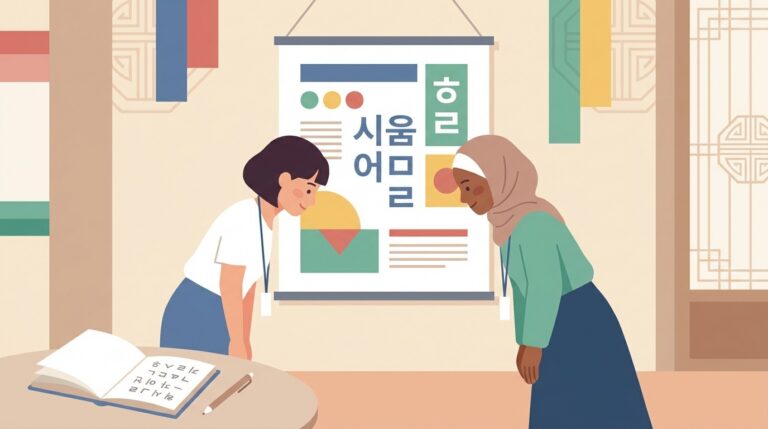
Mastering Korean Conference Networking: How to Discuss Research and Data Like a Native Researcher
Phase 1: 공감 (Empathy-Driven Opening)
안녕하세요! 매일한글 에디터입니다. (Hello! It’s your Daily Hangul editor!)
Picture this: You are standing in a bustling exhibition hall at COEX in Seoul or BEXCO in Busan. The air is thick with academic fervor, the aroma of conference hall drip coffee, and the constant hum of researchers exchanging slides and business cards. You’ve pinned your research poster to the board, adjusted your name tag, and took a deep breath. Suddenly, another researcher—a PhD candidate from another prominent Korean university—walks up to your board. They scan your methodology section, point gracefully toward your clean charts, and look at you with genuine curiosity:
“데이터 정제 과정에서 결측치 처리는 어떻게 하셨나요? 손이 꽤 많이 갔을 것 같은데요!” (Da-e-teo jeong-je gwa-jeong-e-seo gyeol-cheuk-chi cheo-ri-neun eo-tteo-ke ha-syeot-na-yo? Son-i kkwae man-i gat-eul geot gat-eun-de-yo! / How did you handle missing values during your data cleaning? That must have taken a tremendous amount of manual work!)
Your heart skips a beat. You know your data inside and out in English, but how do you express academic nuances, intellectual humility, and professional solidarity in Korean without sounding like a robotic translation tool? In Korean academia, networking is not just an exchange of information; it is an art of showing deep respect while building a warm, enduring alliance—often bonding over the shared tribulations of lab life and messy datasets. This guide was built directly from the feedback of international graduate students who navigated these very poster sessions. By the end of this guide, you will be equipped to network seamlessly, share methodologies, and make lifelong research peers in Korea!
Phase 2: 핵심 표현 3선 심층 분석 (Top 3 Core Expressions)
1. 데이터 정제할 때 결측치 처리는 어떻게 하셨나요?
- Pronunciation: [Dae-i-teo jeong-je-hal ttae gyeol-cbeuk-chi cheo-ri-neun eo-tteo-ke ha-syeot-na-yo?] (Sound analogy: Imagine saying “Day-tuh” followed by “jong-jeh” like a ringing bell, with “gyeol-cheuk-chi” sounding crisp like striking a light match).
- Meaning: Literal: “When purifying data, how did you treat missing values?” / Actual Nuance: “Could you walk me through your methodology for handling missing data points?”
- K-Culture Moment: In workplace and academic dramas like tvN’s Start-Up or JTBC’s Law School, characters pivot from casual introductions to razor-sharp professional inquiries using this exact polite interrogative ending (~는 어떻게 하셨나요?).
- Editor’s Insight: In Korean research culture, using domain-specific terms like 결측치 (missing values/data) and 정제 (cleaning/purification) immediately establishes your technical credibility. Pairing it with the polite honorific past tense -하셨나요? demonstrates immense respect for their effort.
- Situation Spectrum:
- Casual: 🚫 (Sounds overly formal for casual coffee talk with close friends)
- Semi-formal: ⚠️ (Appropriate if you already know the peer somewhat)
- Formal Academic: ✅ (100% ideal for conferences, poster sessions, and lab seminars)
- 🤔 Think About It: In English, you might casually ask “How’d you deal with missing data?” but in Korean, acknowledging the procedural effort (처리/정제) elevates the peer’s work as meaningful academic labor.
2. 손이 많이 가는 작업이었을 텐데, 노하우가 있으신가요?
- Pronunciation: [Son-i man-i ga-neun jak-eop-i-eoss-eul ten-de, no-ha-u-ga iss-eu-sin-ga-yo?]
- Meaning: Literal: “It must have been a job where the hands go often, but do you have know-how?” / Actual Nuance: “That must have taken so much painstaking manual effort—do you have any special insights or tips you used?”
- K-Culture Moment: Frequently heard in variety shows when a master chef or craftsman prepares an intricate dish (e.g., Paik Jong-won’s Alley Restaurant), praising the sheer devotion of the creator before asking for their secrets.
- Editor’s Insight: The idiom 손이 가다 (literally ‘hands go to it’) is deeply resonant in Korean culture. It honors the tedious, unglamorous hours spent cleaning data, labeling rows, or handling edge cases. By saying this, you validate the researcher’s hidden sweat and tears!
- Situation Spectrum:
- Casual: ✅ (Easily used when admiring a friend’s handmade project)
- Semi-formal: ✅ (Great for peer-to-peer networking)
- Formal Academic: ✅ (Builds immediate professional empathy with other researchers)
- 🤔 Think About It: Why does Korean emphasize physical body parts like “hands” (손이 많이 가다) or “feet” (발로 뛰다) to describe intellectual effort? What does this say about the value placed on diligence in Korean society?
3. 혹시 나중에 메일로 스크립트나 레퍼런스 공유 가능할까요?
- Pronunciation: [Hok-si na-jung-e me-il-lo seu-keu-rip-teu-na re-peo-reon-seu gong-yu ga-neung-hal-kka-yo?]
- Meaning: Literal: “By any chance later via email script or reference sharing is it possible?” / Actual Nuance: “Would you mind if I reached out by email later to exchange our scripts or reference materials?”
- K-Culture Moment: In office K-dramas like Misaeng or Agency, networking requests are always softened with 혹시 (by any chance) to prevent making the other party feel cornered or burdened.
- Editor’s Insight: Starting with 혹시 (Hok-si) is your golden social buffer. Asking for someone’s code or preprocessing pipeline directly can feel invasive. Framing it as a gentle inquiry opens the door for genuine scholarly collaboration.
- Situation Spectrum:
- Casual: ⚠️ (Slightly wordy for close friends)
- Semi-formal: ✅ (Excellent for fellow grad students)
- Formal Academic: ✅ (Polite, professional, and non-presumptuous)
- 🤔 Think About It: In Western networking, being direct (“Send me your script!”) is often viewed as efficient. In Korean academic circles, how does cushion phrasing reflect the concept of saving face (체면) and mutual comfort?
Phase 3: 교과서 한국어 vs 진짜 한국어 (Textbook vs. Real Native Korean)
Situation A: Explaining that preprocessing was tedious and difficult
- 📖 교과서 한국어: “데이터 전처리가 매우 힘들었습니다.” (Dae-i-teo jeon-cheo-ri-ga mae-u him-deul-eoss-seum-ni-da. / Data preprocessing was very difficult.)
- 🗣️ 진짜 한국어: “노이즈 제거하고 라벨링 맞추느라 애를 좀 먹었어요.” (No-i-jeu je-geo-ha-go ra-bel-ling mat-chu-neu-ra ae-reul jom meog-eoss-eo-yo. / I had quite a tough time filtering out noise and aligning the labels.)
- 💡 왜 다를까?: While the textbook version is grammatically correct, real graduate researchers speak in specifics. The idiomatic expression 애를 먹다 (to have a hard time / struggle with something) strikes the perfect balance between academic professionalism and relatable human vulnerability.
Situation B: Suggesting keeping in touch after the poster presentation
- 📖 교과서 한국어: “앞으로 지속적으로 연락을 취합시다.” (Ap-eu-ro ji-sok-jeok-eu-ro yeon-rak-eul chwi-hap-si-da. / Let us maintain contact continuously in the future.)
- 🗣️ 진짜 한국어: “앞으로 학회나 세미나에서 뵈면 커피 한잔하면서 교류해요!” (Ap-eu-ro hak-hoe-na se-mi-na-e-seo boe-myeon keo-pi han-jan-ha-myeon-seo gyo-ryu-hae-yo! / Whenever we bump into each other at conferences or seminars, let’s grab a coffee and catch up!)
- 💡 왜 다를까?: The textbook phrase sounds like an ultimatum from a 1980s corporate memo. In real Korean academic circles, networking revolves around friendly solidarity and the quintessential “coffee chat” (커피챗), making the interaction warm and inviting.
Phase 4: K-Culture 딥다이브 & 비언어적 매너 (Culture Deep Dive & Non-verbal Etiquette)
4-1. 눈치 (Nunchi) & Professional Gestures
- Addressing Peers as ‘선생님’ (Seonsaengnim): When networking with researchers from other universities whose exact age or academic year you don’t know, never call them 학생 (student) or 당신 (you). Address them as 선생님 (Teacher/Doctor). In Korean academia, 선생님 is the ultimate respectful, non-hierarchical honorific for fellow scholars.
- Poster Navigation with an Open Palm: Avoid pointing at charts or figures with a single index finger—it can look confrontational or overly critical. Instead, turn your hand flat with palm tilted slightly upward toward the chart as you explain.
- Business Card (명함) Exchange: When exchanging business cards or student lab cards, offer and receive the card with both hands. Spend at least 3–5 seconds reading their laboratory name and department before placing it neatly on your poster table or into a card case.
4-2. 문화 코드 분석: The Solidarity of ‘대학원생’ (Grad Student Life)
If you have watched K-dramas featuring researchers, you might have noticed how graduate students bond almost like soldiers who survived boot camp together. Korean academic culture shares an unspoken code of mutual empathy regarding 야근 (working late), debug nightmares, and advisor revisions. When you acknowledge how much effort preprocessing took, you transition from being a competitive stranger to a comrade in the academic trenches.
Phase 5: 실전 롤플레이 시나리오 (Interactive Roleplay Scenario)
- Location: Hall B Poster Exhibition Area, International AI & Data Science Symposium, Songdo Convensia.
- NPC: 박민우 선생님 (Minwoo Park, 4th-year PhD Candidate, Yonsei University Data Mining Lab).
Turn 1
박민우: “안녕하세요 선생님! 포스터 주제가 저희 연구실 관심사랑 비슷해서 유심히 보게 되었네요.”
[An-nyeong-ha-se-yo seon-saeng-nim! Po-seu-teo ju-je-ga jeo-hui yeon-gu-sil gwan-sim-sa-rang bi-seut-hae-seo yu-sim-hi bo-ge doe-eoss-ne-yo.]
(🎭 Bowing gently at 15 degrees, pointing with an open hand toward the methodology diagram)
“Hello! Your poster topic is very similar to what our lab focuses on, so I found myself reading it closely.”
Turn 2
학습자 (You): “아, 정말요? 관심 가져주셔서 감사합니다, 선생님. 편하게 둘러보세요!”
[A, jeong-mal-yo? Gwan-sim ga-jyeo-ju-syeo-seo gam-sa-hap-ni-da, seon-saeng-nim. Pyeon-ha-ge dul-leo-bo-se-yo!]
(🎭 Smiling warmly with a modest head nod)
“Oh, really? Thank you so much for your interest. Please feel free to look around comfortably!”
Turn 3
박민우: “특히 이 시계열 데이터 전처리 파트가 인상적인데요. 노이즈 제거할 때 결측치는 어떻게 처리하셨어요?”
[Teuk-hi i si-gye-yeol dae-i-teo jeon-cheo-ri pa-teu-ga in-sang-jeog-in-dae-yo. No-i-jeu je-geo-hal ttae gyeol-cheuk-chi-neun eo-tteo-ke cheo-ri-ha-syeot-eo-yo?]
(🎭 Leaning in slightly, showing genuine scientific curiosity)
“In particular, this time-series data preprocessing section is very impressive. When filtering noise, how did you handle the missing data points?”
Turn 4
학습자 (You): “이상치가 많아서 단순 보간 대신 칼만 필터랑 이동 평균을 조합해서 정제했습니다. 손이 꽤 많이 갔어요.”
[I-sang-chi-ga man-a-seo dan-sun bo-gan dae-sin kal-man pil-teo-rang i-dong pyeong-gyun-eul jo-hap-hae-seo jeong-je-haet-seum-ni-da. Son-i kkwae man-i gat-eo-yo.]
(🎭 Gesturing gently to Equation 3 on your poster)
“Because there were so many outliers, instead of simple imputation, I combined a Kalman filter with moving averages. It took quite a bit of manual tweaking.”
Turn 5
박민우: “와, 역시 그렇군요! 저희도 그 부분에서 애를 많이 먹었거든요. 파라미터 튜닝 노하우가 남다르신 것 같습니다.”
[Wa, yeok-si geu-reoh-gun-yo! Jeo-hui-do geu bu-bun-e-seo ae-reul man-i meog-eoss-geo-deun-yo. Pa-ra-mi-teo tyu-ning no-ha-u-ga nam-da-reu-sin geot gat-seum-ni-da.]
(🎭 Nodding emphatically with widespread eyes of validation)
“Wow, I knew it! We struggled with that exact problem too. Your parameter tuning know-how seems really exceptional.”
Turn 6
학습자 (You): “과찬이십니다. 여러 번 삽질하면서 겨우 잡았어요. 민우 선생님 랩에서는 어떤 방식을 쓰셨나요?”
[Gwa-chan-i-sip-ni-da. Yeo-reo beon sap-jjil-ha-myeon-seo gyeo-u jab-at-eo-yo. Min-u seon-saeng-nim raep-e-seo-neun eo-tteon bang-sik-eul sseu-syeot-na-yo?]
(🎭 Laughing softly with modest body posture, bouncing the inquiry back)
“You’re flattering me! I only managed it after tons of trial and error. What approach did your lab use, Minwoo?”
Turn 7
박민우: “저희는 딥러닝 기반 보간을 시도했는데 오버피팅이 심했어요. 혹시 나중에 실례가 안 된다면 메일로 연구 교류 좀 할 수 있을까요?”
[Jeo-hui-neun dip-reo-ning gi-ban bo-gan-eul si-do-haet-neun-de o-beo-pi-ting-i sim-haet-eo-yo. Hok-si na-jung-e sil-rye-ga an doen-da-myeon me-il-lo yeon-gu gyo-ryu jom hal su iss-eul-kka-yo?]
(🎭 Pulling out his business card case politely with both hands)
“We tried deep learning imputation, but suffered heavy overfitting. If it’s not too much trouble later, could we perhaps exchange research thoughts over email?”
Turn 8
학습자 (You): “당연하죠! 제 명함 여기 있습니다. 연락 주시면 전처리 스크립트 레퍼런스 정리해서 보내드릴게요!”
[Dang-yeon-ha-jyo! Je myeong-ham yeo-gi iss-seum-ni-da. Yeon-rak ju-si-myeon jeon-cheo-ri seu-keu-rip-teu re-peo-reon-seu jeong-ri-hae-seo bo-nae-deu-ril-ge-yo!]
(🎭 Handing over your card with both hands and a polite bow)
“Of course! Here is my card. If you send me a note, I’ll compile and send you our preprocessing script references!”
🔀 인터랙티브 분기점 (Interactive Branching Choices)
When Minwoo asks about your parameter tuning in Turn 5, how do you respond to continue the networking?
- Option A: “제가 원래 코딩을 잘해서 금방 했습니다. 다음 질문 있으신가요?” (I am inherently great at coding so I finished it quickly. Next question?)
- Feedback [Bad 🚫]: Highly arrogant! Korean academic culture prizes intellectual modesty. This completely shuts down any chance of networking or future co-authorship.
- Option B: “아니에요, 그냥 운이 좋았을 뿐입니다.” (No, I was just lucky.)
- Feedback [Risk ⚠️]: While humble, it kills the conversation. It provides zero technical insight and gives Minwoo nowhere to take the dialogue.
- Option C: “과찬이십니다. 여러 번 시행착오를 겪으면서 잡았어요. 선생님 랩에서는 어떤 파이프라인을 쓰셨나요?” (You flatter me. I tuned it after many trials and errors. What pipeline did your lab use, seonsaengnim?)
- Feedback [Best ✨]: Perfect! Demonstrates textbook Korean academic humility (과찬이십니다), shares honesty about trial and error, and politely invites the other scholar to discuss their work.
Phase 6: 10초 감정 섀도잉 드릴 (10-Second Emotion Shadowing Drill)
Practice these lines out loud. Pay attention to pauses marked by / and match the emotional cues!
[🤔 진지하고 학구적으로 / Inquiring Scholarly]
“데이터 정제할 때 / 결측치 처리는 / 어떻게 하셨나요?”
(Dae-i-teo jeong-je-hal ttae / gyeol-cheuk-chi cheo-ri-neun / eo-tteo-ke ha-syeot-na-yo?)-
[🤝 겸손하지만 자신감 있게 / Modest yet Confident]
“과찬이십니다 / 여러 번 삽질하면서 / 겨우 파라미터를 잡았어요.”
(Gwa-chan-i-sip-ni-da / yeo-reo beon sap-jjil-ha-myeon-seo / gyeo-u pa-ra-mi-teo-reul jab-at-eo-yo.) -
[☕ 반갑고 친근하게 / Warm and Welcoming]
“앞으로 학회에서 뵈면 / 커피 한잔하면서 / 더 깊게 교류해요!”
(Ap-eu-ro hak-hoe-e-seo boe-myeon / keo-pi han-jan-ha-myeon-seo / deo gip-ge gyo-ryu-hae-yo!)
Phase 7: K-Culture 미니 사전 (Mini Dictionary)
-
선생님 (Seon-saeng-nim)
Meaning: Teacher / Respected Scholar
Usage: Outside of schools, it is the safest, most professional honorific to address fellow researchers, doctors, and senior professionals without assuming age or status. -
전처리 (Jeon-cheo-ri)
Meaning: Preprocessing / Data Wrangling
Usage: Standard technical term used across all quantitative and computational fields in Korea. Often combined with words like 파이프라인 (pipeline) or 과정 (process). -
삽질 (Sap-jjil)
Meaning: Literally “shoveling”; Slang for “tedious trial-and-error” or “fruitless hard work.”
Usage: Universally used among Korean engineers, programmers, and grad students to describe spending hours debugging or testing failing models (삽질 많이 했어요). -
커피챗 (Keo-pi-chaet)
Meaning: Coffee Chat / Informal Networking Chat
Usage: Borrowed from startup and academic culture, this describes an informal 20-30 minute chat over coffee to explore collaboration or exchange industry advice.
Phase 8: 연구자를 위한 생존 키트 (Conference Survival Kit)
서바이벌 표현 TOP 3 (Top 3 Survival Expressions)
- “명함 한 장 교환할 수 있을까요?” (Myeong-ham han jang gyo-hwan-hal su iss-eul-kka-yo?)
Pro Tip: The smoothest way to initiate card exchange. Have your business cards readily accessible in a neat pocket! - “혹시 포스터 관련해서 질문 있으신가요?” (Hok-si po-seu-teo gwan-ryeon-hae-seo jil-mun iss-eu-sin-ga-yo?)
Pro Tip: Perfect icebreaker when a researcher has been scanning your poster for more than 15 seconds. - “발표 들어주셔서 대단히 감사합니다.” (Bal-pyo deul-eo-ju-syeo-seo dae-dan-hi gam-sa-hap-ni-da.)
Pro Tip: Use this polite closing whenever someone finishes listening to your 3-minute lightning summary.
Editor’s Travel Note: Conference Survival in Korea
- Mobile Map Navigation: Google Maps often lacks real-time walking routes and transit updates within Korea. Download and set up the 네이버 지도 앱 (Naver Map App) to find late-night study cafes, printing shops for emergency poster reprints, and good networking restaurants near conference venues like Songdo Convensia, COEX, or DCC Daejeon.
- Coffee Break Etiquette: Academic conference coffee breaks usually feature instant mix coffee sticks (Maxim Mocha Gold) alongside drip coffee. If you see a senior professor or your peer brewing a cup, offering to pass a paper cup sleeve or stir stick is an instant 눈치 (nunchi) bonus point!
Phase 9: “한 발 더 깊이” (Cultural Insight Essay)
In Western academia, intellectual equality is often signaled by immediate familiarity: professors and students call each other by first names, debate aggressively, and grab a beer. In Korea, however, equality and camaraderie among scholars are expressed through mutual elevation. By addressing a peer as 선생님 and describing your own breakthrough as the result of 삽질 (sweaty trial-and-error), you make room for the other person to shine without diminishing your own findings. Respect in Korean research is not distance; it is the ultimate form of intellectual hospitality.
💬 Your Turn: Have you ever experienced an awkward networking moment at an international conference? What is your favorite way to break the ice with researchers in your home country? Share your stories in the comments below!
Phase 10: FAQ & 오해 방지 (FAQ Schema)
Q: Can I address another PhD student as ‘선배님’ (Sunbaenim) if they are older or ahead of me?
A: Only if they attended the exact same university or department! Calling a researcher from another university 선배님 sounds overly presumptuous, as if you are forcing an alumnus connection. Stick strictly to 선생님 (Seonsaengnim) or their title [Name] 연구원님 / 박사과정 선생님.
Q: Is the slang word ‘삽질’ (Sapjjil) too informal to use with researchers I just met?
A: If you use it to describe your own exhausting process (“제가 삽질을 좀 많이 했습니다”), it is seen as delightfully humble, human, and charming! However, never use it to describe someone else’s work (“선생님 연구는 삽질이었네요”), which would be a colossal insult.
Q: How should I follow up via email after the conference?
A: Start by referencing the exact context: “지난 [Conference Name] 학술대회 포스터 세션에서 데이터 전처리 관련해 말씀 나누었던 [Your Name]입니다.” (This is [Your Name], who spoke with you regarding data preprocessing during the poster session at [Conference Name]).
🚨 흔한 실수 (Common Mistakes) 경고판
- Mistake: Calling fellow researchers “당신” (Dangsin) when asking “What do you think?”.
Correct Action: Avoid 당신 completely (it sounds accusatory in modern Korean). Instead use: “선생님께서는 어떻게 생각하시나요?” - Mistake: Receiving business cards with one hand and immediately shoving them into your back pants pocket.
Correct Action: Always accept with two hands, inspect the details thoughtfully, and rest the card gently on the poster table or inside a card case. - Mistake: Saying “제 논문은 완벽합니다” (My paper is perfect).
Correct Action: Frame discoveries humbly: “아직 부족한 점이 많지만, 유의미한 결과를 도출하려 노력했습니다.” (There are still many areas to improve, but I worked hard to derive meaningful results).
Phase 11: 액션 미션 & 참여 유도 (Action Missions)
- 🥉 Bronze Mission (Solo Practice): Stand in front of your mirror or research poster. Practice saying the sentence: “이상치가 많아서 전처리할 때 애를 좀 먹었습니다” five times smoothly without pausing.
- 🥈 Silver Mission (Social Sharing): Post a photo of your research notebook or code editor on Instagram or LinkedIn with the Korean hashtag
#연구스타그램or#데이터전처리and caption one insight using “손이 많이 가는 작업”! - 🥇 Gold Mission (Real Field Application): At your next lab meeting or seminar with Korean scholars, address a visiting presenter as 선생님 and ask them one methodological question using “~는 어떻게 처리하셨나요?”.
- 🎮 K-Culture Mission: Watch an episode of a science or legal K-drama (like Ghost Doctor or Melancholia). Listen carefully to how graduate assistants and researchers introduce their data to senior peers!
Phase 12: 인터랙티브 퀴즈 챌린지 (Interactive Quiz)
1. [상황 판단] A PhD researcher from Korea University approaches your poster and praises your neat data graph. What is the most culturally adept native response?
* (A) “네, 제가 천재라서 그렇습니다.” (Yes, because I am a genius.)
* (B) “과찬이십니다. 데이터 정제할 때 손이 많이 갔는데 좋게 봐주셔서 감사합니다.” (You flatter me. It required a lot of manual work during data cleaning, so thank you for looking upon it favorably.)
* (C) “별거 아닙니다. 5분 만에 끝냈어요.” (It’s nothing. I finished it in 5 minutes.)
2. [빈칸 채우기] Fill in the blank with the correct honorific title:
“혹시 ( ), 이번 학회 끝나고 메일로 논문 레퍼런스 공유 가능할까요?”
3. [True / False 문화 퀴즈]
* When exchanging business cards at a Korean academic conference, it is customary to put the card away immediately into your wallet without reading it so the other person does not feel self-conscious. (T / F)
👉 Click to view answers and explanations! (정답 및 해설 보기)
- Answer: (B) – (B) balances polite modesty (과찬이십니다) with professional appreciation (손이 많이 갔는데 좋게 봐주셔서 감사합니다). (A) is overly boastful, and (C) inadvertently diminishes the scholarly depth of your research.
- Answer: 선생님 (Seonsaengnim) – 선생님 is the gold-standard, polite honorific title for addressing fellow graduate researchers whose age or exact cohort you do not know.
- Answer: False (F) – Putting the card away instantly without reading it is considered dismissive! You should hold it with both hands, read their lab affiliation and name for a few seconds, and keep it resting respectfully in front of you.







