

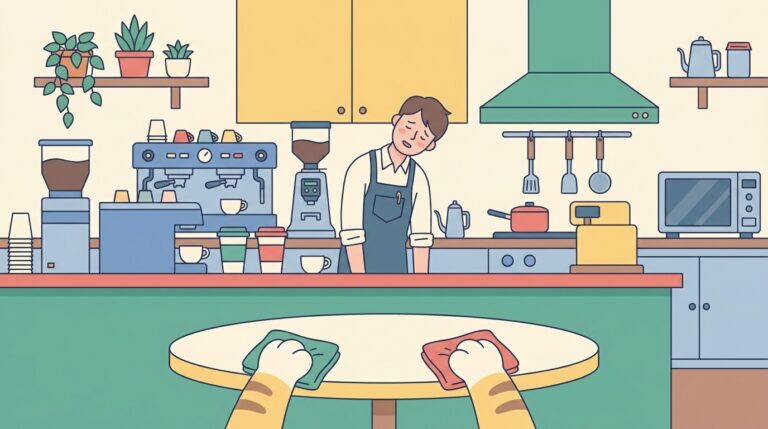
Drowning in Work? Master These Wild Korean Idioms for Being Crazy Busy
Phase 1: 공감 (Welcome to the Real Korean Rush)
안녕하세요! 매일한글 에디터입니다. (Hello! This is your Daily Hangul editor.)
Have you ever lived through one of those chaotic days where notifications won’t stop pinging, your inbox is overflowing, your to-do list resembles an ancient scroll, and your brain is about three seconds away from thermal shutdown? In English, you would casually sigh: “I’m swamped,” “I’m up to my neck in work,” or “I’m running around like a headless chicken.”
Yet, when foreign learners find themselves in this exact spot in Korea, almost everyone defaults to the exact same textbook sentence: “저는 오늘 너무 바빠요” (Jeoneun oneul neomu bappayo – I am very busy today). While grammatically flawless, it feels flat—like reading out of an instruction manual.
Imagine stepping into a packed K-BBQ restaurant during Friday evening dinner rush in Gangnam, or watching a behind-the-scenes episode of Jinny’s Kitchen (서진이네). The tickets are piling up, grease is sizzling, and the head chef gasps to the team: “아이고, 눈코 뜰 새 없이 바쁘네! 고양이 손이라도 빌리고 싶다!” (Aigo, nun-ko tteul sae eopsi bappeune! Goyangi son-irado billigo sipda!)
If you translate that word-for-word, you’d picture someone unable to open their nostrils while searching for a house cat to help flip pork belly! But in Korean, body-part idioms (신체 관용표현) are the lifeblood of day-to-day conversation. After coaching hundreds of international students through the real hustle of Korean workplaces and street life, I can guarantee you one thing: using these vivid phrases won’t just make you sound fluent—it will instantly turn you into an insider who truly understands Korean work camaraderie. Let’s master the art of being busy!
Phase 2: 핵심 표현 3선 심층 분석 (Top 3 Busyness Idioms)
1. 눈코 뜰 새 없이 바쁘다 (Nun-ko tteul sae eopsi bappeuda)
- Pronunciation:
[Nun-ko tteul sae eop-si ba-ppeu-da](Audio Analogy: Pronounce “Noon” like 12 PM, “Ko” like the start of Coca-Cola, “Tteul” like t-tool, and “Sae” like say). - Meaning: Literal: “So busy there’s not even a gap of time to open eyes and nose” | Actual: Overwhelmed with back-to-back tasks; utterly swamped.
- K-Culture Moment: Picture an emergency ward drama like Hospital Playlist where doctors sprint down hallways clutching cold iced Americanos with stethoscopes bouncing.
- Editor’s Insight: Why the nose? In classical Korean folk expressions, eyes and nose symbolized the primary sensory gates of the face. Being unable to “open” them means your senses are so hyper-focused on survival that you can’t even register the outside world!
- Situation Spectrum: Casual ✅ | Semi-formal ✅ | Formal ✅ (Universally respected across casual chatter, company Slack channels, and television news).
- 🤔 Think About It: In English, we say “I can’t even catch my breath.” Why do you think Korean culture ties peak productivity to a sensory blackout of eyes and nose?
2. 고양이 손이라도 빌리고 싶다 (Goyangi son-irado billigo sipda)
- Pronunciation:
[Go-yang-i son-i-ra-do bil-li-go sip-da](Audio Analogy: Sounds like “Go-yahng-ee son-ee-rah-doh bill-lee-go sheep-dah”). - Meaning: Literal: “I’d even want to borrow a cat’s paw” | Actual: Desperately short-handed; in need of any help possible, even if it’s practically useless.
- K-Culture Moment: Think of an aesthetic indie bakery vlog in Seongsu-dong where the solo owner is folding 200 pastry boxes, looking down at their sleeping Scottish Fold cat with a weary, affectionate chuckle.
- Editor’s Insight: Cats are notorious for doing zero chores. Wishing to borrow a tiny, soft cat paw emphasizes your comic desperation: “I know you’re useless at administrative spreadsheets, kitty, but I’m so desperate I’ll take anything!”
- Situation Spectrum: Casual ✅ | Semi-formal ⚠️ | Formal 🚫 (Best reserved for friendly colleagues, peers, or self-deprecating social media posts).
- 🤔 Think About It: Does your language use animals to express comical helplessness? What pet would symbolize lazy comfort in your country?
3. 손이 모자라다 / 일손이 부족하다 (Soni mojallada / Ilsoni bujokhada)
- Pronunciation:
[So-ni mo-ja-ra-da / Il-so-ni bu-jok-ha-da](Audio Analogy: “Son” sounds like ‘sewn’, followed by ‘mo-jah-rah-dah’). - Meaning: Literal: “Hands are lacking / Labor-hands are insufficient” | Actual: Understaffed; short-handed.
- K-Culture Moment: In holiday family dramas during Chuseok, mothers and grandmothers frying mountains of savory pancakes (jeon) yell into the living room: “얘들아, 일손이 모자라니까 와서 좀 도와라!” (Hey kids, we’re short-handed, come help out!)
- Editor’s Insight: In Korean, “손” (hand) represents human labor, generosity (e.g., 손이 크다 – generous host), and influence (e.g., 발이 넓다 – well-connected). When hands are lacking, it’s not a solitary issue; it’s an urgent call for communal support.
- Situation Spectrum: Casual ✅ | Semi-formal ✅ | Formal ✅ (The standard professional expression for operational staffing shortages).
- 🤔 Think About It: English uses “all hands on deck,” but Korean uses “hands” to describe generosity, connection, and craft. How does viewing people as “helping hands” reshape team culture?
Phase 3: 교과서 한국어 vs 진짜 한국어 (Textbook vs Real Korean)
Situation 1: Declining an invitation because you are buried under deadlines
- 📖 교과서 한국어: 저는 오늘 회사 업무가 너무 많아서 갈 수 없습니다. (Jeoneun oneul hoesa eommuga neomu manhaseo gal su eopseumnida. – I cannot attend because I have excessive company business today.)
- 🗣️ 진짜 한국어: 오늘 마감이라 진짜 눈코 뜰 새 없이 바빠서 못 갈 것 같아요 ㅠㅠ (Oneul magam-ira jinjja nun-ko tteul sae eopsi bappeoseo mot gal geot gat-ayo. – Today is deadline day so I’m crazy swamped without a breather, I really don’t think I can make it!)
- 💡 왜 다를까?: The textbook version sounds like a canned automated rejection letter. Native Koreans soften bad news by sharing the emotional frenzy of their day, which elicits instant empathy rather than offense.
Situation 2: Asking a teammate for temporary backup during a rush
- 📖 교과서 한국어: 사람이 적으니 저를 도와주십시오. (Sarami jeogeuni jeoreul dowajusipsio. – People are few, so please assist me.)
- 🗣️ 진짜 한국어: 지금 일손이 너무 모자란데 딱 10분만 고양이 손이라도 보태줄 수 있어요? (Jigeum ilsoni neomu mojaran-de ttak sip-bun-man goyangi son-irado botaejul su isseoyo? – We’re super short-handed right now; could you lend a quick hand for literally 10 minutes?)
- 💡 왜 다를까?: Direct demands can feel abrasive in harmonious workplace cultures. Using the charming “cat’s paw” metaphor breaks the tension while clearly signaling urgency.
Phase 4: K-Culture 딥다이브 & 비언어적 매너 (Nunchi & Culture)
4-1. 눈치 (Nunchi) & Body Language in the Rush
When an office, kitchen, or production set is in full “눈코 뜰 새 없는” mode, silence and kinetic body language take over. If you see a Korean coworker rapidly tucking hair behind their ears, aggressively rolling up their sleeves (팔소매 걷기), or exhaling in short rhythmic puffs while typing, do not initiate casual small talk.
This is where your Nunchi (social radar) shines. Never ask open-ended questions like “So, what should I do?” which forces an already overwhelmed person to spend mental energy delegating. Instead, handle micro-tasks quietly: grab fresh printer paper, hand them an unopened cold beverage with two hands, or organize empty delivery boxes.
4-2. The Cultural Roots of “Palli-Palli” (빨리빨리)
Korea’s legendary Palli-Palli (hurry, hurry) pace isn’t just about impatience; it stems from a historical survival ethos. Historically, agrarian villages survived harsh seasons through 품앗이 (Pum-asi)—the unconditional sharing of collective seasonal labor. When a neighbor’s harvest was threatened, everyone dropped what they were doing to help. When modern Koreans say they want to borrow a cat’s paw, they are subconsciously tapping into this ancient communal spirit: “We are in this crunch together.”
Phase 5: 실전 롤플레이 시나리오 (Real-Life Roleplay)
Setting: Cafe Seongsu, a boutique espresso bar on a Saturday afternoon during a viral strawberry croissant launch.
Characters:
* Minji (민지): Shift manager, dual-wielding portafilters with flour dusting her apron.
* Alex (알렉스 – You): Intermediate barista working your second weekend shift.
- 민지: 알렉스 씨, 지금 대기 번호 35번까지 밀렸어요! (Alex, we have 35 queued orders right now!)
🎭 [Minji pulls four espresso shots simultaneously, hair tucked back with flustered urgency] - 알렉스: 헉, 진짜 눈코 뜰 새 없이 바쁘네요! 뭐부터 도울까요? (Heok, jinjja nun-ko tteul sae eopsi bappeuneyo! Mwo-buteo doulkkayo? – Whoa, it’s crazy swamped without a breather! What should I tackle first?)
🎭 [Alex grabs a clean bar towel and immediately steps into station posture] - 민지: 지금 픽업대 포장할 일손이 너무 모자라요. (Jigeum pik-eop-dae pojang-hal ilsoni neomu mojallayo. – We’re severely short-handed packaging to-go orders at the pickup counter.)
🎭 [Minji points with her chin toward a tower of pastry boxes while steaming oat milk] - 알렉스: 알겠습니다! 포장은 제가 번개처럼 끝낼게요. (Algetseumnida! Pojangeun jega beongae-cheoreom kkeunnaelgeyo. – Understood! I’ll wrap those up at lightning speed.)
🎭 [Alex swiftly folds takeout boxes and matches receipts with precision] - 민지: 고마워요. 주말 성수동은 진짜 고양이 손이라도 빌리고 싶은 심정이에요. (Gomawoyo. Jumal Seongsu-dongeun jinjja goyangi son-irado billigo sipeun simjeong-ieyo. – Thank you. Seongsu-dong weekends genuinely make me feel like borrowing a cat’s paw.)
🎭 [Minji wipes brow with her wrist and offers Alex a warm, grateful grin] - 알렉스: 제 손이 고양이 손보다 훨씬 쓸모있게 해드릴게요, 매니저님! (Je soni goyangi son-boda hwolssin sseulmo-itge haedeurilgeyo, maenijeo-nim! – I’ll make sure my hands are way more useful than a cat’s paws, Manager!)
🎭 [Alex smiles playfully while sliding a neatly folded pastry bag to the counter] - 민지: 하하! 그 말 들으니 든든하네요. 우리 이 러시만 넘기고 커피 한 잔 마셔요! (Haha! Geu mal deureuni deundeunhaneyo. Uri i reosiman neomgigo keopi han jan masyeoyo! – Haha! Hearing that is so reassuring. Let’s power through this rush and take a coffee break!)
🎭 [Minji rings the order pickup bell with renewed energy] - 알렉스: 네, 파이팅! 다음 주문 준비 완료입니다! (Ne, paiting! Daeum jumun junbi wanryo-imnida! – Yes, fighting! Next order is prepped and ready!)
🎭 [Alex hands the package to the smiling customer with both hands]
🔀 Interactive Branching Point
During the peak rush, Minji accidentally drops a stainless milk pitcher on the floor with a loud CLANG. What do you do?
* Option A: “매니저님, 제가 치울 테니 음료 계속 만드세요! 눈코 뜰 새 없는 거 다 알아요.” (Manager, I’ll clean this up, keep crafting the drinks! I know we don’t have a second to breathe.)
* Option B: “너무 바쁘시면 주문을 잠시 멈추셔야 하는 거 아니에요?” (If you’re this busy, shouldn’t you pause the orders?)
* Option C: “고양이 손 빌려오면 되니까 걱정 마세요!” (Don’t worry, we can just borrow a cat’s paw!)
Outcome Feedback:
* Choice A (Best): 🏆 Flawless! You handled the immediate obstacle without halting workflow and validated her stress using natural idioms. Ultimate nunchi mastery.
* Choice B (Bad): ❌ Critical workplace faux pas. Questioning store operations during an active crunch feels condescending and kills team morale.
* Choice C (Risk): ⚠️ Mild risk. While witty, cracking jokes while sticky milk pools on someone’s shoes during an active rush can sound dismissive.
Phase 6: 10초 감정 섀도잉 드릴 (10-Second Emotional Shadowing)
Pay attention to the rhythm pauses marked with / and mimic the emotional tags! Repeat each sentence three times out loud.
[😫 Exhausted & Drowning]
요즘 / 마감 프로젝트 때문에 / 눈코 뜰 새 없이 / 바빠 죽겠어요!
(Yojeum / magam peurojekteu ttaemune / nun-ko tteul sae eopsi / bappa jukgesseoyo!)
“Lately / due to the deadline project / I’m so breathless / I could literally die of busyness!”-
[🥺 Playful Desperation]
매장에 일손이 너무 부족해서 / 지금은 / 고양이 손이라도 / 빌리고 싶어요.
(Maejange ilsoni neomu bujokhaeseo / jigeumeun / goyangi son-irado / billigo sipeoyo.)
“We’re so understaffed in the store / that right now / I’d honestly / borrow a cat’s paws.” -
[💪 Reliable & Encouraging]
일손이 모자라면 / 언제든 편하게 말씀하세요 / 제가 바로 도와드릴게요!
(Ilsoni mojallamyeon / eonjedeun pyeonhage malsseumhaseyo / jega baro dowadeurilgeyo!)
“If you’re short-handed / tell me comfortably anytime / I will back you up instantly!”
Phase 7: K-Culture 미니 사전 (Core Vocabulary)
- 일손 (Il-son) | Noun | Hands of labor; active human workforce.
- Real-world usage: Used widely in hospitality, startup crunches, and seasonal agriculture (e.g., “농번기라 일손이 귀해요” – It’s harvest season so labor is precious).
- 마감 (Ma-gam) | Noun | Deadline; store closing.
- Real-world usage: Whether it’s an urgent graphic design deadline or a restaurant’s last order, shouting “마감 러시!” signals peak focus.
- 러시 (Reo-si) | Noun (Konglish) | The rush hour peak.
- Real-world usage: Baristas and retail staff constantly refer to the 12:00–1:00 PM post-lunch crowd as the “점심 러시” (lunch rush).
- 품앗이 (Pum-a-si) | Noun | Traditional community labor exchange.
- Real-world usage: In modern offices, helping a colleague design slides today knowing they will debug your code tomorrow is playful corporate pum-asi.
Phase 8: 여행자를 위한 생존 키트 (Traveler’s Survival Kit)
Top 3 Survival Phrases for Busy Spots
- 지금 주문이 밀려서 시간이 좀 걸려요. (Jigeum jumuni millyeoseo sigani jom geollyeoyo.)
Meaning: “Orders are backed up right now, so it will take a little time.”
Pro Tip: Hear this from a server? Take a seat and chill—your food is coming, they are just in the thick of a rush! - 천천히 주셔도 괜찮아요! (Cheoncheonhi jusyeodo gwaenchanayo!)
Meaning: “Take your time, it’s totally okay!”
Pro Tip: Say this to an elderly sole proprietor sweating over a stove during lunchtime. You will immediately get extra side dishes (service). - 제가 뭐 좀 도와드릴까요? (Jega mwo jom dowadeurilkkayo?)
Meaning: “Can I help you with anything?”
Pro Tip: The ultimate polite question at guesthouses or neighborhood community spaces.
Editor’s Travel Note
If you find yourself navigating Seoul during rush hours (8:00 AM–9:00 AM and 6:30 PM–7:30 PM), line 9 and Gangnam stations turn into literal human rivers. To avoid being swept away, check live train congestion maps on the Kakao Metro App on Google Play before descending into the station. At convenience store checkouts during rush periods, unlock your mobile pay or hold your T-Money card ready in hand—keeping lines moving is considered high-level city etiquette!
Phase 9: 한 발 더 깊이 (Critical Thinking Essay)
Korea’s modern economy rocketed from post-war poverty to high-tech prominence within a single generation, crystallizing the famed Palli-Palli speed into national character. Yet beneath the frantic pursuit of efficiency lies an unspoken human covenant: extreme speed requires intense community synchronicity. When a Korean colleague admits that they cannot open their eyes or nose, or jokingly asks for a kitten’s paw, they are not lodging a bureaucratic complaint. They are offering an honest, vulnerable bid for connection—inviting you to step into the fray alongside them.
💬 Your Turn: In your home country, what sensory body idioms or animal sayings do people use when work gets out of hand? Share your native phrases in the comments below!
Phase 10: FAQ & 오해 방지 (FAQ Schema)
Q: Can I use ‘고양이 손이라도 빌리고 싶어요’ in an executive business meeting?
A: No. It is far too casual and whimsical for high-level boardroom presentations or contract negotiations. In formal corporate contexts, use “현재 가용 인력이 부족한 상황입니다” (Hyeonjae gayong ilryeogi bujokhan sanghwang-imnida – Currently, available personnel is insufficient). Save the cat paws for coffee breaks and peer chats!
Q: Is ‘눈코 뜰 새 없이 바쁘다’ appropriate in written Korean?
A: Yes! Unlike the cat’s paw idiom, 눈코 뜰 새 없다 is an official standard Korean idiom. You will routinely see it printed in newspaper headlines such as “명절을 앞두고 눈코 뜰 새 없는 택배 물류센터” (Courier logistics centers swamped ahead of holidays).
Q: Does ‘손이 크다’ mean having big hands to do lots of work?
A: No! This is a massive trap for foreign learners. 손이 크다 means someone is extraordinarily generous—especially someone who cooks enormous banquet portions or gives extravagant gifts. If you lack workers, use 손이 모자라다!
🚨 Common Mistakes Watchlist
- Saying “손이 없어요” (Soni eopseoyo):
Error: Translating “I don’t have hands/help” literally.
Correction: In Korean, saying “손이 없어요” literally implies you have no physical hands! Always say “손이 부족해요” or “일손이 모자라요”. - Mispronouncing “눈코” as “Noon-go”:
Error: Softening the aspirated [kʰ] sound.
Correction: Pronounce the 코 with a sharp, crisp puff of air like the English word “Coat”. - Using “고양이 손” to insult someone:
Error: Telling a colleague “당신은 고양이 손이에요” (You are a cat’s paw) to imply they are unhelpful.
Correction: This idiom is only used to express your own desire for help, never as an insult toward another person’s competence!
Phase 11: 액션 미션 & 참여 유도 (Action Missions)
- 🥉 Bronze Mission (Solo Mastery): Record a 10-second voice memo on your phone saying: “오늘 마감이라 눈코 뜰 새 없이 바빠요!” Listen back and check your rhythm.
- 🥈 Silver Mission (Social Challenge): Take a photo of your messy desk, study notes, or busy workspace and post it to Instagram Stories or Threads with the caption: “고양이 손이라도 빌리고 싶은 하루 🐾 #DailyHangul #KoreanIdioms”.
- 🥇 Gold Mission (Real-World Test): Next time you order at a busy Korean cafe or restaurant, offer a bright smile and say to the busy clerk: “바쁘신데 감사합니다!” (Thank you for your hard work while so busy!).
- 🎮 K-Culture Mission: Watch any reality cooking show (like Jinny’s Kitchen or The Backpacker Chef) and see if you can spot the cast muttering about lacking hands (일손) during prep!
Phase 12: 인터랙티브 퀴즈 챌린지 (Interactive Quiz)
- Situational Judgment: You are talking to a colleague over lunch and want to express that your department desperately needs two more interns because everyone is drowning in paperwork. Which phrase fits best?
- A) 우리 부서는 지금 손이 너무 커요.
- B) 우리 부서는 요즘 눈코 뜰 새 없이 바빠서 일손이 너무 모자라요.
- C) 우리 부서는 고양이 손을 다 팔았어요.
- Fill-in-the-blank: Complete the popular expression:
너무 바빠서 ( ) 손이라도 빌리고 싶을 지경이에요. -
True / False: The phrase “눈코 뜰 새 없이 바쁘다” is pure modern slang invented on internet forums and cannot be used in professional newspapers.
👉 Click here to reveal answers & explanations!
-
Correct Answer: B
Explanation: B naturally pairs the sensory idiom (눈코 뜰 새 없이 바쁘다) with the shortage of personnel (일손이 모자라다). Option A means your department is overly generous, and Option C is nonsensical. -
Correct Answer: 고양이 (Goyangi – Cat)
Explanation: The full idiom is “고양이 손이라도 빌리고 싶다” (wishing to borrow even a cat’s paw). -
Correct Answer: False
Explanation: “눈코 뜰 새 없이 바쁘다” is a registered standard Korean idiom with centuries of folk history, widely used in professional broadcasting and journalism.







