

Phase 1: Empathy & Story Opening
안녕하세요! 매일한글 에디터입니다. (Hello! I’m your Daily Hangul editor.)
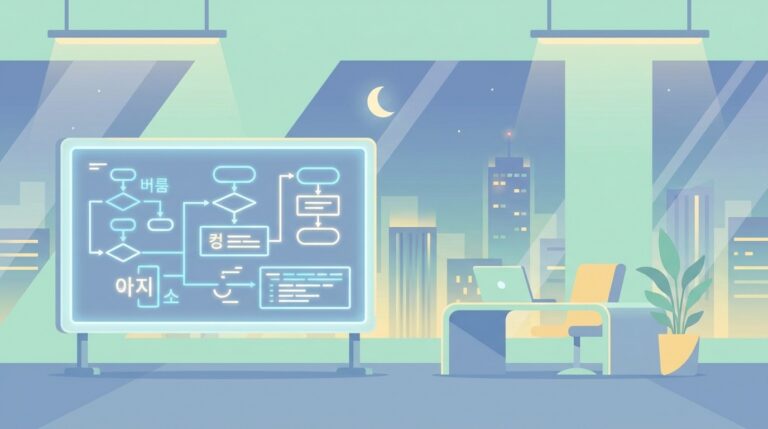
Picture this: It’s 11:30 PM in a high-rise office nestled inside Pangyo Techno Valley—South Korea’s pulsating Silicon Valley. Empty iced Americano cups clutter the glass whiteboard table. You and your engineering cohort are hitting a wall: your advanced agentic workflow keeps stumbling on complex algorithm generation whenever it relies on zero-shot instincts. A fellow lead engineer drops his marker, rubs his temples, and sighs: “우리 너무 즉답에만 매달리지 말고, 추론 시점 연산을 늘려 생각의 사슬을 단계별로 밟아봅시다.” (Let’s not cling to instant answers; let’s expand test-time compute and trace the chain of thought step by step.)
Navigating C2-level technical and intellectual Korean requires far more than memorizing textbook jargon. It demands understanding how Koreans articulate deep deliberation, intellectual pacing, and structured problem-solving. This guide is crafted directly from field debriefs with top-tier bilingual machine learning practitioners in Seoul.
Phase 2: Key Expressions Deep Dive
1. 단번에 결론짓기보다, 단계별로 짚어가며 검증해 보죠.
- Pronunciation: [Dan-beon-e gyeol-lon-jit-gi-bo-da, dan-gye-byeol-lo ji-peo-ga-myeo geom-jeung-hae bo-jyo] (Think: Dahn-bun-eh gyul-lon-jit-ghee-bo-dah, dahn-gyeh-byul-lo jee-puh-gah-myuh gum-jeung-hae bo-jyo)
- Meaning: Literal: “Rather than concluding in one shot, let’s point out and verify step by step.” / Real Nuance: “Instead of forcing an immediate zero-shot answer, let’s leverage sequential step-by-step verification (Chain-of-Thought).”
- K-Culture Moment: You’ll hear this in boardroom scenes of tech K-dramas like Start-Up when the brilliant CTO reins in impulsive founders.
- Editor’s Insight: The verb ‘짚어가다’ (to touch upon or trace sequentially) is an elegant C2 idiom indicating deliberate, calculated reflection.
- Situation Spectrum: Casual: ⚠️ | Semi-formal: ✅ | Formal: ✅
- 🤔 Think About It: Does your native tongue have a distinct phrasing for moving from intuitive “System 1” reaction to structured “System 2” analysis?
2. 생각의 결을 펼쳐놓고 따져봐야 실타래가 풀립니다.
- Pronunciation: [Saeng-gag-ui gyeo-reul pyeol-chyeo-no-ko tta-jyeo-bwa-ya sil-tta-rae-ga pul-lim-ni-da] (Think: Saeng-gahk-ee gyul-eul pyul-chyu-no-koh ttah-jyuh-bwah-yah sheel-ttah-rae-gah pool-leem-nee-dah)
- Meaning: Literal: “Only when we spread out the grain of thoughts and scrutinize them does the tangled yarn unravel.” / Real Nuance: “Expanding the reasoning space allows us to disentangle convoluted architectural and mathematical bottlenecks.”
- K-Culture Moment: A classic phrase used by senior Korean researchers or professors during peer reviews when debugging complex model logic.
- Editor’s Insight: ‘결’ (grain/texture) metaphorically conveys the natural trajectory of logic, while ‘실타래가 풀리다’ (the yarn unrolls) denotes breakthrough resolution.
- Situation Spectrum: Casual: ⚠️ | Semi-formal: ✅ | Formal: ✅
- 🤔 Think About It: How does visualizing thoughts as a physical “texture” influence how calmly an engineering team approaches debugging?
3. 추론 시간을 충분히 확보해야 허상을 걸러낼 수 있어요.
- Pronunciation: [Chu-ron si-ga-neul chung-bun-hi hwak-bo-hae-ya heo-sang-eul geol-leo-nael su i-sseo-yo] (Think: Choo-rohn shee-gahn-eul choong-boon-hee hwahk-boh-hae-yah huh-sahng-eul gul-luh-nael soo ee-ssuh-yoh)
- Meaning: Literal: “Only when securing sufficient inference time can we filter out illusions.” / Real Nuance: “Scaling test-time compute is mandatory to prune hallucinations and false-positive code sequences.”
- K-Culture Moment: Echoed across Pangyo coffee shops during post-mortems after an AI agentic demonstration either shined or failed.
- Editor’s Insight: ‘허상’ (illusion/phantom) is the sophisticated, intellectual Korean counterpart for technical hallucinations.
- Situation Spectrum: Casual: ⚠️ | Semi-formal: ✅ | Formal: ✅
- 🤔 Think About It: Contrast the word “hallucination” with ‘허상’—notice how ‘허상’ captures a philosophical falsity rather than just an error.
Phase 3: Textbook Korean vs. Real Korean
Situation 1: Calling for Step-by-Step Chain-of-Thought Deliberation
- 📖 교과서 한국어: 하나씩 순서대로 깊이 생각해보겠습니다. (Hanassik sunseodaero gipi saenggakhaebogessseumnida.) — “I will think deeply one by one in order.”
- 🗣️ 진짜 한국어: 생각의 사슬을 차근차근 펼쳐서 자체 검증을 거쳐야죠. (Saenggagui saseureul chageunchageun pyeolchyeoseo jache geomjeungeul geochyeoyajyo.) — “We should unravel the chain of thought step by step and pass it through self-verification.”
- 💡 왜 다를까? Textbook phrases sound like an elementary school pledge. Sophisticated native engineers utilize terms like ‘생각의 사슬’ (Chain-of-Thought) and ‘차근차근’ (methodically) to convey nuanced intellectual rigor.
Situation 2: Cautioning Against Rushed Intuitive Responses (System 1 vs System 2)
- 📖 교과서 한국어: 너무 빨리 대답하면 틀리기 쉽습니다. (Neomu ppalli daedaphamyeon teulligi swipsumnida.) — “If you answer too quickly, it is easy to be wrong.”
- 🗣️ 진짜 한국어: 직관적 응답에만 기대면 고난도 수식에서 겉돌아요. 추론 연산량을 더 태워야 합니다. (Jikgwanjeok eungdabe-man gidaemyeon gonando susigeseo geotdorayo. Churon yeonsanryangeul deo taewoya hamnida.) — “Relying purely on intuitive answers causes the model to skate on the surface of high-difficulty formulas; we must burn more test-time compute.”
- 💡 왜 다를까? C2 native discourse in tech relies on dynamic, vivid verbs like ‘겉돌다’ (to spin wheels superficially) and ‘연산량을 태우다’ (to burn/allocate compute cycles).
Phase 4: K-Culture Deep Dive & Non-verbal Manners
4-1. 눈치 (Nunchi) & Whiteboard Etiquette
In a high-stakes Korean research setting, intellectual pacing is communicated bodily. When an engineer suggests scaling test-time compute rather than quick answers, blurted interruptions come across as brash. Instead, master the “심사숙고의 끄덕임” (deliberative nod): slow nodding while resting your thumb under your jaw. When stepping up to the whiteboard to illustrate an inference path, hold the marker capped, make brief eye contact with the team lead, and declare, “자, 논리의 흐름을 천천히 짚어보죠” (Now, let’s steadily trace the flow of logic). This honors team harmony while steering them away from rushed mistakes.
4-2. The Cultural Shift: Beyond “Ppalli-Ppalli”
Korea’s corporate mythology is famous for “빨리빨리” (hurry, hurry). However, modern Korean tech culture is spearheading a profound counter-movement: “정교한 숙고” (exquisite contemplation). In the era of LLM foundational engineering, instant output without deep inference leads to catastrophic hallucinations. High-level professionals in Korea now view deliberate pauses and step-by-step verification not as delays, but as the pinnacle of elite craftsmanship.
Phase 5: Real-World Roleplay Scenario
Setting: A late-night glass-walled conference room at an AI startup in Pangyo. Min-woo, the Principal Research Scientist, is analyzing a benchmark test where their reasoning model failed a complex Olympiad mathematics problem.
- Turn 1 (Min-woo): [고개를 갸웃거리며 모니터를 가리킨다] 이번 벤치마크에서 수학 코딩 점수가 왜 이렇게 주저앉았을까요? (Ibeon benchimakeueseo suhak koding jeomsuga wae ireoke jujeoanj-asseulkkayo?)
🎭 Stage Direction: Tilting head slightly, pointing with a stylus at the dip in the benchmark curve.
“Why did our math coding score collapse like this in this benchmark?” -
Turn 2 (You): 모델이 직관적 패턴 매칭으로 서둘러 정답 토큰을 생성하려다 꼬인 것 같습니다. (Moderi jikgwanjeok paeteon maeching-euro seodulleo jeongdap tokeuneul saengseongharyeoda kkoin geot gatseumnida.)
🎭 Stage Direction: Speaking evenly while calmly sliding an inference trace graph forward.
“It seems the model got tangled up trying to generate the answer token prematurely via intuitive pattern matching.” -
Turn 3 (Min-woo): 즉각적인 응답인 시스템 1 방식의 한계에 봉착했다는 뜻이군요. (Jeukgakjeogin eungdabin siseutem il bangsik-ui hangyee bongchakhaetdaneun tteus-igun-yo.)
🎭 Stage Direction: Crosses arms, nodding pensively.
“So you mean we’ve hit the wall of the immediate System 1 response modality.” -
Turn 4 (You): 맞습니다. 단번에 결론짓기보다 추론 시점 연산을 늘려 생각의 사슬을 전개해야 합니다. (Matseumnida. Danbeone gyeollonjitgiboda churon sijeom yeonsaneul neullyeo saenggagui saseureul jeongaehaeya hamnida.)
🎭 Stage Direction: Uncapping marker, drawing a branching multi-path tree on the board.
“Exactly. Rather than jumping to conclusions in one shot, we must scale test-time compute to unfold the chain of thought.” -
Turn 5 (Min-woo): 추론 시간을 확장하면 중간 단계에서 스스로 오류를 역추적해 검증할 수 있을까요? (Churon siganeul hwakjanghamyeon junggan dangyeseo seuseuro oryureul yeokchujeokhae geomjeunghal su isseulkkayo?)
🎭 Stage Direction: Leaning forward, eyes sharpening with interest.
“If we scale inference time, can it backtrack and verify intermediate errors autonomously?” -
Turn 6 (You): 물론입니다. 생각의 결을 펼쳐놓고 따져봐야 깊은 수학적 실타래가 풀릴 테니까요. (Mollon-imnida. Saenggagui gyeoreul pyeolchyeono-ko ttajyeobwaya gipeun suhakjeok silttaraega pullil tenikkayo.)
🎭 Stage Direction: Writing down the verification step with a clear, firm stroke.
“Undoubtedly. Only when the texture of logic is laid bare can we disentangle profound mathematical knots.” -
Turn 7 (Min-woo): 좋습니다. 그럼 당장 서브루틴에 자가 검증 루프와 추론 연산 확장을 반영합시다. (Jotseumnida. Geureom dangjang seoburutine jaga geomjeung rupeuwa churon yeonsan hwakjangeul banyeonghapsida.)
🎭 Stage Direction: Smiling warmly with a decisive tap on the desk.
“Excellent. Let’s immediately implement the self-verification loop and test-time compute scaling into the subroutine.” -
Turn 8 (You): 네, 그렇게 설계하면 까다로운 엣지 케이스 코드도 탄탄하게 뽑아낼 수 있습니다. (Ne, geureoke seolgyehamyeon kkadaro-un etji ke-iseu kodeodo tantanhage ppobanael su itseumnida.)
🎭 Stage Direction: Bowing head gently with professional confidence.
“Yes, with that architecture, we can reliably generate even the most treacherous edge-case code.”
🔀 Interactive Decision Point
How would you formulate your concluding synthesis to Min-woo to solidify the architecture pivot?
- Option A: “그냥 파라미터 큰 모델을 쓰면 다 해결되니 모델을 키우시죠.” (Geunyang paramiteo keun modereul sseumyeon da haegyeoldoeni modereul kiusijyo.)
- Option B: “추론 시간 연산 확장을 통해 모델 스스로 사유하고 교정할 시간을 확보해 주는 편이 효율적입니다.” (Churon sigan yeonsan hwakjangeul tonghae model seuseuro sayuhago gyojeonghal siganeul hwakbohae juneun pyeoni hyoyuljeogimnida.)
- Option C: “코딩은 감이니까 일단 프롬프트 몇 개 더 넣고 결과를 지켜보겠습니다.” (Koding-eun gaminikka ildan peurompeuteu myeot gae deo neoko gyeolgwaryul jikyeobogessseumnida.)
Feedback:
* Option A (Risk): Naively recommends scaling pre-training parameters without addressing test-time reasoning bottlenecks. Inefficient and tone-deaf.
* Option B (Best!): Flawless C2 phrasing utilizing high-register terms (‘사유하다’, ‘교정하다’, ‘확보하다’) while directly capturing test-time compute expansion.
* Option C (Bad): Suggests coding is “just intuition” (‘감’), showing zero understanding of formal verification or reasoning architectures.
Phase 6: 10-Second Emotional Shadowing Drill
Practice the cadence, pause points (/), and authentic workplace emotional coloring.
[🤔 신중하고 차분하게 - Deliberate & Calm]
단번에 결론짓기보다, / 단계별로 짚어가며 / 검증해 보죠.
(Dan-beon-e gyeol-lon-jit-gi-bo-da, / dan-gye-byeol-lo ji-peo-ga-myeo / geom-jeung-hae bo-jyo.)-
[💡 통찰력과 확신에 차서 - Insightful & Confident]
생각의 결을 펼쳐놓아야 / 꼬여있던 실타래가 / 비로소 풀립니다.
(Saeng-gag-ui gyeo-reul pyeol-chyeo-no-a-ya / kko-yeo-it-deon sil-tta-rae-ga / bi-ro-so pul-lim-ni-da.) -
[🧐 분석적이고 결단력 있게 - Analytical & Decisive]
추론 시간을 충분히 확보해야 / 알고리즘의 허상을 / 확실히 걸러낼 수 있어요.
(Chu-ron si-ga-neul chung-bun-hi hwak-bo-hae-ya / al-go-ri-jeum-ui heo-sang-eul / hwak-sil-hi geol-leo-nael su i-sseo-yo.)
Phase 7: K-Culture Mini Dictionary
- 추론 시간 연산 확장 (Churon Sigan Yeonsan Hwakjang) | Scaling Test-Time Compute | Crucial terminology in modern Korean machine learning labs to describe allocating computational resources at inference rather than just training.
- 생각의 사슬 (Saenggagui Saseul) | Chain of Thought (CoT) | Widely used both colloquially and academically in Korea to describe explicit, step-by-step reasoning paths.
- 심사숙고 (Simsasukgo) | Profound Deliberation (System 2 thinking) | A four-character idiom (사자성어) frequently invoked in high-level engineering and executive planning when cautioning against premature decisions.
- 자가 교정 (Jaga Gyojeong) | Autonomous Self-Correction | In agentic workflows and coding LLMs, this highlights a model’s capacity to audit its own code and repair logic bugs before serving output.
Phase 8: Professional Traveler’s Survival Kit
Survival Expressions TOP 3
- “조금 더 시간을 두고 꼼꼼하게 검토해 주시겠어요?” (Jogeum deo siganeul dugo kkomkkomhage geomtohae jusigesseoyo?)
Pro Tip: Perfect when you want a Korean partner or engineer to deliberate deeply rather than rushing an unverified response. - “이 부분의 논리적 연결 고리를 다시 한번 짚어봅시다.” (I bubunui nollijeok yeonggyeol gorireul dasi hanbeon jipeobopsida.)
Pro Tip: An authoritative yet polite C2 phrase for deep-dive collaborative code reviews. - “결과가 다소 직관과 다릅니다. 역추적 검증이 필요합니다.” (Gyeolgwaga daso jikgwangwa dareumnida. Yeokchujeok geomjeung-i piryohamnida.)
Pro Tip: Use this when anomaly detection flags hallucinated data, calling for backward-verification.
Editor’s Travel Note
Heading to Seoul’s tech corridors in Gangnam or Pangyo? Commuting smoothly is paramount. Make sure to download the official KakaoMap navigation app for subterranean station routing. When networking at tech co-working spaces like Front1 or Pangyo Startup Campus, bring along crisp physical name cards (명함); exchange them holding with both hands while slightly bowing your head—it sets an instantly respectful, C2-level professional standard.
Phase 9: “One Step Deeper” (Reflective Essay)
In Korean linguistic philosophy, thinking is rarely framed as a disembodied computational trigger; rather, it is described as weaving fabric or untangling threads—hence idioms like ‘생각을 엮다’ (weaving thoughts) or ‘실타래를 풀다’ (unraveling yarn). While Western tech discourse often treats reasoning through strictly mechanical metaphors (e.g., execution trees, compute budgets), Korean thought-leaders naturally merge these engineering concepts with humanistic contemplation (심사숙고). When you articulate ‘추론 시간 연산 확장’ through Korean idioms of patient craftsmanship, you bridge technological precision with profound cultural resonance.
💬 Your Turn: Have you ever noticed your problem-solving style change when speaking a second language? Leave a comment below sharing whether your thought process feels faster (System 1) or more structured (System 2) when expressing yourself in Korean!
Phase 10: FAQ & Common Mistakes
Q: Can ‘생각의 사슬’ (Chain of Thought) be used in non-technical daily Korean conversation?
A: Absolutely! While it originated in philosophy and AI research, educated natives frequently use it in intellectual debates or casual philosophical banter to mean, “Don’t jump around; follow my line of reasoning!” (내 생각의 사슬을 따라와 봐.)
Q: What is the difference between ‘생각하다’ and ‘사유하다’?
A: ‘생각하다’ is universal (“to think”). ‘사유하다’ is a high-register C2 term meaning “to philosophize, deeply contemplate, or engage in systematic speculative reasoning.” Using ‘사유하다’ when discussing advanced AI reasoning demonstrates extraordinary linguistic sophistication.
Q: How do I say “model hallucination” naturally in Korean tech environments?
A: While many simply say ‘할루시네이션’ (hallucination), the refined, native Korean term favored in published whitepapers and executive presentations is ‘허상 토큰’ (illusory token) or ‘환각 현상’ (hallucination phenomenon).
🚨 Common Mistakes
- Mistake: Saying “빨리 생각해서 고치세요” (Think fast and fix it) to a technical peer.
- Correct Action: Say “추론 단계를 차근차근 점검해 보시죠” (Let’s methodically inspect the reasoning steps). Demanding rapid thought in complex situations contradicts modern collaborative respect.
- Mistake: Confusing ‘추측’ (guesswork) with ‘추론’ (formal inference/reasoning).
- Correct Action: Always use ‘추론’ when referring to logic chains, deduction, or algorithmic inference.
- Mistake: Using casual slang like “멍때리다” (spacing out) to refer to latency or test-time compute delays.
- Correct Action: Express latency intentionally: “모델이 심층 추론을 수행 중입니다” (The model is conducting deep inference).
Phase 11: Action Mission & Engagement
- 🥉 Bronze Mission (Solo Practice): Read the Phase 6 Shadowing Drills aloud 3 times, paying close attention to the pause slash (
/) and capturing the deliberate, calm tone. - 🥈 Silver Mission (Community Share): Write your own Korean sentence comparing System 1 (직관적 사고) vs. System 2 (논리적 추론) in the comments below or post it on Instagram tagging
@DailyHangul. - 🥇 Gold Mission (Real-World Execution): In your next technical chat, code review, or study session with Korean speakers, naturally deploy the phrase: “단번에 결론짓기보다, 단계별로 짚어가며 검증해 보죠.”
- 🎮 K-Culture Mission: Watch an episode of a Korean workplace or startup drama (e.g., Start-Up or Search: WWW). Listen closely for how project leads pause the room when high-stakes decisions occur. Note down if they use ‘짚어보다’ or ‘숙고하다’!
Phase 12: Interactive Quiz Challenge
1. Situation Judgment Quiz
Your colleague is frustrated because a generative AI code-assistant hallucinated a syntax error during a real-time demo. How do you advise them using optimal C2 technical Korean?
* A) “코딩은 속도가 생명이니 그냥 프롬프트 길이를 대폭 줄이세요.”
* B) “추론 시점 연산을 늘려 생각의 사슬을 검증하도록 아키텍처를 유도해 보세요.”
* C) “어차피 인공지능은 다 거짓말쟁이니까 사람이 손으로 다 짜야 합니다.”
2. Fill-in-the-Blank Quiz
Fill in the missing words to complete this sophisticated reasoning insight:
“직관에만 의존하지 말고, 생각의 ( )을/를 펼쳐놓고 따져봐야 문제의 ( )이/가 풀립니다.”
(Hint: Texture of thought / Tangled yarn)
3. True or False Culture Quiz
True or False: In contemporary elite Korean tech workspaces like Pangyo, taking deliberate, quiet pauses during discussions to ponder algorithmic logic is viewed as incompetent and slow.
👉 Click to reveal answers & deep explanations!
-
Answer: B.
Explanation: Option B is the ideal professional recommendation. Option A misdiagnoses the problem, and Option C is an emotional dismissal of AI capabilities. -
Answer: 결, 실타래
Explanation: The full poetic C2 phrase is “생각의 결을 펼쳐놓고 따져봐야 문제의 실타래가 풀립니다.” (Only when laying out the grain of thoughts and scrutinizing them can the knot of the problem unravel.) -
Answer: False.
Explanation: While everyday street culture values “빨리빨리”, cutting-edge Korean intellectual and engineering ecosystems deeply respect “심사숙고” (deep contemplation) and systematic verification over hurried, erroneous outputs.







