

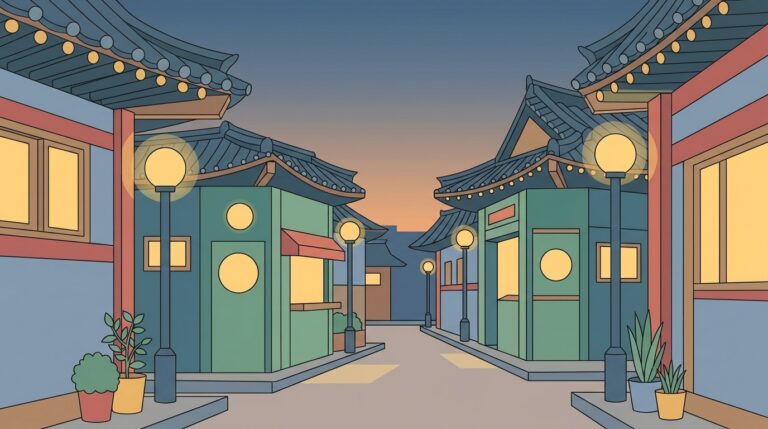
Why Seoul Alleyways Lose Their Soul When Franchises Take Over
Phase 1: Empathy (Story-Immersive Opening)
안녕하세요! 매일한글 에디터입니다. (Hello! I’m your Daily Hangul editor.)
Picture this: A few years ago, you stumbled into a winding, sun-drenched alley in Ikseon-dong or Yeonnam-dong. You fell in love with a tiny coffee roastery tucked behind an old tiled roof (hanok), where the barista roasted single-origin beans while sharing stories about indie artists in the neighborhood. You promised yourself you would come back.
Two years later, you return—only to find the cozy roastery gone. In its place stands a glittering three-story franchise cafe with fluorescent lighting, flanked by a massive corporate cosmetics outlet and a branded burger chain. Walk down another block, and the vintage bookstore is also shuttered, replaced by an empty storefront plastered with yellowing notices: “임대 문의 (Inquire for Rent).” The unique character of the alley is washed away. When every neighborhood looks like an identical carbon copy of corporate brands, the magic disappears. Shoppers stop visiting, foot traffic evaporates, and the entire district enters a painful economic slump.
At the B2 intermediate level, your Korean journey moves beyond ordering food or asking for directions. You are ready to dive into the real, nuanced social realities shaping modern Korea. One of the hottest, most heartfelt cultural debates in Seoul today is 젠트리피케이션 (Gentrification)—often poetically termed 둥지 내몰림 (nest eviction)—and the struggle between giant corporate franchises and local neighborhood creators. Today’s guide is crafted from real discussions with Seoul local creators, urban activists, and intermediate learners who wanted the right words to talk about community, urban transformation, and authentic culture without sounding like a robotic textbook.
Phase 2: In-Depth Breakdown of 3 Core Expressions
1. 개성을 잃다 (Gaeseong-eul ilta)
- Pronunciation: [Gae-seong-eul il-ta] (Think: “Gay-song-ool eel-tah”)
- Meaning: Literal: “To lose one’s individuality/character.” | Nuance: Used when a district, creative space, or person loses their distinctive flavor and becomes completely bland, cookie-cutter, or commercialized.
- K-Culture Moment: In the urban regeneration drama Itaewon Class, Park Saeroyi emphasizes that a pub survives on its distinct colors and values. When a vibrant district turns generic, Korean drama characters look around and sigh: “여기도 이제 개성을 다 잃어버렸네.” (Yeogido ije gaeseong-eul da ireobeoryeonne. – “This place has completely lost its unique charm now too.”)
- Editor’s Insight: There is a crucial difference between 개성이 없다 (it was never interesting to begin with) and 개성을 잃다 (it once possessed a distinct, vibrant soul, but lost it due to commercial encroachment). Using 잃다 expresses nostalgic regret.
- Situation Spectrum: Casual: ✅ | Semi-formal: ✅ | Formal: ✅
- 🤔 Think About It: In English, we might say a neighborhood became “cookie-cutter” or “gentrified.” Why does Korean personify the neighborhood by saying it lost its 개성 (personality/individuality)?
2. 둥지 내몰림 (Dungji naemollim)
- Pronunciation: [Dung-ji nae-mol-lim] (Think: “Doong-jee neh-mohl-leem”)
- Meaning: Literal: “Being driven out of one’s nest.” | Nuance: The native Korean civic term for gentrification—specifically the painful reality where long-time shopkeepers, artists, and creators who built a neighborhood’s fame are driven out by sudden rent hikes.
- K-Culture Moment: In current affairs programs and documentaries like KBS Docu Insight, young ceramic artists and chefs in Seongsu-dong or Euljiro speak candidly about how skyrocketing commercial lease deposits trigger 둥지 내몰림 현상 (dungji naemollim hyeonsang – nest eviction phenomenon).
- Editor’s Insight: While the English loanword 젠트리피케이션 is widely recognized, modern civic campaigns and municipal policies actively use 둥지 내몰림. It emphasizes empathy by comparing a small business to a bird’s nest (둥지) vulnerable to harsh commercial winds.
- Situation Spectrum: Casual: ⚠️ (in everyday chat, friends just say “쫓겨나다” – to get kicked out) | Semi-formal: ✅ | Formal: ✅
- 🤔 Think About It: How does viewing a shop as a “nest” (둥지) change the ethical dimension of a landlord raising rent compared to a purely transactional business perspective?
3. 발길이 끊기다 (Balgir-i kkeunkida)
- Pronunciation: [Bal-gi-ri kkeun-ki-da] (Think: “Bahl-gee-ree kkoon-kee-dah”)
- Meaning: Literal: “Footpaths/footsteps are severed.” | Nuance: Foot traffic comes to a complete halt; customers and visitors stop coming altogether.
- K-Culture Moment: On business rescue shows like Baek Jong-won’s Alley Restaurant, veteran restaurant owners point to desolate alleyways at 8 PM and lament: “프랜차이즈가 들어오고 나서는 손님들 발길이 뚝 끊겼어요.” (Peurancha-ijeuga deureoogo naseoneun sonnimdeul balgiri ttuk kkeunkyeosseoyo. – “Ever since the big franchises flooded in, customer foot traffic was cut off completely.”)
- Editor’s Insight: Notice that Korean uses the passive voice verb 끊기다 (to be cut off) rather than the active 끊다 (to cut). This emphasizes that the people leaving is an inevitable, tragic consequence of the environment losing its appeal.
- Situation Spectrum: Casual: ✅ | Semi-formal: ✅ | Formal: ✅
- 🤔 Think About It: While English speaks of abstract “traffic” or “footfall,” Korean evokes the physical, poetic movement of footsteps (발길).
Phase 3: Textbook Korean vs. Real-World Korean
Situation 1: Describing a street that has become overcrowded with chain brands
- 📖 Textbook Korean: 여기에 프랜차이즈 매장이 많아졌습니다. (Yeogie peurancha-ijeu maejang-i man-ajyeossseumnida. – “Chain stores have become numerous here.”)
- 🗣️ Real-World Korean: 동네가 온통 대기업 간판 천지라 너무 뻔해졌어요. (Dongnega ontong daegieop ganpan cheonjira neomu ppeonhaejyeosseoyo. – “The whole neighborhood is nothing but big conglomerate signs now, so it’s gotten totally generic.”)
- 💡 Why is it different? Intermediate native speakers use ~천지 (cheon-ji, “paradise of / flooded entirely with”) to highlight an overwhelming presence, and 뻔하다 (ppeon-hada) to convey that a place has become totally predictable and uninspiring.
Situation 2: Explaining the vicious cycle of high rents and empty storefronts
- 📖 Textbook Korean: 임대료가 상승하여 가게들이 폐업합니다. (Imdaeryoga sangseunghayeo gagedeuri pye-eophamnida. – “As rent rises, shops shut down business.”)
- 🗣️ Real-World Korean: 월세가 치솟아서 원년 멤버들은 쫓겨나고 결국 공실만 남았잖아요. (Wolsega chisos-aseo wonnyeon membeodeureun jjotkyeonago gyeolguk gongsilman namatjanayo. – “Rents skyrocketed, so the founding creators got booted out, leaving only vacant storefronts.”)
- 💡 Why is it different? Real Koreans speak with vivid verbs like 치솟다 (to soar/skyrocket) and colloquially refer to the pioneer cafe owners as 원년 멤버 (founding members/pioneers). 공실 (gongsil) is the authentic term for empty commercial units.
Phase 4: K-Culture Deep Dive & Non-Verbal Manners
4-1. Nunchi (눈치) & Gestures: Navigating Neighborhood Nostalgia
When chatting with small local shopkeepers or Korean friends about neighborhood changes, never point your finger directly at new conglomerate buildings across the street. Publicly displaying loud anger or overt pointing breaks social harmony (눈치). Instead, Koreans gently tilt their head sideways, let out a soft sigh with a quiet clicking sound through the teeth (“씁…”), and lower their gaze slightly. If you notice a neighborhood favorite has vanished, expressing quiet empathy—such as slowly scanning the empty storefront with a reflective nod—signals deep cultural respect.
4-2. Cultural Code: The Rise of “골목상권” (Alley Economies) vs. Capital
In Korea, alleys are not merely transit routes; they are cultural ecosystems known as 골목상권 (golmok sanggwon). Over the last decade, young “Local Creators” (로컬 크리에이터) transformed neglected industrial and residential areas—such as Euljiro’s print shops (“Hipjiro”), Mullae-dong’s iron foundries, and Seongsu-dong’s shoe factories—into iconic cultural hotspots (핫플, hat-peul).
However, this triggers a predictable cycle:
1. Indie creators create a unique, artisanal vibe.
2. Influencers flock to social media.
3. Corporate conglomerates notice the foot traffic and open identical franchised stores with massive capital.
4. Landlords raise rents drastically.
5. The original creators suffer 둥지 내몰림 and leave.
6. The street loses its originality, visitors stop coming (발길이 끊기다), and vacant storefronts multiply.
Understanding this dynamic gives you an authentic window into modern Korean youth culture and social politics.
Phase 5: Real-Life Roleplay Scenario
Setting: A quiet corner roastery in an ironworks alley of Mullae-dong. Sunlight filters through handcrafted ceramic mugs. Min-jun, a pioneer roaster and local community organizer, is packing up a few craft tools behind the counter.
Characters:
* You: A devoted regular customer and intermediate Korean speaker.
* Min-jun (민준): A 34-year-old local roaster who built this alley’s reputation over the last six years.
— Dialogue Start —
- You: 🎭 (noticing packed moving boxes with a concerned look)
사장님, 저 박스들은 다 뭐예요? 설마 가게 정리하시는 건 아니죠?
(Sajangnim, jeo bakseudeureun da mwoyeyo? Seolma gage jeongrihasineun geon anijyo?)
“Boss, what are all those boxes? You aren’t… wrapping up the shop, are you?” -
Min-jun: 🎭 (sighs softly, placing down a coffee kettle with a bitter smile)
아, 눈치채셨네요. 네, 이번 달까지만 영업하고 문 닫게 됐어요.
(A, nunchichaesyeotneyo. Ne, ibeon dalkkajiman yeongeophago mun datge dwaesseoyo.)
“Ah, you noticed. Yes, I’m only operating until the end of this month and then closing down.” -
You: 🎭 (furrowing brows in disbelief)
네? 여기가 이 골목의 터줏대감인데 왜요? 손님도 늘 많았잖아요.
(Ne? Yeogiga i golmogui teojutdaegam-inde waeyo? Sonnimdo neul manatjanayo.)
“What? But you’re the cornerstone pioneer of this alley! Why? You always had plenty of customers.” -
Min-jun: 🎭 (pointing quietly toward the main street where a giant yellow franchise logo is being installed)
보시다시피 큰 길가에 대기업 프랜차이즈들이 들어오면서 건물주가 월세를 두 배 넘게 올려달라네요. 둥지 내몰림이죠, 뭐.
(Bosidasipi keun gilgae daegieop peurancha-ijedeuri deureo-omyeonseo geonmuljuga wolse-reul du bae neomge ollyeodallaneyeo. Dungji naemollim-ijyo, mwo.)
“As you can see, large franchises moved onto the main street, and the landlord demanded more than double the rent. Typical nest eviction, I guess.” -
You: 🎭 (nodding sorrowfully with genuine empathy)
결국 여기도 젠트리피케이션을 못 피했군요. 개성 있는 가게들이 사라지면 결국 손님들 발길도 끊길 텐데요.
(Gyeolguk yeogido jenteuripikeisyeon-eul mot pihaetgunyo. Gaeseong inneun gagedeuri sarajimyeon gyeolguk sonnimdeul balgildo kkeunkil tendeyo.)
“In the end, this alley couldn’t escape gentrification either. If unique shops disappear, customer visits will completely dry up too.” -
Min-jun: 🎭 (nodding in agreement while wiping the counter)
맞아요. 온 동네가 똑같은 프랜차이즈로 도배되면 누가 굳이 이 먼 골목까지 찾아오겠어요? 상권이 다 죽는 악순환이죠.
(Majayo. On dongnega ttokgateun peurancha-ijeuro dobaedwoemyeon nuga guji i meon golmokkkaji chajaogesseoyo? Sanggwoni da jungneun aksunhwan-ijyo.)
“Exactly. When the whole neighborhood is plastered with identical chain stores, who would bother traveling all the way to this alley? It’s a vicious cycle where the district collapses.” -
You: 🎭 (stepping closer, offering warm encouragement)
사장님만의 개성과 커피 철학은 어디를 가도 빛날 거예요. 새로 자리 잡으시면 꼭 연락 주세요.
(Sajangnim-man-ui gaeseong-gwa keopi cheolhageun eodireul gado binnal geoyeyo. Saero jari jabs-eusimyeon kkok yeollak juseyo.)
“Your distinct style and coffee philosophy will shine wherever you go. Please let me know as soon as you find a new home.” -
Min-jun: 🎭 (smiling warmly with renewed strength)
그렇게 말씀해 주시니 큰 힘이 되네요. 잊지 않고 단골분들께 가장 먼저 소식 전할게요.
(Geureoke malsseumhae jusini keun himi doeneyo. Itji anko dangolbundeulkke gajang meonjeo sosik jeonhalgeyo.)
“Hearing you say that gives me real strength. I won’t forget—I’ll share the news with my regulars first.”
— Dialogue End —
🔀 Interactive Decision Point
How would you react when Min-jun first shares the news in Turn 4? Choose your response:
- Option A: “대기업이 들어오면 상권이 더 커져서 좋은 거 아닌가요?” (Isn’t it better if big conglomerates enter because the district grows bigger?)
- Feedback: Bad 🚫. This shows a serious lack of 눈치 (Nunchi). It completely ignores that rising rents kick out the very locals who made the area popular, alienating the shopkeeper.
- Option B: “진짜 너무하네요! 그 건물주 찾아가서 따져야 하는 거 아니에요?” (That’s outrageous! Shouldn’t we go confront the landlord right now?)
- Feedback: Risk ⚠️. While your passion is supportive, inciting an aggressive confrontation makes the Korean business owner uncomfortable and disrupts social decorum.
- Option C: “결국 여기도 젠트리피케이션을 못 피했군요. 개성 있는 가게들이 사라지면 결국 손님들 발길도 끊길 텐데요.” (In the end, this alley couldn’t escape gentrification either. If unique shops disappear, customer visits will dry up too.)
- Feedback: Best ✅. Empathetic, culturally aware, and uses B2-level analytical vocabulary (개성, 발길이 끊기다) to build a deep, genuine bond.
Phase 6: 10-Second Emotion Shadowing Drill
Train your intonation and rhythm. The / marks a natural breath pause.
- [😔 씁쓸하고 안타깝게 – With bittersweet sorrow]
골목마다 / 똑같은 간판만 남으면 / 결국 동네만의 개성을 / 다 잃어버리게 돼요.
(Golmok-mada / ttokgateun ganpan-man nameumyeon / gyeolguk dongne-man-ui gaeseong-eul / da ireobeorige dwaeyo.)
“If only identical chain signs remain on every alley / the neighborhood ends up / completely losing its unique soul.” -
[😤 답답하고 비판적으로 – With critical frustration]
임대료가 치솟아서 / 원년 멤버들이 다 떠나면 / 손님들 발길도 / 완전히 끊기고 말아요.
(Imdaeryoga chisos-aseo / wonnyeon membeodeuri da tteonamyeon / sonnimdeul balgildo / wanjeonhi kkeunkigo marayo.)
“When rents skyrocket / and the original pioneers all leave / visitor foot traffic / ends up completely cut off.” -
[🌱 희망을 담아 진지하게 – With sincere hope and conviction]
프랜차이즈와 로컬 크리에이터가 / 상생할 수 있는 / 건강한 골목을 / 만들어야 해요.
(Peurancha-ijeuwa rokeol keurieiteoga / sangsaenghal su inneun / geonganghan golmog-eul / mandeureoya haeyo.)
“We must build a healthy alley / where giant franchises and local creators / can genuinely coexist.”
Phase 7: K-Culture Mini Dictionary
-
터줏대감 (Teojutdaegam)
- Translation: The foundational pillar / Long-time local fixture.
- Usage: Originating from the guardian deity of a house (터주), this noun describes a pioneer shop or person who anchored a street before it became trendy. Example: “이 카페가 성수동 골목의 터줏대감이에요.” (This cafe is the foundational pillar of the Seongsu-dong alley.)
- 상생 (Sangsaeng)
- Translation: Win-win coexistence / Mutual flourishing.
- Usage: Vital in socio-economic discussions. Used to describe models where large retail corporations support independent local stores rather than suffocating them. Example: “대기업과 소상공인의 상생 방안이 필요합니다.” (We need mutual coexistence measures between conglomerates and small merchants.)
- 악순환 (Aksunhwan)
- Translation: Vicious cycle.
- Usage: Applied when one negative event triggers another: High rent ➔ Artisans evicted ➔ Loss of character ➔ Empty alleys (공실). Example: “이런 방식은 결국 상권 침체라는 악순환을 부릅니다.” (This approach ultimately leads to the vicious cycle of commercial stagnation.)
- 특색 (Teuksaek)
- Translation: Distinctive trait / Local color.
- Usage: A slightly more formal, sophisticated synonym of 개성. Used when analyzing urban districts or artistic products. Example: “지역의 특색을 살린 브랜드가 오래 살아남아요.” (Brands that preserve the distinctive traits of the region survive longest.)
Phase 8: Traveler’s Survival Kit
Top 3 On-the-Street Phrases:
- 여기 골목만의 특색 있는 시그니처 메뉴가 뭐예요?
(Yeogi golmok-man-ui teuksaek inneun sigeunicheo menyuga mwoyeyo?)
“What is this alley’s distinctive signature menu item?”- Pro Tip: Shows you value the artisan’s craft over generic commercial coffee.
- 이 근처에 프랜차이즈 말고 개성 있는 로컬 소품샵 있을까요?
(I geuncheoe peurancha-ijeu malgo gaeseong inneun rokeol sopumsyap isseulkkayo?)
“Are there any unique local boutique/craft shops around here instead of chain stores?”- Pro Tip: Use this when asking indie baristas for hidden neighborhood gems.
- 원래 여기에 있던 독립 서점은 어디로 이전했는지 아세요?
(Wollae yeogie itdeon dongnip seojeomeun eodiro ijeonhaenneunji aseyo?)
“Do you happen to know where the independent bookstore that used to be here relocated to?”- Pro Tip: Demonstrates deep respect for neighborhood history.
Editor’s Travel Note: Finding Real Alleys in Seoul
- Navigate Beyond Corporate Maps: To bypass heavily sponsored franchise results, download the Naver Map app on Google Play or Apple App Store. Type in curate-focused keywords such as #로컬크리에이터 (Local Creator), #독립서점 (Independent Bookstore), or #골목책방 (Alley Bookshop).
- Spotting Early-Stage Neighborhoods: Look out for “임대 문의” (Lease inquiries). If multiple vintage metalworking shops or tailor studios still operate beside indie cafes, you are experiencing an authentic creative neighborhood before commercial uniformity sweeps in.
- Support Local Directly: In districts like Mapo-gu or Jongno-gu, pay using 지역사랑상품권 (Local Love Gift Certificates) or ZeroPay (제로페이) to ensure your money stays in the pockets of local creators.
Phase 9: Step Deeper (Reflective Cultural Essay)
In Western urban theory, gentrification is often analyzed primarily through the lens of capital flow, real estate yields, and class displacement. In Korea, however, the transformation of an alley cuts straight to an emotional concept: 정 (Jeong)—the invisible, warm bond cultivated over shared time and space.
Korean alleys have historically served as communal living rooms. When a small neighborhood dry cleaner, tailor, and neighborhood diner (백반집) are replaced overnight by global fast-food franchises and sterile convenience stores, Koreans feel the painful loss of 동네의 온기 (the warmth of the neighborhood). The city becomes efficient, clean, and modern—yet emotionally hollow. True urban sophistication lies not in eliminating old alleys with corporate capital, but in safeguarding the delicate ecosystem where heritage creators and innovative young minds thrive together.
💬 Your Turn: Have you witnessed a favorite local neighborhood in your home country lose its original soul to massive corporate chains? What Korean words would you use to describe that feeling? Share your thoughts in the comments below!
Phase 10: FAQ & Avoiding Misunderstandings
Q: Can I use the loanword “젠트리피케이션” in everyday conversations?
A: Yes! Educated Koreans and media use 젠트리피케이션 constantly. However, if you are speaking with an elderly shop owner or wanting to sound more emotionally resonant and natural, using 둥지 내몰림 (nest eviction) or 원래 가게들이 쫓겨나다 (original shops being pushed out) sounds far warmer and more native.
Q: Is it considered offensive to say an alley has “died” (상권이 죽었다)?
A: Saying “이 골목 상권이 다 죽었네요” (This alley’s commercial district is completely dead) is acceptable when analyzing general business trends with friends. However, you should never say this directly to an active shop owner operating in that alley! To an active merchant, say: “요즘 손님들 발길이 좀 뜸해져서 걱정이에요” (I’m worried that visitor footsteps have slowed down lately).
Q: What is the exact difference between “프랜차이즈” and “대기업” in this context?
A: While “프랜차이즈” refers to the franchise business format itself (some franchises can be small), Koreans use 대기업 프랜차이즈 (chaebol/corporate franchise) to emphasize multi-billion-won retail giants muscling out independent mom-and-pop stores.
🚨 Common Mistakes Alert (외국인 학습자 흔한 실수 TOP 3)
- Mistake: Calling an empty shop “비어 있는 가게” (sounds clumsy)
- Correct Action: Use the intermediate business noun 공실 (gongsil). Example: “공실이 늘어나고 있어요” (Vacancies are increasing).
- Mistake: Confusing 임대 (imdae – For Lease) with 매매 (maemae – For Sale)
- When you see banners hanging outside empty stores, “임대 문의” means looking for a tenant, the classic visual symbol of a gentrified ghost street.
- Mistake: Telling a local owner: “여기는 개성이 없네요” (You have no personality here)
- Correct Action: That sounds like a direct personal insult! If you want to critique commercialization, critique the street (“골목이 예전의 특색을 잃어가는 것 같아 아쉬워요” – It’s sad that the alley seems to be losing its past distinctiveness).
Phase 11: Action Missions & Community Engagement
- 🥉 Bronze Mission (Solo Mastery): Stand in front of your mirror and practice the Phase 6 Shadowing Drill. Deliver sentence #1 with genuine bittersweet sorrow (씁쓸한 표정).
- 🥈 Silver Mission (Social Engagement): Find an Instagram post from a local Seoul creator or independent cafe in Mullae or Seongsu. Leave an encouraging Korean comment: “골목만의 고유한 개성을 지켜주셔서 감사해요! (Thank you for protecting the alley’s unique character!)”
- 🥇 Gold Mission (Real-World Challenge): Next time you visit a non-chain, indie cafe in Korea, skip the automated kiosk. Ask the barista in Korean: “여기 골목만의 시그니처 메뉴 추천해 주실 수 있나요? (Could you recommend this alley’s unique signature menu item?)” Note their reaction!
🎮 K-Culture Media Mission: Watch Episode 1 or 2 of Itaewon Class. Observe how the protagonist struggles with property owners and corporate bullies. Spot how many times terms related to 상권 (commercial district) and 자리 (location/spot) are used!
Phase 12: Interactive Quiz Challenge
Test your mastery of B2 neighborhood and gentrification vocabulary!
1. Situational Judgment
You visit an alley you loved three years ago, but it is now packed with identical corporate cosmetic shops and coffee franchises. How do you describe this tragedy to a Korean friend?
* (A) 동네가 아주 깨끗해져서 개성이 생겼어요.
* (B) 프랜차이즈만 넘쳐나서 골목만의 개성을 다 잃어버렸어요.
* (C) 둥지 내몰림 덕분에 손님들 발길이 끊이지 않아요.
2. Fill-in-the-Blank
월세가 너무 치솟아서 가게들이 다 쫓겨나면, 결국 손님들의 _______(이/가) 끊기면서 상권이 침체되는 악순환이 발생합니다.
(When rents skyrocket and shops are kicked out, visitors’ footsteps cease, causing a vicious cycle of district depression.)
* Hint: Two syllables meaning footsteps or pedestrian traffic.
3. Cultural Nuance Check (True/False)
- Q: In Korea, the term “둥지 내몰림” is used strictly by real estate lawyers and is considered rude in public civic campaigns. (True / False)
👉 Click to reveal answers & explanations!
-
Answer: (B)
Explanation: When chain stores flood in, an alley loses its distinct personality (개성을 잃다). (A) is incorrect because uniformity destroys distinctiveness. (C) makes no sense because nest eviction (둥지 내몰림) causes visitors to leave, not multiply! -
Answer: 발길 (Balgil)
Explanation: The idiom is 발길이 끊기다, meaning visitors cease coming and footfall dries up. -
Answer: False
Explanation: 둥지 내몰림 is an officially sanctioned, warm civic term actively promoted by city governments (like the Seoul Metropolitan Government) to build public empathy for small merchants.







