

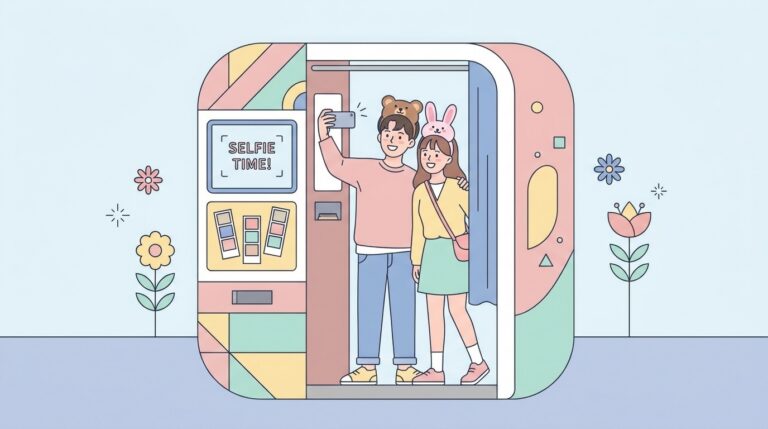
Master Native Korean Numbers: Hana, Dul, Set, Cheese!
Phase 1: Empathy & Story Intro
안녕하세요! 매일한글 에디터입니다. (Hello! This is your Daily Hangul editor.)
Picture this: You are standing under the neon-lit street of Hongdae in Seoul on a breezy Friday evening. You and your friends squeeze into one of those ultra-popular self-photo studios—decked out with fluffy bunny ears, oversized sunglasses, and colorful props. The countdown timer on the screen starts flashing red: 3… 2… 1…! You want to lead the countdown like a true local, but your brain suddenly short-circuits. Wait, do I say ‘Il, I, Sam’ (일, 이, 삼) or ‘Hana, Dul, Set’ (하나, 둘, 셋)? And do Koreans actually shout ‘Kimchi’ or ‘Cheese’?!
If you have ever frozen in front of a camera lens or felt confused by Korea’s two different number systems, you are not alone. Almost every beginner learner stumbles over this exact moment! But here is the secret: mastering native Korean numbers from one to ten is not just about memorizing math—it is your VIP ticket to taking spontaneous group selfies, grabbing street food portions, and sharing pure joy with Korean friends. Based on feedback from hundreds of beginner students at Daily Hangul, this guide will turn that awkward hesitation into natural, rhythmic confidence. Let’s make your next Korean photo moment unforgettable!
Phase 2: Core 3 Expressions
1. 하나, 둘, 셋 (Hana, dul, set)
- Pronunciation: Hana, dul, set (Think of: Ha-na like the girl’s name “Hannah”, Dul rhymes with “bull”, and Set rhymes with “bet” with a crisp, clipped ending).
- Meaning: “One, two, three” (Countdown for action or photos).
- K-Culture Moment: Every variety show host on Running Man or K-pop group taking a backstage polaroid counts down with this exact, punchy cadence.
- Editor’s Insight: While Sino-Korean numbers (il, i, sam) are used for phone numbers, minutes, and money, Native Korean numbers (hana, dul, set…) are strictly used for counting physical items, people, and real-time countdowns. Keep it short and rhythmic!
- Situation Spectrum: Casual: ✅ | Semi-formal: ✅ | Formal: ✅
- 🤔 Think About It: In English, we often say “3, 2, 1!” counting backwards. Why do you think Koreans usually count forward: “1, 2, 3!”? It reflects building up collective energy together towards a shared moment!
2. 김치 / 치즈! (Gimchi / Chijeu!)
- Pronunciation: Gimchi (like “geem-chee”) / Chijeu (like “chee-zeu”).
- Meaning: “Kimchi!” or “Cheese!” (The smiling prompt).
- K-Culture Moment: While older generations and proud grandmothers love yelling an enthusiastic “Gim-chi~!”, Korean Gen-Z and K-pop idols at photo booths almost always chirp “Chi-jeeu~!” for a cuter mouth shape.
- Editor’s Insight: Saying “Kimchi” naturally pulls the corners of your mouth wide into an “ee” vowel sound, creating an instant natural smile. Both are beloved, but 치즈 (Chijeu) feels slightly trendier among younger crowds.
- Situation Spectrum: Casual: ✅ | Semi-formal: ✅ | Formal: ⚠️
- 🤔 Think About It: Food is so central to Korean bonding that even the universal camera trigger word is a staple side dish. What food does your culture smile to?
3. 한 장 더 찍어요! (Han jang deo jjigeoyo!)
- Pronunciation: Han jang deo jjigeoyo! (Han sounds like “hahn”, jang rhymes with “song”, deo sounds like “duh”, jjig-eo-yo sounds like “jeeg-uh-yo”).
- Meaning: Literal: “One sheet more let’s take!” / Real nuance: “Let’s take one more shot!”
- K-Culture Moment: The universal phrase shouted right after checking the screen at an Insaeng-nekot (Life Four Cuts) booth when someone blinked.
- Editor’s Insight: Notice that 하나 (hana) shrinks into 한 (han) when placed directly before a counting unit like 장 (jang – flat sheet/photo). This is a golden rule for numbers 1 to 4!
- Situation Spectrum: Casual: ✅ | Semi-formal: ✅ | Formal: 🚫
- 🤔 Think About It: In Korean, nouns take specific “counters” (sheets, bottles, people). It highlights how Korean speakers categorize the physical world by texture and shape.
Phase 3: Textbook Korean vs. Real Korean
Situation 1: Counting down before snapping a photo
- 📖 교과서 한국어 (Textbook): 사진을 찍겠습니다. 일, 이, 삼. (Sajineul jjikgetseumnida. Il, i, sam.) — “I will take a photo. One, two, three.”
- 🗣️ 진짜 한국어 (Real-life): 자, 찍어요! 하나, 둘, 셋~ 김치! (Ja, jjigeoyo! Hana, dul, set~ Gimchi!) — “Alright, shooting now! One, two, three~ Kimchi!”
- 💡 왜 다를까? (Why the difference?): Using Sino-Korean numbers (il, i, sam) during a photo countdown sounds robotic and stiff, like an automated elevator voice. Real humans always use Native Korean numbers (hana, dul, set) with warm, melodic rhythm!
Situation 2: Asking a stranger or friend to retake a photo
- 📖 교과서 한국어 (Textbook): 사진을 다시 한 번 촬영해 주시겠습니까? (Sajineul dasi han beon chwal-yeonghae jusigetseumnikka?) — “Would you please capture the photograph once again?”
- 🗣️ 진짜 한국어 (Real-life): 저, 한 번만 더 찍어주실 수 있나요? (Jeo, han beonman deo jjigeojusil su innayo?) — “Excuse me, could you take it just one more time?”
- 💡 왜 다를까? (Why the difference?): The textbook term 촬영 (chwal-yeong) belongs on a professional movie set. In everyday life, native speakers use the friendly verb 찍다 (jjikda – to snap/shoot) with the polite softening particle 저 (jeo – excuse me).
Phase 4: K-Culture Deep Dive & Non-Verbal Manners
4-1. 눈치 (Nunchi) & Gestures: The Perfect Korean Photo Pose
In Korea, standing still with your arms hanging flat at your sides is considered a missed opportunity! When someone calls out 하나, 둘, 셋, it is your cue to show active engagement:
* The K-Finger Heart (손가락 하트 – Songarak Hateu): Cross your thumb and index finger subtly at chest level.
* The Cheek Heart (볼하트 – Bol-hateu): Bend one hand into a half-heart and place it gently against your cheek.
* The Eye Contact Rule: If a friendly stranger offers to take your photo outside a tourist landmark like Bukchon Hanok Village, give a quick 15-degree bow, say 감사합니다 (Gamsahamnida) before handing over your phone, and hold your pose until they say 끝! (Kkeut! – Done!).
4-2. Culture Code: The 4-Cut Photo Booth Craze
Self-photo studios like Life Four Cuts (인생네컷) and Photoism (포토이즘) are not just novelty booths—they are a core social ritual in South Korea. Friends, couples, and coworkers head inside right after dinner or drinks to commemorate the day. The booths print horizontal or vertical four-panel strips within minutes. Because the booth timer is strict (giving you only 8 to 10 seconds per shot), everyone shouts 하나, 둘, 셋! in unison to coordinate hilarious matching poses. Knowing your numbers from one to four keeps you in perfect sync!
Phase 5: Real-Life Roleplay Scenario
Setting: A vibrant, pastel-pink photo booth studio in Yeonnam-dong, Seoul. You are with Minji, your energetic Korean friend, trying on quirky headbands.
- Minji: 머리띠 골랐어? 우리 이제 들어갈까?
(Meoritti gollasseo? Uri ije deureogalkka?)
(Did you pick a headband? Shall we head inside?)
🎭 Adjusting a giant crab headband and pointing at the vacant photo booth. -
You: 응, 준비 완료! 가자!
(Eung, junbi wanryo! Gaja!)
(Yeah, all ready! Let’s go!)
🎭 Grabbing a pair of flower-shaped sunglasses and stepping into the booth. -
Minji: 화면 터치해 봐. 총 네 장 찍는 거야!
(Hwamyeon teochihye bwa. Chong ne jang jjingneun geoya!)
(Touch the screen. We take four shots in total!)
🎭 Tapping the start button as the digital counter begins. -
You: 첫 번째 포즈는 뭐야?
(Cheot beonjjae pojeuneun mwoya?)
(What is our first pose?)
🎭 Looking at the camera lens in slight panic. -
Minji: 볼하트 하자! 자, 카운트다운 시작한다!
(Bol-hateu haja! Ja, kaunteudaun sijakhanda!)
(Let’s do cheek hearts! Here, countdown starts!)
🎭 Placing her hand on her cheek and flashing a radiant smile. -
You & Minji: 하나, 둘, 셋, 치즈!
(Hana, dul, set, chijeu!)
(One, two, three, cheese!)
🎭 Flash lights up the room with a crisp snap sound. -
Minji: 앗, 잠깐만! 나 눈 감았어. 한 장 더 찍자!
(At, jamkkanman! Na nun gamasseo. Han jang deo jjikja!)
(Oh, wait! I blinked. Let’s take one more!)
🎭 Giggling and fixing her hair quickly before the next countdown. -
You: 좋아, 이번엔 브이 포즈! 하나, 둘, 셋!
(Joha, ibonen beui pojeu! Hana, dul, set!)
(Nice, peace sign this time! One, two, three!)
🎭 Throwing up a double V-sign with total confidence.
🔀 Interactive Choice Point
The screen shows the final preview before printing, but one of the pictures is slightly blurry. Minji looks at you and asks: “어떡하지? 다시 찍을까? (What should we do? Should we retake it?)” What do you say?
- Option A: “일, 이, 삼 다시 해요!” (Il, i, sam dasi haeyo!)
- Option B: “응! 한 번만 더 찍어요!” (Eung! Han beonman deo jjigeoyo!)
- Option C: “사진이 나빠요. 끝내요.” (Sajini nappayo. Kkeunnaeyo.)
— Choice Feedback —
* Option A (Risk): While Minji will understand, mixing Sino-Korean (il, i, sam) into counting actions sounds unnatural and clunky for beginner conversation.
* Option B (BEST!): Perfect! You correctly transformed 하나 (hana) into 한 (han) before 번 (beon – time/instance) and used friendly, natural A1 grammar.
* Option C (Bad): Too blunt and harsh! In Korean social settings, keeping the mood cheerful is key. Saying 사진이 나빠요 sounds like an angry complaint.
Phase 6: 10-Second Emotion Shadowing Drill
Practice reading these out loud to build your muscle memory. Pay close attention to the pause markers / and emotional cues!
[😊 Cheerful & Rhythmic]
하나, / 둘, / 셋, / 치즈~!
(Ha-na, / dul, / set, / chi-jeeu~!)
(“One, / two, / three, / cheese~!”)-
[📸 Excited & Quick]
자, / 여기 보세요! / 하나, 둘, 셋!
(Ja, / yeogi boseyo! / Hana, dul, set!)
(“Now, / look here! / One, two, three!”) -
[🥺 Friendly & Pleading]
저기요, / 사진 한 장만 / 더 찍어주세요~!
(Jeogiyo, / sajin han jangman / deo jjigeojuseyo~!)
(“Excuse me, / please take just / one more photo~!”)
Phase 7: K-Culture Mini Dictionary
- 인생네컷 (Insaeng-nekot) | Noun | “Life Four Cuts” — The iconic Korean self-photo booth franchise, now used as a generic term for all 4-panel instant photo kiosks across Korea.
- 볼하트 (Bol-hateu) | Noun | “Cheek Heart” — A signature K-pop pose where you place a curved hand against your cheek to complete a heart shape with your face.
- 찰칵 (Chalkak) | Onomatopoeia | “Click / Snap” — The universal Korean sound mimicking a camera shutter capturing a shot.
- 원조 (Wonjo) | Noun | “The Original / Authentic” — Often seen outside photo studios or restaurants indicating that this spot started the trend.
Phase 8: Traveler’s Survival Kit
Top 3 Survival Expressions for Sightseeing
- 사진 좀 찍어주실 수 있나요? (Sajin jom jjigeojusil su innayo?)
Pro Tip: Use this when approaching someone at Gyeongbokgung Palace. The word 좀 (jom – please/a little) softens your request instantly! - 하나, 둘, 셋, 김치~! (Hana, dul, set, gimchi~!)
Pro Tip: If a traveler hands you their smartphone, always count this out loud with high energy so they know the exact moment to smile! - 한 번만 더요! (Han beonman deoyo!)
Pro Tip: The quickest, most natural way to ask for an extra take without getting tongue-tied.
Editor’s Travel Note
- When wandering around trendy neighborhoods like Seongsu or Hongdae, photo booths often require 1,000 KRW bills or domestic cards. Check the studio counter: most booths have bill exchange machines or accept global cards at the kiosk.
- To find the nearest highly-rated studio, use the search term “인생네컷” directly in the official Naver Map app download for iOS and Android, as Google Maps often lacks real-time updates for niche boutique booths.
Phase 9: One Step Deeper (Reflective Thought)
Taking a photograph in Korea is rarely an individualistic, hurried act; it is a collaborative ritual of care and togetherness. When someone counts 하나, 둘, 셋, everyone adjusts their shoulders, syncs their breathing, and smiles in harmony. By counting aloud in native Korean, you aren’t merely marking seconds—you are stepping into Korea’s collective rhythm and signaling warmth to those around you.
💬 Your Turn: Have you ever taken photos inside an Asian-style photo booth, or do you prefer candid phone snapshots? Tell us your favorite photo pose in the comments below!
Phase 10: FAQ & Common Mistakes
Q: When do I use 하나, 둘, 셋 versus 일, 이, 삼?
A: Use Native Korean numbers (하나, 둘, 셋…) for counting items, people, hours on the clock, counting down for photos, and age. Use Sino-Korean numbers (일, 이, 삼…) for dates, phone numbers, prices, and minutes!
Q: Why did “하나” change to “한” when counting photos?
A: The first four native numbers change form when placed right before a counter noun: 하나 (1) ➔ 한, 둘 (2) ➔ 두, 셋 (3) ➔ 세, and 넷 (4) ➔ 네. So “one photo” is 사진 한 장 (sajin han jang), not 하나 장.
Q: Do young Koreans still say “김치” (Kimchi)?
A: Yes, but 치즈 (Chijeu) and whimsical sounds like 스마일 (Seu-ma-il – Smile) or 개구리 뒷다리 (Gaeguri dwit-dari – Frog’s hind legs, which forces an “ee” mouth shape) are very popular among younger generations.
— 🚨 Common Mistakes Board —
* ❌ Mistake 1: Shouting 일, 이, 삼! (Il, i, sam!) during a group countdown.
👉 Correct Action: Always shout 하나, 둘, 셋! (Hana, dul, set!) for countdowns.
* ❌ Mistake 2: Saying 하나 장 주세요 (Hana jang juseyo) for one print.
👉 Correct Action: Say 한 장 주세요 (Han jang juseyo).
* ❌ Mistake 3: Dropping your pose immediately after hearing “셋”.
👉 Correct Action: Hold your smile for an extra second until the camera clicks (찰칵!).
Phase 11: Action Mission & Engagement
- 🥉 Bronze Mission (Solo Practice): Stand in front of your mirror, raise a finger-heart, and chant “하나, 둘, 셋, 치즈!” three times with a confident smile.
- 🥈 Silver Mission (Social Connection): Take your next selfie or group picture with friends and count down aloud in Korean: Hana, dul, set!
- 🥇 Gold Mission (Real-life Execution): Walk into a local Korean photobooth, restaurant, or meetup and order or count items using 한 (1), 두 (2), 세 (3), 네 (4).
- 🎮 K-Culture Mission: Watch any backstage vlog of your favorite K-pop group on YouTube and spot how many times the members say 하나, 둘, 셋 before bowing or taking a group photo!
Phase 12: Interactive Quiz Challenge
Question 1: Situational Judgment
You are taking a picture for a lovely Korean couple near Han River. How do you count down naturally before pressing the button?
(A) 일, 이, 삼, 김치!
(B) 하나, 둘, 셋, 치즈!
(C) 첫째, 둘째, 셋째!
Question 2: Fill-in-the-Blank
Fill in the missing native numbers:
하나 (1) – [ ? ] (2) – [ ? ] (3) – 넷 (4) – 다섯 (5)
Question 3: True or False (Culture Check)
True or False: In a Korean photo booth, saying 하나 장 더 찍어요 is grammatically flawless.
👉 Click to reveal answers & explanations!
-
Answer: (B) 하나, 둘, 셋, 치즈!
Explanation: Countdown actions always take Native Korean numbers (하나, 둘, 셋). Option A uses Sino-Korean numbers, while Option C means “first, second, third” (ordinal numbers). -
Answer: 둘 (dul), 셋 (set)
Explanation: The sequence of native numbers from 1 to 5 is: 하나 (hana), 둘 (dul), 셋 (set), 넷 (net), 다섯 (daseot). -
Answer: False
Explanation: Before the counter 장 (jang), 하나 must change into its modified form 한 (han)! The natural sentence is 한 장 더 찍어요 (Han jang deo jjigeoyo).







