

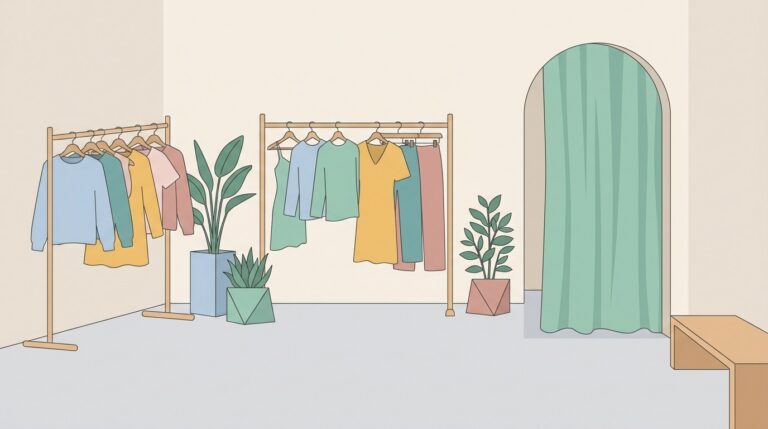
Phase 1: Empathy (Welcome to the K-Shopping Scene!)
안녕하세요! 매일한글 에디터입니다.
Imagine this: You are strolling through the trendy, neon-lit alleys of Hongdae or the chic designer boutiques of Seongsu-dong. Through a glass window, a minimalist oversized graphic tee catches your eye. It is the exact K-aesthetic you have been searching for! You step inside, your heart thumping. You pick up the hanger and admire the fabric.
Suddenly, an impeccably styled shop clerk glides toward you, bowing politely: “도와드릴까요?” (Do you need help?).
Your mind goes completely blank. You want to ask if you can try it on, but panic sets in: What if white shirts aren’t allowed in fitting rooms? How do I ask if they have a bigger size? Am I supposed to take off my shoes? You smile nervously, hang the shirt back on the rack, and walk out empty-handed, regretting that missed opportunity.
Take a deep breath! You are not alone. As an educator who has guided thousands of international visitors through their first real-world Korean conversations, I can tell you that shopping anxiety is the number one hurdle for beginners. Today’s guide will transform you from a hesitant window-shopper into a confident local who can walk into any boutique, find the right fit, and ask the right questions with natural ease.
Phase 2: Top 3 Core Expressions Deep-Dive
1. 이 티셔츠 입어 봐도 돼요? (I tisyeocheu ibeo bwado dwaeyo?)
- Pronunciation: [ee tee-syeo-cheu ee-beo bwa-do dway-yo?] (Think of saying: “ee” + t-shirt + “ee-bur” + “bwah-doh” + “dway-yo?”)
- Meaning: Literal: “Even if I wear this t-shirt, is it okay?” | Actual: “May I try on this T-shirt?”
- K-Culture Moment: You’ll hear this all the time in K-pop idol shopping vlogs when members pick out stage outfits in Garosu-gil boutiques!
- Editor’s Insight: The pattern
-아/어도 돼요?(-a/eodo dwaeyo?) is the golden key of Korean courtesy. It translates to asking for polite permission. You can swap티셔츠(tisyeocheu / t-shirt) with바지(baji / pants) or재킷(jaekit / jacket). - Situation Spectrum:
- Casual (반말): ⚠️ 이 티셔츠 입어 봐도 돼? (Use only with close friends)
- Semi-formal (존댓말): ✅ 이 티셔츠 입어 봐도 돼요? (Standard & Most Recommended)
- Formal (격식체): ✅ 이 티셔츠 입어 봐도 되겠습니까? (Overly stiff for shopping)
- 🤔 Think About It: In English, we ask “Can I try this on?” (focusing on ability). In Korean, you ask “Is it okay even if I wear this?” (focusing on permission and respecting the store’s space). How does this reflect Korean etiquette?
2. 다른 색상 있어요? (Dareun saeksang isseoyo?)
- Pronunciation: [da-reun saek-sang eess-eo-yo?] (Sound out: “dah-run sack-sahng ee-ssuh-yoh?”)
- Meaning: Literal: “Is there a different color?” | Actual: “Do you have this in other colors?”
- K-Culture Moment: A classic K-drama scene where the stylish lead character asks the clerk if that coat comes in beige or black.
- Editor’s Insight:
다른(dareun) means “different” or “another,” while색상(saeksang) means “color.” If you want to sound even more casual, you can just say다른 색 있어요?(Dareun saek isseoyo?). - Situation Spectrum:
- Casual: ⚠️ 다른 색상 있어? (Friends only)
- Semi-formal: ✅ 다른 색상 있어요? (Perfect for shopping)
- Formal: ✅ 다른 색상이 있습니까? (A bit too formal)
- 🤔 Think About It: Notice how natural Korean sentences frequently leave out pronouns like “you” or “your store.” Stating what you’re looking for is clear enough!
3. 더 큰 사이즈 있어요? (Deo keun sa-i-jeu isseoyo?)
- Pronunciation: [deo keun sah-ee-jeu eess-eo-yo?] (Think: “duh koon sigh-joo ee-ssuh-yoh?”)
- Meaning: Literal: “Is there a more big size?” | Actual: “Do you have a bigger size?”
- K-Culture Moment: Browsing trendy Hongdae street fashion where everything is labeled “Free Size” and you need something roomier.
- Editor’s Insight:
더(deo) means “more” and큰(keun) means “big.” If you need a smaller size instead, just say더 작은 사이즈 있어요?(Deo jageun sa-i-jeu isseoyo?). - Situation Spectrum:
- Casual: ⚠️ 더 큰 사이즈 있어?
- Semi-formal: ✅ 더 큰 사이즈 있어요? (Ideal)
- Formal: ✅ 더 큰 사이즈가 있습니까?
- 🤔 Think About It: Korean sizing often runs smaller than Western sizing. Knowing this simple sentence prevents you from buying clothes you can’t wear!
Phase 3: Textbook Korean vs. Real Korean
Situation 1: Asking to try something on
- 📖 교과서 한국어 (Textbook): 이 의류를 피팅룸에서 착용해 보아도 되겠습니까? (May I try on this article of clothing inside the fitting room?)
- 🗣️ 진짜 한국어 (Real-life): 저기요, 이거 입어 봐도 돼요? (Jeogiyo, igeo ibeo bwado dwaeyo? / Excuse me, can I try this on?)
- 💡 왜 다를까?: Textbook Korean often uses Sino-Korean vocabulary like
의류(clothing) and착용(donning/wearing). Real Koreans simply point at the item and use casual, polite conversational verbs.
Situation 2: Asking if a garment comes in another color
- 📖 교과서 한국어 (Textbook): 해당 상품의 다른 색상 재고가 구비되어 있습니까? (Does inventory exist for other colors of the corresponding product?)
- 🗣️ 진짜 한국어 (Real-life): 혹시 이거 다른 색도 있어요? (Hoksi igeo dareun saekdo isseoyo? / By any chance, do you have this in other colors too?)
- 💡 왜 다를까?: Adding
혹시(hoksi / by any chance) instantly softens your tone and makes your Korean sound smooth, respectful, and native.
Phase 4: K-Culture Deep Dive & Non-Verbal Etiquette
4-1. 눈치 (Nunchi) & Fitting Room Gestures
- The Two-Handed Hold: Whenever a clerk hands you an item or you hand a garment back, hold it gently using both hands or support your right wrist with your left hand. It conveys immense respect.
- The Eyebrow Nod: If an assistant is busy folding shirts, catch their eye and give a soft nod before asking
저기요(jeogiyo / excuse me). Yelling across the store is considered impolite.
4-2. The Mystery of the “Face Cover” (페이스 커버)
- When trying on pullover tops, sweaters, or dresses in Korean boutiques, the staff will hand you a white, non-woven fabric pouch. Do not be confused! This is a 페이스 커버 (face cover). You put it over your face before pulling clothes over your head so makeup or sunscreen does not stain the merchandise. Respecting this rule earns you instant appreciation from boutique staff!
- Warning: White tops, knitwear, and silk shirts often have a strict “no try-on” policy in small underground shopping centers. Always ask
입어 봐도 돼요?before stepping in!
Phase 5: Real-Life Roleplay Scenario
Setting: A minimalist clothing store in Seongsu-dong.
Characters: Alex (A stylish traveler) & Minji (The friendly boutique manager).
- Minji (Staff): 어서 오세요! 편하게 둘러보세요.
(Eoseo oseyo! Pyeonhage dulleoboseyo.)
“Welcome! Feel free to take a look around.”
🎭 [Hands resting neatly in front, bowing with a warm smile] -
Alex: 저기요, 이 티셔츠 입어 봐도 돼요?
(Jeogiyo, i tisyeocheu ibeo bwado dwaeyo?)
“Excuse me, may I try on this T-shirt?”
🎭 [Pointing politely with an open palm toward a cotton graphic tee] -
Minji (Staff): 네, 가능해요! 피팅룸은 안쪽에 있어요. 페이스 커버 착용해 주세요~
(Ne, ganeunghaeyo! Pitingrumeun anjjoge isseoyo. Peiseu keobeo chak-yonghae juseyo~)
“Yes, you can! Fitting rooms are inside. Please wear a face cover~”
🎭 [Hands Alex a soft white face cover with both hands] -
Alex: 네, 감사합니다!
(Ne, gamsahamnida!)
“Yes, thank you!”
🎭 [Receives the cover with two hands and bows slightly] -
Minji (Staff): 입어 보신 옷 어떠세요? 잘 맞으세요?
(Ibeo bosin ot eotteoseyo? Jal majeuseyo?)
“How is the outfit you tried on? Does it fit well?”
🎭 [Checks in politely from outside the curtain] -
Alex: 음, 조금 작아요. 혹시 더 큰 사이즈 있어요?
(Eum, jogeum jagayo. Hoksi deo keun sa-i-jeu isseoyo?)
“Um, it’s a bit small. By any chance, do you have a bigger size?”
🎭 [Adjusting the shoulder seam and looking hesitant] -
Minji (Staff): 네! 라지(L) 사이즈로 가져다드릴게요. 잠시만요!
(Ne! Laji sa-i-jeuro gajyeodadeurilgeyo. Jamsimanyo!)
“Yes! I’ll bring you a Large. Just a moment!”
🎭 [Nods warmly and quickly retrieves the larger shirt] -
Alex: 와, 딱 맞아요. 이거 살게요!
(Wa, ttak majayo. Igeo salgeyo!)
“Wow, it fits perfectly. I’ll take this!”
🎭 [Smiling happily and handing the tag to Minji]
🔀 Interactive Decision Fork
What should Alex say after trying on the shirt if the color looks washed out?
* Choice A: “야! 색깔 별로야, 바꿔줘.” (Hey! The color is bad, change it.)
* ❌ Bad: Extremely rude. Using informal language (야) to staff will shock everyone in the room.
* Choice B: “혹시 이거 블랙 색상도 있어요?” (By any chance, do you have this in black too?)
* ✅ Best: Polite, natural, and accurately uses 혹시 and 색상.
* Choice C: “이거 그냥 가져갈게요.” (I will just take this.)
* ⚠️ Risk: You end up spending money on clothes you won’t wear just because you were shy to ask!
Phase 6: 10-Second Emotion Shadowing Drill
Read these sentences aloud, paying attention to the pause markers (/) and emotional cues:
- [😊 Politely & Curious]
“저기요, / 이 티셔츠 / 입어 봐도 돼요?”
(Jeogiyo, / i tisyeocheu / ibeo bwado dwaeyo?) -
[🤔 Soft & Inquiring]
“혹시 / 이거 / 다른 색도 있어요?”
(Hoksi / igeo / dareun saekdo isseoyo?) -
[🥺 Slightly hesitant & Hopeful]
“조금 작아서 그런데, / 더 큰 사이즈 / 있어요?”
(Jogeum jagaseo geureonde, / deo keun sa-i-jeu / isseoyo?)
Phase 7: K-Culture Mini Dictionary
- 피팅룸 (Piting-rum) | Fitting Room
- Usage: Look for this sign near the back of the store. Most stores have 1 to 3 booths.
- 페이스 커버 (Pe-i-seu keo-beo) | Face Cover
- Usage: The thin non-woven sheet given to shoppers to prevent makeup transfer on tops.
- 프리사이즈 (Peu-ri-sa-i-jeu) | Free Size / One Size Fits All
- Usage: Common in Korea. It generally corresponds to standard US Small or Medium (US 2-6).
- 결제 (Gyeol-je) | Payment / Checkout
- Usage: Heard at the counter: “결제 도와드릴게요” (Gyeolje dowadeurilgeyo / Let me help you with payment).
Phase 8: Traveler’s Survival Kit
Top 3 Survival Phrases for Shoppers
- 이거 주세요. (Igeo juseyo.)
- Meaning: “Please give me this one / I’ll take this.”
- Pro Tip: Point your finger at the chosen piece and say this with a smile.
- 얼마예요? (Eolmayeyo?)
- Meaning: “How much is it?”
- Pro Tip: Helpful in open markets (like Goto Mall or Dongdaemun) where price tags are missing.
- 카드 돼요? (Kadeu dwaeyo?)
- Meaning: “Do you take credit cards?”
- Pro Tip: Korea is virtually cashless, but street stalls sometimes prefer cash or bank transfers.
Editor’s Travel Note
- When wandering the stylish backstreets of Seongsu-dong or Hannam-dong, standard Google Maps often lags behind. Be sure to check the Naver Map app download to find boutique locations and their opening hours accurately.
- Tax Refund Tip: Look for the “Tax Free” logo at cash registers. If you spend over 15,000 KRW, show your physical passport to receive an immediate tax discount or refund slip on the spot!
Phase 9: One Step Deeper (Cultural Reflection)
Korean shopping etiquette highlights the concept of 배려 (Baeryeo – Consideration for others). The strict rule of using face covers and asking permission before trying on light-colored clothes exists to protect the garment for the next customer who might buy it. Shopping in Korea is a cooperative social harmony where both the seller and the buyer treat the merchandise with mutual care.
💬 Your Turn: In your home country, can you freely try on white shirts and makeup-sensitive clothes without asking? Share your shopping experiences in the comments below!
Phase 10: FAQ & Avoiding Misunderstandings
Q: Can I try on white clothes in Korean clothing stores?
A: In many street boutiques and fast-fashion shops, trying on white t-shirts, light knitwear, or delicate silk tops is prohibited due to makeup and sweat marks. Always ask the clerk first: “이거 입어 봐도 돼요?” (Igeo ibeo bwado dwaeyo?).
Q: Do I need to take off my shoes before entering the fitting room?
A: Always check the floor right in front of the fitting room curtain! If there is a raised wooden platform, a stool, or a mat, take off your shoes and step in with your socks.
Q: What should I do if a store doesn’t have my size on the rack?
A: Show the item to a staff member and ask: “혹시 새 상품이나 다른 사이즈 있어요?” (Hoksi sae sangpumina dareun sa-i-jeu isseoyo? / By any chance, do you have new stock or other sizes?). They often keep extra stock in the back room.
🚨 Common Mistakes (흔한 실수)
- Mistake: Rushing straight into the fitting room with an armful of clothes without notifying the staff.
- Correct Action: Always hold up the clothes and ask “입어 봐도 돼요?” first so they can count your items and give you a face cover.
- Mistake: Throwing clothes onto the floor inside the fitting room while trying them on.
- Correct Action: Hang clothes on the provided hooks or place them on the fitting room bench.
- Mistake: Assuming “Free Size” means it stretches to fit all body shapes.
- Correct Action: Inspect the measurements or hold the garment against your shoulders before heading to checkout.
Phase 11: Action Missions
- 🥉 Bronze Mission (Solo Practice): Stand in front of your mirror holding a shirt. Say aloud three times: “저기요, 이 티셔츠 입어 봐도 돼요?” (Jeogiyo, i tisyeocheu ibeo bwado dwaeyo?).
- 🥈 Silver Mission (Social Share): Snap a picture of an outfit you like and share it to your Instagram story with the caption: “이거 입어 봐도 돼요? 🛍️ Learning Korean with #DailyHangul”.
- 🥇 Gold Mission (Real Life): Walk into a Korean shop, an Asian mart, or practice with a Korean friend by asking for a different size using: “더 큰 사이즈 있어요?”.
- 🎮 K-Culture Mission: Watch an episode of a K-fashion makeover show or a shopping vlog on YouTube. Listen closely for the word “피팅룸” (piting-rum) or “사이즈” (sa-i-jeu)!
Phase 12: Interactive Quiz Challenge
1. [Situational Question] You found a gorgeous white blouse, but you are wearing foundation and red lipstick. What should you do before entering the fitting room?
* A) Rub your face with a tissue.
* B) Ask “입어 봐도 돼요?” and wear the provided 페이스 커버 (face cover).
* C) Just try it on very carefully without telling anyone.
2. [Fill in the Blank] Fill in the missing Korean word to ask: “Do you have this in a bigger size?”
* “더 _______ 사이즈 있어요?” (Hint: Opposite of 작은)
3. [True or False] In Korea, “Free Size” means the clothing will comfortably fit any body size from XS to XXL.
* (True / False)
👉 Click here to reveal the answers and explanations!
- Answer: B. Always ask permission first and use the face cover provided by the boutique to prevent makeup stains on merchandise.
- Answer: 큰 (keun). The full sentence is “더 큰 사이즈 있어요?” (Deo keun sa-i-jeu isseoyo?).
- Answer: False. In Korea, “Free Size” typically corresponds to a US Small to Medium (approx. US size 2 to 6). Always check the fit before purchasing!







