

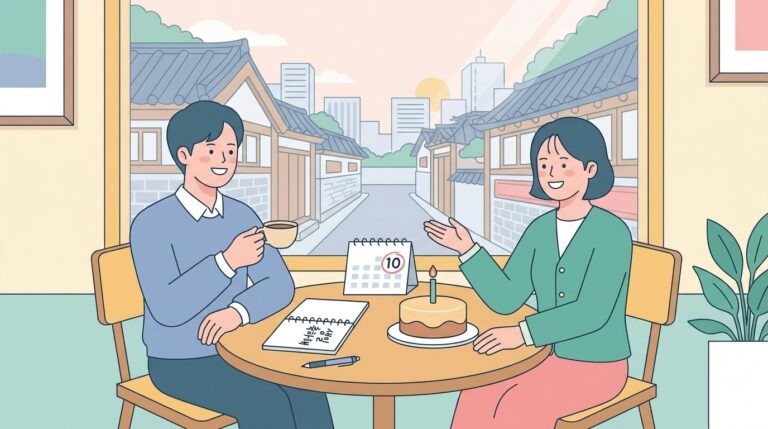
Phase 1: Empathy (Story Opening)
안녕하세요! 매일한글 에디터입니다. Have you ever been in a conversation with a new Korean friend or watched a scene in a K-drama where, barely five minutes into meeting someone, the question drops like a sudden plot twist: “몇 살이에요? (How old are you?)” If your first instinct was to freeze or wonder if you accidentally did something offensive to trigger a background check, breathe easy—you are definitely not alone! In Western cultures, asking an acquaintance their exact age can feel intrusive or even rude. But in Korea, asking “몇 살이에요?” is actually the ultimate warm sign of friendliness. It’s the cultural key that unlocks how people will address you, which honorifics to use, and whether you’re about to become lifelong friends or respected older siblings. In this lesson, designed from real classroom breakdowns and student struggles, we’ll transform that awkward shock into effortless Korean confidence!
Phase 2: 3 Core Expressions In-Depth
1. 몇 살이에요? (Myeot sarieyo?)
- Pronunciation: [Myeot-sa-ri-eyo] (Sounds like: Myut sah-ree-eh-yo — imagine saying “mute” quickly, then “sorry-eh-yo”!)
- Meaning: Literal: “How many years/ages are you?” | Real Nuance: “How old are you?” (Polite, everyday casual)
- K-Culture Moment: In youthful romance dramas like Our Beloved Summer, characters at university orientation or friendly hangouts naturally ask this to establish speech hierarchy and see if they can drop honorifics.
- Editor’s Insight: The word 살 (sal) counts years of age, while 이에요 (ieyo) adds polite friendliness. It is ideal for peers, social meetups, and classmates, but not for elders or high-ranking bosses!
- Situation Spectrum: Casual ✅ | Semi-formal ✅ | Formal ⚠️
- 🤔 Think About It: In English, asking age can feel like a social taboo. Why do you think Korean society considers knowing someone’s age essential for showing genuine respect?
2. 저는 [나이]살이에요. (Jeoneun [age]sarieyo.)
- Pronunciation: [Jeo-neun … sa-ri-eyo] (Sounds like: Juh-nun … sah-ree-eh-yo — “juh” like “just”, “nun” like a bread bun)
- Meaning: Literal: “As for me, I am [age] years old.” | Real Nuance: “I am [age] years old.”
- K-Culture Moment: In variety shows like Running Man, guest idols introduce themselves politely to senior hosts using this exact structure before everyone figures out their team nicknames.
- Editor’s Insight: Remember to pair this with Native Korean numbers (하나, 둘, 셋…) rather than Sino-Korean numbers. For example, 20 is 스무 (seumu), making 20 years old 스무 살이에요 (seumu sarieyo).
- Situation Spectrum: Casual ✅ | Semi-formal ✅ | Formal ✅
- 🤔 Think About It: Why does Korean use a completely different number set (Native Korean) for counting human age compared to counting phone numbers or money?
3. 몇 년생이에요? (Myeot nyeonsaeng-ieyo?)
- Pronunciation: [Myeon-nyeon-saeng-i-eyo] (Sounds like: Myun-nyun-seng-ee-eh-yo)
- Meaning: Literal: “Which birth year are you?” | Real Nuance: “What year were you born?”
- K-Culture Moment: K-Pop fandoms live by this line! When idols meet on music talk shows, they instantly compare birth years (e.g., “00년생이에요!” / “I was born in 2000!”) to bond as same-age friends.
- Editor’s Insight: This is modern Korea’s golden life-hack phrase. Asking for the birth year skips all the confusing math of age systems and avoids any awkwardness over birthdays!
- Situation Spectrum: Casual ✅ | Semi-formal ✅ | Formal ⚠️
- 🤔 Think About It: How does identifying with your birth year create instant generational camaraderie compared to just knowing a numeric age?
Phase 3: Textbook Korean vs Real-life Korean
- Situation 1: Asking someone’s age in a social gathering
- 📖 교과서 한국어: 나이가 어떻게 되세요? (Naiga eotteoke doeseyo? / “What is your honorable age?”)
- 🗣️ 진짜 한국어: 몇 살이에요? (Myeot sarieyo?) or 몇 년생이에요? (Myeot nyeonsaeng-ieyo?)
- 💡 왜 다를까?: While “나이가 어떻게 되세요?” is grammatically impeccable, using it with someone in their 20s or 30s at a cafe makes you sound like an insurance agent or a government inspector! Young adults prefer natural, friendly tones.
- Situation 2: Answering how old you are to new friends
- 📖 교과서 한국어: 저는 스물다섯 살입니다. (Jeoneun seumuldaseot sarimnida. / “I am twenty-five years of age.”)
- 🗣️ 진짜 한국어: 저 99년생이에요! (Jeo gusip-gu nyeonsaeng-ieyo! / “I was born in ’99!”)
- 💡 왜 다를까?: Native numbers above twenty can trip up learners, and “~입니다” feels rigid. Real locals simply drop the last two digits of their birth year followed by “년생이에요” for a super smooth delivery.
Phase 4: K-Culture Deep Dive & Non-verbal Manners
4-1. 눈치 (Nunchi) & Gestures
When asking “몇 살이에요?”, tone and body language make all the difference. Never point your finger directly at the person while asking. Instead, maintain a soft, open posture, tilt your head slightly with a warm smile, and keep your hands loosely clasped in front of your lap or on the table. This non-verbal cue signals: “I’m asking because I want to get closer to you and speak comfortably, not to judge you!”
4-2. Cultural Code: The Social Compass of Korea
In Western languages, whether you talk to a 19-year-old or a 45-year-old, you still say “You”. In Korean, the word “You” (당신 – dangsin) is practically absent in polite conversation! To speak without offending someone, Koreans must choose between formal speech (존댓말 – jondaetmal) and casual speech (반말 – banmal), as well as affectionate titles like 언니 (unni), 누나 (noona), 오빠 (oppa), or 형 (hyung). Knowing your age isn’t personal nosiness—it is social navigation so both of you feel comfortable and respected.
Phase 5: Real-Life Roleplay Scenario
Setting: A cozy board game cafe near Hongik University Station. The aroma of freshly brewed iced Americanos fills the room. You sit across from Minji, a cheerful 22-year-old college student who just invited you to join her table.
- Turn 1 (Minji): 안녕하세요! 혼자 오셨어요? (Annyeonghaseyo! Honja osyeosseoyo?) [🎭 Smiling warmly as she sets down a menu] (Hello! Did you come alone?)
- Turn 2 (You): 네, 한국어 연습하고 싶어서 왔어요. (Ne, hangugeo yeonseuphago sipeoseo wasseoyo.) [🎭 Nodding politely with a friendly grin] (Yes, I came because I want to practice Korean.)
- Turn 3 (Minji): 와, 한국어 진짜 잘하시네요! 혹시 몇 살이에요? (Wa, hangugeo jinjja jalhasineyo! Hoksi myeot sarieyo?) [🎭 Leaning in with curious, welcoming eyes] (Wow, your Korean is really good! By any chance, how old are you?)
- Turn 4 (You): 저 스물세 살이에요. 2001년생이에요! (Jeo seumulse sarieyo. Icheon-il nyeonsaeng-ieyo!) [🎭 Checking your mental notes and smiling confidently] (I am 23 years old. Born in 2001!)
- Turn 5 (Minji): 헐, 대박! 저도 2001년생이에요! 우리 동갑이네요! (Heol, daebak! Jeodo icheon-il nyeonsaeng-ieyo! Uri donggabineyo!) [🎭 Clapping her hands together excitedly] (OMG, awesome! I was also born in 2001! We are the same age!)
- Turn 6 (You): 정말요? 반가워요! 우리 친구네요. (Jeongmalyo? Bangawoyo! Uri chinguneyo.) [🎭 Relaxing shoulders and smiling broadly] (Really? Nice to meet you! We are friends then.)
- Turn 7 (Minji): 맞아요! 그럼 우리 말 편하게 할까요? (Majayo! Geureom uri mal pyeonhage halkkayo?) [🎭 Tilting her head playfully] (Exactly! Then shall we drop honorifics and speak comfortably?)
- Turn 8 (You): 좋아요! 편하게 이야기해요. (Joayo! Pyeonhage iyagihaeyo.) [🎭 High-fiving her gently across the table] (Sounds great! Let’s chat comfortably.)
🔀 Interactive Choice Point
Right after Minji asks Turn 3: “혹시 몇 살이에요?”, what is your best move?
* Option A: Say “비밀이에요! (Bimirieyo! / It’s a secret!)” with a deadpan stare.
* Feedback: [Bad] 🚫 In Korea, refusing to share your age stops the social interaction in its tracks. The other person won’t know how to address you and will feel terribly awkward.
* Option B: Say “저는 스물세 살이에요. 민지 씨는 몇 살이에요? (Jeoneun seumulse sarieyo. Minji ssineun myeot sarieyo?)”
* Feedback: [Best] ✅ Courteous, answers the question clearly, and politely bounces the question back to keep the dialogue flowing!
* Option C: Say “왜 물어봐요? 나이 많아요? (Wae mureobwayo? Nai manayo? / Why do you ask? Are you old?)”
* Feedback: [Risk] ⚠️ Sounds confrontational and defensive. Even if meant as a joke, without high-level fluency it comes across as very rude.
Phase 6: 10-Second Emotion Shadowing Drill
Repeat these lines aloud! Follow the emotion markers and pause at the slashes (/).
[😊 Bright and welcoming]
혹시 / 몇 살이에요? / 만나서 반가워요!
(Hoksi / myeot sarieyo? / Mannaseo bangawoyo!)
“By any chance / how old are you? / So nice to meet you!”-
[😄 Delighted and amazed]
헐, / 진짜요? / 우리 완전 동갑이네요!
(Heol, / jinjja-yo? / Uri wanjeon donggabineyo!)
“Whoa, / really? / We are totally the exact same age!” -
[🤝 Relaxed and friendly]
저 스무 살이에요. / 편하게 말씀하세요!
(Jeo seumu sarieyo. / Pyeonhage malsseumhaseyo!)
“I’m twenty years old. / Please feel free to speak comfortably!”
Phase 7: K-Culture Mini Dictionary
- 동갑 (Dong-gap)
- Translation: Same age (peers born in the same calendar year).
- Usage: In Korea, “friend” (친구 – chingu) traditionally refers strictly to people of the exact same age. If someone is your dong-gap, you can immediately form an effortless bond!
- 빠른년생 (Ppareun-nyeonsaeng)
- Translation: “Fast” birth year (born in January or February before 2003).
- Usage: Older Koreans born early in the year entered school a year early, often sharing social seniority with people born a year earlier. It’s a classic conversation starter in K-dramas.
- 호칭 (Hoching)
- Translation: Relational address titles (Oppa, Unni, Hyung, Noona, Sunbae).
- Usage: Once your age gap is identified, you use these titles instead of personal names to show both intimacy and social etiquette.
- 만 나이 (Man nai)
- Translation: International / Legal Age system.
- Usage: Enacted recently in Korea to standardize ages starting from 0 at birth. When asked your age today, answering with your man nai is completely valid and accepted!
Phase 8: Traveler’s Survival Kit
Top 3 Survival Phrases
- 몇 살이에요? (Myeot sarieyo?)
- Pronunciation: Myut-sa-ri-eyo
- Pro Tip: Use with peers at youth hostels, pub crawls, or language exchanges to break the ice instantly.
- 몇 년생이세요? (Myeot nyeonsaeng-iseyo?)
- Pronunciation: Myun-nyun-seng-ee-seh-yo
- Pro Tip: A softer, slightly more deferential way to ask birth year to people who look a bit older than you.
- 동갑이에요! (Dong-gabieyo!)
- Pronunciation: Dong-gah-bee-eh-yo
- Pro Tip: The magic word when finding out you share the same age. Instant smile guaranteed!
Editor’s Travel Note
When wandering through vibrant youth districts like Hongdae or Seongsu, you will find tons of friendly local meetups. To navigate between trendy cafes seamlessly, make sure to download the Naver Map app for exploring Seoul streets ahead of time. Public transit is tap-to-ride using your T-money card or climate card, so keep it handy in your phone case!
Phase 9: “One Step Deeper” (Reflective Essay)
In many Western cultures, individuality emphasizes that everyone is an equal peer regardless of when they were born. In Korean culture, however, relationships are deeply relational and harmonious, influenced by traditional Confucian values. Age isn’t a badge of superiority; it is a structural guide that tells an older person to look out for, mentor, and even buy meals for the younger person, while the younger person provides respect and loyalty. When a Korean asks your age, they aren’t ranking you—they are trying to find where your pieces fit into the puzzle of mutual care.
💬 Your Turn: How would you feel if someone asked your age within minutes of meeting in your hometown? Drop your thoughts and birth year below in the comments!
Phase 10: FAQ & Common Mistakes
Q: What if I don’t know Native Korean numbers yet?
A: Don’t panic! Simply use your birth year. Saying “2000년생이에요 (Icheon-nyeonsaeng-ieyo)” using Sino-Korean numbers is 100% natural and widely preferred by modern Korean youth.
Q: Can I ask an elderly person or a taxi driver “몇 살이에요?”?
A: Absolutely not! “몇 살이에요?” is casual-polite and only meant for people around your age or younger. For elders, use the respectful honorific: “연세가 어떻게 되세요? (Yeonsega eotteoke doeseyo?)”.
Q: Did Korea abolish the traditional Korean age system?
A: Yes! Since June 2023, Korea officially adopted the international age (man nai) for legal and administrative standards. You can comfortably state your regular international age.
🚨 Common Mistakes Alert
- ❌ Mistake 1: Using Sino-Korean numbers with 살 (e.g., 이십 살 instead of 스무 살).
- ✔️ Correct Action: Count age with Native Korean numbers (열, 스물, 서른) or switch to birth year (~년생).
- ❌ Mistake 2: Calling someone “당신 (Dangsin)” because you don’t know their age yet.
- ✔️ Correct Action: Call them by name with “~씨” (e.g., 민지 씨) until age and mutual nicknames are settled.
- ❌ Mistake 3: Dropping honorifics immediately upon finding out someone is younger.
- ✔️ Correct Action: Always ask “말 편하게 해도 돼요? (May I speak comfortably?)” first!
Phase 11: Action Missions
- 🥉 Bronze Mission (Solo Practice): Stand before a mirror and pronounce your age in Korean 5 times: “저는 [나이]살이에요!”
- 🥈 Silver Mission (Social Share): Share a short social media post or comment with your favorite K-pop star’s birth year: “[Idol Name]은/는 [Year]년생이에요!”
- 🥇 Gold Mission (Real Life Action): The next time you meet a Korean speaker at a meetup or online language exchange, ask: “혹시 몇 살이에요?” and celebrate if you are dong-gap!
- 🎮 K-Culture Mission: Watch any episode of a Korean reality show (like Single’s Inferno or Transit Love) and spot the exact moment the contestants reveal their age. Watch their facial expressions change!
Phase 12: Interactive Quiz Challenge
1. Situational Judgment:
You meet a university peer at a campus library. You want to ask their age politely without sounding like an elderly grandfather. Which sentence is best?
* A) 연세가 어떻게 되십니까?
* B) 몇 살이에요?
* C) 너 몇 살이야?
2. Fill-in-the-Blank:
When two people discover they were born in the same year, they exclaim: “우리 ______이에요!” (We are the same age!)
3. True or False:
Since June 2023, it is completely standard in Korea to calculate and state your age using the international age (man nai).
* True / False
👉 Click to view answers and explanations!
- Answer: B (몇 살이에요?)
- Explanation: Option A is excessively formal (for seniors/grandparents), and Option C is rude banmal (impolite to someone you just met). Option B hits the perfect friendly, polite note!
- Answer: 동갑 (Dong-gap)
- Explanation: “우리 동갑이에요!” translates to “We are the same age!”
- Answer: True
- Explanation: South Korea officially enacted the international age system into law in June 2023, making your international birthday age the official standard!
- Explanation: South Korea officially enacted the international age system into law in June 2023, making your international birthday age the official standard!







