

Phase 1: Empathy (Storytelling Opening)
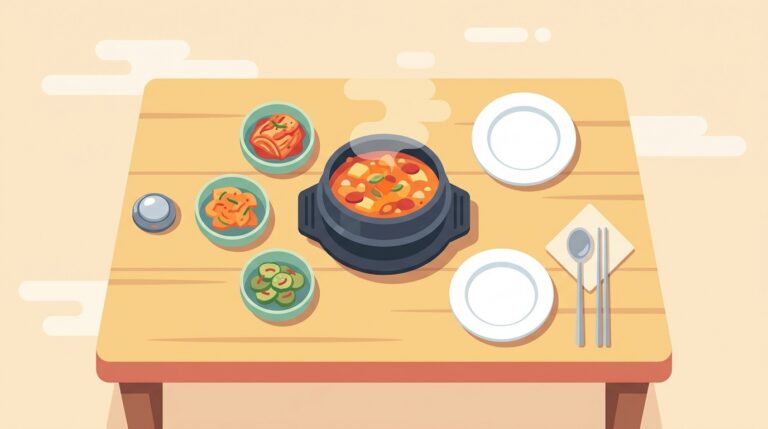
안녕하세요! 매일한글 에디터입니다. Have you ever sat down at a buzzing, vibrant Korean restaurant in Seoul, completely captivated by the bubbling stone pot of Kimchi Jjigae or a sizzling grill of Samgyeopsal right in the middle of your table? The savory aroma fills the air, your mouth waters, and your Korean friends immediately reach their metal chopsticks into the shared dish. But then comes that sudden moment of dining panic: you freeze, staring at the boiling hot stew, wondering, “Wait… am I supposed to eat straight from this scalding pot without burning my tongue? Where is my personal bowl?”
Here is a little secret from a 10-year Korean culture navigator: even native Koreans do not eat piping-hot soup straight out of a shared boiling pot! Everyone relies on a small, individual dish called an 앞접시 (Ap-jeopsi / sharing plate). Yet, if you are a beginner learner, catching the server’s eye and trying to ask for one can feel like an impossible obstacle course.
Over years of coaching beginner students at Daily Hangul, we have seen so many learners burn their tongues or silently wait in thirst simply because they were scared of saying the wrong word. Today, we are putting an end to that restaurant anxiety! In this guide, you will master the exact words, body language, and cultural know-how to effortlessly ask for sharing plates, water, and side dish refills like a seasoned local.
Phase 2: Deep Dive into 3 Core Expressions
1. 앞접시 두 개 주세요 (Ap-jeopsi du gae juseyo)
- Pronunciation: [Ap-jeop-si du gae ju-se-yo] (Think: “Up-jup-she doo gae joo-say-yo”)
- Meaning: Literal: “Front-plate two pieces please” | Actual Nuance: “Could we please have two individual sharing plates?”
- K-Culture Moment: In food-centric K-dramas like Weightlifting Fairy Kim Bok-joo or Let’s Eat, whenever a giant pan of spicy tteokbokki lands on the table, friends instantly request 앞접시 so everyone can scoop their own portion without making a mess.
- Editor’s Insight: The word comes from 앞 (ap / front) + 접시 (jeopsi / plate). It literally refers to the small saucer positioned right in front of your seat to hold food portioned from the main shared dish.
- Situation Spectrum: Casual: ⚠️ (Say ‘앞접시 두 개 줘’ only with same-age besties) | Semi-formal: ✅ (Standard polite form for dining out) | Formal: ✅
- 🤔 Think About It: In many Western dining settings, individual dinner plates are laid out prior to ordering. Why do you think Korean restaurants wait for the customer to ask for sharing plates depending on the dish?
2. 물 좀 더 주세요 (Mul jom deo juseyo)
- Pronunciation: [Mul jom deo ju-se-yo] (Think: “Mool jom duh joo-say-yo”)
- Meaning: Literal: “Water a little more please” | Actual Nuance: “Could we please have some more water?”
- K-Culture Moment: The iconic K-variety scene where an idol takes a huge bite of fiery spicy chicken feet (닭발), fan their tongue with their hands, and desperately looks around asking for more cold water!
- Editor’s Insight: The tiny magic word 좀 (jom / a little) is Korean’s ultimate politeness buffer. It softens your sentence from sounding like an abrupt order into a modest, considerate request.
- Situation Spectrum: Casual: ⚠️ | Semi-formal: ✅ | Formal: ✅
- 🤔 Think About It: Why does adding a word meaning ‘just a little’ make requests feel significantly more respectful in Korean communication?
3. 반찬 리필해 주세요 (Banchan ripil-hae juseyo)
- Pronunciation: [Ban-chan ri-pil-hae ju-se-yo] (Think: “Bahn-chahn ree-peel-hae joo-say-yo”)
- Meaning: Literal: “Side dishes refill please” | Actual Nuance: “Could we please get a refill on these side dishes?”
- K-Culture Moment: International travel shows where foreign tourists are shocked to discover that mountains of kimchi, fish cakes, and pickled radishes keep getting refilled for zero extra cost.
- Editor’s Insight: While traditional Korean uses “반찬 더 주세요” (Please give more side dishes), modern restaurants universally use the Konglish term 리필 (ripil / refill). It is clear, punchy, and instantly understood.
- Situation Spectrum: Casual: ⚠️ | Semi-formal: ✅ | Formal: ✅
- 🤔 Think About It: What does the uniquely Korean tradition of unlimited free side dishes reveal about historical community values and Korean hospitality?
Phase 3: Textbook Korean vs. Real Korean
Situation 1: Requesting Sharing Plates at a Restaurant
- 📖 교과서 한국어 (Textbook Korean): 작은 접시를 두 개 가져다주시겠습니까? (Jageun jeopsireul du gae gajyeodajusigesseumnikka? / Would you be so kind as to bring two small plates?)
- 🗣️ 진짜 한국어 (Real Korean): 저기요, 앞접시 두 개만 주세요! (Jeogiyo, ap-jeopsi du gae-man juseyo! / Excuse me, two sharing plates please!)
- 💡 왜 다를까? (Why is it different?): Textbook Korean can sound stiff, like writing a legal contract. In a bustling, noisy restaurant, staff appreciate quick, clear, and naturally polite phrases starting with 저기요 (Jeogiyo / Excuse me).
Situation 2: Asking for More Kimchi
- 📖 교과서 한국어 (Textbook Korean): 김치를 다시 제공해 주실 수 있나요? (Kimchireul dasi jegonghae jusil su innayo? / Can you provide kimchi once again?)
- 🗣️ 진짜 한국어 (Real Korean): 이모님, 김치 좀 더 주세요~ (Imo-nim, kimchi jom deo juseyo~ / Auntie, could we have a little more kimchi please?)
- 💡 왜 다를까? (Why is it different?): The word “제공” (provision) sounds corporate. Calling a friendly female owner 이모님 (Imo-nim / Auntie) and asking with a melodic lilt instantly creates warm rapport.
Phase 4: K-Culture Deep Dive & Non-Verbal Manners
4-1. 눈치 (Nunchi) & Gestures
Calling a server in Korea requires proper 눈치 (Nunchi / situational awareness). First, check your table surface or wall edge for a round call bell button (벨). If there is a bell, simply press it once—no shouting necessary! If there is no bell, look toward the staff, raise one hand gently at chest level with fingers softly gathered (never snap your fingers or wave aggressively), and make friendly eye contact while saying “저기요!” (Jeogiyo!).
When the server hands you your plates or water, always receive the items using two hands (or support your right forearm with your left hand). This simple gesture shows instant respect and will delight restaurant owners!
4-2. Cultural Code Analysis: The Spirit of ‘정’ (Jeong) & Sharing
Korean food culture is founded upon 정 (Jeong / emotional bonding and affection). Historically, families and neighbors gathered around a single giant pot to share sustenance. Today, while communal pots remain central to dishes like budae jjigae and dakgalbi, the 앞접시 serves as the perfect cultural bridge: it preserves the warmth of communal sharing while respecting personal dining comfort and hygiene.
Phase 5: Real-Life Roleplay Scenario
Setting: A popular braised short ribs (갈비찜) diner in Hongdae during dinner rush. Steam rises from every table, and the welcoming restaurant auntie is bustling between tables.
- Alex: 저기요! (Jeogiyo!) – Excuse me!
🎭 Alex gently raises his hand while making brief eye contact. - 이모님 (Server): 네, 갑니다! 뭐 드릴까요? (Ne, gamnida! Mwo deurilkkayo?) – Yes, coming! What can I get you?
🎭 She wipes her hands on her apron and smiles warmly. - Alex: 앞접시 두 개 주세요. (Ap-jeopsi du gae juseyo.) – Please give me two small plates.
🎭 Alex politely gestures toward their steaming pot. - 이모님 (Server): 네, 여기 있어요. 뜨거우니까 조심해요! (Ne, yeogi isseoyo. Tteugeo-unikka josimhaeyo!) – Sure, here they are. It’s hot, so be careful!
🎭 She hands over two clean ceramic bowls with both hands. - Alex: 감사합니다! 그리고 물 좀 더 주세요. (Gamsahamnida! Geurigo mul jom deo juseyo.) – Thank you! And could we also get some more water?
🎭 Alex receives the bowls using both hands and points gently to his empty cup. - 이모님 (Server): 물은 저기 냉장고에서 셀프예요~ (Mureun jeogi naengjanggo-eseo sel-peu-yeyo~) – Water is self-service from that fridge over there~
🎭 She points with an open palm toward a stainless steel refrigerator. - Alex: 아, 셀프요? 알겠습니다! (A, sel-peu-yo? Algesseumnida!) – Ah, self-service? Got it!
🎭 Alex nods respectfully with an understanding grin. - 이모님 (Server): 맛있게 먹어요, 학생! (Mas-itge meogeoyo, haksaeng!) – Enjoy your food, student!
🎭 She gives an encouraging nod and returns to the kitchen.
🔀 Interactive Branching Decision Point
You just finished your first bowl of kimchi and want another scoop. What do you do?
- Choice A: Shout across the diner: “야! 김치 더 가져와!” (Ya! Kimchi deo gajyeowa!)
- Feedback [Bad]: This is harsh, informal speech (반말) that sounds like barking an order at a servant. The entire restaurant will turn quiet in shock!
- Choice B: Press the table bell or catch eye contact and say: “저기요, 김치 리필 좀 부탁드려요~” (Jeogiyo, kimchi ripil jom butakdeuryeoyo~)
- Feedback [Best]: Flawless! Extremely natural, respectful, and friendly. The server will likely bring you a generous portion with a warm smile.
- Choice C: Stand up with your chopsticks and walk directly into the commercial cooking area to grab kimchi from the prep fridge.
- Feedback [Risk]: Unsafe and boundary-crossing! Unless there is a clearly marked dining room self-bar labeled “추가 반찬 셀프” (Extra side dishes self-service), never enter kitchen staff quarters.
Phase 6: 10-Second Emotional Shadowing Drill
Read these lines aloud using the slash marks (/) for natural breath pauses!
[😊 Bright & Polite]저기요! / 앞접시 두 개 주세요. (Jeogiyo! / Ap-jeopsi du gae juseyo.) – Excuse me! / Two small plates please.[🥺 Gentle & Courteous]이모님, / 물 좀 더 주실 수 있나요? (Imo-nim, / mul jom deo jusil su innayo?) – Auntie, / could you give us a little more water?[😄 Cheerful & Grateful]네, 감사합니다! / 잘 먹겠습니다! (Ne, gamsahamnida! / Jal meokgesseumnida!) – Yes, thank you! / We will eat well!
Phase 7: K-Culture Mini Dictionary
- 앞접시 (Ap-jeopsi) | Personal sharing plate | Essential at any Korean restaurant serving communal hot pots, BBQ, stews, or pizzas.
- 셀프 (Sel-peu) | Self-service (Konglish from ‘Self’) | Commonly spotted on dining wall signs like “물은 셀프” (Water is self-service) or “반찬 셀프” (Side dish self-bar).
- 벨 (Bel) | Table call button | The electronic buzzer fixed to table surfaces across Korea that chimes your table number to the staff counter.
- 리필 (Ripil) | Refill (Konglish from ‘Refill’) | Used casually when requesting additional free side dishes or soup broth refills.
Phase 8: Traveler’s Survival Kit
Survival TOP 3 Phrases
- 물 셀프예요? (Mul sel-peu-yeyo?) – Is water self-service? (Pro Tip: If you don’t see a water bottle brought to your table within 2 minutes, check the beverage fridge for this sign!)
- 이거 더 주세요. (Igeo deo juseyo.) – Please give me more of this. (Pro Tip: Simply point your finger at whichever side dish dish is empty.)
- 앞접시 하나만 더 주세요. (Ap-jeopsi hana-man deo juseyo.) – Just one more sharing plate, please. (Pro Tip: Hold up one finger as you speak if you feel nervous about numbers.)
Editor’s Travel Note
Before heading out on your Seoul food tour, make sure you complete your setup by following our guide to 네이버 지도 앱 다운로드. Unlike foreign maps, Naver Map displays accurate dining hours, photos of call-bell setups, and user reviews detailing whether side dishes are self-service. Also, remember: in 90% of casual Korean restaurants, spoons, metal chopsticks, and napkins are tucked away inside a hidden slide-out drawer right under the rim of your table!
Phase 9: “A Step Deeper” (Reflective Question)
In Korean culture, the word for “family” is traditionally 식구 (Sik-gu), which translates character-by-character to “mouths that eat food together.” Eating together out of the same pot was historically the ultimate demonstration of warmth and trust. As times changed and modern standards evolved, the 앞접시 became the everyday tool that preserves this warm spirit of collective sharing without sacrificing personal hygiene.
💬 Your Turn: In your home country, is sharing a single large communal dish standard, or does everyone strictly receive their own individual plate from the beginning? Tell us about your culture in the comments below!
Phase 10: FAQ & Avoiding Misunderstandings
Q: Is it considered rude to ring the table call bell multiple times if the staff is busy?
A: Yes, please avoid pressing the bell repeatedly like a buzzer game. In Korean diners, one press registers your table number on the kitchen LED display. If no one comes after a minute during peak rush hour, press it once more or make polite eye contact.
Q: Are all side dish refills really free in Korean restaurants?
A: Yes! Standard vegetable side dishes (kimchi, beansprouts, pickled radish, salad) are 100% complimentary and refillable. However, premium protein additions like a mini steamed egg (계란찜) or specialty seafood side dishes may have a small re-order fee.
Q: What should I do if the restaurant says “물은 셀프입니다”?
A: This means you can stand up, walk over to the tall glass-door refrigerator, grab a cold water bottle and metal cups from the UV sanitizer cabinet, and bring them back to your table yourself.
🚨 Common Mistakes Alert Board
- Mistake 1: Calling a young female server “아줌마” (Ajumma).
- Correct Action: Never use “아줌마”—it can sound disrespectful! Instead, use 저기요 (Jeogiyo / Excuse me) or 사장님 (Sajangnim / Boss/Owner).
- Mistake 2: Sitting and waiting silently for 15 minutes expecting staff to check on you.
- Correct Action: Korean restaurant service is proactive on your command. Staff will not interrupt your conversation unless you press the bell or call them.
- Mistake 3: Leaving cash or your credit card on the dining table when leaving.
- Correct Action: In Korea, you always bring your bill slip up to the register near the front door to pay upon exiting.
Phase 11: Action Mission & Engagement
- 🥉 Bronze Mission (Solo Practice): Stand in front of your mirror, hold up two fingers, and practice saying “저기요, 앞접시 두 개 주세요!” with a friendly smile 3 times.
- 🥈 Silver Mission (Social Connection): Take a photo of your next home meal or restaurant outing and share it with the caption: “앞접시 두 개 주세요! (Please give me two plates!)” tagging @DailyHangul.
- 🥇 Gold Mission (Real Life): Visit a local Korean restaurant, find the table bell or call the server, and order sharing plates and a side dish refill entirely in Korean!
- 🎮 K-Culture Mission: On your next K-drama binge session, spot how many times characters ask for an 앞접시 or fetch water from a self-service fridge!
Phase 12: Interactive Quiz Challenge
1. Situational Judgment: You are sharing a piping-hot stew with your travel partner and need two small dishes so you don’t burn your tongues. What is the best phrase?
* A) 저기요, 냄비 두 개 주세요. (Jeogiyo, naembi du gae juseyo.)
* B) 저기요, 앞접시 두 개 주세요. (Jeogiyo, ap-jeopsi du gae juseyo.)
* C) 저기요, 물컵 두 개 주세요. (Jeogiyo, mulkeop du gae juseyo.)
2. Fill-in-the-Blank: Complete the polite phrase to ask for more kimchi:
* “이모님, 김치 [______] 더 주세요!”
3. True or False: If a sign reads “물은 셀프입니다”, you should sit and wait for the waiter to pour water for you. (True / False)
👉 Click here to reveal quiz answers and explanations!
Answers & Explanations:
1. Answer: B) 저기요, 앞접시 두 개 주세요. (‘앞접시’ means sharing plates. ‘냄비’ means cooking pots, and ‘물컵’ means water cups!)
2. Answer: 좀 (jom) (‘좀’ acts as the polite cushion word, making your request sound sweet and courteous!)
3. Answer: False. (‘셀프’ means self-service! You should grab a water bottle and cups from the dining room fridge yourself.)







