

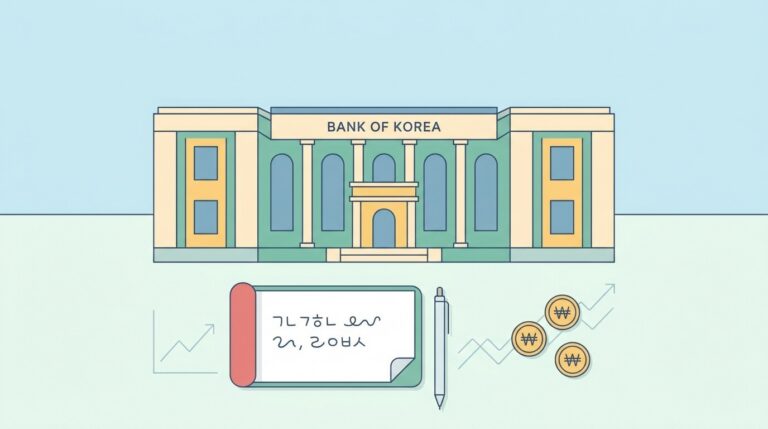
Anchoring Inflation Expectations: How to Discuss Korea’s Monetary Policy Dilemma Like an Insider
Phase 1: Empathy (Story Opening)
안녕하세요! 매일한글 에디터입니다. (Hello! I’m your Daily Hangul editor.)
Picture this: You are sitting at a bustling cafe in Yeouido—Seoul’s bustling Wall Street—surrounded by sharp-suited financial analysts holding iced Americanos. On the wall-mounted television, a breaking news banner flashes across the screen: “한국은행, 기준금리 결정 앞두고 물가와 성장 사이 고심” (Bank of Korea agonizes between inflation and growth ahead of base rate decision). At the next table, two colleagues sigh over their receipts, muttering, “요즘 점심값 오른 거 보면 월급 올려달라고 해야 하는데, 그러면 물가가 또 오르겠죠?” (Looking at lunch prices lately, we need to ask for a raise, but then prices will just jump again, right?).
If you have ever tried tuning into Korean business news or participating in high-level economic discussions at work, you have probably hit a wall of intimidating terminology. How do you articulate complex macroeconomic dynamics—like anchoring inflation expectations to prevent a self-reinforcing wage-price spiral—without sounding like an awkward textbook translation? Based on direct feedback from C1-level professionals working in multinational firms across Seoul, mastering these specific economic formulations doesn’t just elevate your vocabulary; it commands immediate professional respect in any conference room. Let’s break down these high-stakes concepts together!
Phase 2: Core Expressions Deep Dive
1. 기대인플레이션을 안착시키다
- Pronunciation: Gidae-inpeulleisyeon-eul anchaksikida (Pronounced like Gi-dae in-flation-eul ahn-chak-shee-kee-da, sounding like gently guiding a massive ship into harbor).
- Meaning: Literal: “To cause expected inflation to land safely” / Nuance: To anchor or stabilize public expectations of future inflation so panic pricing and preemptive wage demands cease.
- K-Culture Moment: Heard during Bank of Korea (한국은행) press briefings and financial dramas like Money Game (머니게임) when policy chiefs justify tough rate hikes.
- Editor’s Insight: ‘안착(安着)’ literally means landing safely (as an aircraft does). In Korean macroeconomic rhetoric, expectations are treated like volatile airborne objects that must be brought down securely to target levels before they cause turbulence.
- Situation Spectrum: Casual 🚫 / Semi-formal ⚠️ / Formal ✅
- 🤔 Think About It: Why does Korean economic discourse prefer nautical/aviation metaphors like ‘안착’ (safe landing) rather than simply saying ‘통제하다’ (to control)? What does this reveal about market psychology?
2. 임금과 물가의 악순환 고리
- Pronunciation: Imgeum-gwa mulga-ui aksunhwan gori (Eem-geum-gwa mool-ga-eui ahk-soon-hwan go-ree, with a sharp, interlocking cadence).
- Meaning: Literal: “The vicious chain of wages and prices” / Nuance: The classic wage-price spiral, where higher consumer costs drive aggressive wage demands, which subsequently spike business overhead and retail prices.
- K-Culture Moment: A tense boardroom debate in Agency (대행사) where corporate executives and labor representatives clash over annual salary adjustments.
- Editor’s Insight: Koreans pair ‘악순환’ (vicious cycle) with ‘고리’ (link/chain). When you use this phrase, native speakers visualize an unbreakable physical chain that requires decisive external policy intervention to snap.
- Situation Spectrum: Casual ⚠️ / Semi-formal ✅ / Formal ✅
- 🤔 Think About It: In your native tongue, do you describe this spiral as an expanding coil or a closed circle? How does picturing an interlocking chain (‘고리’) alter the urgency of breaking it?
3. 선제적으로 대응하다
- Pronunciation: Seonjejeog-euro daeeunghada (Sun-jeh-juhg-eu-ro dae-eung-ha-da, crisp and assertive).
- Meaning: Literal: “To respond in a preemptive manner” / Nuance: Taking decisive monetary policy action before inflationary momentum solidifies into collective psychology.
- K-Culture Moment: A seasoned fund manager in a Yeouido investment thriller analyzing Federal Reserve and Bank of Korea simultaneous rate hikes.
- Editor’s Insight: Korea’s renowned ‘빨리빨리’ (hurry-hurry) efficiency translates into executive leadership as ‘선제적’ (preemptive). Reactive actions (‘사후 대처’) are criticized; preemptive strikes (‘선제적 대응’) signal true competence.
- Situation Spectrum: Casual 🚫 / Semi-formal ⚠️ / Formal ✅
- 🤔 Think About It: In Korean corporate culture, why is acting ‘preemptively’ considered a mark of supreme foresight rather than reckless impatience?
Phase 3: Textbook Korean vs. Real Korean
Situation 1: Talking about how prices and salaries feed into each other
- 📖 교과서 한국어: 물가 상승률이 높아서 노동자들의 임금 인상 요구가 지속되고 있습니다. (Because the inflation rate is high, workers’ demands for wage increases continue.)
- 🗣️ 진짜 한국어: 물가가 워낙 뛰니까 임금 인상 압박이 거세지고, 이게 다시 물가를 자극하는 형국이에요. (Prices are surging so hard that wage hike pressures are intensifying, and this is creating a situation that agitates inflation all over again.)
- 💡 왜 다를까?: Native Korean finance professionals rarely stick to sterile textbook verbs like ‘지속되다’ (to continue). Instead, they deploy dynamic verbs like ‘뛰다’ (to jump/surge), ‘거세지다’ (to intensify), and the analytical noun ‘형국’ (the unfolding state of affairs).
Situation 2: Debating whether the central bank should hike rates
- 📖 교과서 한국어: 중앙은행은 물가를 억제하기 위해 기준금리를 올려야 할 것입니다. (The central bank will likely have to raise the base interest rate to suppress prices.)
- 🗣️ 진짜 한국어: 경기 침체 리스크를 감수하더라도, 일단 기대심리를 꺾으려면 금리를 선제적으로 올릴 수밖에 없어요. (Even if they have to shoulder recession risks, they have no choice but to raise rates preemptively if they want to break expected inflation sentiment.)
- 💡 왜 다를까?: Advanced speakers frame policy through unavoidable trade-offs: ‘리스크를 감수하다’ (to shoulder risk) paired with ‘-ㄹ 수밖에 없다’ (to have no other choice).
Phase 4: K-Culture Deep Dive & Non-Verbal Manners
4-1. Nunchi & Non-Verbal Manners in Korean Financial Discourse
When discussing sensitive monetary topics in Korea—such as base rate hikes that directly strain domestic mortgage holders—tactful delivery (Nunchi, 눈치) is critical.
* The Thoughtful Nod (경청의 고개 끄덕임): When a senior partner or client voices worry over rising debt burdens, maintain quiet eye contact, lower your chin slightly, and nod slowly before introducing macroeconomic theory. Jumping in aggressively with economic jargon comes across as tone-deaf.
* Two-Handed Presentation (양손 제스처): When indicating an upward or downward trend on an iPad or printed pitch book, gently sweep your open right hand across the chart while resting your left fingers lightly beneath your right wrist. This classic Korean formal gesture conveys deep respect and professional polish.
4-2. Cultural Code: The ‘Lunchflation’ Phenomenon
In South Korea, inflation is experienced most viscerally at 11:30 AM in the office districts of Gwanghwamun and Gangnam. The trending portmanteau 런치플레이션 (Lunch-flation) sparked a cultural shift where office workers deserted traditional 12,000-won Kimchi stew joints in favor of convenience store dosirak (편의점 도시락) or in-house cafeteria subscriptions. When salaries fail to keep up with consumer price indexes, employees flood the anonymous workplace community app Blind (블라인드) to demand aggressive bonuses. This everyday corporate pressure is precisely what forms the ground-level fuel of the wage-price spiral.
Phase 5: Real-World Roleplay Scenario
Setting: A morning macroeconomic strategy meeting on the 23rd floor of an asset management firm overlooking the Han River in Yeouido.
Character: Team Leader Min-woo (민우 팀장), a seasoned, sharp-eyed macro strategist.
- Turn 1 (Min-woo): 🎭 Looking up from his tablet with a serious expression
“이번 한국은행 금융통화위원회 의사록 봤어요? 금리 동결과 추가 인상 사이에서 고심이 깊어 보이던데요.”
(Ibeon Hangugeunhaeng Geumyungtonghwawiwonhoe uisarok bwasseoyo? Geumri donggyeol-gwa chuga insang saieseo gosim-i gipeo boideon-deyo.)
“Did you see the latest Bank of Korea Monetary Policy Board minutes? They seem deeply torn between freezing and hiking rates further.” -
Turn 2 (Learner): 🎭 Nodding respectfully, leaning slightly forward
“네, 팀장님. 경기 둔화 우려도 상당하지만, 지금은 기대인플레이션을 잡는 게 급선무라는 기조였습니다.”
(Ne, timjangnim. Gyeonggi dunhwa uryeodo sangdanghajiman, jigeum-eun gidae-inpeulleisyeon-eul jamneun ge geubseonmuranun gijoyeossseumnida.)
“Yes, Team Leader. While concerns over an economic slowdown are substantial, the overarching stance was that anchoring inflation expectations remains the top priority.” -
Turn 3 (Min-woo): 🎭 Tapping his pen on the desk thoughtfully
“맞아요. 그런데 가계부채 뇌관이 언제 터질지 모르는데, 왜 굳이 추가 긴축 카드를 만지작거릴까요?”
(Maj-ayo. Geureonde gagye-buchae noegwan-i eonje teojilji moreuneunde, wae guji chuga ginchuk kadeureul manjijakgeorilkkayo?)
“True. But with household debt being a ticking time bomb, why are they still contemplating another tightening card?” -
Turn 4 (Learner): 🎭 Speaking with steady confidence, gesturing toward the market slide
“장기 기대인플레이션이 안착되어야 임금과 물가가 서로를 밀어 올리는 악순환 고리를 끊을 수 있기 때문입니다.”
(Janggi gidae-inpeulleisyeon-i anchakdoeeoya imgeum-gwa mulga-ga seororeul mireo ollineun aksunhwan gorireul kkeuneul su itgi ttaemun-imnida.)
“Because long-term inflation expectations must be anchored in order to break the vicious cycle where wages and prices push each other upward.” -
Turn 5 (Min-woo): 🎭 Impressed, nodding with approval
“정확한 분석입니다. 기대심리가 고착화되면 나중에는 금리를 더 큰 폭으로 올려야만 하니까요.”
(Jeonghwak-han bunseok-imnida. Gidaesimriga gochakhwadoemyeon najung-eneun geumrireul deo keun pog-euro ollyeoyaman hanikkayo.)
“Spot-on analysis. If expectations become entrenched, we would be forced to hike rates much more aggressively down the road.” -
Turn 6 (Learner): 🎭 Maintaining a composed and analytical posture
“그렇습니다. 따라서 하반기 임금 협상 국면을 앞두고 시장에 선제적인 경고 시그널을 보내는 셈입니다.”
(Geureohseumnida. Ttaraseo habangi imgeum hyeopsang gukmyeon-eul apdugo sijang-e seonjejeogin gyeonggo sigeuneoreul bonaeneun sem-imnida.)
“Exactly. Therefore, it serves as a preemptive warning signal to the market ahead of upcoming second-half wage bargaining cycles.” -
Turn 7 (Min-woo): 🎭 Closing his binder and looking directly at you
“좋습니다. 그렇다면 우리 채권 운용 포트폴리오 듀레이션은 어떻게 가져가는 게 맞겠습니까?”
(Jotseumnida. Geureotdamyeon uri chaegwon unyong poteupolrio dyureisyeon-eun eotteoke gajyeoganeun ge matgetseumnikka?)
“Great. In that case, how should we position our bond portfolio duration?” -
Turn 8 (Learner): 🎭 Delivering the strategic conclusion with conviction
“금리 상방 압력이 여전하므로, 단기물 비중을 유지하며 금통위 메시지를 확인한 뒤 점진적으로 늘리는 것을 제안합니다.”
(Geumri sangbang amnyeog-i yeojeonhamuro, dangimul bijung-eul yujihamyeo geumtongwi mesijireul hwag-inhan dwi jeomjinjeog-euro neullineun geoseul je-anhamnida.)
“Since upward pressure on interest rates persists, I propose maintaining our weight in short-term paper and expanding duration gradually after confirming the policy board’s signals.”
🔀 Interactive Decision Point
How would you answer Min-woo if you wanted to recommend a portfolio tilt?
* Choice A (Conservative & Analytical): “기대인플레이션 안정 시그널이 확인될 때까지는 보수적으로 단기물 위주의 방어적 포지션을 취해야 합니다.” (We should conservatively take a defensive position focused on short-term paper until inflation stabilization signals are confirmed.)
* Feedback: Best! Demonstrates sophisticated risk management and professional C1 economic terminology.
* Choice B (Overly Emotional & Alarmist): “경기 다 망할 것 같으니까 채권이고 주식이고 다 팔아서 현금만 쥐고 있어야 합니다!” (The whole economy will collapse, so sell all bonds and stocks and hold only cash!)
* Feedback: Bad. Highly unprofessional and melodramatic for a financial strategy setting.
* Choice C (Evasive & Passive): “한국은행이 알아서 잘 결정할 테니 일단 아무것도 하지 말고 기다려 보죠.” (The Bank of Korea will figure it out, so let’s just do nothing and wait.)
* Feedback: Risk. Signals passivity and a lack of analytical conviction to your Korean team leader.
Phase 6: 10-Second Emotional Shadowing Drill
Practice reading these out loud, observing the / pauses and the emotional direction markers:
[🧐 진지하고 단호하게 (Serious & Resolute)]
장기 기대인플레이션이 / 확실하게 안착되어야 / 임금과 물가의 악순환 고리를 / 끊어낼 수 있습니다.
(Janggi gidae-inpeulleisyeon-i / hwaksilhage anchakdoeeoya / imgeum-gwa mulga-ui aksunhwan gorireul / kkeuneonael su itsseumnida.)
“Only when long-term inflation expectations are firmly anchored can we sever the vicious cycle of wages and prices.”-
[💡 통찰력 있게 설득하듯 (Insightful & Persuasive)]
임금 인상이 / 다시 소비재 가격을 밀어 올리는 순간, / 통화 정책의 부담은 / 눈덩이처럼 불어납니다.
(Imgeum insang-i / dasi sobijae gagyeog-eul mireo ollineun sungan, / tonghwa jeongchaeg-ui budam-eun / nundeong-icheoreom bureonamnida.)
“The moment wage increases drive consumer goods prices up again, the burden on monetary policy snowballs.” -
[⚖️ 균형 잡힌 정책관으로 (Balanced & Measured)]
단기적인 경기 위축을 감수하더라도, / 기대심리를 선제적으로 제어하는 것이 / 장기적 비용을 줄이는 길입니다.
(Dangijeogin gyeonggi wichug-eul gamsuhadeorado, / gidaesimrireul seonjejeog-euro jeeohaneun geosi / janggijeok biyong-eul jurineun girimnida.)
“Even if we must endure short-term economic contraction, preemptively controlling expectations is the path to reducing long-term costs.”
Phase 7: K-Culture Mini Dictionary
-
금통위 (Geumtongwi)
Pronunciation: Geum-tong-wi | Translation: Monetary Policy Board (MPC).
Usage: Short for 금융통화위원회 (Financial Monetary Committee). You will hear Korean news anchors say: “내일 금통위에서 기준금리를 결정합니다” (Tomorrow the MPC decides the base rate). -
영끌족 (Yeong-kkeul-jok)
Pronunciation: Yeong-kkeul-jok | Translation: People who leveraged every last asset to buy real estate.
Usage: Contraction of ‘영혼까지 끌어모으다’ (gathering even one’s soul) + ‘족’ (clan). They represent the demographic most vulnerable to central bank rate hikes. -
런치플레이션 (Lunch-flation)
Pronunciation: Reon-chi-peul-lei-syeon | Translation: Lunch + Inflation.
Usage: Used daily in office conversations across Yeouido, Pangyo, and Gangnam to describe the pain of dining out on workdays. -
긴축 발작 (Ginchuk Baljak)
Pronunciation: Gin-chuk Bal-jak | Translation: Taper tantrum / Tightening shock.
Usage: A medical metaphor (‘발작’ = spasm/fit) describing financial markets reacting violently to sudden liquidity contraction.
Phase 8: Traveler’s Survival Kit
Everyday Economic Survival Expressions TOP 3
- “요즘 물가가 진짜 장난 아니네요.” (Yojeum mulga-ga jinjja jangnan anineyo.)
Translation: “Prices lately are seriously no joke!”
Pro Tip: Perfect icebreaker with taxi drivers or restaurant owners when chatting about daily life. - “혹시 점심 특선이나 가성비 메뉴 있을까요?” (Hoksi jeomsim teukseon-ina gaseongbi menyu isseulkkayo?)
Translation: “Do you have a lunch special or a cost-effective menu item?”
Pro Tip: Use this to find affordable weekday lunch sets in busy Seoul office districts. - “모바일 온누리상품권이나 제로페이 결제 되나요?” (Mobail Onnuri-sangpumgwon-ina Jeropei gyeolje doenayo?)
Translation: “Can I pay with Mobile Onnuri gift certificates or ZeroPay?”
Pro Tip: A great way to save 7–10% at traditional markets and registered local neighborhood stores.
Editor’s Travel Note
When navigating dining costs during an inflationary period in Seoul, avoid generic tourist spots and seek out government-certified “착한가격업소” (Good Price Establishments). You can easily locate these neighborhood gems by consulting the official portal via the 행정안전부 착한가격업소 포털 검색 or pinpointing local bus routes via 네이버 지도 앱 다운로드.
Phase 9: “One Step Deeper” (Reflective Essay)
In South Korea, inflation is never viewed purely as an abstract mechanical metric; it is profoundly communal. When prices surge, public discourse swiftly centers on ‘고통 분담’ (burden sharing). The tension between labor unions demanding wage compensations and central bankers striving to anchor inflation expectations reflects a broader cultural struggle: How does a society that achieved rapid industrialization through unified sacrifice balance collective economic stability against personal financial survival? When central bankers emphasize anchoring expectations, they aren’t merely managing data; they are appealing to social trust.
💬 Your Turn: In your home country, is inflation viewed as a systemic governance dilemma or a personal financial obstacle? Share your perspective in the comments below!
Phase 10: FAQ & Common Mistakes
Q: What is the difference between ‘안착시키다’ and ‘안정시키다’?
A: ‘안정시키다’ (to stabilize) is a broad term meaning to make something calm or steady. ‘안착시키다’ (to anchor / land safely), however, specifically implies taking a volatile, floating element (like public inflation expectations) and pinning it securely into a predefined, safe baseline target. In central bank communications, ‘기대인플레이션 안착’ is the gold-standard technical collocation.
Q: Can I use the phrase ‘악순환 고리’ in everyday personal conversations?
A: Yes! While frequently used in economics (‘임금과 물가의 악순환 고리’), it is also widely used in everyday situations, such as breaking bad lifestyle habits: “야근과 야식의 악순환 고리를 끊어야 해요” (I need to break the vicious cycle of overtime work and late-night snacking).
Q: How do Korean professionals differentiate between ‘기준금리’ and ‘시장금리’?
A: ‘기준금리’ (Gijun geumri) refers exclusively to the benchmark base rate set by the Bank of Korea’s Monetary Policy Board. ‘시장금리’ (Sijang geumri) refers to market-determined rates (commercial bank loan rates, corporate bond yields). Confusing the two in business meetings will immediately undermine your credibility.
🚨 Common Mistakes Warning Board
- Mistake: Translating “wage-price spiral” word-for-word as “임금 물가 나선형” (Wage-price spiral-shape).
Correct Action: Always use the established idiom ‘임금과 물가의 악순환 고리’. - Mistake: Using informal endings like “~것 같아” in executive policy briefings.
Correct Action: Anchor your points with assertive formal endings such as “~로 판단됩니다” (It is judged to be…) or “~가 급선무입니다” (…is the top priority). - Mistake: Pronouncing ‘인플레이션’ without proper Korean syllable blocks (e.g., saying it like English “in-flay-shun”).
Correct Action: Clearly enunciate all six Hangul syllables: 인-플-레-이-션 (in-peul-re-i-syeon).
Phase 11: Action Mission
- 🥉 Bronze Mission: Read the Phase 6 Shadowing Drill sentences aloud 5 times into your smartphone voice recorder, checking your
/pauses and rhythmic pacing. - 🥈 Silver Mission: Find a recent economic article from a Korean outlet (such as 한국경제 or 매일경제) containing the keyword ‘기준금리’ or ‘기대인플레이션’, take a screenshot of one sentence, and share it on your social feed tagging #매일한글 #한국어C1.
- 🥇 Gold Mission: In your next Korean 1-on-1 tutoring session or conversation exchange, explain the wage-price spiral using the phrase: “장기 기대인플레이션이 안착되어야 악순환 고리를 끊을 수 있어요.”
- 🎮 K-Culture Mission: Watch an episode of a Korean business reality show or finance podcast on YouTube (e.g., 삼프로TV) and listen for the moment the guest mentions ‘금통위’ or ‘선제적 대응’.
Phase 12: Interactive Quiz Challenge
Test your mastery of advanced Korean economic discourse!
Q1. Situational Judgment
Your Korean client asks: “한국은행이 왜 경기 침체 위험에도 불구하고 금리를 계속 매파적으로 가져갈까요?” (Why is the Bank of Korea taking a hawkish rate stance despite recession risks?) Which response sounds most sophisticated and native-like?
* A) 물가가 오르는 건 당연하니까 그냥 놔두는 게 낫기 때문입니다.
* B) 장기 기대인플레이션을 선제적으로 안착시켜 임금발 악순환 고리를 차단하기 위함입니다.
* C) 자영업자들의 대출 이자를 늘려서 은행을 부유하게 만들려고 그럽니다.
Q2. Fill in the Blank
Complete the sentence with the natural business idiom:
“소비자들의 물가 상승 심리가 굳어지기 전에, 정책 당국이 [ ]으로 시장에 개입해야 합니다.”
(Hint: The word means “preemptively”.)
Q3. True or False
In Korean corporate discourse, ‘런치플레이션’ (Lunch-flation) refers only to fine-dining restaurants raising their dinner prices. (True / False)
👉 Click here to reveal answers & explanations!
Q1 Answer: B
Explanation: Option B uses refined C1 phrasing: ‘선제적으로 안착시켜’ (preemptively anchoring) and ‘임금발 악순환 고리를 차단하기 위함’ (in order to block a wage-driven vicious cycle). Option A is passive nonsense, and Option C is an ungrounded conspiracy tone.
Q2 Answer: 선제적 (선제적으로)
Explanation: ‘선제적으로 개입하다’ (to intervene preemptively) is the standard professional collocation used when describing timely policy action before market panic solidifies.
Q3 Answer: False
Explanation: ‘런치플레이션’ refers specifically to the rising costs of ordinary, everyday lunches consumed by everyday wage workers in business hubs, leading many to pack lunchboxes or rely on convenience stores.







