

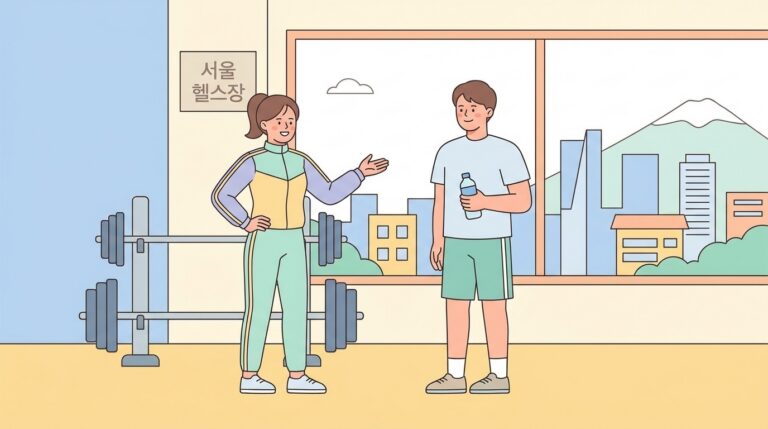
Phase 1: 공감 (Story-driven Intro)
안녕하세요! 매일한글 에디터입니다.
Imagine walking into a sleek, brightly lit fitness center in Hongdae or Gangnam. K-pop beats are pumping in the background, neon signs read 오운완 (Today’s Workout Complete), and an energetic personal trainer welcomes you with a cheerful bow. You hold an InBody consultation sheet in your hands. You don’t want to become an Olympic powerlifter; you simply want to shed a little extra body fat from all those late-night chimaek (chicken and beer) runs and build enough stamina to climb the endless stairs of the Seoul subway without panting.
Yet, when the trainer smiles and asks, “어떤 목적으로 운동을 시작하시나요?” (What goal brings you to work out?), your mind freezes. How do you explain “fat loss” and “basic stamina” without sounding like you’re reading a clinical medical textbook? Many of our Daily Hangul learners tell us that walking into a Korean gym feels intimidating simply because of this initial barrier. This guide is built directly from real gym consultations experienced by international residents in Korea. By the end of this post, you will be able to step onto that scale, talk to any Korean coach comfortably, and state your workout goals with natural, friendly confidence!
Phase 2: 핵심 표현 3선 심층 분석 (3 Core Expressions)
1. 제 목표는 체지방을 줄이고 기초 체력을 기르는 거예요. (한글)
- Pronunciation: [Je mok-pyo-neun che-ji-bang-eul ju-ri-go gi-cho che-ryeo-geul gi-reu-neun geo-ye-yo] (Sound analogy: Say “che-ji-bang” like ‘cherry’ without the ‘r’ + ‘bang’, and “che-ryeok” like ‘chair-yuck’)
- Meaning: Literal: “My goal is reducing body fat and raising foundation physical strength.” / Real Nuance: “My main focus is burning off some body fat and building up my baseline stamina.”
- K-Culture Moment: In fitness reality shows like Physical: 100 or lifestyle vlogs on YouTube, celebrities often tell their trainers they are not training for a competition, but simply striving for everyday stamina and lean health.
- Editor’s Insight: Notice the pairing of 체지방 (body fat) with 줄이다 (to reduce), and 기초 체력 (basic stamina) with 기르다 (to cultivate/grow). Saying 체력을 기르다 sounds far more natural than using generic verbs like “만들다” (to make).
- Situation Spectrum: Casual: ⚠️ (too formal for close gym buddies) | Semi-formal: ✅ (perfect for PT consultations) | Formal: ✅
- 🤔 Think About It: In English, people frequently say “I want to get in shape.” Korean speakers tend to be more specific by distinguishing between muscle mass, body fat, and baseline stamina (체력). Why do you think Korean fitness culture places such high emphasis on measurable baseline stamina?
2. 인바디 검사 먼저 해볼 수 있을까요? (한글)
- Pronunciation: [In-ba-di geom-sa meon-jeo hae-bol su is-seul-kka-yo?] (Sound analogy: “In-body gum-sa mawn-juh hae-bol soo ee-seul-kka-yo”)
- Meaning: Literal: “Can I try doing an InBody test first?” / Real Nuance: “Could we start by checking my body composition on the InBody machine?”
- K-Culture Moment: Almost every Korean gym membership starts at the iconic InBody impedance analysis machine. In K-Dramas, characters nervously take off their socks before stepping on the silver footplates.
- Editor’s Insight: “~해볼 수 있을까요?” is the ultimate polite request pattern in Korean. It softens your sentence and sounds collaborative rather than demanding.
- Situation Spectrum: Casual: ⚠️ | Semi-formal: ✅ (ideal for trainers and front desk staff) | Formal: ✅
- 🤔 Think About It: In Korea, “InBody” has become a generalized brand name used as a common noun for all body composition tests. Do you have a similar brand name in your native language that replaced an entire fitness concept?
3. 무리하지 않는 선에서 시작하고 싶어요. (한글)
- Pronunciation: [Mu-ri-ha-ji an-neun seo-ne-seo si-jak-ha-go si-peo-yo] (Sound analogy: “Moo-ree-ha-jee ahn-neun sun-eh-suh she-jahk-ha-go she-paw-yo”)
- Meaning: Literal: “I want to start within a line that is not overdoing it.” / Real Nuance: “I’d like to take it easy at first without pushing myself to extremes.”
- K-Culture Moment: You will hear this exact phrase when non-athletes train with intense Korean coaches who might otherwise program 100 squats on day one!
- Editor’s Insight: The phrase “~하는 선에서” (within the boundary of…) is an elegant, polite way to set realistic physical boundaries without sounding lazy.
- Situation Spectrum: Casual: ⚠️ | Semi-formal: ✅ (crucial for protecting yourself in consultations) | Formal: ✅
- 🤔 Think About It: Setting boundaries politely is a core element of Korean social etiquette (눈치, nunchi). How does framing limits as “within a reasonable line” prevent awkward friction with an eager trainer?
Phase 3: 교과서 한국어 vs 진짜 한국어 (Textbook vs. Real Korean)
Situation 1: Explaining your weight loss goal
- 📖 교과서 한국어: 저는 체중 감량을 희망합니다. (Jeo-neun che-jung gam-ryang-eul hui-mang-ham-ni-da.) – “I desire weight reduction.”
- 🗣️ 진짜 한국어: 군살 좀 빼고 탄탄해지고 싶어요. (Gun-sal jom ppae-go tan-tan-hae-ji-go si-peo-yo.) – “I want to lose a bit of flab and tone up.”
- 💡 왜 다를까?: The textbook phrase sounds like an official written medical report. Real locals talk about “flab/excess fat” (군살) and becoming “toned/firm” (탄탄하다).
Situation 2: Asking for a trial PT session
- 📖 교과서 한국어: 개인 교습 1회를 체험할 수 있습니까? (Gae-in gyo-seup il-hoe-reul che-heom-hal su it-seum-ni-kka?) – “Is it possible to experience one session of individual instruction?”
- 🗣️ 진짜 한국어: 1회 무료 체험 PT 받아볼 수 있나요? (Il-hoe mu-ryo che-heom Pi-Ti ba-da-bol su in-na-yo?) – “Can I try out a free one-time PT trial?”
- 💡 왜 다를까?: Koreans almost never say “개인 교습” for gym workouts; everyone uses the English acronym “PT” (피티), and pairing it with “무료 체험” (free trial) is standard practice when scouting gyms.
Phase 4: K-Culture 딥다이브 & 비언어적 매너 (Culture & Body Language)
4-1. 눈치 (Nunchi) & Gym Etiquette
When consulting with a Korean trainer, keep these cultural gestures in mind:
* The InBody Barefoot Rule: When asked to step onto the InBody machine, take off both your shoes and socks neatly, placing your shoes parallel toward the exit. Stepping on the machine with socks on will disrupt the sensors and cause the trainer to gently intervene!
* Two-Handed Clipboard Return: When filling out the health questionnaire or signing a trial agreement, hand the pen and paper back using both hands (or with your left hand supporting your right wrist). This conveys respect and gratitude for their time.
* Gentle Head Nodding (끄덕임): While the trainer explains your muscle-to-fat ratio, nod slightly and use short affirmative vocalizations like “네~” (Ne~) or “아, 그렇군요” (Ah, I see). Silence can make the coach wonder if you are unhappy with their explanation.
4-2. The “O-woon-wan” (오운완) Phenomenon
In Korea, working out is not just personal wellness; it is a major social culture. You will notice members taking mirror selfies tagging #오운완 (오늘 운동 완료, Today’s Workout Complete). Furthermore, many Koreans train toward a “Body Profile” (바디프로필)—a professional studio photo shoot showing peak conditioning. When your trainer learns that your goal is simply general fitness rather than an intense Body Profile, they will adjust their coaching style to be supportive, sustainable, and less militaristic!
Phase 5: 실전 롤플레이 시나리오 (Real-Life Roleplay)
- Setting: An upscale fitness center near Hapjeong Station in Seoul. Coach Min-woo (트레이너 민우), wearing a sleek black polo shirt with a clipboard in hand, welcomes you to the counseling desk.
- 트레이너 민우: 안녕하세요! 상담 예약하고 오셨죠? 이쪽으로 앉으세요. (An-nyeong-ha-se-yo! Sang-dam ye-yak-ha-go o-syeot-jyo? I-jjok-eu-ro an-jeu-se-yo.)
🎭 Smiling warmly while pulling out a consultation chair for you.
“Hello! You booked a consultation, right? Please have a seat over here.” -
학습자 (You): 네, 안녕하세요! 상담받으러 왔어요. (Ne, an-nyeong-ha-se-yo! Sang-dam-ba-deu-reo wat-eo-yo.)
🎭 Sitting down politely with a light bow.
“Yes, hello! I came for the consultation.” -
트레이너 민우: 혹시 이전에 PT 받아보신 적 있으세요? 특별한 운동 목표가 있으신가요? (Hok-si i-jeon-e Pi-Ti ba-da-bo-sin jeok it-eu-se-yo? Teuk-byeol-han un-dong mok-pyo-ga it-eu-sin-ga-yo?)
🎭 Tapping a pen lightly on the paper, making friendly eye contact.
“Have you ever done PT before? Do you have any specific fitness goals?” -
학습자 (You): 제 목표는 체지방을 줄이고 기초 체력을 기르는 거예요. (Je mok-pyo-neun che-ji-bang-eul ju-ri-go gi-cho che-ryeo-geul gi-reu-neun geo-ye-yo.)
🎭 Speaking clearly while placing your hands on the table.
“My goal is to reduce body fat and build up my basic stamina.” -
트레이너 민우: 아주 좋은 목표네요! 그럼 먼저 인바디부터 재고 자세히 이야기 나눌까요? (A-ju jo-eun mok-pyo-ne-yo! Geu-reom meon-jeo In-ba-di-bu-teo jae-go ja-se-hi i-ya-gi na-nul-kka-yo?)
🎭 Standing up and guiding you toward the assessment corner.
“That’s a great goal! Shall we measure your InBody first and discuss the details?” -
학습자 (You): 네, 좋아요. 그런데 제가 운동 초보라서 무리하지 않는 선에서 시작하고 싶어요. (Ne, jo-a-yo. Geu-reon-de je-ga un-dong cho-bo-ra-seo mu-ri-ha-ji an-neun seo-ne-seo si-jak-ha-go si-peo-yo.)
🎭 Smiling shyly to establish your comfort boundary.
“Yes, sounds good. But since I’m a beginner, I’d like to start within reasonable limits.” -
트레이너 민우: 걱정 마세요! 회원님 체력 수준에 맞춰서 천천히 루틴 잡아드릴게요. (Geok-jeong ma-se-yo! Hoe-won-nim che-ryeok su-jun-e mat-chwo-seo cheon-cheon-hi ru-tin ja-ba-deu-ril-ge-yo.)
🎭 Nodding reassuringly with an encouraging smile.
“Don’t worry at all! I will set up a routine slowly, matched right to your current stamina level.” -
학습자 (You): 안심이 되네요. 잘 부탁드립니다! (An-sim-i doe-ne-yo. Jal bu-tak-deu-rim-ni-da!)
🎭 Giving an appreciative, respectful nod.
“That’s a relief. I look forward to working with you!”
🔀 인터랙티브 분기점 (Choose Your Response!)
At Turn 6, if the trainer asks if you want to aim for a fast, intensive 2-month transformation, how do you respond?
- Option A: “무조건 빡세게 굴려주세요!” (Roll me as hard as you can!)
- Feedback (Risk): While funny in Korean gym memes, using this slang implies you are ready for extreme, military-style training that could lead to immediate injury.
- Option B: “아니요, 저는 체지방 감량이랑 건강 유지가 먼저예요.” (No, fat loss and maintaining health come first for me.)
- Feedback (Best): Clear, mature, and perfectly sets your expectations without ambiguity.
- Option C: “운동 안 할래요.” (I don’t want to work out.)
- Feedback (Bad): This sounds dismissive and rude after booking an in-person consultation session!
Phase 6: 10초 감정 섀도잉 드릴 (Emotional Shadowing Drill)
Practice reading these sentences aloud, pausing at the slashes (/), and adopting the suggested emotion:
[😊 차분하고 분명하게 - Calm & Clear]
제 목표는 / 체지방을 줄이고 / 기초 체력을 기르는 거예요.
(Je mok-pyo-neun / che-ji-bang-eul ju-ri-go / gi-cho che-ryeo-geul gi-reu-neun geo-ye-yo.)-
[🙋♂️ 정중하고 조심스럽게 - Polite & Inquiring]
인바디 검사 / 먼저 해볼 수 있을까요?
(In-ba-di geom-sa / meon-jeo hae-bol su is-seul-kka-yo?) -
[🥺 솔직하고 편안하게 - Honest & Relaxed]
무리하지 않는 선에서 / 천천히 시작하고 싶어요.
(Mu-ri-ha-ji an-neun seo-ne-seo / cheon-cheon-hi si-jak-ha-go si-peo-yo.)
Phase 7: K-Culture 미니 사전 (Fitness Keyword Mini-Dict)
-
헬스장 (Hel-seu-jang) | Fitness gym / Health club
Usage: From the English word “health” combined with the Sino-Korean “장” (place). In Korea, gyms are universally called 헬스장, not “짐” (gym). -
오운완 (O-un-wan) | Today’s Workout Complete (Acronym for 오늘 운동 완료)
Usage: The most popular Korean fitness hashtag on Instagram. Posting an 오운완 mirror selfie is proof of daily consistency. -
득근 (Deuk-geun) | Gaining muscle mass (Literal: Obtain muscle)
Usage: Commonly used as a cheer among gym-goers. You will often hear people say, “오늘도 득근하세요!” (Have a fruitful muscle-gaining workout today!). -
헬린이 (Hel-lin-i) | Gym beginner / Gym newbie
Usage: A blend of 헬스 (fitness) and 어린이 (child). Use it self-deprecatingly: “저 완전 헬린이에요!” (I am a total gym newbie!).
Phase 8: 여행자를 위한 생존 키트 (Traveler’s Survival Kit)
서바이벌 표현 TOP 3
-
일일권 얼마예요? (Il-il-gwon eol-ma-ye-yo?)
Meaning: How much is a day pass?
Pro Tip: Perfect when you are traveling in Korea and want to drop by a local gym without signing an annual contract. -
운동복이랑 수건 대여되나요? (Un-dong-bok-i-rang su-geon dae-yeo-doe-na-yo?)
Meaning: Can I rent workout clothes and towels?
Pro Tip: Most Korean gyms provide standardized cotton t-shirts, shorts, and towels either for free or for a tiny fee (around 1,000–2,000 KRW). -
라커는 어떻게 이용해요? (Ra-keo-neun eo-tteo-ke i-yong-hae-yo?)
Meaning: How do I use the locker?
Pro Tip: Gyms in Korea often use electronic keypad wristbands or small physical keys tied to shoe lockers.
Editor’s Travel Note
Before stepping into a local fitness studio, download the Korean map app by checking out the 네이버 지도 앱 다운로드. Search for 헬스장 일일권 (gym day pass) to find nearby spots that welcome drop-in visitors. Many commercial Korean gyms accept foreign credit cards at automated kiosks near the entrance!
Phase 9: “한 발 더 깊이” (Cultural Reflection)
In many Western cultures, working out is viewed primarily as an individualized, solitary pursuit. In Korea, however, fitness carries a strong communal identity. Gym members bond over shared InBody metrics, exchange protein drinks, and encourage each other with the term 득근. While this community focus brings immense warmth and motivation, it can sometimes make newcomers feel hyper-conscious of their body image. Remember: stating your personal goals clearly is the best way to enjoy Korea’s vibrant gym culture on your own terms.
💬 Your Turn: What is the primary fitness goal you would share with a personal trainer in Korea? Drop your answer in Korean in the comments below!
Phase 10: FAQ & 오해 방지 (FAQ Schema)
Q: Can I sign up for a Korean gym membership if I only speak basic Korean?
A: Yes! Most trainers are eager to help and will use translation apps or body demonstrations. Knowing the core phrases in this guide (like 체지방 줄이기 and 기초 체력 기르기) is more than enough to establish your goals.
Q: Is InBody testing mandatory at Korean gyms?
A: No, it is not legally mandatory, but it is standard operating procedure. Trainers use it as an objective baseline to recommend a safe workout split. If you feel uncomfortable, you can politely say, “인바디는 다음에 할게요” (I’ll do the InBody next time).
Q: What does PT mean in Korea, and does it include gym entry?
A: PT stands for Personal Training. In many Korean gyms, personal training fees and general membership (entry & locker access) are calculated separately. Always ask: “회원권 포함 가격인가요?” (Does this price include the gym membership?).
🚨 흔한 실수 (Common Mistakes) 경고판
- Mistake: Saying “다이어트하고 싶어요” without context.
Correct Action: In Korea, 다이어트 often implies extreme dieting/starvation. Say “체지방을 감량하고 싶어요” (I want to lose body fat) to focus on healthy body composition. - Mistake: Confusing “체력” (stamina/endurance) with “근육량” (muscle mass).
Correct Action: If you get tired quickly, emphasize 기초 체력 (basic stamina), not just lifting heavy weights. - Mistake: Stepping into workout zones with outdoor street shoes.
Correct Action: Korean gyms require dedicated clean indoor sneakers (실내용 운동화). Bring a separate pair in your bag!
Phase 11: 액션 미션 & 참여 유도 (Action Missions)
- 🥉 Bronze Mission (Solo): Stand in front of your mirror and practice saying: “제 목표는 체지방을 줄이고 기초 체력을 기르는 거예요” 3 times out loud without looking at the romanization.
- 🥈 Silver Mission (Social): Take a photo of your running shoes or gym bag, post it on your Instagram story, and caption it with #오운완 and #헬린이!
- 🥇 Gold Mission (Real-Life): Walk into a gym in Korea (or message a Korean fitness creator online) and ask: “1회 무료 체험 PT 받아볼 수 있나요?”
🎮 K-Culture Mission: Search for the hashtag #오운완 on Instagram. Look at 3 posts and find how Korean fitness enthusiasts describe their daily workout routines!
Phase 12: 인터랙티브 퀴즈 챌린지 (Interactive Quiz)
Test what you learned today before you head to the gym!
- Situational Judgment: You want to tell your trainer that you are a beginner and don’t want extreme workouts. What should you say?
- A) 무조건 빡세게 굴려주세요.
- B) 무리하지 않는 선에서 시작하고 싶어요.
- C) 운동하기 싫어요.
- Fill in the Blank: “제 목표는 체지방을 줄이고 기초 (________)을/를 기르는 거예요.” (Hint: Stamina)
-
True / False: You can wear the sneakers you wore outside directly onto the gym treadmills in Korea.
👉 Click here to check the answers and explanations!
-
Answer: B
Explanation: “무리하지 않는 선에서 시작하고 싶어요” politely sets your physical boundaries while showing willingness to train. -
Answer: 체력 (che-ryeok)
Explanation: 기초 체력 means baseline physical stamina or endurance. -
Answer: False
Explanation: Most Korean gyms strictly require a clean pair of indoor-only sneakers (실내용 운동화) to keep workout areas clean!







