

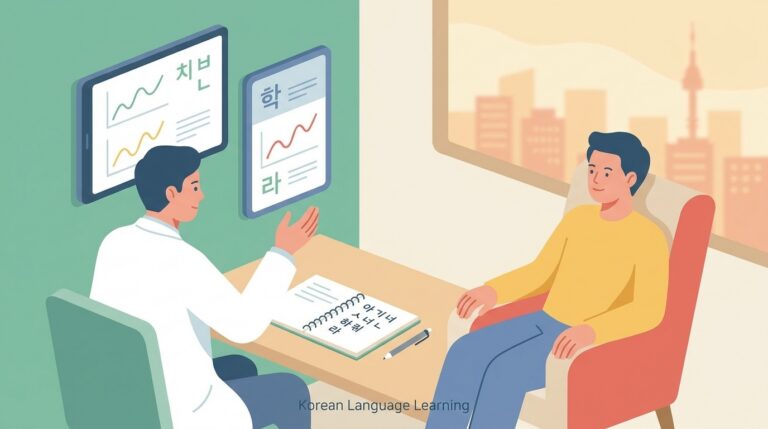
Decoding Your Korean Biopsy Results Without Panic: A Practical Guide
Phase 1: Empathy & Storytelling
안녕하세요! 매일한글 에디터입니다. (Hello! It’s your Daily Hangul editor.)
Imagine this familiar scene straight out of a Korean medical drama like Hospital Playlist: you are seated on a squeaky vinyl stool in an immaculate Seoul clinic, gripping a crisp white envelope or staring anxiously at a KakaoTalk notification marked [결과 안내] (Results Notice). Your heart thumps loudly. You recently underwent your first comprehensive health checkup in Korea—braving the notorious bowel-cleansing prep for a colonoscopy—and the doctor removed a small polyp. The phrase 조직 검사 (biopsy) was tossed around, conjuring dramatic soap opera tropes of grave diagnoses.
Then the physician enters, smiles gently, and hands you the summary sheet. Words like 양성 선종 (benign adenoma), 악성 (malignant), and 추적 관찰 (follow-up monitoring) dance before your eyes. You want to ask, “Is it cancer? Do I need surgery? When should I come back?” but medical Korean feels like an insurmountable wall. Many expat learners tell us that receiving medical results triggers peak vulnerability because conversational Korean doesn’t prepare you for specialized clinical jargon. This guide is crafted specifically from real expat consultations to give you the vocabulary, conversational nuance, and cultural insight needed to understand your biopsy results clearly and advocate for your health in Korea with total confidence.
Phase 2: Core Expressions Deep Dive
1. 조직 검사 결과 다행히 악성이 아니에요.
- Pronunciation: Jojik geomsa gyeolgwa dahang-i akseong-i anieyo. (Intuitive: joh-jeek guhm-sah gyul-gwah dah-haeng-ee ahk-sung-ee ah-nee-eh-yoh)
- Meaning: Literally: “As for the biopsy results, fortunately, it is not malignant.” Natural nuance: “The biopsy came back clear—luckily, it’s not cancerous!”
- K-Culture Moment: You will hear this sigh of relief uttered by doctors in family weekend dramas whenever a beloved matriarch receives routine test results, immediately prompting tearful bows of gratitude from her children.
- Editor’s Insight: The adverb 다행히 (dahang-i – fortunately/thankfully) is vital here. In Korean culture, delivering medical news involves high relational empathy. Even objective doctors often front-load 다행히 to instantly disarm your anxiety before explaining complex pathology terms.
- Situation Spectrum: Casual: ⚠️ (sounds too blunt without honorifics) | Semi-formal: ✅ | Formal: ✅
- 🤔 Think About It: In English, doctors often state: “The biopsy was negative.” In Korean, stating “악성이 아니다” (It is not malignant) paired with emotional relief (다행히) bridges medical clinicality with human compassion. Does your culture’s medical communication prefer detachment or empathetic reassurance?
2. 양성 선종이라서 3년 뒤에 추적 관찰이 필요합니다.
- Pronunciation: Yangseong seonjong-iraseo samnyeon dwie chujeok gwanchal-i piryohamnida. (Intuitive: yahng-sung sun-jong-ee-rah-suh sahm-nyun dwee-eh choo-juhk gwahn-chahl-ee pee-ryoh-hahm-nee-dah)
- Meaning: Literally: “Because it is a benign adenoma, follow-up observation is necessary after 3 years.” Natural nuance: “It was a precancerous benign polyp, so we recommend a surveillance colonoscopy in three years.”
- K-Culture Moment: Seen in documentary programs like 생로병사의 비밀 (The Secrets of Life, Aging, Sickness, and Death) when experts explain preventive screening timelines.
- Editor’s Insight: Break down the terms: 양성 (yangseong – benign) contrasts with 악성 (akseong – malignant), while 선종 (seonjong – adenoma) is a specific type of growth. 추적 관찰 (chujeok gwanchal) literally means “tracking observation,” which is the standard Korean medical term for “follow-up surveillance.”
- Situation Spectrum: Casual: 🚫 | Semi-formal: ✅ | Formal: ✅
- 🤔 Think About It: Notice how the Korean medical timeline is precise and preventative. Why do you think Korea’s national screening system places such a strong linguistic and administrative emphasis on fixed surveillance cycles?
3. 대장 내시경 다시 예약 잡아야 하나요?
- Pronunciation: Daejang naesigyeong dasi yeyak jab-aya hanayo? (Intuitive: dae-jahng nae-she-gyung dah-she yeh-yahk jahb-ah-yah hah-nah-yoh?)
- Meaning: Literally: “Do I need to hold/make a reservation for a colonoscopy again?” Natural nuance: “Should I schedule the repeat colonoscopy right now, or wait?”
- K-Culture Moment: Everyday dialogue at the reception desk in Korean neighborhood clinics where patients finalize schedules with swift, efficient staff.
- Editor’s Insight: The verb 잡다 (japda) means “to hold” or “to catch,” but colloquially combined with 예약 (yeyak – reservation), 예약을 잡다 means “to book an appointment.” It sounds far more natural and native than the mechanical 예약을 하다 (yeyag-eul hada).
- Situation Spectrum: Casual: ⚠️ | Semi-formal: ✅ | Formal: ✅
- 🤔 Think About It: In English, we “schedule an appointment” or “book a slot.” In Korean, grasping a slot (잡다) reflects the dynamic, fast-paced nature of securing coveted hospital schedules!
Phase 3: Textbook Korean vs. Real Korean
Situation 1: Inquiring if the condition is life-threatening or cancerous
- 📖 교과서 한국어 (Textbook): 이것은 암입니까? (Igeoseun am-imnikka? / Is this cancer?)
- 🗣️ 진짜 한국어 (Real-life): 혹시 암이나 안 좋은 쪽은 아닌 거죠? (Hoksi am-ina an joeun jjogeun anin geojyo? / Just to be sure, it’s nothing malignant or bad, right?)
- 💡 왜 다를까? (Why the difference?): Bluntly asking “Is it cancer?” can sound jarring or overly confrontational in a Korean consultation room. Koreans naturally soften heavy topics using euphemistic framing like 안 좋은 쪽 (an joeun jjok – the bad side/direction) preceded by the softening adverb 혹시 (hoksi – by any chance).
Situation 2: Understanding the doctor’s follow-up instruction
- 📖 교과서 한국어 (Textbook): 3년 후에 병원에 다시 내원하십시오. (Samnyeon hue byeong-wone dasi naewonhasipsio. / Please visit the clinic again after three years.)
- 🗣️ 진짜 한국어 (Real-life): 3년 뒤에 내시경 한 번 더 보러 오세요. (Samnyeon dwie naesigyeong han beon deo boreo oseyo. / Come back in three years to take another look with a scope.)
- 💡 왜 다를까? (Why the difference?): While written diagnostic papers use rigid Sino-Korean nouns like 내원 (naewon – visiting the clinic), doctors speaking face-to-face adopt warm, sensory phrasing such as 보러 오다 (boreo oda – to come and see/look).
Phase 4: K-Culture Deep Dive & Non-Verbal Manners
4-1. 눈치 (Nunchi) & Clinical Etiquette
When receiving biopsy findings in Korea, non-verbal cues communicate respect and attentiveness:
1. Two-Handed Acceptance (양손 매너): When the doctor passes you the pathology printout or medical summary sheet, receive it with both hands (or your right hand supported at the forearm by your left). Snatching it with one hand breaks relational harmony.
2. Engaged Eye Line & Nodding: Doctors frequently review your data on vertical monitors. Instead of staring directly at their screen uninvited, sit upright, tilt your head slightly forward, and offer steady, rhythmic nods (고개 끄덕임) paired with polite fillers like 네, 원장님 (Ne, wonjangnim) or 아, 그렇군요 (Ah, geureokunyo).
3. Tone of Relief: When the doctor shares good news, sighing gently and saying 아, 정말 다행이네요 (Ah, jeongmal dahaeng-ineyyo – Oh, what a relief) demonstrates that you appreciate their reassurance.
4-2. Cultural Code: The Culture of 건강검진 (Geongang Geomjin)
In Korea, health checkups are not rare luxury experiences; they are a standardized national rite of passage. Under the National Health Insurance Service (NHIS), all enrolled adults receive free or highly subsidized biennial checkups. Major Korean corporations even offer comprehensive luxury health screenings (종합건강검진) as standard employee benefits, which routinely include endoscopies and ultrasound panels.
Because of this widespread screening infrastructure, Korean adults routinely discuss things like polyp removals (용종 뗐어) as casual lunch chatter. Consequently, finding a polyp (선종) during a colonoscopy is considered an ordinary preventive milestone rather than a medical emergency. The social expectation is simply: remove it early, verify pathology, and observe the routine follow-up schedule.
Phase 5: Real-Life Roleplay Scenario
Setting: Consultation Room 3 at Seoul Premier Gastroenterology Clinic. Soft instrumental music plays. Dr. Kim sits before a dual monitor displaying high-definition endoscopic imagery.
Characters:
* Dr. Kim (김 원장): Calm, professional, and friendly gastroenterologist.
* Alex (알렉스): An expat professional visiting for his post-colonoscopy biopsy report.
- Dr. Kim: 🎭 (Smiling warmly, pointing at the printed endoscopic photo) 알렉스 씨, 지난주에 뗀 용종 조직 검사 결과가 나왔어요. 다행히 암은 아닙니다.
(Alex-ssi, jinanju-e tten yongjong jojik geomsa gyeolgwaga nawasseoyo. Dahang-i am-eun animnida.)
“Alex, the biopsy results for the polyp we removed last week came in. Fortunately, it is not cancer.” -
Alex: 🎭 (Exhaling deeply with both hands resting on lap) 휴, 정말 다행이네요. 결과지 보고 며칠 동안 가슴이 철렁했거든요.
(Hyu, jeongmal dahaeng-ineyyo. Gyeolgwaji bogo myeochil dongan gaseumi cheolleong-haetgeodeunyo.)
“Phew, that is such a relief. My heart sank for days after seeing the preliminary report.” -
Dr. Kim: 🎭 (Turning screen toward Alex to show the cells) 걱정 많으셨죠? 정확히는 양성 선종이었어요. 그냥 놔두면 나중에 암으로 발전할 위험이 있어서 미리 잘 떼어낸 겁니다.
(Geokjeong maneusyeotjyo? Jeonghwakineun yangseong seonjong-ieosseoyo. Geunyang nwadumyeon najung-e am-euro baljeonhal wiheom-i isseoseo miri jal tte-eonaen geomnida.)
“You must have been worried! To be precise, it was a benign adenoma. If left alone, it could have developed into cancer later, so it was good that we excised it early.” -
Alex: 🎭 (Leaning in attentively, nodding) 아, 선제적으로 제거한 거군요. 그럼 앞으로 다른 치료나 복용할 약이 있을까요?
(Ah, seonjejeog-euro jegeohan geogunyo. Geureom apeuro dareun chiryona bogyonghal yagi isseulkkayo?)
“Ah, so it was removed preemptively. Then do I need any other treatment or prescription medications?” -
Dr. Kim: 🎭 (Shaking head reassuringly) 아니요, 약은 전혀 필요 없고요. 다만 선종이 있었던 분들은 재발 가능성을 주기적으로 확인해야 합니다.
(Aniyo, yag-eun jeonhyeo piryo eopgoyo. Daman seonjong-i isseotdeon bundeureun jaebal ganeungseong-eul jugijeog-euro hwaginhaeya hamnida.)
“No, you don’t need any medication at all. However, patients who had an adenoma must check periodically for recurrences.” -
Alex: 🎭 (Taking out a notebook) 네, 원장님. 그럼 추적 관찰은 언제쯤 받으면 될까요?
(Ne, wonjangnim. Geureom chujeok gwanchal-eun eonjejjeum badeumyeon doelkkayo?)
“Understood, Doctor. Then around when should I schedule follow-up monitoring?” -
Dr. Kim: 🎭 (Typing on the chart and writing on a card) 3년 뒤에 대장 내시경 추적 검사를 받으러 오세요. 3년 주기면 충분합니다.
(Samnyeon dwie daejang naesigyeong chujeok geomsareul badeureo oseyo. Samnyeon jugimyeon chungbunhamnida.)
“Please come back for a follow-up colonoscopy in three years. A three-year interval will be completely sufficient.” -
Alex: 🎭 (Receiving the schedule reminder card with both hands and bowing slightly) 3년 뒤요, 잘 알겠습니다. 꼼꼼하게 설명해 주셔서 감사합니다!
(Samnyeon dwiyo, jal algessumnida. Kkomkkomhage seolmyeonghae jusyeoseo gamsahamnida!)
“Three years from now, got it. Thank you so much for the thorough explanation!”
🔀 Interactive Choice Point
Imagine Dr. Kim just told you that you need a follow-up colonoscopy in 3 years. What would you say next?
- Option A: “선생님, 3년 뒤 검사 시기를 잊지 않게 병원에서 문자나 카톡 알림을 주시나요?” (Doctor, does the clinic send a text or KakaoTalk reminder so I won’t forget the date in 3 years?)
- Option B: “3년 뒤요? 혹시 모르니까 6개월 뒤에 매달 내시경 다시 받으면 안 되나요?” (In 3 years? Just in case, can’t I get a colonoscopy every month or after 6 months?)
- Option C: “양성이면 다 끝난 거니까 3년 뒤 검사는 안 받아도 상관없죠?” (If it’s benign it’s all done, so it doesn’t matter if I skip the test in 3 years, right?)
Feedback:
* Option A is the Best Choice! Proactive and natural. Most Korean hospitals offer automated notification services (알림톡 서비스), and asking for it demonstrates your grasp of Korean clinic logistics.
* Option B is Bad. Colonoscopies require rigorous bowel prep and carry minor procedural risks. Requesting monthly checkups shows excessive panic and misunderstands clinical protocols.
* Option C is Risky. Adenomas signify that your colon environment is prone to forming polyps. Dismissing follow-up monitoring risks missing future polyps that could turn malignant.
Phase 6: 10-Second Emotional Shadowing Drill
Practice reading these lines aloud with the emotional cues and pauses indicated by /:
[😌 안도하며 안도의 한숨과 함께 - Relieved, with a genuine sigh]
“휴… / 다행히 악성이 아니라니 / 정말 십년감수했네요.”
(Hyu… / dahang-i akseong-i anirani / jeongmal simnyeongamsuhaetneyo.)
“Phew… / since it’s fortunately not malignant / I feel like ten years were added back to my life!”-
[🧐 진지하고 꼼꼼하게 - Serious, meticulous and focused]
“양성 선종이면 / 3년 뒤에 / 대장 내시경으로 추적 관찰하면 되나요?”
(Yangseong seonjong-imyeon / samnyeon dwie / daejang naesigyeong-euro chujeok gwanchalhamyeon doenayo?)
“If it’s a benign adenoma / do I just follow up / with a colonoscopy in three years?” -
[🙏 정중하고 감사한 태도로 - Polite, respectful and appreciative]
“선생님 덕분에 / 마음이 한결 편해졌습니다. / 3년 뒤에 꼭 다시 뵐게요.”
(Seonsaengnim deokbune / ma-eumi hangyeol pyeonhaejyeosseumnida. / Samnyeon dwie kkok dasi boelgeyo.)
“Thanks to you, Doctor / my mind is so much more at ease. / I’ll be sure to see you again in three years.”
Phase 7: K-Culture Mini Dictionary
- 용종 (Yongjong)
- Translation: Polyp.
- Usage: Any abnormal growth projecting from a mucous membrane. In casual Korean conversations, people often refer to polyps using the colloquial noun 혹 (hok – lump/bump): “대장에 작은 혹이 하나 있었대요” (They said there was a tiny lump in my colon).
- 양성 선종 (Yangseong seonjong)
- Translation: Benign adenoma.
- Usage: A non-cancerous tumor made of glandular tissue. While benign today, it is considered a precancerous lesion (전암성 병변), which is why removal and surveillance are mandatory.
- 추적 관찰 (Chujeok gwanchal)
- Translation: Follow-up observation / Medical surveillance.
- Usage: A ubiquitous clinical term in Korea. Used for monitoring everything from thyroid nodules and liver enzymes to gallbladder polyps. It means “keep an eye on it over time without active medical treatment.”
- 국가건강검진 (Gukga geongang geomjin)
- Translation: National Health Screening.
- Usage: The mandatory biennial preventative health check provided by Korea’s National Health Insurance Service (NHIS). Essential knowledge for anyone living and working in South Korea.
Phase 8: Expat & Traveler Survival Kit
Top 3 Survival Phrases
- 조직 검사 결과지 영문으로 발급받을 수 있을까요?
(Jojik geomsa gyeolgwaji yeongmun-euro balgeupbadeul su isseulkkayo?)
“Could I get an English copy of the biopsy report?”
Pro Tip: Korean hospitals readily issue certified English pathology reports (영문 결과지) for a nominal fee (usually 1,000–3,000 KRW). Always request one for your personal records or overseas insurance. - 결과는 카카오톡 알림톡으로도 받아볼 수 있나요?
(Gyeolgwaneun Kakaotok allimtok-eurodo badabol su innayo?)
“Can I receive the results via KakaoTalk notification?”
Pro Tip: If no severe abnormalities are detected, many clinics deliver the digital summary directly through KakaoTalk, sparing you an extra in-person trip. - 추적 검사는 아무 병원에서나 받아도 되나요?
(Chujeok geomsaneun amu byeong-woneseona badado doenayo?)
“Can I take the follow-up test at any clinic, or must I return here?”
Pro Tip: Doctors usually recommend returning to the same specialist because they have your baseline endoscopic photos on file.
Editor’s Travel & Expat Note
Navigating Korean healthcare is easiest with dedicated digital tools. Make sure to download the 굿닥 (Goodoc) 병원 예약 및 비대면 진료 앱 to easily search for English-speaking gastroenterologists (소화기내과 전문의) and review patient satisfaction ratings in your neighborhood. Also, retain your physical 진료비 영수증 (medical fee receipt) and 진료비 세부내역서 (itemized bill)—Korean private health insurance (실손의료비/실비보험) and foreign travel policies require both for reimbursement.
Phase 9: “One Step Deeper” (Cultural Reflection)
In many Western cultures, a hospital is a place you visit only when symptoms become unbearable. In South Korea, however, the medical philosophy is fundamentally rooted in hyper-preventive maintenance. The ubiquitous Korean idiom “소 잃고 외양간 고친다” (Mending the barn after losing the cow) embodies the deep-seated cultural dread of belated intervention.
Underneath the country’s world-class medical efficiency lies a collective ethos that views regular screening not as an inconvenience, but as a moral responsibility to oneself and one’s family. When your Korean physician calmly schedules your checkup three years down the road, they are inviting you into this cultural pact of proactive wellness. Health isn’t merely the absence of disease; it is the vigilant maintenance of harmony.
💬 Your Turn: Have you ever received a medical test or screening in South Korea or abroad? How did the doctor’s communication style compare to healthcare providers in your home country? Share your stories in the comments below!
Phase 10: FAQ & Common Mistakes
Q: What is the exact difference between 용종 (polyp) and 선종 (adenoma)?
A: 용종 (Yongjong) is an umbrella anatomical term for any elevated projection or lump growing on the mucosal lining. 선종 (Seonjong) is a specific histological subcategory of polyp that has glandular cellular architecture. While not all polyps become cancerous, adenomas have neoplastic potential and must be removed and monitored.
Q: Why do Korean doctors suggest 3 years for a follow-up instead of 5 or 10 years?
A: Standard Korean gastrointestinal guidelines recommend a surveillance colonoscopy at 3 years if you had an adenoma removed (especially if it was larger than 1cm, multiple, or histologically advanced). The 3-year interval accounts for typical Korean dietary patterns, high screening accessibility, and conservative clinical risk management.
Q: If my biopsy says ‘양성’ (yangseong), does that mean I tested positive for cancer?
A: No! This is one of the most dangerous linguistic traps for foreigners. In Korean medical pathology, 양성 (陽性, yangseong) means benign (non-cancerous), whereas 악성 (惡性, akseong) means malignant (cancerous). Do not confuse it with testing “positive” on a viral lab test!
🚨 Common Mistakes Warning Board
- Mistake 1: Confusing 양성 (Benign) with Positive (Cancer)
- Wrong Reaction: Panicking because you think “양성” means positive test result for disease.
- Correct Action: Remember: 양 (Good/Sun) = Benign = Safe! 악 (Evil/Bad) = Malignant = Dangerous!
- Mistake 2: Throwing away the 조직검사 결과지 (Pathology Sheet)
- Wrong Reaction: Discarding the printed report because “everything was fine.”
- Correct Action: Keep a digital scan. Your next endoscopist in 3 years will need to know the exact histological subtype (e.g., tubular adenoma vs. sessile serrated lesion).
- Mistake 3: Skipping the 3-Year Follow-up Because You Feel Healthy
- Wrong Reaction: Assuming that since polyps were removed, you are permanently cured.
- Correct Action: Polyps grow silently without symptoms. Honor the 3-year surveillance window religiously.
Phase 11: Action Missions
- 🥉 Bronze Mission (Solo Practice): Read the Phase 6 Shadowing Drill out loud three times, matching the rhythm, natural pauses (
/), and emotional intonation. - 🥈 Silver Mission (Social Share): Write a mock text message to a Korean friend telling them your biopsy went well using the phrase: “조직 검사 결과 나왔는데 다행히 악성이 아니래!” (The biopsy results came out and thankfully it’s not malignant!).
- 🥇 Gold Mission (Real-world Application): During your next clinic checkup or medical inquiry, ask the front desk reception for an itemized summary: “진료비 세부내역서 한 장 발급해 주세요” (Please issue me an itemized medical bill).
- 🎮 K-Culture Mission: Watch an episode of a Korean medical drama (such as Hospital Playlist or Doctor Romantic) and spot at least two instances where doctors use the word 결과 (results) or 수술 (surgery)!
Phase 12: Interactive Quiz Challenge
Question 1 (Situational Judgement)
You are reviewing your colonoscopy results with your doctor. The physician says: “선종이긴 한데 악성은 아니니까 안심하세요.” What is your best response?
* A) “네, 악성이니까 큰 병원으로 트랜스퍼해 주세요.”
* B) “다행이네요! 그럼 다음 추적 관찰은 언제쯤 받으면 될까요?”
* C) “선종이면 암이니까 오늘 바로 입원 수술할게요.”
Question 2 (Fill in the Blank)
Fill in the missing medical term:
* “조직 검사 결과 다행히 ________ (malignant) 종양이 아니라 ________ (benign) 선종으로 나왔습니다.”
Question 3 (True / False Cultural Check)
- In Korea, because polyps found during checkups are removed immediately on the spot, you never need to undergo another colonoscopy in the future. (True / False)
👉 Click to reveal answers & explanations!
- Answer 1: B
- Explanation: The doctor confirmed it is a benign adenoma (선종이긴 한데 악성은 아님), so you should express relief and ask for the follow-up surveillance schedule.
- Answer 2: 악성 (akseong) / 양성 (yangseong)
- Explanation: 악성 = malignant; 양성 = benign.
- Answer 3: False
- Explanation: Once adenomatous polyps form, your likelihood of developing new polyps in subsequent years increases. Regular follow-up colonoscopy (typically every 3 to 5 years) is crucial.







