

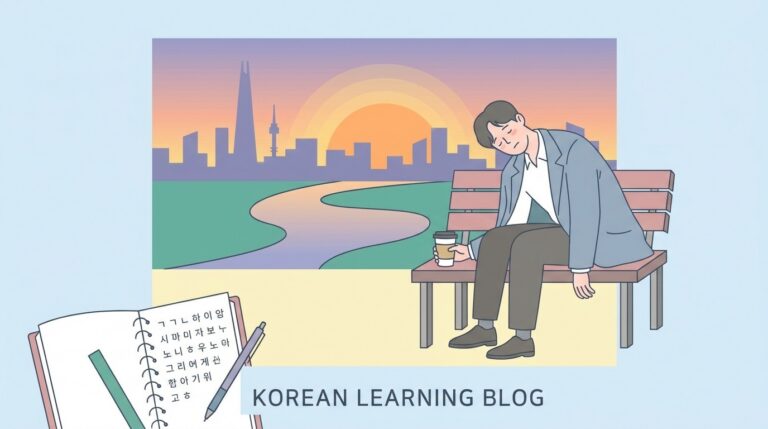
Phase 1: Empathy & Immersive Story Opening
안녕하세요! 매일한글 에디터입니다. (Annyeonghaseyo! This is your Daily Hangul editor.)
Picture this: It’s 10:30 PM outside a convenience store in Yeouido, the pulsating financial hub of Seoul. Two exhausted office workers in sharp suits are sitting on flimsy plastic chairs, clutching giant plastic cups of iced Americano in near-freezing weather. One of them looks up, chuckles hollowly, and says: “오늘 기획안 까이고 야근까지 했는데, 집 가는 막차도 놓쳤어. 진짜 완벽하게 웃프다.” (Oneui gihoegan kkago yageunkkaji haenneunde, jip ganeun makchado notchyeosseo. Jinjja wanbyeokhage utpeuda. / “My proposal got shredded, I worked overtime, and now I just missed the last train home. It’s truly, perfectly laughably tragic.”) Immediately, the other bursts out laughing, clinking their coffee cups together as if toasting a victory.
If you have studied classical Korean culture, you probably learned about Han (恨)—that deep, heavy sorrow born from historical hardship, endured in quiet, painful silence. But step into the streets of modern Seoul, and you will notice something fascinating: Korea’s younger generation isn’t wallowing in classical gloom. In an ultra-competitive, fast-paced society, today’s 20- and 30-somethings have flipped ancient Han on its head, converting societal burnout into razor-sharp, self-deprecating humor (jajojeok yumeo) and subversive irony.
As advanced C1 learners, understanding this cultural pivot is your golden key. You won’t sound like a dusty 19th-century history book; instead, you will master the art of modern Korean bonding—where vulnerability turns into wit, and shared struggle transforms into instant solidarity. Based on hundreds of real feedback sessions with our advanced learners, this guide unpacks the contemporary emotional DNA of Korea.
Phase 2: Core Expressions Deep Dive
1. 웃프다 (Utpeuda)
- Pronunciation: [Ut-peu-da] (Think of the English exclamation “Oot!” followed by “poo-dah” with a dry, ironic snap).
- Meaning: Literally a portmanteau of 웃기다 (utgida, to be funny) and 슬프다 (seulpeuda, to be sad). Nuance: Laughably tragic, bittersweet, or so devastatingly absurd that you have no choice but to laugh.
- K-Culture Moment: You’ll hear this constantly in Korean variety shows like Running Man or web sitcoms when a character tries extraordinarily hard to succeed, fails miserably in an absurdly dramatic way, and everyone laughs while wiping a tear.
- Editor’s Insight: Traditional Han wept in isolation. Utpeuda invites others to laugh with you at life’s absurdity. It is emotional self-defense: acknowledging pain without letting it crush your spirit.
- Situation Spectrum: Casual ✅ | Semi-formal ⚠️ | Formal 🚫
- 🤔 Think About It: Does your native culture have a single word that blends grief and comedy so effortlessly, or do you tend to separate tragedy from humor?
2. 현타 오다 (Hyeonta oda)
- Pronunciation: [Hyeon-ta o-da] (Sounds like “hyun” in Hyundai, paired with a sharp “tah”, then “oh-dah”).
- Meaning: Short for 현실 자각 타임 (hyeonsil jagak taim, reality-realization time). Nuance: The sudden, cold splash of reality crashing into you after a period of intense daydreaming, hyper-effort, or meaningless hustle.
- K-Culture Moment: Protagonists in K-dramas like My Liberation Notes (나의 해방일지) frequently experience this when staring into the subway window after a 14-hour workday, suddenly wondering, “What am I actually doing with my life?”
- Editor’s Insight: It is the modernized linguistic cousin of existential disillusionment. Instead of spiraling into dramatic existential angst, Koreans say “현타 왔어” (Hyeonta wasseo) to shrug off disillusionment and restart.
- Situation Spectrum: Casual ✅ | Semi-formal ⚠️ | Formal 🚫
- 🤔 Think About It: When was the last time you felt a sudden reality check? Notice how giving that state of mind a lighthearted name makes the heaviness easier to bear.
3. 존버하다 (Jonbeohada)
- Pronunciation: [Jon-beo-ha-da] (Starts with a punchy “jon” as in John, followed by “burr-ha-dah”).
- Meaning: A gritty portmanteau of vulgar slang (jon-na, extremely) and 버티다 (beotida, to endure/hold out). Nuance: To endure tenaciously against impossible odds, gritting your teeth with grim determination.
- K-Culture Moment: Massively popularized in Korea’s crypto, stock trading, and hyper-competitive civil service exam subcultures. You see it in webtoons when an underdog trainee vows to survive corporate tyranny.
- Editor’s Insight: While traditional Han celebrated passive endurance (cham-eul in, 忍), Jonbeo is active, stubborn, and slightly rebellious defiance disguised as patience.
- Situation Spectrum: Casual ✅ | Semi-formal 🚫 | Formal 🚫 (Contains an informal vulgar root; use strictly with peers!)
- 🤔 Think About It: How does colloquial slang in your country transform historically revered values like patience into edgy everyday survival slogans?
Phase 3: Textbook Korean vs. Real Korean
Situation 1: Describing overwhelming, futile overtime work
- 📖 교과서 한국어 (Textbook): “과도한 업무와 경쟁으로 인해 깊은 무력감과 슬픔을 느낍니다.” (Gwadohan eommuwa gyeongjaengeuro inhae gipeun muryeokgamgwa seulpeumeul neukkimnida. / “I feel deep helplessness and sadness due to excessive work and competition.”)
- 🗣️ 진짜 한국어 (Real-World): “오늘 영혼까지 탈탈 털렸는데, 내일 또 출근인 거 실화냐? 진짜 웃프다.” (Oneul yeonghonkkaji taltal teollyeonneunde, naeil tto chulgeunin geo silhwanya? Jinjja utpeuda. / “My soul was completely pulverized today, and is it for real that I have to work again tomorrow? Truly laughably tragic.”)
- 💡 왜 다를까? Educated native speakers rarely voice corporate fatigue like a Victorian novel. Instead of direct lamentation, they frame misery through sarcastic disbelief (실화냐?) and ironic catharsis (웃프다).
Situation 2: Waking up from unrealistic career expectations
- 📖 교과서 한국어 (Textbook): “인생의 무상함과 제 한계를 절감하게 되었습니다.” (Insaengui musanghamgwa je hangyereul jeolgamhage doeeotseumnida. / “I have acutely realized the futility of life and my own limitations.”)
- 🗣️ 진짜 한국어 (Real-World): “주말 다 바쳐서 준비했는데 1차 탈락했어. 순간 멍하면서 급 현타 오더라.” (Jumal da bachyeoseo junbihaenneunde il-cha tallakhaesseo. Sungan meonghamyeonseo geup hyeonta odeora. / “Sacrificed my entire weekend preparing, only to get dropped in round one. My mind went blank and a sudden reality check hit hard.”)
- 💡 왜 다를까? Modern Koreans process professional setbacks through shared psychological shorthand like 현타 to neutralize feelings of personal failure without losing face.
Phase 4: K-Culture Deep Dive & Non-Verbal Manners
4-1. Nunchi & Physical Gestures
When exchanging self-deprecating humor (자조적 유머), delivery is everything:
* The Hollow Chuckle & Nape Rub: When delivering lines like “웃프다” or “현타 왔다”, avoid looking genuinely crushed. Tilt your head slightly, release a dry breath of laughter (“허…”), and lightly touch the back of your neck. This signals that while your situation is rough, you are resilient and inviting camaraderie rather than pity.
* The Collective Exhale: Pay attention to the communal sigh (“하…”). When a coworker shares an absurd hardship, synchronizing a brief sigh before making an ironic joke is the modern gesture of deep Jeong (affectionate empathy).
4-2. Cultural Code Analysis: The Satire of Modern K-Dramas
Look at critically acclaimed dramas like Misaeng (미생) or the satirical sketch comedy of SNL Korea. While 1970s Korean cinema depicted Han through devastating family tragedies and wailing protagonists, 21st-century hits frame workplace horror through deadpan micro-humor. In contemporary Korea, taking yourself too seriously when facing systemic stress marks you as lacking Nunchi. Embracing the absurdity of the hustle together is how bonds of Jeong are forged in modern offices.
Phase 5: Real-World Roleplay Scenario
Setting: A vibrant, noisy Craft Beer Pub in Euljiro after an exhausting quarterly review.
Characters:
* Min-ho (민호): Your Korean project teammate, visibly wiped out, loosening his tie.
* You (Alex / 알렉스): An overseas strategist working alongside Min-ho at a tech startup.
- 민호: 🎭 (맥주잔을 내려놓으며 깊은 한숨을 쉰다) “알렉스 씨, 오늘 이사님 피드백 들었죠? 한 달 동안 밤새운 기획을 한마디로 엎으시네요.”
(Alex-ssi, oneul isanim pideubaek deureotjyo? Han dal dongan bamsaeun gihoegeul hanmadiro eopeusineyo. / “Alex, did you hear the director’s feedback today? He wiped out a month of our overnight work in a single sentence.”) - 알렉스: 🎭 (씁쓸한 미소를 지으며 잔을 채워준다) “그러게요. 진짜 멘붕이었어요. 민호 님 얼굴 하얘지는 거 실시간으로 봤어요.”
(Geureogeyo. Jinjja menbungieosseoyo. Min-ho nim eolgul hayaejineun geo silsiganeuro bwasseoyo. / “Tell me about it. It was a total mental breakdown. I literally watched your face turn pale in real time.”) - 민호: 🎭 (자조적인 헛웃음을 터뜨리며) “아… 진짜 눈물 나는데 왜 웃음이 나오죠? 이 상황이 너무 어처구니없어서 웃퍼요.”
(Ah… jinjja nunmul naneunde wae useumi naojyo? I sanghwangi neomu eocheogunieopseoseo utpeoyo. / “Ah… tears are welling up, but why am I laughing? The situation is so ridiculous that it’s painfully hilarious.”) - 알렉스: 🎭 (어깨를 으쓱하며 맥주잔을 든다) “이게 바로 K-직장인의 삶인가요? 저도 순간 급 현타 오더라고요.”
(Ige baro K-jikjanginui salmingayo? Jeodo sungan geup hyeonta odeoragoyo. / “Is this the authentic life of a Korean worker? A sudden reality check hit me hard right there too.”) - 민호: 🎭 (고개를 끄덕이며 공감한다) “맞아요. ‘내가 이러려고 매일 갓생 산다고 설쳤나’ 싶고… 공허하더라고요.”
(Majayo. ‘Naega ireoryeogo maeil gatsaeng sandago seolchyeonna’ sipgo… gongheohadeoragoyo. / “Exactly. I caught myself thinking, ‘Did I hustle every single day to live my best life just for this?’ Felt so hollow.”) - 알렉스: 🎭 (단호하지만 유쾌한 눈빛으로) “그래도 여기서 무너질 순 없죠. 주말엔 푹 쉬고, 다음 주부터 다시 존버 모드 들어가시죠!”
(Geuraedo yeogiseo muneojil sun eopjyo. Jumaren puk swigo, daeum jwubuteo dasi jonbeo modeu deureogasijyo! / “Still, we can’t collapse here. Let’s rest up this weekend and enter pure survival mode again next week!”) - 민호: 🎭 (눈을 동그랗게 뜨며 웃는다) “와, 알렉스 씨 입에서 ‘존버’라는 말이 나오니까 뼈 맞은 것처럼 정신이 번쩍 드네요!”
(Wa, Alex-ssi ibeseo ‘jonbeo’raneun mari naonikka ppyeo majeun geotcheoreom jeongsini beonjjeok deuneyo! / “Wow, hearing ‘jonbeo’ come out of your mouth felt like a witty reality-check; it snapped me right awake!”) - 알렉스: 🎭 (장난스럽게 짠을 하며) “자, 우리의 멘탈 회복을 위하여! 건배!”
(Ja, uriui mental hoebogeul wihayeo! Geonbae! / “Now, to the recovery of our sanity! Cheers!”)
🔀 Interactive Choice Point
At Turn 6, Min-ho shares his deep career emptiness. How do you respond?
- Option A: “맞아요. 이 회사는 가망이 없으니 내일 당장 사표를 씁시다.” (Majayo. I hoesaneun gamangi eopseuni naeil dangjang sapyoreul sseupsida. / “You’re right. This company has no future, let’s both resign tomorrow morning.”)
- Option B: “그래도 여기서 무너질 순 없죠. 주말엔 푹 쉬고, 다음 주부터 다시 존버 모드 들어가시죠!” (Geuraedo yeogiseo muneojil sun eopjyo. Jumaren puk swigo, daeum jwubuteo dasi jonbeo modeu deureogasijyo! / “Still, we can’t fall apart here. Rest over the weekend and let’s go full tenacious survival mode next week!”)
- Option C: “조선시대 조상님들의 한에 비하면 이 정도 고통은 아무것도 아니에요.” (Joseonsidae josangnimdeurui hane bihamyeon i jeongdo gotongeun amugeotdo anieyo. / “Compared to the Han of our Joseon dynasty ancestors, this pain is nothing.”)
Feedback:
* Option A (Risky/Extreme): Overstepping boundaries. Even if colleagues complain passionately, outright advocating immediate resignation breaks the unspoken rule of cathartic venting.
* Option B (Best Choice): Perfect equilibrium! You validate his distress while pivoting to resilient humor using an authentic high-frequency slang term (존버).
* Option C (Bad/Awkward): Unsolicited moral lecturing. Trivializing current struggles with historical comparisons kills the mood instantly.
Phase 6: 10-Second Emotion Shadowing Drill
Read these aloud, pausing at / and infusing the specified emotional texture:
[🥺 씁쓸하면서도 실소하듯이]“오늘 밤샘 작업 다 날아갔는데… / 왜 웃음이 나지? / 진짜 완벽하게 웃프다.”
(Oneul bamsaem jageop da naraganneunde… / wae useumi naji? / jinjja wanbyeokhage utpeuda. / “All my all-nighter work just evaporated… / why am I laughing? / It is so perfectly laughably tragic.”)[😮💨 허탈함을 담아 담담하게]“새벽부터 줄 서서 티켓팅 도전했는데 / 1초 만에 매진이래. / 급 현타 오네.”
(Saebyeokbuteo jul seoseo tiketting dojeonhaenneunde / il-cho mane maejinirae. / geup hyeonta one. / “Waited in the ticketing queue since dawn / only to hear it sold out in one second. / Instant reality check hitting hard.”)[🔥 악바리 근성으로 결연하게]“이번 분기 실적 압박 심하지만 / 별수 있나? / 끝까지 존버해야지.”
(Ibeon bungi siljeok apbak simhajiman / byeolsu inna? / kkeutkkaji jonbeohaeyaji. / “Quarterly sales pressure is brutal / but what choice do I have? / Gotta hold out with iron grit until the end.”)
Phase 7: K-Culture Mini Dictionary
- 갓생 (Gatsaeng) | Lit: God + Life | Refers to living an ultra-productive, disciplined routine (waking at 5 AM, studying, working out). Often used with self-mockery when one fails to sustain it: “갓생 살기 3일 만에 포기.” (Gave up living the ‘God-life’ in 3 days).
- 뼈 맞다 (Ppyeo matda) | Lit: Struck in the bone | Used when someone delivers an unvarnished, accurate truth that hits painfully close to home. The emotional equivalent of “That hit a nerve, but you’re so right.”
- 해탈하다 (Haetalhada) | Lit: To attain Nirvana/enlightenment | Used humorously when someone transcends anger or panic because circumstances have become so overwhelmingly absurd that they reach serene indifference.
- 어쩔티비 (Eojjeol-TV) | Modern Irony Slang | A cheeky, childlike retort meaning “So what? Go watch TV!” Used among younger peers to playfully deflect unwanted nagging or doom-and-gloom talk.
Phase 8: Traveler’s Survival Kit
Top 3 Survival Expressions for Seoul Navigators
- “영혼이 탈출할 것 같아요.” (Yeonghoni talchulhal geot gatayo.)
Pro Tip: Use this at a packed subway transfer station like Sindorim at 8:30 AM. Locals will give you an understanding nod of shared survival. - “오늘 하루도 버텼다!” (Oneul harudo beotyeotda!)
Pro Tip: An endearing way to celebrate finishing an intense travel or study day with Korean friends over evening drinks. - “이 조합, 웃픈데요?” (I johap, utpeundeyo?)
Pro Tip: Great when your food delivery arrives with mismatched sides or an unintended culinary disaster happens.
Editor’s Travel Note
Navigating Seoul’s hyper-efficient grid requires practical tools. Before riding the subway during rush hour, make sure to check the Naver Map navigation app guide to find optimal transfer car doors, saving you minutes of frantic sprinting. Remember: on subway escalators during rush hour, stand strictly on the right side if resting; keep the left clear for those speed-walking to catch their trains!
Phase 9: “한 발 더 깊이” (One Step Deeper)
Historically, the concept of Han functioned as a shared cultural cushion, allowing a wounded nation to collectively mourn colonization, war, and sudden industrial upheaval. Today’s youth operate in an hyper-individualistic society where success is often framed purely as personal merit, yet external socio-economic ceilings persist. By transmuting classic sorrow into 자조적 유머 (self-deprecating memes), younger Koreans have ingeniously re-engineered Jeong: creating an impromptu digital and verbal sanctuary where nobody has to bear societal pressure entirely alone.
💬 Your Turn: Have you ever used self-effacing humor to bond with someone after a terrible day? How do you think sharing our struggles through laughter changes our emotional resilience? Drop your thoughts below!
Phase 10: FAQ & Common Mistakes
Q: Is Han completely dead in modern Korean culture?
A: Not at all. Classical Han still echoes through historical film, ballad music, and older generations. However, younger Koreans experience it not as a romanticized melancholy, but as acute social exhaustion that requires fast, ironic release valves.
Q: Can I use words like 존버 (Jonbeo) in a formal business meeting?
A: Definitely not. While universally recognized, 존버 derives from vulgar slang (ㅈㄴ). In business meetings, use polite equivalents like 끈기 있게 추진하다 (kkeungi itge chujinhada, to pursue with perseverance) or 인내심을 갖고 지켜보다 (innaesimeul gatgo jikyeoboda).
Q: What is the emotional difference between 웃프다 and 어이없다?
A: 어이없다 expresses speechless shock or disbelief at something illogical (often bordering on frustration). 웃프다 must contain sympathetic sadness blended with genuine amusement. If there is no comedic element, use 어이없다 or 슬프다.
🚨 Common Mistakes Alert
| Typical Mistake | Why It Fails | Correct Action |
|---|---|---|
| Calling an elderly stranger’s sad story 웃프다 | Sounds deeply disrespectful and mocks genuine misfortune | Save 웃프다 for ironic, everyday petty mishaps among peers |
| Using 현타 for physical tiredness | 현타 is strictly cognitive/existential disillusionment, not sore muscles | Use 방전되다 (bangjeondoeda, battery depleted) for physical exhaustion |
| Saying 존버 to your company CEO or professor | Severe breach of corporate hierarchy etiquette | Substitute with formal perseverance phrases like 인내하며 극복하겠습니다 |
Phase 11: Action Mission & Engagement
- Bronze Mission (Solo Practice): Pick one minor inconvenience that happened to you today (e.g., dropped your toast butter-side down) and whisper to yourself: “진짜 완벽하게 웃프다.”
- Silver Mission (Social Engagement): Leave an Instagram or X (Twitter) comment under a funny relatable meme using: “완전 뼈 맞아서 급 현타 왔어요 ㅋㅋㅋ”
- Gold Mission (Real Interaction): Next time your Korean language partner or peer mentions being swamped with assignments or tasks, gently encourage them with: “주말까지 같이 존버해요!”
- 🎮 K-Culture Mission: Watch an episode of an office sitcom or a web-variety show (like Workman or Psick Univ). Count how many times they use ironic sighing or modern survival slang!
Phase 12: Interactive Quiz Challenge
1. Situational Judgment
Your coworker just discovered that the cafeteria ran out of their favorite tonkatsu right before their turn, leaving only cold salad. What is the most culturally natural, witty remark?
* A) “조선시대 농민들의 기근에 비하면 견딜 만합니다.”
* B) “진짜 웃프네요… 제 샐러드 드실래요?”
* C) “현타가 오니 즉시 인사과에 항의합시다.”
👉 Click to Reveal the Answer & Explanation
Correct Answer: B
Explanation: Option B strikes the ideal balance of affectionate Jeong and self-deprecating humor (웃프다). Option A is absurdly preachy, and Option C completely misapplies 현타 to an exaggerated administrative grievance.
2. Fill-in-the-Blank
Complete the sentence using the correct modern concept:
“새벽 4시까지 시험공부 했는데 시험 날짜가 다음 주라는 공지를 봤다. 순간 머리가 멍해지면서 급 ( ) 왔다.”
👉 Click to Reveal the Answer & Explanation
Correct Answer: 현타 (or 현타가)
Explanation: The sudden realization that your frantic effort was wasted creates an instant existential reality check (현실 자각 타임 -> 현타).
3. Cultural True/False
(True or False) The term 존버하다 is suitable to use in academic thesis defenses and formal client presentations as long as it shows determination.
👉 Click to Reveal the Answer & Explanation
Correct Answer: False
Explanation: 존버 contains an explicit slang prefix. Even though it is widely used in casual culture and social media, using it in an academic defense or client presentation will damage your professional standing. Use formal terms like 끈기 (kkeungi) or 인내 (innae).







