

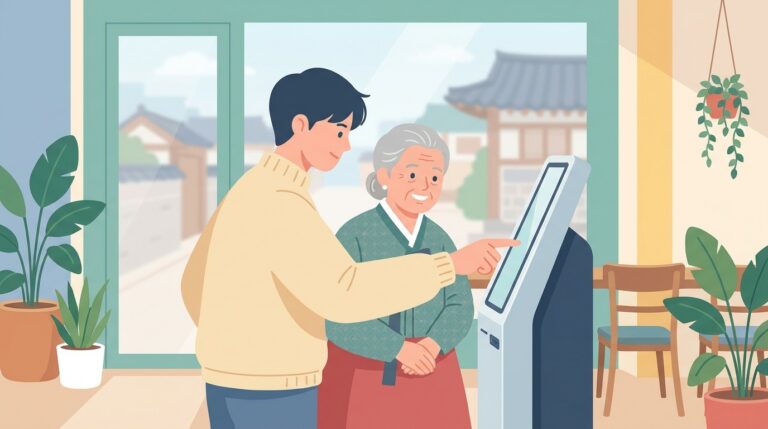
Mastering Korean Kiosk Culture: Empathy, Convenience, and Useful Expressions
Phase 1: Empathy (Story-driven Opening)
안녕하세요! (Hello!) It’s your Daily Hangul editor here. Imagine stepping inside a bustling, neon-lit cafe in Hongdae or a trendy fast-casual restaurant in Gangnam. The scent of roasted coffee beans is in the air, but there is no cashier at the counter. Instead, two tall, glowing digital touchscreens stand guard, with a growing queue of busy office workers checking their smartwatches behind you.
You step up to order, but the screen is filled with tiny fonts, flashing promotions, multiple dropdown options for ice levels, syrup pumps, and take-out stamps. Your palms start to sweat. You feel the sharp gaze of the people lined up behind you. In Korea, this exact scenario is not just a hurdle for international visitors—it is a widespread daily reality known as digital exclusion. In fact, many elderly Koreans simply give up and walk out empty-handed because of this social pressure: 복잡한 화면 구성과 작은 글씨, 뒷사람의 눈치 때문에 주문을 포기하고 그냥 나가시는 분들도 계신대요 (Because of complex menus, tiny text, and pressure from people waiting behind them, some seniors give up and walk out).
As a B1 intermediate learner, learning how to discuss this side of modern Korean society will elevate your conversations from basic survival chit-chat to thoughtful, culturally nuanced dialogue. Based on real feedback from students navigating Seoul’s automated streets, this guide will equip you with the exact words to express hesitation, offer help, and discuss the trade-offs of an ultra-efficient cashless society.
Phase 2: 3 Core Expressions In-Depth Analysis
1. 뒷사람 눈치가 보여요 (Dwit-saram nunchiga boyeoyo)
- Pronunciation: [Dwit-sa-ram noon-chi-ga bo-yeo-yo] (Sounds like dweet-sah-rahm noon-chee-gah bo-yuh-yo)
- Meaning: Literally “The back person’s nunchi is seen,” naturally meaning “I feel self-conscious because of the person behind me” or “I feel rushed by the queue.”
- K-Culture Moment: Often heard in slice-of-life K-Dramas when parents visit the city and struggle with automated subway ticket dispensers or burger chain screens.
- Editor’s Insight: In Korea, 눈치 (nunchi) is the art of sensing moods and social dynamics. Adding 보이다 (to be visible/felt) turns it into an involuntary emotional burden where you cannot help but worry about being a nuisance.
- Situation Spectrum:
- Casual: 뒷사람 눈치 보여 (Dwit-saram nunchi boyeo) ✅
- Semi-formal: 뒷사람 눈치가 보여요 (Dwit-saram nunchiga boyeoyo) ✅
- Formal: 뒷사람의 눈치가 보입니다 (Dwit-saram-ui nunchiga boimnida) ⚠️ (A bit stiff for daily chat)
- 🤔 Think About It: In your native culture, do you feel collective pressure to hurry when ordering in line, or is taking your time considered a personal right?
2. 주문을 포기하고 나가셨대요 (Jumuneul pogihago nagasyeotdaeyo)
- Pronunciation: [Ju-mun-eul po-gi-ha-go na-ga-syeot-dae-yo] (Think joo-moon-eul po-gee-hah-go nah-gah-shyut-day-yo)
- Meaning: “They said someone gave up on ordering and walked out.”
- K-Culture Moment: Used by YouTube vloggers or news commentators discussing how automated kiosks isolate elderly citizens (디지털 소외 계층).
- Editor’s Insight: The ending -대요 (-daeyo) is a vital B1 grammar point used to convey hearsay or information heard from someone else. Combining the honorific -시- (-si-) shows high respect for the elder who faced the trouble.
- Situation Spectrum:
- Casual: 주문 포기하고 나갔대 (Jumun pogihago nagatdae) ✅
- Semi-formal: 주문을 포기하고 나가셨대요 (Jumuneul pogihago nagasyeotdaeyo) ✅
- Formal: 주문을 포기하고 나가셨다고 합니다 (Jumuneul pogihago nagasyeotdago hamnida) ✅
- 🤔 Think About It: How does indirect quotation (-대요) soften your statements in Korean when sharing a sensitive observation?
3. 기계 다루기가 서툴러요 (Gigye darugiga seotulleoyo)
- Pronunciation: [Gi-gye da-ru-gi-ga seo-tul-leo-yo] (Sounds like gee-gyeh dah-roo-gee-gah suh-tool-luh-yo)
- Meaning: Literally “Handling machines is clumsy,” idiomatically “I’m not good with electronic devices / technology.”
- K-Culture Moment: Frequently said with an apologetic smile to clerks or companions when a self-checkout screen displays an error.
- Editor’s Insight: The word 서툴다 (seotulda – to be unaccustomed or clumsy) is gentle and modest. It avoids sounding defensive while politely explaining why you might need extra time.
- Situation Spectrum:
- Casual: 기계 다루는 거 서툴러 (Gigye daruneun geo seotulleo) ✅
- Semi-formal: 기계 다루기가 서툴러요 (Gigye darugiga seotulleoyo) ✅
- Formal: 기계 조작이 서툰 편입니다 (Gigye jojagi seotun pyeon-imnida) ✅
- 🤔 Think About It: Why does admitting unfamiliarity open the door for immediate warmth and assistance in Korean social contexts?
Phase 3: Textbook Korean vs Real Korean
Scenario 1: Expressing difficulty in front of an automated kiosk
- 📖 교과서 한국어: 이 기계의 사용법을 잘 모르겠습니다. 도와주시겠습니까? (I do not know how to use this machine well. Would you assist me?)
- 🗣️ 진짜 한국어: 죄송한데 이것 좀 대신 눌러주실 수 있으세요? (Excuse me, could you perhaps tap this for me?)
- 💡 왜 다를까? Textbook Korean sounds like an official audio guide. Real native speakers use soft hedges like 죄송한데 (I’m sorry, but…) and specific physical actions like 눌러주다 (to tap/press for someone).
Scenario 2: Telling someone not to rush because of people behind them
- 📖 교과서 한국어: 뒤에 사람이 있으니 신속하게 주문하십시오. (Please order expeditiously as there are people behind you.)
- 🗣️ 진짜 한국어: 천천히 하셔도 돼요. 신경 쓰지 마세요! (Take your time. Don’t worry about it!)
- 💡 왜 다를까? While textbook phrases sound cold and instructional, Koreans often reassure companions by dismissing the surrounding pressure with warm reassurance.
Phase 4: K-Culture Deep Dive & Non-verbal Manners
4-1. Nunchi & Kiosk Body Language
In Korea’s rapid payment ecosystem, standing before a screen involves subtle spatial etiquette. If you find yourself hesitating, taking half a step backward and tilting your head slightly while glancing at your phone signals to the queue: “I am deciding, feel free to step ahead.” If an older person is struggling in front of you, sighing, shifting your weight from foot to foot, or crossing your arms produces heavy pressure (눈치 주다 – giving someone nunchi). Instead, keep relaxed posture and gentle eye contact. If you wish to assist, step forward with an open palm gesturing toward the screen.
4-2. The Duality of “Ppalli-Ppalli” and Cashless Innovation
Korea leads the world in cashless transactions; many independent coffee shops and convenience stores display 현금 없는 매장 (Cashless Stores) signs. While this supercharges the country’s signature 빨리빨리 (hurry-hurry) culture, it has ignited serious debate across Korean news and variety shows regarding the digital divide (디지털 격차). Public campaigns in Seoul now provide high-contrast “Easy Modes” on public kiosks, teaching us that technological speed must always balance human empathy.
Phase 5: Real-life Roleplay Scenario
Setting: A trendy bakery cafe in Seongsu-dong during weekday lunch hour. Min-su (a friendly local regular) notices an older lady (Halmeoni) and an international student (You) observing the complex kiosk screen with hesitation.
- Turn 1: 할머니: 아이고, 글씨가 너무 작아서 뭐가 뭔지 통 모르겠네… (Aigo, geulssiga neomu jagaseo mwoga mwonji tong moreugenne…) 🎭 Squinting closely at the touchscreen, finger hovering hesitantly (Oh dear, the text is so small that I can’t make out anything at all…)
- Turn 2: You: 저도요, 메뉴 옵션이 너무 복잡해서 한참 보고 있었어요. (Jeodoyo, menyu opsyeoni neomu bokjaphaeseo hancham bogo isseosseoyo.) 🎭 Smiling empathetically while stepping beside her (Me too, the menu options are so complex that I’ve been staring at them for a while.)
- Turn 3: 민수: 두 분, 주문하시는 데 어려우시면 제가 도와드릴까요? (Du bun, jumunhasineun de eoryeousimyeon jega dowadeurilkkayo?) 🎭 Stepping forward politely with warm eyes, hands clasped (Excuse me both, if ordering is difficult, would you like me to help?)
- Turn 4: 할머니: 뒷사람 눈치 보여서 그냥 가려던 참이었는데… 고마워요 총각. (Dwit-saram nunchi boyeoseo geunyang garyeodeon cham-ieonneunde… gomawoyo chong-gak.) 🎭 Sighing with relief, placing a hand on her chest (I was just about to give up and leave because I felt bad for the queue behind me… Thank you, young man.)
- Turn 5: You: 요즘 현금 안 받는 매장이 많아서 다들 힘들어하시는 것 같아요. (Yojeum hyeongeum an banneun maejangi manaseo dadeul himdeureohasineun geot gatayo.) 🎭 Nodding thoughtfully (These days, so many places don’t take cash that it seems everyone struggles a bit.)
- Turn 6: 민수: 맞아요. 기계가 편하긴 한데 글씨도 작고 너무 빨리 넘어가더라고요. (Majayo. Gigyega pyeonhagin hande geulssido jakgo neomu ppalli neomeogadareagoyo.) 🎭 Selecting the high-contrast larger font button on the screen (That’s true. Machines are convenient, but the fonts are small and screens change too quickly.)
- Turn 7: 할머니: 따뜻한 십전대보차 한 잔 마시고 싶었는데, 덕분에 마실 수 있겠네. (Ttatteut-han sipjeondaebocha han jan masigo sipeonneunde, deokbune masil su itgenne.) 🎭 Beaming warmly at Min-su and you (I just wanted a warm cup of herbal tea, and thanks to you two, I can have one.)
- Turn 8: You: 천천히 드시고 가세요, 어르신! (Cheoncheonhi deusigo gaseyo, eoreusin!) 🎭 Bowing slightly with hands together in respect (Enjoy your tea comfortably, ma’am!)
🔀 Interactive Choice Point
The elderly customer is struggling to scan her membership barcode, and the queue behind you is sighing audibly. What do you do?
* Option A: 말없이 키오스크 화면을 직접 터치해 바코드를 대신 찍어준다. (Silently reach in front of her and scan the barcode yourself.)
* Feedback [Risk]: While well-intentioned, stepping into an elder’s personal space without asking can feel abrupt or patronizing.
* Option B: “어르신, 바코드 제가 한번 찍어봐 드려도 될까요?” 하고 정중하게 물어본다. (“Ma’am, would it be alright if I try scanning the barcode for you?” politely asking first.)
* Feedback [Best]: Excellent! Honoring her agency while using respectful honorifics (어르신, ~봐 드리다) puts everyone at ease.
* Option C: 뒤돌아서서 뒷사람들에게 조용히 하라고 큰 소리로 화를 낸다. (Turn around and yell at the people in line to be quiet.)
* Feedback [Bad]: Causes unnecessary public confrontation (갑분싸 – sudden mood kill) and intensifies the elder’s embarrassment.
Phase 6: 10-Second Emotion Shadowing Drill
- [🥺 당황하며 / Feeling flustered and apologetic]
- 뒷사람 눈치가 보여서 / 주문을 못 하겠어요. (Dwit-saram nunchiga boyeoseo / jumuneul mot hagesseoyo.)
- “I feel so self-conscious of the queue behind me / that I can’t even order.”
- [😊 친절하고 다정하게 / Warmly and reassuringly]
- 천천히 누르셔도 돼요, / 제가 도와드릴게요! (Cheoncheonhi neureusyeodo dwaeyo, / jega dowadeurilgeyo!)
- “Take your time tapping the screen, / I will help you!”
- [🤔 진지하고 공감하며 / Thoughtfully and empathetically]
- 어르신들께는 / 화면 글씨가 너무 작을 것 같아요. (Eoreusindeulkkeneun / hwamyeon geulssiga neomu jageul geot gatayo.)
- “For senior citizens, / the screen letters must be far too small.”
Phase 7: K-Culture Mini Dictionary
- 키오스크 (Kiosk – Ki-o-seu-keu): Automated touchscreen self-ordering terminals dominant in Korean cafes, express diners, and photo booths.
- 디지털 소외 (Digital Exclusion – Di-ji-teol So-oe): The social challenge where vulnerable demographics, particularly the elderly, are left behind by smartphone-only or automated interfaces.
- 눈치 보다 (Watching other’s mood – Nunchi boda): The act of anxiously observing other people’s facial cues or impatience to adjust one’s own behavior.
- 현금 없는 매장 (Cashless Store – Hyeon-geum eom-neun mae-jang): Commercial establishments that strictly refuse paper money and coins, accepting only credit cards, mobile pay, or transit cards.
Phase 8: Traveler’s Survival Kit
Top 3 Survival Phrases
- 카드 결제만 가능해요? (Kadeu gyeoljeman ganeunghaeyo?)
- “Is it card payment only?”
- Pro Tip: Use this at the counter if you don’t see a cash register or if the kiosk shows a card-reader icon.
- 어르신 전용 화면 있어요? (Eoreusin jeonyong hwamyeon isseoyo?)
- “Is there a senior-friendly / simplified screen mode?”
- Pro Tip: Many Korean fast-food franchises feature a button labeled “간편 화면” (Simple Screen) or “어르신 모드” (Senior Mode) at the bottom corner with bigger text.
- 먼저 주문하세요. (Meonjeo jumunhaseyo.)
- “Please go ahead and order first.”
- Pro Tip: Step sideways and make this polite gesture if you need more time studying the menu without feeling the heat of the queue.
Editor’s Travel Note
Seoul is nearly 100% cashless. While credit cards work smoothly, foreign cards occasionally trigger security verification failures at unattended kiosks. Always carry a secondary international card or install the [NAMANE Card official service app] or [T-Money Korea smart transit balance guide] on your phone, which allow you to load funds using cash at convenience stores and tap kiosks without local bank cards.
Phase 9: “One Step Deeper” (Reflective Question)
South Korea’s rapid transformation into a hyper-convenient digital society showcases unmatched speed and technological elegance. Yet, deep within the culture lies the principle of 정 (Jeong)—a communal affection and responsibility toward elders. When digital interfaces replace human interaction, this bond is challenged, sparking social movements for slower, more inclusive technology.
💬 Your Turn: Have you ever felt rushed or excluded by technology while traveling abroad? How does your culture balance digital convenience with accessibility for all generations? Drop your thoughts below in English or Korean!
Phase 10: FAQ & Common Mistakes
Q: Can I still use cash anywhere in Korea if the kiosk rejects it?
A: Yes! By law, major convenience stores (CU, GS25, 7-Eleven) and public transportation top-up machines must accept cash. If a cafe kiosk refuses cash, approach the counter directly and politely ask: 현금 결제 되나요? (Hyeongeum gyeolje doenayo? – Is cash payment possible?) The staff will gladly assist at the POS register.
Q: What should I say if someone behind me is tapping their foot impatiently?
A: Maintain your composure and say calmly: 먼저 하시겠어요? (Meonjeo hasigesseoyo? – Would you like to go first?) Stepping aside instantly diffuses the tension without losing face.
Q: What does the suffix “-대요 (-daeyo)” add to the sentence?
A: It is an intermediate contracted form of -다고 해요 (-dago haeyo), meaning you are reporting what someone else said or an objective fact you heard. It sounds natural and collaborative rather than judgmental.
🚨 Common Mistakes Alert
- Mistake: Yelling “저기요! (Jeogiyo!)” loudly across the room when a machine freezes.
- Correct Action: Walk toward the pickup counter, make brief eye contact with an employee, and quietly say: 기계가 멈췄어요 (Gigyega meomchwosseoyo – The machine froze).
- Mistake: Assuming all seniors need you to push buttons for them without asking.
- Correct Action: Always ask permission first with 도와드릴까요? (Dowadeurilkkayo? – May I help you?) to respect their independence.
- Mistake: Saying 눈치 없어요 (Nunchi eopseoyo) to mean “I don’t care about others.”
- Correct Action: 눈치 없다 means someone is tactless or dense. To say you don’t feel intimidated, say 눈치 안 봐요 (Nunchi an bwayo).
Phase 11: Action Mission & Engagement
- 🥉 Bronze Mission (Solo Practice): Practice the hearsay ending -대요 by reading today’s phrase aloud three times: 포기하고 나가셨대요 (Pogihago nagasyeotdaeyo).
- 🥈 Silver Mission (Community Sharing): Leave a comment sharing one app or kiosk feature that has confused you in Korea or in your hometown.
- 🥇 Gold Mission (Real-world Challenge): Next time you use a kiosk in Korea or an international Korean mart, see if you can locate the 간편 모드 (Simple/High-contrast Mode) button within 5 seconds!
- 🎮 K-Culture Mission: Watch an episode of a modern Korean family drama (like Reply 1988 or My Liberation Notes) and note down how characters interact when introducing new technology to their parents.
Phase 12: Interactive Quiz Challenge
Q1. Situational Judgment: You are ordering boba tea at an automated kiosk. Three teenagers line up behind you, chatting loudly. You are not sure how to adjust the sugar level. What is the most polite and natural action?
* A) Just press random buttons quickly so you don’t get judged.
* B) Step aside and say: “먼저 주문하세요, 제가 좀 서툴러서요.” (Please go first, I’m a bit clumsy with this.)
* C) Turn off the machine.
Q2. Fill in the Blank: Complete the sentence with the correct hearsay form for “They say some people give up” (from 포기하다):
* 뒷사람 눈치 때문에 주문을 _________ (포기하다 + -대요).
Q3. True or False: In Korea, 현금 없는 매장 (Cashless stores) are strictly illegal because everyone must accept paper won by municipal law.
👉 Click to view Answers and Explanations!
- Q1 Answer: B
- Explanation: Stepping aside with 먼저 주문하세요 (Please order first) relieves the queue pressure instantly and shows great manners (배려).
- Q2 Answer: 포기한대요 (or 포기하신대요 with honorifics)
- Explanation: When attaching -대요 to present-tense action verbs, -ㄴ/는대요 is used (포기한대요), or with honorifics for seniors, 포기하신대요.
- Q3 Answer: False
- Explanation: Cashless stores are entirely legal and rapidly expanding across Korea, especially among major franchises and independent modern cafes!
- Explanation: Cashless stores are entirely legal and rapidly expanding across Korea, especially among major franchises and independent modern cafes!







